
Amplitude pricing in 2026: Free, Plus, startup offers and usage limits
Data Engineer and Co-founder, martechdevs
Last updated 9 min read
Amplitude's Free plan includes two million monthly events, while the current Plus plan starts at $0 and scales with usage. Growth and Enterprise require quotes. The live Plus estimator, your selected billing term and the checkout terms determine the useful price comparison. Also check event limits, required add-ons and startup eligibility before using an older fixed starting price in your budget.
Last updated: 12 October 2026. Live Plus calculator checked with monthly and annual payment selections; prices are USD before taxes.
Two teams with the same number of employees can have very different Amplitude bills. The event stream, required features and commercial terms decide the cost. Staff count mainly tells you who needs to use the analysis.
Is Amplitude Plus still $49 a month?
The current Amplitude pricing page presents Plus as starting at $0 with the first two million monthly events free. It directs buyers to an estimator for higher usage. Do not treat an older $49 starting price as the current universal offer.
Free, Plus, Growth and Enterprise have different feature and governance limits even when several product categories appear in every plan. Build a short list of required capabilities before comparing capacity: saved analysis, account-level reporting, scheduled activation, permissions, experimentation and replay retention can change the purchase.
Martechdevs' product analytics service connects the event design to those decisions. The Mixpanel versus Amplitude guide compares the operating fit before either tool's discount enters the discussion.
What does the live Plus calculator show?
On 12 October 2026, the public calculator displayed the following base-plan estimates after its value animation completed:
- Five million monthly events: $281 with monthly payment, or a displayed $225 monthly equivalent with annual payment.
- Fifteen million monthly events: $1,170 with monthly payment, or a displayed $936 monthly equivalent with annual payment.
These are dated observations from Amplitude's Plus estimator, not a negotiated quote or a guarantee of future checkout prices. They exclude taxes and separately purchased features.
The annual equivalents imply $2,700 and $11,232 over twelve months if those displayed amounts apply throughout the term. Confirm the actual payable total and billing schedule at checkout; rounded headline equivalents can differ from invoice arithmetic.
Use the displayed total for the selected tier. A rounded “per event” figure is not precise enough to reconstruct the invoice, and subtracting the free allowance again can produce a false estimate. Record volume, term, total and included features together.
What would teams of 10, 25 and 50 people pay?
Use these as illustrative workloads, not spending benchmarks for companies of those sizes. The software amounts below use the observed base-plan values and assume the required features fit that plan.
Ten people with 1.5 million monthly events
The workload fits within the Free event allowance, so the base subscription can be $0. Check whether the Free analysis, collaboration and governance limits support the way the team works.
The cost of instrumentation still exists. If an engineer spends four hours a month maintaining definitions and investigating event quality at an assumed $80 loaded hourly cost, the internal operating effort is $320. Free software does not remove the need for ownership.
Twenty-five people with five million monthly events
The observed Plus estimate is $281 on monthly payment, or $225 a month equivalent annually. At constant usage, twelve monthly payments would total $3,372 versus a $2,700 annual equivalent, a $672 difference before rounding, taxes or changes.
Annual payment is worthwhile only if the term, features and expected usage fit. A team still changing its event schema may value the flexibility of monthly payment more than the immediate discount.
Fifty people with fifteen million monthly events
The observed base estimate is $1,170 monthly or $936 a month equivalent annually. The corresponding twelve-month arithmetic is $14,040 versus $11,232, a difference of $2,808 under unchanged assumptions.
A fifty-person company may require Growth or Enterprise for permissions or other capabilities. In that case, the Plus estimate is a capacity reference rather than a valid substitute for the actual quote. Specify the required feature set before comparing vendors.
What counts as a billable event?
Amplitude's limits documentation distinguishes events from Identify and Group Identify updates, which do not count towards monthly event volume. Hidden and backfilled events still count; blocking future ingestion changes the count going forward. Usage resets by calendar month.
Use that distinction to design the data model correctly. A current plan or account segment can be a trait. A purchase, invitation or completed workflow is an action whose timing may matter. Do not erase valuable behavioural history by converting every action into a profile update.
An event's billing relevance also differs from its visibility in a report. The platform can ingest data that a particular chart cannot query or does not include. Reconcile billing with the account's usage view and then inspect event-level sources.
What happens if the Free plan exceeds its allowance?
Amplitude says a non-paying account is blocked after exceeding the monthly allowance three times. Charts and dashboards become unavailable while certain administrative functions remain accessible. Continued overuse without upgrading can lead to deletion six months after the initial block. Free-account limits.
Treat the allowance as an operating constraint. Set a review point before a product launch, new autocapture rollout or historical import. Assign someone who can either reduce unnecessary collection or approve the appropriate capacity before reporting is interrupted.
Do not interpret “three times” as permission to plan three overages. It is an enforcement rule, and the account's current notices and terms still matter. A business-critical dashboard needs a predictable operating plan.
What is the Plus 200% rule?
The Plus addendum effective 23 July 2026 allows additional usage to be charged at 1.0 times the applicable per-unit fee. It also permits suspension or termination when event or MTU volume exceeds 200% of purchased volume. That threshold is not a second free allowance or a promise that service continues below it.
The same addendum makes payment obligations non-cancellable and fees generally non-refundable, provides monthly or annual renewal terms and says renewal uses then-current fees. Cancel before the current term ends if you do not want renewal, subject to the agreement's provisions.
Save the selected quantity and checkout terms with the purchase approval. The wording on a marketing comparison about “no overage penalties” does not eliminate the separate possibility of additional usage charges described in the contract.
For an illustrative purchased allowance of five million events, 200% is ten million. The policy described above concerns usage exceeding that threshold. Set internal alerts much earlier so a broken event loop is investigated before either the bill or service availability becomes a problem.
How does MTU pricing differ from event pricing?
A monthly tracked user, or MTU, is an identified or anonymous user with activity during the calendar month. The Plus terms allow MTU purchases and define an event allowance as purchased MTUs multiplied by 1,000. Use the actual purchased quantity and contract, not a guessed allowance from realised users.
Model both unique users and events per user. A high-frequency workflow used by a small group and a public site with many one-time visitors can favour different billing structures. Anonymous visitors can still count towards MTU usage.
Compare the complete quote at expected and high usage. Include any allowance for events per MTU, add-ons and relevant legacy counting rules. A lower headline per-user price is unhelpful if the event allowance creates the next constraint.
How can you reduce the bill safely?
Find high-volume events with little demonstrated analytical use, then inspect their dependencies before stopping them. Amplitude's usage reports include event volume, query activity and references from charts or cohorts, which can help identify candidates.
Low query count is a signal for review, not automatic permission to delete. An event might support a quarterly analysis, an operational audience or a future experiment already in progress. Ask the owner and record the decision.
Use the correct ingestion control. Amplitude's instrumentation guidance distinguishes hiding, blocking and deleting. Hiding cleans up the interface while collection continues. Blocking prevents new ingestion for the blocked event; it cannot recover data that was never ingested during the block.
Fix dynamic event names such as an order ID embedded in the event name. Put the ID in a property and keep a stable event name. Amplitude documents a 2,000-event-type limit per project; exceeding it can leave additional event types unqueryable while still contributing to usage.
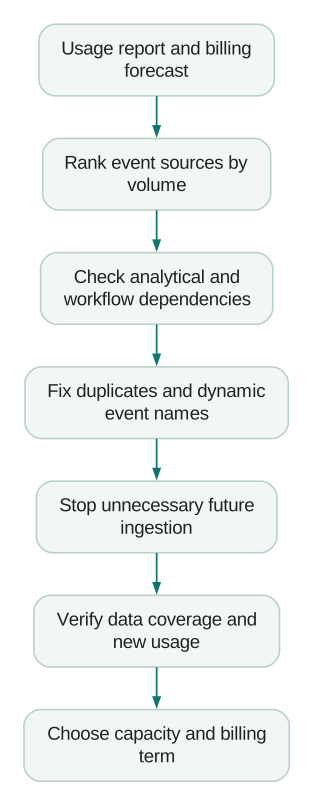
Separate diagnostic telemetry from customer analytics where appropriate. A background process firing every few seconds may belong in an operational monitoring system. Preserve the business event that represents the outcome customers care about.
What should you budget for beyond the base plan?
Ask about each feature your team actually needs: account analysis, extra session replay, experimentation controls, scheduled audience syncs, support and permissions. Record the included limit, the add-on price and the dependency on a higher plan.
Model maintenance and migration as well as subscription. Event design, identity repair, dashboard recreation and staff training can outweigh the first year's difference between two small plans. The Mixpanel pricing guide provides a comparable event-based worksheet.
For an original planning example, suppose an unnecessary event source pushes a team from a five-million-event requirement to fifteen million. Using the observed annual Plus equivalents, the difference is $936 minus $225, or $711 a month. If removing it safely costs $1,600 in engineering effort, simple payback is about 2.3 months once the lower subscription cost can take effect.
Do not claim that saving immediately on a non-cancellable commitment. If the purchase cannot be reduced until renewal, the short-term benefit is spare capacity and the cash saving arrives later. Record both dates in the business case.
Is Amplitude free for startups?
Amplitude's current startup programme advertises a free first year on Growth for eligible companies with less than $10 million in funding and fewer than twenty employees. The page describes up to 100 million monthly events or the programme's MTU configuration, followed by 40% off an annual Plus plan in year two.
The year-two offer is specifically described as Plus. Do not assume all Growth features continue at that discounted price. Review the features the team adopted during the free year and request the appropriate continuation options before it ends.
Apply before budgeting around acceptance. Keep normal usage forecasts during the free period and avoid collecting unused events simply because the temporary allowance is generous. The eventual paid plan should fit a deliberate event stream.
A checklist before purchasing or renewing
- Confirm whether the account uses event or MTU billing.
- Measure current production usage and expected launches or imports.
- Record the live estimator's volume, total and billing term.
- Check required capabilities against the selected plan.
- Price add-ons and higher-tier dependencies explicitly.
- Read the current usage, renewal and cancellation terms.
- Assign an owner and alerts well before a limit is reached.
- Remove unnecessary ingestion only after checking dependencies.
- Check startup eligibility and the post-programme plan.
- Compare total operating cost with an equivalent alternative.
At Martechdevs, we build product tracking around useful events, dependable identity and questions the team can act on. Start with the free martech AI audit, or explore an AI assistant built around your approved workflows.
Questions people ask
Does Amplitude charge for every employee who uses it?
The current pricing page advertises unlimited seats across plans. Usage and required capabilities determine the plan discussed here. Confirm contract-specific access and administration features separately.
Can we calculate the bill from the rounded per-event number?
Use the estimator's displayed total for the chosen volume and term. Rounded unit figures can produce an inaccurate reconstruction. Save the final checkout quantity and price as the purchase record.
Are hidden events free?
No. Hiding an event changes its presentation while ingestion can continue. Use an appropriate source or ingestion change to stop unnecessary future collection, and check what analysis will be affected.
Does the 200% rule mean the first overage is free?
No. Additional usage charges and the potential suspension threshold are separate provisions. Read the purchased allowance and applicable per-unit rate together with the current Plus terms.
Should a startup commit annually immediately?
First check programme eligibility and whether the event stream and feature needs have stabilised. Annual payment can lower the displayed equivalent while creating a longer commitment. Compare that saving with the flexibility needed during product changes.
Sources
- Amplitude, Pricing and live Plus estimator, checked 12 October 2026.
- Amplitude, Limits and quotas, checked October 2026.
- Amplitude, Plus Plan Addendum, effective 23 July 2026.
- Amplitude, Usage reports, checked October 2026.
- Amplitude, Instrumentation and governance issues, checked October 2026.
- Amplitude, Startup programme, checked October 2026.
Written by
Jafrin Akter AloData Engineer and Co-founder, martechdevs
Jafrin Akter Alo is a data engineer and co-founder of martechdevs, where the team has delivered 74+ martech, data and growth stack implementations.