
PostHog vs Mixpanel: Choose the Workflow Your Team Can Actually Run
Data Engineer and Co-founder, martechdevs
Last updated 11 min read
Choose between PostHog and Mixpanel by testing the decisions your team needs to make, the identity model those decisions require and the cost of operating the whole setup. Both now cover more than charts. A comparison that says PostHog has replay and feature flags while Mixpanel only has analytics is out of date.
Last updated: 14 September 2026.
Start with the work, then compare the tools
PostHog is a strong candidate when engineers want product behavior, replay, releases and technical investigation close together. Mixpanel is a strong candidate when product and growth teams need a shared behavioral analysis workflow they can operate repeatedly. Treat those as starting hypotheses for a pilot, not rules about which job titles may use each product.
PostHog's product analytics documentation describes shared events and properties across analytics, replay and feature exposure, with SQL, API and MCP access. That connected workflow can be useful when the same team investigates a drop, finds the affected sessions and ships a correction.
Mixpanel also offers replay, autocapture and release tooling. Its feature flags and experiments announcement extended those products to Free and Growth, with usage limits. The meaningful comparison is how your team configures and uses those capabilities, including any plan conditions.
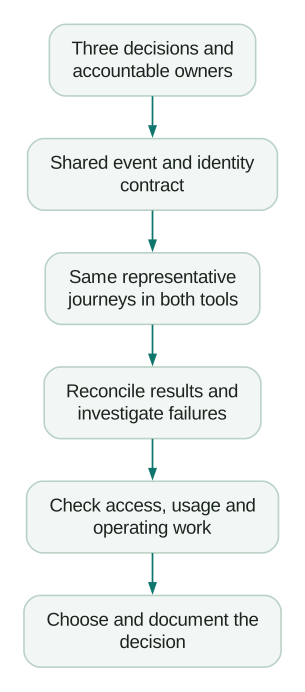
Start with three questions you would act on this month. For a collaboration product, they might be which new workspaces reach first value, where invitations fail and whether a recent change improved repeated use. Name the person who will investigate each question and the decision they can make.
If nobody owns the resulting action, a better analytics subscription will not fix the problem. If the questions are already answered reliably in your current stack, require a specific improvement before taking on migration work.
Test whether both tools can answer the same question
A funnel screenshot is not a comparison unless its population and rules match. Specify the starting cohort, entity, event sequence, conversion window, exclusions and treatment of repeat attempts before building either chart.
Mixpanel's funnel documentation distinguishes unique users, total attempts, re-entry behavior and ordering. PostHog's funnel guide also provides ordering and matching controls. Similar chart labels can hide different settings.
Use a written analysis contract that a second person can check. This original example describes a decision, not a configuration file for either vendor:
question: Which trial workspaces reach their first successful export?
entity: workspace_id
cohort_entry: first Trial Started event for the workspace
conversion: Export Completed with status equal to success
window: within 7 elapsed days after cohort entry
ordering: entry must precede completion
repeat_trials: excluded from this first-trial cohort
internal_workspaces: excluded
observation: include only workspaces with a full 7-day window
output: eligible workspaces, converted workspaces, conversion rate
Create a small set of known journeys before using live aggregate data. Include a normal conversion, a failure, a retry, a conversion outside the window and a workspace with more than one participating person. Write down the expected result for each.
Check the underlying qualifying entities, not just the percentage. Two configurations can produce 40% from different customers. That coincidence will disappear as soon as you filter by acquisition source or compare retention.
Also ask a teammate to reproduce the answer without the original builder. Record which definitions they misunderstood and how much help they needed. That observation is more useful than an unsupported claim that one interface is universally easier.
For B2B SaaS, people and accounts are separate decisions
A person can work in several customer accounts. Several people can complete different parts of one account's journey. Your analytics model must preserve both relationships.
Consider this illustrative pilot with five eligible workspaces. In Cedar, one person starts the trial and another completes the export on day two. In Birch, the same person performs both actions on day three. Elm never exports. Ash exports on day eight. Pine only produces a failed export.
Under the seven-day workspace contract, Cedar and Birch convert: two of five, or 40%. A same-person funnel counts only Birch: one of five trial-starting people, or 20%. Neither calculation is inherently broken. They answer different questions. A user-level chart cannot silently stand in for workspace activation.
Mixpanel's Group Analytics changes the analysis entity to an event property such as company or account ID. It is an add-on for Growth or Enterprise. Confirm the entitlement before making an account-level pilot depend on it.
PostHog's group analytics documentation also treats groups as a separate analysis capability. Its add-on billing applies to all captured identified events in a subscribed project, including events without group properties. Enabling the billing subscription matters independently of adding group instrumentation.
For either tool, send the account relevant to the event. A consultant switching from Cedar to Birch should not carry Cedar's account context into the next action. Test account switching, background jobs and users with concurrent memberships. Clear or update persistent client context deliberately.
Do not use the account ID as every employee's person ID. That collapses people who need distinct histories and can produce misleading retention, targeting and support investigations. The identity merge guide explains how to keep person identity and account membership separate.
Autocapture gets you observations, not business meaning
Both products support autocapture. Mixpanel's autocapture guide documents web collection and SDK-specific mobile support. PostHog supports automatic interaction collection alongside named business events. You do not need to choose between capturing every click and instrumenting nothing.
Use automatic interaction data to investigate the interface: which controls people use, where they stop and which screen preceded a problem. Use explicit business events for outcomes that must have a stable definition.
For example, Export Button Clicked tells you the person tried. Export Completed should mean the export service finished successfully. A timeout, permission error or cancelled job should not become a completed export because the button was clicked.
Specify the authoritative producer and a stable operation identifier for important outcomes. If the browser and backend both observe the same success, decide which event is canonical and how retries are handled. Avoid counting two observations as two completed business actions.
Inspect real payloads during the pilot. Check URLs, element attributes and properties for customer content you did not intend to collect. Configure recording and event collection separately where required; disabling one feature does not prove every other collection path is disabled.
Then estimate volume from the configuration you intend to keep. A comparison based on ten deliberate events per session is misleading if production will also collect hundreds of automatic interactions. The product analytics setup guide provides the event ownership and acceptance steps behind a reliable implementation.
Identity choices affect both analysis and PostHog's bill
PostHog distinguishes anonymous events from events associated with a person profile. Its anonymous versus identified events guide says anonymous events cannot support person cohorts or group analytics. Web and backend defaults also differ. An event with an opaque internal ID can still count as identified; the classification is not simply whether an email appears in the payload.
Past anonymous events linked after identification retain their original billing classification. Subsequent events for an identified person are treated as identified. Check this behavior when comparing a marketing website with a logged-in product; they can have very different event mixes.
Do not strip identity from an account-activation workflow solely to reach a cheaper headline rate. First decide what the analysis needs. Then remove unnecessary collection and use the appropriate capture mode for each context.
For Mixpanel projects using Simplified ID Merge, the identification guide describes linking device and user IDs through an event containing both. The client flow includes identifying at authentication, sending a subsequent event and resetting on logout. Existing projects may use a different identity model, so inspect the project before transferring assumptions.
Run the same identity acceptance cases in both tools: anonymous visit followed by login, return on another device, logout followed by another person on the same device and switching accounts while staying logged in. Check the event sequence and the final report, not merely that an identify call returned successfully.
Compare the whole bill at your intended configuration
Both vendors currently include one million monthly analytics events in their free offers. PostHog's pricing page lists separate meters for products such as replay, flags and AI. Mixpanel's pricing page lists Free, Growth and Enterprise, with Group Analytics and other capabilities subject to plan or add-on conditions.
Those facts do not make one million events a complete budget. Write down analytics events, person-profile behavior, group analysis, recorded sessions, experiment exposure, required retention, access controls and support. Add the cost of existing tools only if you will actually retire them.
Use our product analytics pricing comparison for the volume calculations. For a selection decision, the important question is whether the chosen configuration still works as usage grows, including any account-specific or negotiated terms.
There is a data-quality consequence to a hard spending limit. PostHog says events beyond a free or configured billing limit can be permanently dropped. A flat dashboard after the limit may describe missing collection rather than stable demand. Put billing and ingestion alerts in the operating plan and label affected reporting periods.
Separate cash savings from team capacity. In a hypothetical decision, a new configuration saves $300 a month in subscriptions but requires forty hours of migration work. At an internal planning rate of $90 per hour, that is $3,600 of work, or twelve months of subscription savings before ongoing effort. The rate is illustrative, and salaried time is not automatically a cash expense you can remove.
If an additional three hours per month are needed at the same planning rate, the modeled monthly benefit falls to $30 and simple recovery stretches to 120 months. That does not prove migration is wrong. It shows why the case may depend on better decisions, faster diagnosis or retired infrastructure rather than a smaller event invoice.
Self-hosting PostHog is an operating commitment
PostHog provides a Docker Compose self-hosting option, but its current self-hosting guide says deployments are unsupported, with no paid support plan or guarantees. Paid-plan capabilities are Cloud-only. The guide also explains that it does not publish conventional tagged releases for the self-hosted product.
Treat self-hosting as a requirement to evaluate, not an automatic cost advantage. Name the person responsible for updates, backups, restores, capacity, monitoring and security fixes. Include their time and the infrastructure in the budget.
Require a recovery exercise with realistic data before relying on the instance for a business process. A successful installation proves the stack starts. It does not establish that you can recover after a failed upgrade or retain usable history while volume grows.
If your reason is a specific data-handling requirement, write that requirement precisely and assess the available deployment arrangements against it. “We prefer control” is not enough to estimate the work, and choosing a region or running your own server does not by itself settle every privacy obligation.
For a small team whose actual requirement is low cost and reliable analytics, evaluate the hosted allowance first. Self-hosting makes more sense when the deployment constraint and operating capability are explicit, rather than when it is used to avoid examining the cloud bill.
Migration means preserving decisions, not moving every chart
Inventory the reports people use to make decisions. Record their owners, definitions, source events and dependencies. Retire unused reports instead of paying to recreate a large archive nobody trusts.
Mixpanel's migration documentation explicitly separates live ingestion and historical backfill from rebuilding saved reports and improving data quality. PostHog's Python SDK documentation supports historical migration mode. Neither fact proves that every identity relationship, dashboard or replay will transfer automatically.
Map event names, timestamps, units, account keys and user identifiers. Decide what historical data is useful and legally appropriate to retain. Preserve the original occurrence time rather than making a backfill look like a burst of new activity today.
Use a small historical sample first, then a bounded period of parallel collection. Reconcile event totals, distinct business operations and the exact entities entering the important funnels. Keep a discrepancy log: missing event, changed identity, different exclusion, time-zone boundary or report configuration.
Choose the overlap period from the metric. A seven-day activation window needs enough follow-up to observe the final trial entrants. Monthly retention requires a longer plan than a same-day event-count comparison. Do not declare parity before the chosen cohorts mature.
Set a cutover owner and a rollback condition. Preserve access to the old definitions and required exports until the new reports are accepted. Remove duplicate capture once the transition is complete, and check that retired SDKs or pipelines are actually gone.
Make the selection with evidence your team can challenge
Before the pilot, classify requirements as mandatory or preferred. A missing mandatory capability cannot be repaired by a high average feature score. For preferences, agree what improvement matters: fewer manual reconciliations, faster investigation or less engineering help for routine analysis.
Record the result of each task, who completed it, what assistance was needed and which plan was used. Keep vendor claims separate from your observations. A sales demo may establish that a feature exists; your pilot establishes whether your setup and team can use it.
Choose PostHog when its connected product and technical workflow solves the actual tasks with acceptable operating work. Choose Mixpanel when its analysis and collaboration workflow does so more effectively for your team. Keep your current tool when neither candidate produces enough benefit to justify the transition.
Checklist
- The same three business questions were tested in both tools.
- Person and account-level results reconcile with expected journeys.
- Successful outcomes are separate from interface attempts and retries.
- Identity survives login, logout, device changes and account switching.
- Required replay, release and analysis capabilities exist in the evaluated plan.
- Usage forecasts include group analysis and all enabled products.
- Billing-limit behavior and missing-data alerts are understood.
- Retention, permissions and deployment requirements have explicit owners.
- Migration includes report definitions, mature cohorts and a cutover plan.
- The people who will use the system can reproduce the important answers.
Our product analytics implementation work can turn those requirements into a bounded pilot, a tracking contract and reconciled decision reports. The deliverable should leave your team able to investigate the next question, not dependent on someone else to explain every chart.
Questions people ask
Is PostHog free?
Its hosted free offer includes monthly allowances across products, including one million analytics events. Required features, usage beyond allowances and additional products can change the bill. Check what happens when a limit is reached before relying on a free configuration for complete reporting.
Is Mixpanel only useful for analytics while PostHog handles releases?
No. Mixpanel now includes feature flags and experiments on Free and Growth within their limits, alongside analytics and replay. Evaluate the actual release and investigation workflow instead of using an old feature comparison.
Which is better for a marketing or growth team?
Use the questions the team owns. Test acquisition-to-activation analysis, account context, cohort definitions and the ability to reproduce a report without engineering help. Team labels alone do not establish which product will work better.
Can I self-host PostHog instead of paying for a hosted plan?
A self-hosted option exists, but operating it introduces infrastructure and maintenance responsibilities, and the current deployment is unsupported. Check feature availability and prove recovery before treating it as an equivalent production alternative.
Can I migrate without losing all my historical analysis?
Potentially, if the necessary source events, identifiers and definitions are available and compatible. Test a representative backfill and rebuild priority reports. Missing source history or different funnel semantics cannot be fixed by importing more rows.
Sources
- PostHog: Product analytics
- Mixpanel: Experiments and feature flags on Free and Growth
- Mixpanel: Advanced funnel concepts
- PostHog: Funnels
- Mixpanel: Group Analytics
- PostHog: Group analytics and billing
- Mixpanel: Autocapture
- PostHog: Anonymous and identified events
- Mixpanel: Simplified identity management
- PostHog: Pricing and limits
- Mixpanel: Pricing and plan capabilities
- PostHog: Self-hosting
- Mixpanel: Migration scope
- PostHog: Python SDK and historical migrations
Written by
Jafrin Akter AloData Engineer and Co-founder, martechdevs
Jafrin Akter Alo is a data engineer and co-founder of martechdevs, where the team has delivered 74+ martech, data and growth stack implementations.