
PostHog vs Heap: Autocapture, Event History and Product Costs
Pick Heap when a product team wants to define useful analysis from captured interface behavior; pick PostHog when a technical team wants event analysis connected to release and engineering workflows. PostHog vs Heap should compare capture quality, identity and the history required by the business question. Both support autocapture, so the decision needs more than a manual-versus-automatic tracking label.
On this page
PostHog vs Heap comparison
The public terms below use USD where a rate is shown; Heap paid scope needs the applicable estimate or quote.
| Decision | Heap | PostHog |
|---|---|---|
| Free analytics allowance | Up to 10,000 monthly sessions | 1 million analytics events/month |
| Free history | Six months of data history | Free analytics offer lists one-year data retention |
| Paid entry | Growth estimate after installation; Pro and Premier use custom session pricing | Graduated analytics-event pricing after free allowance |
| First paid analytics rate | Required Heap package estimate | $0.00005/event in the 1-to-2-million band |
| Replay scope | Replay listed as an add-on on Pro and Premier | Separate 5,000-recording monthly free allowance |
| Main definition risk | Later labels cannot recover metadata never captured | A captured click is not automatically a completed business event |
See Heap pricing, PostHog pricing and PostHog analytics rates. Sessions and events are different billing units, and replay scope should be evaluated separately from the analytics allowance.
We would start a Heap trial with a team that needs to turn existing interface behavior into maintained product definitions. We would start a PostHog trial with engineers and analysts who want to connect that evidence to flags, experiments or release investigation. The same accepted product journey should be tested in both.
At Martechdevs, we define the source events, user identity and historical properties through our product analytics implementation service. That preparation makes the pilot a test of trustworthy evidence and ongoing ownership, rather than a contest between dashboards.
Heap and PostHog decision blocks
Heap
- Best for: Product teams that want to analyze captured interface interactions and maintain useful event definitions over that data.
- Pros: Autocapture records supported events and properties that can be labeled for later analysis. This can help investigate a question that was not fully specified before collection began.
- Cons: New snapshots and newly added properties are not automatically historical. User and account properties also have different historical behavior from event properties.
- Free plan and startup offer: Free includes up to 10,000 monthly sessions and six months of history. Growth needs an estimate, and Pro/Premier use custom session pricing. No startup concession is assumed. See Heap plans.
- Choose it if: The captured behavior supports the required questions and the team will maintain definitions, selectors and source-property meaning.
- Skip it if: The purchase depends on recovering old metadata that was never captured or on obtaining replay through an analytics-only scope.
PostHog
- Best for: A technical product team joining analytics with replay, feature exposure, experiments and other engineering context.
- Pros: Product analytics supports both custom events and autocaptured pageviews, clicks and form submissions, with links to other product evidence.
- Cons: A broader set of products creates separate usage and maintenance decisions. Technical ownership remains necessary for stable identity and business-event definitions.
- Free plan and startup offer: The ongoing monthly allowance includes 1 million analytics events, 5,000 recordings and 1 million feature-flag requests. No additional startup credit is included in these examples. See PostHog pricing.
- Choose it if: The intended maintainers can validate instrumentation and use its evidence in the release process.
- Skip it if: Nobody owns the event model, or the team expects automatic capture to infer the application's accepted business outcome.
Autocapture and explicit business events
Heap and PostHog both capture interface interactions, so a comparison that presents one as automatic and the other as entirely manual misses their overlap. Heap documents pageviews, clicks, changes and submissions among its default events. PostHog documents autocapture alongside SDK-supplied custom events. See Heap capture and PostHog analytics.
The important distinction is between an interaction and a business result. A click on Create workspace can fail validation. A payment form can submit before the processor declines the charge. The captured interaction is useful evidence, but activation or revenue reporting needs the accepted result.
Define a small set of explicit business events for those outcomes. Record the source, required properties and owner. Retain interface events where they help explain the path, while keeping the official metric tied to the completed task.
A useful pilot includes a successful action, a validation failure and a repeated click. Ask each platform to distinguish them. Then change the button label or component layout in a test version and repeat the cases. The maintenance task reveals whether the event definition survives an ordinary product release.
For a focused website-reporting requirement, Plausible vs PostHog explains a narrower measurement model. For a guidance-led adoption program, PostHog vs Pendo compares a different operating workflow.
Retroactive labels and missing history
Heap's captured data can support later analysis because the relevant interaction properties already exist. That does not mean every new requirement can be answered retrospectively. A property that was never collected has no stored historical values to query.
Heap explicitly states that snapshots begin collecting new metadata when created and are not retroactive. The snapshot guide also distinguishes mobile installations from supported web contexts. If a pilot depends on a new property, record its collection start and confirm that the intended application surface supports it. See Heap snapshots.
For example, a team may have captured clicks on a plan selector but never captured the plan value at the moment of selection. A later label can identify the clicks if the captured selector is sufficient. It cannot invent the earlier selected plan merely because that property has now been added.
Apply the same evidence rule to PostHog. New custom events or properties only describe the data actually sent. If the question needs historical state that the application can supply from another reliable source, define a separate backfill and reconciliation process. Do not relabel missing history as zero activity.
Mark the coverage boundary in the report. A period before complete collection should be excluded from a comparison or explicitly identified as incomplete. A visually smooth trend across a tracking change can be less honest than a visible break with a clear explanation.
Current properties and historical state
Heap distinguishes stateful event and session properties from stateless user and account properties. The latter retain the current value rather than a history of earlier values. Its documentation recommends an event property when the analysis needs the state at the moment an action occurred. See Heap property history.
That matters for subscription plans, customer status and account ownership. A user who is paid today may have performed an action while still on a free plan. Filtering an old period by today's paid status answers a different question from counting actions performed while paid.
Consider a hypothetical set of one hundred historical actions by people who are all paid customers today. Forty of those actions happened before the relevant person upgraded, while sixty occurred after upgrade.
| Business question | Relevant actions | Required state | Interpretation |
|---|---|---|---|
| Historical actions by today's paid customers | 100 | Current customer status | Present-day cohort viewed historically |
| Actions performed during paid status | 60 | Status at event time | Historical behavior under the paid plan |
| Actions before upgrade | 40 | Status at event time | Free-plan behavior before conversion |
The paid-at-event share is 60 ÷ 100 = 60%. The current-paid cohort includes all one hundred actions. Both views can be useful, but they should have different labels and be built from the appropriate property.
The same design choice belongs in a PostHog tracking contract. Choose whether a report needs current person properties or values attached to each event. Test an upgrade and a cancellation, then confirm the earlier period still answers the intended question.
Use the marketing metric contracts guide to document that distinction. The identity merge guide covers another common source of disagreement: several technical identifiers representing one real user.
Heap vs PostHog usage costs
A hypothetical product with 8,000 monthly sessions and forty captured events per session creates 320,000 events. Increasing capture to two hundred events per session creates 1.6 million events with the same session count. A session-based quote and an event-based bill therefore respond differently to the tracking design.
| Hypothetical usage | Calculation | Result | Budget meaning |
|---|---|---|---|
| Initial event volume | 8,000 sessions × 40 events | 320,000 events/month | Below PostHog analytics free allowance |
| Expanded event volume | 8,000 × 200 | 1,600,000 events/month | Same sessions, higher event demand |
| PostHog paid events in expanded case | 1,600,000 minus 1,000,000 | 600,000 events | First paid band |
| PostHog analytics subtotal | 600,000 × $0.00005 | $30/month | Analytics only |
The PostHog rate comes from its analytics pricing. The Heap Free allowance is up to 10,000 sessions, but feature and history requirements can still require a paid package. See Heap pricing.
Do not convert either allowance into a recommendation without checking the required work. Heap's paid plan may be needed for account analytics, warehouse delivery or replay. PostHog's event subtotal excludes separate replay, flags, other usage and platform packages. Quote the configuration that passes the pilot.
History also belongs in the purchase. Heap Free lists six months, Growth twelve months, with higher scope available on other arrangements. A year-over-year requirement cannot be validated from a six-month free-history promise. Confirm both retained history and the date complete collection began. See Heap history limits.
The product analytics pricing guide and software pricing tool help separate product charges from implementation and recurring maintenance. A low event subtotal does not fund the person responsible for investigating a broken definition.
Session replay and capture coverage
Heap lists replay as an add-on on Pro and Premier. Its replay documentation says a past session can be investigated through a later event definition only if replay was already enabled at the time. A retroactive event label does not create a recording that was never collected. See Heap plans and replay capture.
The capture surface matters as well. Heap documents limitations for certain rendered content, including canvas and WebGL changes. Test the actual interface your product uses, especially if a visual component is central to the suspected failure. A normal HTML form is a weak substitute for the application's real interaction.
PostHog's web replay documentation distinguishes input masking from general page text. Review the selected configuration and inspect recorded results with synthetic values. Event analytics and replay are separate capture surfaces; a clean event payload does not establish that the replay contains only approved content. See PostHog replay privacy.
For both tools, define who can inspect detailed sessions and who can change capture rules. Retain a known test journey that includes a masked field, an excluded area and a failed action. Repeat those checks after changes to the component or analytics setup.
Best fit by analytics team
| Company or operating model | Best fit | Runner-up | Decision reason |
|---|---|---|---|
| Product team defining questions from existing captured UI behavior | Heap | PostHog | Captured properties and definition maintenance lead the trial |
| Technical team connecting analytics with release work | PostHog | Heap | Engineering context and instrumentation ownership matter |
| B2B product needing historical plan-state analysis | Event-state design first | Either qualified platform | Current user properties cannot replace historical state |
| Small team within both free allowances | Matched free-scope pilot | The other candidate | Required history and features decide the configuration |
| Team investigating a specialized visual interface | Capture-coverage test | Either qualified replay setup | The actual rendered surface must be observable |
Capture and definition decision
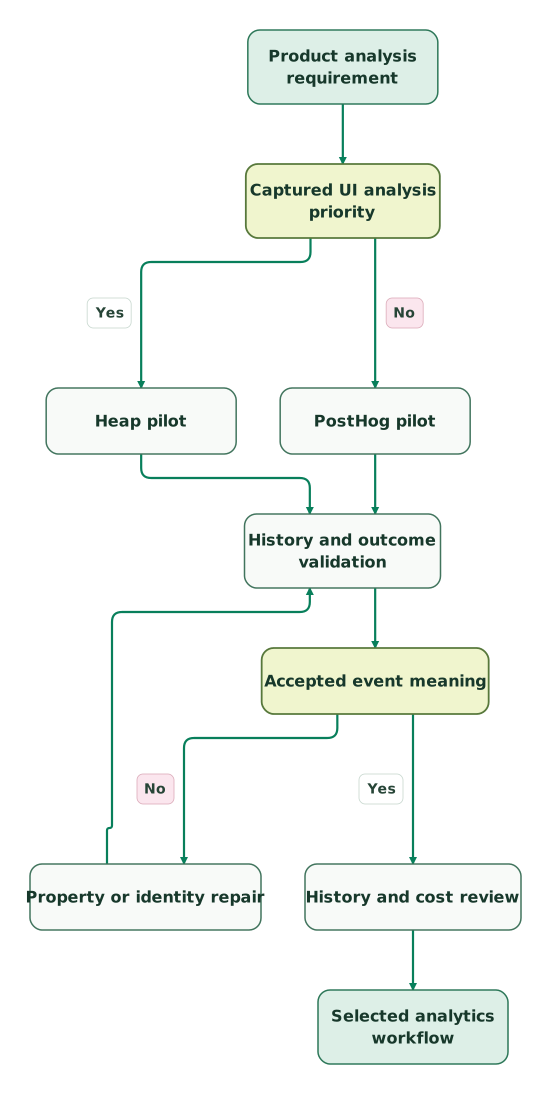
The graph starts with the principal analysis workflow, then validates historical properties and business outcomes. A repair returns to that validation before history, feature scope and cost are reviewed.
Read diagram as text
- Product analysis requirement to Captured UI analysis priority.
- Captured UI analysis priority to Heap pilot: Yes.
- Captured UI analysis priority to PostHog pilot: No.
- Heap pilot to History and outcome validation.
- PostHog pilot to History and outcome validation.
- History and outcome validation to Accepted event meaning.
- Accepted event meaning to Property or identity repair: No.
- Property or identity repair to History and outcome validation.
- Accepted event meaning to History and cost review: Yes.
- History and cost review to Selected analytics workflow
Heap and PostHog evaluation checklist
- A business-event definition separate from its interface interaction.
- Known success, failure and repeated-action test cases.
- Stable identity through sign-in, logout and account changes.
- A distinction between current properties and state at event time.
- Collection-start dates for every newly required property.
- Explicit session and event volume assumptions.
- Required history, account analytics and replay included in the package.
- Capture tests using the actual application components.
- A second maintainer able to update and revalidate the definition.
Use the marketing data audit skill to record identity and historical-state evidence. The PostHog implementation mistakes guide helps investigate duplicate capture and incorrect success events before attributing a bad report to the platform.
Keep reading
Browse all Product Analytics guides
 Product Analytics
PostHog vs Plausible: Website Reporting, Product Analytics and Cost
Choose Plausible for focused website reporting or PostHog for product journeys. Compare identity rules, event costs, conversion definitions and implementation scope.
Jafrin Akter AloLast updated 11 min read
 Product Analytics
PostHog Pricing: Estimate Each Product Separately
Estimate PostHog costs by event type, web and mobile recordings, flag requests and add-ons. Includes tier calculations and billing-limit consequences.
Jafrin Akter AloLast updated 13 min read
 Product Analytics
Best Product Analytics Tools for Startups: 7 Options Compared by the Job They Do
Compare GA4, Mixpanel, Amplitude, PostHog, Heap, Pendo and Statsig on free tiers, experiments, server-side events, raw data export and warehouse options.
Jafrin Akter AloLast updated 27 min read
Product analytics
See the implementation scope, deliverables and acceptance checks.
Questions people ask
Does Heap retroactive analysis recover every property added later?
Heap retroactive analysis does not recover properties that were never captured. Existing autocaptured fields can support later definitions, while new snapshots begin collecting at creation. Record the coverage start for each required value and treat earlier missing data as unavailable. The distinction is explicit in Heap's snapshot documentation.
Is PostHog entirely dependent on manually instrumented events?
PostHog is not entirely dependent on manually instrumented events. It supports autocaptured pageviews, clicks and form submissions alongside custom events. The useful design combines interaction evidence with explicit business outcomes where necessary. Test a successful and a failed action before assuming a captured click represents completion. See PostHog product analytics.
Can a current paid-user property accurately describe past subscription status?
A current paid-user property describes today's status and may not describe the status when a historical action occurred. Heap documents that user and account properties are stateless, while event properties can preserve event-time values. Use the appropriate field for the business question and test an upgrade or cancellation. See Heap property history.
Can Heap show an old replay from before replay capture was enabled?
Heap cannot create an old replay from a period when replay capture was not enabled. Its retroactive replay statement applies to sessions already captured, which can later be associated with a newly defined event. Confirm the recording start and retained period before using an old date range as pilot evidence. See Heap replay capture.
Can the same session volume produce different PostHog event costs?
The same session volume can produce different PostHog event costs when the tracking configuration records a different number of events per session. Estimate the intended capture and monitor the actual count after changes. Keep session-based vendor quotes separate from event-based calculations, and include replay or other product usage as distinct budget lines.
Sources

Written by
Jafrin Akter AloData Engineer and Co-founder at Martechdevs and Growth and Analytics Partners
Jafrin writes practical guides to marketing technology, customer data, analytics and AI workflows. Martechdevs is a Growth and Analytics Partners company.