
PostHog vs Matomo: Product Analytics, Web Reporting and Data Control
Pick PostHog when product decisions need event analysis connected to replay, feature flags and experiments. Pick Matomo when web analytics and a deliberate hosting and data-control model are the main job. PostHog vs Matomo is not a simple free-versus-paid comparison. Price the required features and operating work, then validate identity, consent behavior and the business events behind the reports.
On this page
PostHog and Matomo compared
USD public monthly prices below exclude tax, implementation and separately purchased features or infrastructure.
| Decision | PostHog | Matomo |
|---|---|---|
| Cloud entry example | First 1 million analytics events free/month; next million at $0.00005/event | Published USD Cloud offer: $26/month for 50,000 hits |
| Self-hosting option | Self-hosted deployment has separate support and operating limitations | Community core is free software; hosting and premium features are separate |
| Starting workflow | Product funnels, retention, replay and experiment-related analysis | Web traffic, acquisition, events and conversion reporting |
| Advanced feature budget | Replay, flags and other products have their own meters | Cloud allowances and on-premise plugins or bundles need comparison |
| Main counting distinction | Analytics events and product-specific usage | Cloud hits differ from visits and reporting actions |
Sources: PostHog analytics pricing, PostHog product allowances, Matomo pricing and published USD offers, Matomo hit definition.
A pageview report and an account-activation analysis answer different questions. A purchase should name the decisions the team will make repeatedly and the evidence needed to make them. A free allowance is useful only when the selected features and collection model serve that job.
At Martechdevs, we implement product analytics around accepted business outcomes and accountable owners. The work starts with the event, identity and reporting contract. Installing another tracker before those definitions are clear can produce another dashboard without resolving the original question.
Web reporting and product decisions
Matomo supports web analytics and event tracking, with additional funnel and other analytical capabilities depending on the chosen deployment and features. It should not be described as a pageview-only tool. The plan decision needs the actual reports, events and extensions your team requires. Matomo event tracking, funnels.
PostHog's product analytics includes trends, funnels, retention and paths, alongside connected replay and other products. Its experimentation workflow can use product outcomes to evaluate a change. This is useful when the team must connect a product release to adoption, retention or another defined result. Product analytics, experiments.
Matomo also offers A/B testing. Availability and implementation belong in the feature budget, especially when comparing Community core with paid plugins or bundles. A broad claim that only one product supports experimentation would hide that purchasing detail. Matomo experiments, plan scope.
We would start with Matomo for a web-reporting requirement where the organization has a clear hosting and privacy-control preference. We would start with PostHog for a product team that needs the event-to-investigation-to-experiment workflow and can maintain its instrumentation. Keep both in the trial if those jobs materially overlap.
Matomo selection boundaries
- Best for: a website team with defined reporting needs and a deliberate cloud or self-hosted operating model.
- Pros: web analytics, event tracking and a choice of deployment arrangements can share one measurement design.
- Cons: advanced on-premise features, archiving and infrastructure can add costs and operating work.
- Free plan and startup offer: Community core is free software; paid plugins, hosting and any separately approved offer need their own budget.
- Choose it if: the selected feature set answers the web-reporting questions and a named owner accepts the hosting and collection responsibilities.
- Skip it if: the purchase depends on assuming every premium feature is included in the free core.
PostHog selection boundaries
- Best for: product teams connecting activation and retention analysis with investigation and controlled releases.
- Pros: events, replay, flags and experiments can support the same product decision.
- Cons: separate usage meters and a maintained identity model require operating ownership.
- Free plan and startup offer: recurring product allowances cover small workloads; any approved startup credits should be separated from the later recurring budget.
- Choose it if: engineering can maintain the events, identities and product changes used in the analysis.
- Skip it if: the required job is a narrow web report and the broader product workflow would remain unused.
Event and identity design
Write the outcome before its event name. For a SaaS product, clicking Connect is an attempt, while a successful first data connection is an accepted result. A funnel that treats the click as activation can report growth while users still fail the operation.
| Business outcome | Suitable evidence | Important boundary |
|---|---|---|
| Signup accepted | Successful account creation | Failed form submission remains separate |
| First data connection | Confirmed connection result | Button click alone is insufficient |
| Report shared | Accepted sharing operation | Repeated clicks do not create repeated outcomes |
| Paid subscription | Agreed billing state | Payment attempt and accepted payment differ |
| Repeat value | Another successful use within the chosen window | Return visit alone may not demonstrate value |
For example, suppose 500 new accounts are created and 150 complete the defined activation step. Account activation is 30%. If those accounts contain 2,000 people, dividing the same 150 by people produces 7.5%, a different measure. Name the entity and cohort before comparing tools.
PostHog group analytics can represent account or workspace behavior, with its own setup and billing considerations. Stable group identity and event associations are required for an account-level result. Its person-identification guidance also includes resetting identity on logout so a shared device does not attach later activity to the previous user. Group analytics, identity behavior.
For either implementation, test anonymous activity, login, logout, a second account and a changed email. An analytics migration should preserve the meaning of the user and account, even when the destination represents them differently. The tracking-plan guide provides the event-contract structure.
Matomo hits and PostHog event costs
Matomo Cloud bills hits, which include pageviews, events, downloads, outlinks and other supported tracking interactions. Hits are broader than visits or the visible action count. Standard heartbeat pings update duration without counting toward the hit quota, while an event deliberately sent on a timer would count. Hit rules.
A hypothetical month with 50,000 pageviews, 30,000 tracked events and 5,000 downloads produces 85,000 hits from those inputs. It exceeds a 50,000-hit allowance even though pageviews alone fit. Additional features and tracking requests can change the total.
Matomo's published USD Cloud offers list $26/month for 50,000 hits, $42 for 100,000 and $85 for 300,000. The example above fits the 100,000-hit allowance at $42 before extras and tax. Use the selected currency, billing term and actual account usage when purchasing. Matomo Cloud pricing.
PostHog analytics bills captured events with a free monthly allowance and volume tiers. A three-million-event month costs $50 for the first paid million plus $34.30 for the next million, or $84.30, under the published event rates. That calculation covers analytics events only. Event rates.
| Worked example | Billing input | Calculation | Product charge |
|---|---|---|---|
| Matomo Cloud website | 85,000 hits | Published 100,000-hit monthly tier | $42 |
| PostHog analytics | 1,500,000 events | 500,000 paid events × $0.00005 | $25 |
| PostHog analytics | 3,000,000 events | $50 + $34.30 across paid tiers | $84.30 |
Sources: Matomo rates, PostHog tiers. These are separate examples of billing mechanics. They are not equivalent feature configurations or a claim that a Matomo hit always maps to one PostHog event.
Count other PostHog products separately. The public allowances include 5,000 replay recordings and one million feature-flag requests per month, distinct from analytics events. Matomo Cloud and premium on-premise features also have their own scope and allowances. PostHog product meters, Matomo plans.
Use the PostHog pricing guide for a fuller product budget. Keep implementation and the people maintaining the measurement system beside the software amount.
Cloud and self-hosted operating models
Matomo Cloud handles hosting, updates, maintenance and backups under its service. Its Cloud data location is Frankfurt, Germany. Matomo On-Premise puts the infrastructure and its operation under your chosen hosting design. That gives more deployment control and also creates an operating responsibility. Cloud service, Cloud location.
Community core is free software. Premium functions such as funnels, session recording and other capabilities may require a paid plugin or bundle in an on-premise setup. Compare the exact feature set instead of using the free core licence as the full cost of an advanced deployment. On-premise feature scope.
Matomo reporting also involves archiving: processing collected data into reports. A self-operated installation needs a maintained archiving schedule and enough resources for the actual traffic and report workload. Include monitoring and recovery of that processing in the ownership plan. Auto-archiving.
PostHog's self-hosting guide states that it does not manage self-hosted instances or provide paid support plans for them. Its hobby deployment should therefore be evaluated as a separate operating model from managed Cloud. Do not use the availability of source code as evidence that the organization has purchased managed production support. Self-hosting scope.
For a hypothetical self-hosting budget, $60/month of hosting, $25 of backups and monitoring, and $150 allocated to routine operating work total $235/month before premium software and unexpected incidents. These are internal planning assumptions, not vendor prices. Replace each with the proposed infrastructure and support scope.
Collection controls and privacy behavior
Choose the permitted data and collection behavior before enabling broad tracking. URLs, query parameters, free-text inputs, identifiers and replay content can carry information the team did not intend to collect. Test synthetic examples of those fields in the actual payload.
Matomo distinguishes tracking consent from cookie consent. Its requireConsent setting prevents tracking requests and cookies until consent is provided. requireCookieConsent permits tracking requests while withholding cookies. Select the mechanism that matches the approved collection policy; the two settings are not interchangeable. Matomo consent controls.
PostHog provides opt-in, opt-out, autocapture and masking controls. Apply them to the chosen SDKs and verify behavior before and after consent changes. A browser setting does not automatically establish the same behavior in a separately implemented backend event path. PostHog collection controls.
For replay, inspect sensitive screens, validation messages and network or console capture settings. PostHog's replay privacy controls are a separate part of that configuration. Keep replay enabled only where its diagnostic value and approved data scope justify collection. Replay privacy.
Data location and software settings are inputs to the organization's privacy design. They do not replace a defined purpose, appropriate permissions, retention and deletion process. PostHog explicitly distinguishes filtering before collection from transformations after data reaches its servers; use the former when a field must never be sent. Storage and processing boundaries.
Report completeness and usage limits
Matomo's report row limits can aggregate long-tail results into an Others row during archiving. That behavior differs from sampling visits. In Matomo 6, page-report archiving has a revised limit process; other action reports retain their own table and subtable behavior. Check the relevant report and version before interpreting a missing visible row as missing collection. Report limits.
Use a known test page or event to trace collection, archiving and report display separately. Retain evidence of the source event and the expected reporting path. This makes a quota, filter, row-limit or collection failure easier to distinguish.
Matomo Cloud provides overage notifications and usage-management options. Review the selected allowance and response with its owner before enabling a large new tracking feature. A pageview estimate alone can miss new event and plugin-generated traffic. Matomo overage management.
PostHog's configured billing limits can stop ingestion and processing, and data above the limit is lost. The budget control therefore has a measurement consequence. Assign an alert response for a business-critical report instead of assuming the cap merely delays an invoice. PostHog billing limits.
Best fit by team requirement
| Requirement | Starting candidate | Runner-up | Deciding evidence |
|---|---|---|---|
| Website acquisition and conversion reporting | Matomo | Current web-reporting setup | Required reports, tracking scope and hosting model |
| Product activation, retention and release investigation | PostHog | Matomo with required analytical features | Accepted events, identity and connected workflow |
| Organization-operated web analytics infrastructure | Matomo On-Premise evaluation | Current hosting model | Paid feature scope, archiving and support ownership |
| Small product team avoiding infrastructure work | PostHog Cloud evaluation | Current product analytics setup | Product usage, collection controls and cost limits |
| Website reporting plus a distinct product-analysis need | Explicitly scoped combined setup | One platform with accepted scope | Definitions, duplicate collection and total operating burden |
For acquisition comparisons with Google's analytics, see PostHog vs Google Analytics. For a replay-centered evaluation, PostHog vs FullStory addresses the investigation workflow. Do not add two platforms unless each has a useful responsibility and the team can explain their differing totals.
Analytics selection and rollout
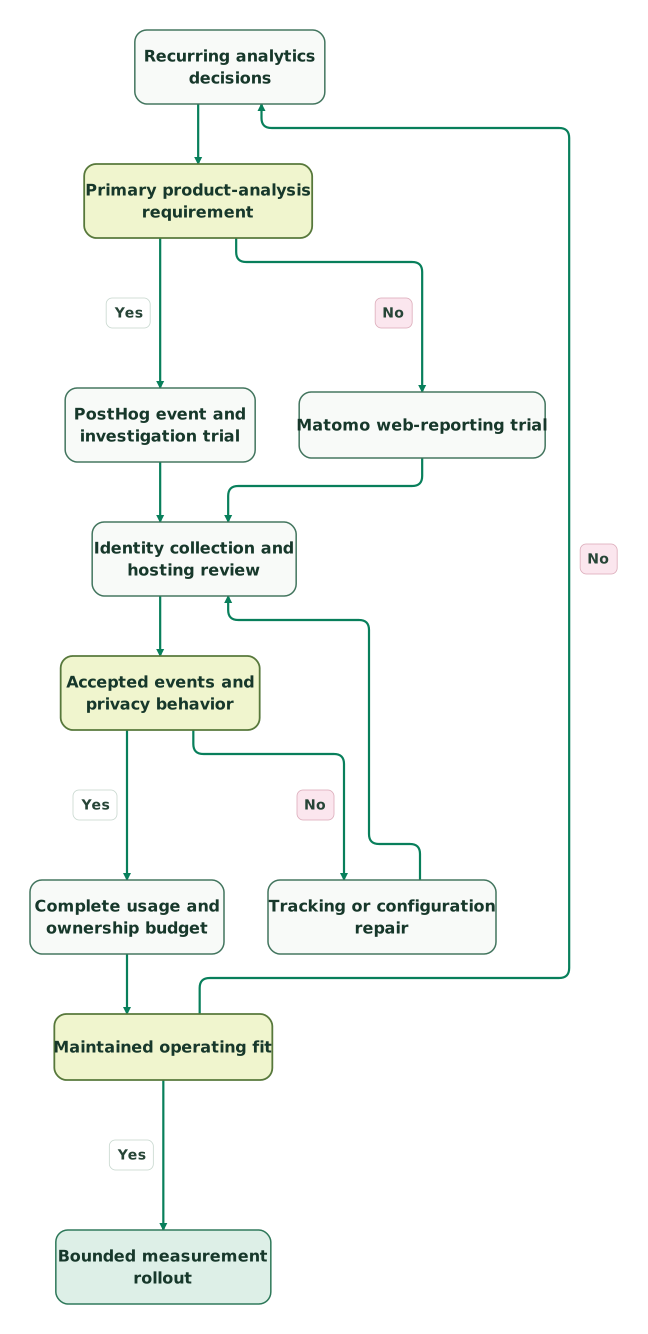
Read diagram as text
- Recurring analytics decisions to Primary product-analysis requirement.
- Primary product-analysis requirement to PostHog event and investigation trial: Yes.
- Primary product-analysis requirement to Matomo web-reporting trial: No.
- PostHog event and investigation trial to Identity collection and hosting review.
- Matomo web-reporting trial to Identity collection and hosting review.
- Identity collection and hosting review to Accepted events and privacy behavior.
- Accepted events and privacy behavior to Tracking or configuration repair: No.
- Tracking or configuration repair to Identity collection and hosting review.
- Accepted events and privacy behavior to Complete usage and ownership budget: Yes.
- Complete usage and ownership budget to Maintained operating fit.
- Maintained operating fit to Recurring analytics decisions: No.
- Maintained operating fit to Bounded measurement rollout: Yes
PostHog and Matomo checklist
- Required web and product decisions are separated.
- Accepted outcomes distinguish attempts, successes and repeat events.
- People, accounts, visits, hits and events have explicit definitions.
- The selected feature set is included in the deployment budget.
- Self-hosting has owners for updates, backups, report processing and recovery.
- Consent, logout and sensitive-payload cases pass synthetic tests.
- Report limits and usage caps have documented operating consequences.
- One known cohort reconciles before the reports guide business decisions.
Use the tracking-plan audit skill to organize the event evidence. Our product analytics implementation scope connects those definitions to collection and reporting. The $99 audit includes a written assessment and a one-hour specialist call.
Keep reading
Browse all Product Analytics guides
 Product Analytics
PostHog vs Fullstory: Replay, Product Analytics and the Cost of Useful Evidence
Compare PostHog and Fullstory for replay, product analytics and experiments. Includes usage costs, retention, privacy controls and a practical evaluation checklist.
Jafrin Akter AloLast updated 11 min read
 Product Analytics
PostHog vs Google Analytics: Product Decisions, Acquisition and Cost
Compare PostHog and GA4 for acquisition, product analysis and cost. See event pricing, identity checks, export limits and a practical selection checklist.
Jafrin Akter AloLast updated 11 min read
 Product Analytics
PostHog Implementation Mistakes: Capture, Identity and Replay
Diagnose duplicate pageviews, identity mistakes, replay privacy gaps and missing recordings with an explicit export journey and synthetic QA probes.
Jafrin Akter AloLast updated 13 min read
Product analytics
See the implementation scope, deliverables and acceptance checks.
Questions people ask
Is a Matomo Cloud hit the same as a website visit?
A hit is a tracked interaction, and one visit can generate multiple pageviews, events, downloads and other hits. Forecast the tracking requests your implementation produces, rather than buying a plan from visit count alone. The standard heartbeat request has different treatment, so adding event-based timers should be evaluated separately from enabling Matomo's heartbeat feature. Matomo hits.
Does free Matomo Community include every premium analytics feature?
Community provides the core software, while advanced functions can require paid plugins or bundles. Hosting, archiving, backups and maintenance also remain part of a self-operated deployment. List the required reports and diagnostic features before comparing its total with a managed Cloud plan, so a free licence is not mistaken for the entire implementation and operating budget. Matomo feature plans.
Are Matomo tracking consent and cookie consent equivalent settings?
They produce different collection behavior. Tracking-consent mode withholds tracking requests until consent, while cookie-consent mode can continue requests without setting cookies. Choose the setting from the approved policy and test before consent, after consent and after withdrawal. Inspect the actual request behavior rather than inferring it from whether a cookie appears in the browser. Consent mechanisms.
Does an Others row in Matomo prove the data was sampled away?
An Others row can result from report aggregation and row limits during archiving. It should not automatically be interpreted as sampled or missing collection. Check the report type, Matomo version and underlying data before changing tracking. A known event traced from receipt through report generation helps distinguish collection problems from the way the report presents its long tail. Report limits.
Can a Matomo visit conversion rate replace account-level product activation?
A visit conversion rate and account activation use different populations. Define the new-account cohort, the accepted activation event and the completion window before calculating the product metric. One account can include several people and visits, so a website reporting total cannot be substituted automatically. Test the account associations and reconcile known cases in the proposed implementation.
Sources
- Matomo pricing and published USD offers
- Matomo on-premise feature plans
- Matomo hit definition
- Matomo event tracking
- Matomo funnels
- Matomo A/B testing
- Matomo Cloud service
- Matomo Cloud data location
- Matomo automatic report archiving
- Matomo tracking and cookie consent
- Matomo report row limits
- Matomo overage management
- PostHog analytics pricing
- PostHog product allowances
- PostHog product analytics
- PostHog experiments
- PostHog group analytics
- PostHog identity behavior
- PostHog self-hosting scope
- PostHog collection controls
- PostHog replay privacy
- PostHog storage and processing
- PostHog billing limits

Written by
Jafrin Akter AloData Engineer and Co-founder at Martechdevs and Growth and Analytics Partners
Jafrin writes practical guides to marketing technology, customer data, analytics and AI workflows. Martechdevs is a Growth and Analytics Partners company.