Amplitude vs PostHog: choose by who runs it, what the free year covers and the month 13 bill
Data Engineer and Co-founder at Martechdevs and Growth and Analytics Partners
Last updated 16 min read
Pilot Amplitude first when product and growth staff will own the analysis and need its reporting workflow. Pilot PostHog first when engineers want analytics, replay, flags and debugging in one working environment. Both require deliberate identity and event design. Price the capabilities you will retain after startup benefits expire, especially account analytics and experimentation, before treating either free year as a decision.
When should you choose Amplitude or PostHog?
Choose the tool whose intended operator can answer the difficult product question and verify the result. My default for an engineering-led SaaS team is to pilot PostHog first; for an analyst-led product organisation, I would pilot Amplitude first. These are evaluation starting points, not assumptions that only engineers can use PostHog or only analysts can use Amplitude.
The strongest test is usually a real account journey: one person creates a workspace, another completes setup and a third becomes the paying administrator. If the report counts three unrelated users rather than one activated account, the product's feature list has not solved your problem.
At Martechdevs, product analytics implementation starts with those definitions, the tracking plan and identity behaviour. A new analytics subscription cannot supply a missing activation definition or fix duplicate producers by itself.
If Mixpanel is also a candidate, use Mixpanel versus Amplitude to decide whether it should replace one of these pilots. Limit the shortlist to products that can pass the same required workflow.
What are the useful pros and cons of each tool?
Amplitude offers a reporting and governance workflow to evaluate with product staff; PostHog offers several product-development tools whose shared data can shorten investigation. Both still need an owner for instrumentation, permissions and spend. Capabilities and terms below were checked on 17 October 2026.
Amplitude
- Best for: Product and growth teams that want repeatable funnels, retention analysis and shared definitions.
- Pros: The Free event allowance supports an initial test; analytics can connect to replay and other platform modules; an eligible startup can test Growth before committing to a paid renewal.
- Cons: Feature availability differs by tier and add-on; account analysis needs explicit entitlement confirmation; the year-two discounted plan may differ from the first-year Growth experience.
- Free tier and startup offer: Free provides limited ongoing capacity; the Startup Plan is a separate twelve-month Growth offer with eligibility conditions.
- Choose it if: The product team can maintain the analysis and the required account, access and experiment capabilities fit the confirmed quote.
- Skip it if: Operators still need routine specialist intervention for the core questions, or the necessary package fails the budget.
PostHog
- Best for: An engineering-led team that wants to move between product behaviour, replay, errors and feature rollout.
- Pros: Individual products have usage meters and free allowances; billing limits can be set per product; the shared environment can reduce movement between separate tools.
- Cons: Limits can cause data loss or flag fallback; group analytics adds a charge; self-hosting adds unsupported infrastructure work rather than a managed-service substitute.
- Free tier and startup offer: Monthly free allowances continue on paid usage plans. Eligible startups can apply for a time-limited credit balance with exclusions.
- Choose it if: Engineers and product staff can share a useful workflow without leaving taxonomy, permissions or spend unowned.
- Skip it if: The team cannot maintain the implementation, or self-hosting is being chosen without a credible operating plan.
For a short pilot, these are useful first choices and alternatives:
Which tool should each team pilot first?
| Team and job | First pilot | Runner-up | Requirement that can reverse the choice |
|---|---|---|---|
| 10-person SaaS with an engineering owner | PostHog | Amplitude | Product staff cannot reproduce the needed analysis independently |
| 25-person product team with an analyst | Amplitude | PostHog | Required account analysis or controls make the package unsuitable |
| 50-person business with strict access rules | Quote the required controls in both | Keep the current tool during evaluation | Neither quoted tier satisfies the actual access policy |
| Warehouse owns the reliable account history | Evaluate the reporting layer against that history | Either hosted event tool | Another event store duplicates work without improving the decision |
The last scenario deserves a warehouse-native analytics evaluation, rather than assuming the answer must be another SDK.
Which free limits and retention differences matter?
Free allowances are useful only when the required analysis and retention fit as well as the event count. The table records monthly capacities and data-access periods checked on 17 October 2026; these are limits, not promises that every feature is included.
| Requirement | Amplitude Free | PostHog Free | Check before relying on it |
|---|---|---|---|
| Analytics events/month | 2,000,000 | 1,000,000 | Include backend events, autocapture and expected growth |
| Web replays/month | 10,000 | 5,000 | Capture and masking rules must fit the intended investigation |
| Flag capacity | Unlimited flags listed; experiment results excluded | 1,000,000 flag requests; experiments billed with flags | Flag count and request volume are different units |
| Analytics history | One year of data access | One year of event retention | Define which historical decisions must remain possible |
| Replay history | One month | One month | Do not confuse replay retention with event retention |
Amplitude's plan comparison, PostHog pricing and retention.
Amplitude's quota guide says a non-paying account is blocked after exceeding its monthly limit three times. Continued excess without upgrading can lead to deletion six months after the initial block. Hidden and backfilled events can still count. Amplitude limits.
PostHog says excess events on Free are permanently dropped and flag calls return a quota-limited default response. The same failure mode applies when a paid product reaches a configured billing limit. Its paid plan extends event retention to seven years and replay retention to 90 days, subject to the documented product rules. A zero-dollar cap is therefore also a data-availability decision. PostHog limit behaviour.
Use the focused Amplitude pricing guide and PostHog pricing guide for the detailed meters. Set an alert before a limit changes the evidence your team uses.
Does account-level analytics require an extra purchase?
Account-level analysis needs a confirmed entitlement in both tools. Sending a company ID as an event property does not establish that the plan includes account funnels or group experimentation.
Amplitude's public comparison labels group behaviour analysis “Available” from Plus upward, while its account-reporting documentation describes an Accounts add-on. The pricing page lists expanded Accounts packages under Growth and Enterprise. Treat “Available” as a reason to request the exact entitlement and price, rather than assuming the base Plus estimate includes the complete B2B workflow.
PostHog documents group analytics as a paid add-on. Once enabled, its usage is based on all captured identified events in the project, including events without group properties. Enabling it on the billing page starts that billing treatment; merely adding group code is a separate action.
Build a fixture with two workspaces and three people. One person belongs to both workspaces; a different member performs each activation step. Write the expected account count and conversion before opening either report. Test whether account selection, user membership and event context produce that result.
Amplitude distinguishes event-level groups from persistent user-level group assignment, and says group changes apply to new data rather than rewriting history. PostHog links people and groups through events. These differences make a multi-workspace specimen more useful than a generic “supports B2B” checkbox. Use a stable workspace key and preserve event context in your source data.
What happens after the startup benefits end?
Amplitude's published second-year offer discounts annual Plus, while PostHog's credit balance expires after twelve months. Neither benefit removes the need to price the capabilities and workload you will keep.
As checked on 17 October 2026, Amplitude's Startup Plan offers twelve months of Growth, up to 100 million events or 200,000 MTUs monthly, for qualifying companies with fewer than 20 employees and under USD 10 million raised. Its published year-two offer is 40% off annual Plus; a usage-based renewal offer arrives about 60 days before expiry. Confirm add-ons separately. Amplitude Startup Plan.
PostHog offers USD 50,000 of credits for twelve months to qualifying companies under two years old and under USD 5 million raised, using a company-domain account and the documented signup-date criteria. From 14 September 2026, credits exclude PostHog AI, Replay Vision, Desktop, the Slack app and Inbox; they also cannot purchase a BAA. Credits still cover other eligible products, including AI observability. PostHog startup terms.
Do not copy one vendor's description of the other's eligibility. Use the programme owner's page and the accepted offer. The startup programmes guide compares those benefits with the rest of the stack.
During the final quarter, list each paid capability the team uses. A cheaper renewal can still be the wrong choice if it removes the account report or access control on which the weekly operating process depends.
What would a 6,000-user SaaS actually need to budget?
The hypothetical SaaS below generates 2.4 million monthly events, 8,000 web replays and two million flag requests. Its complete B2B quote must also cover group analysis and the required experiment workflow.
Assume 6,000 monthly active users, twenty client sessions each and fifteen client events per session. Add 600,000 backend events. Of the resulting 2.4 million events, assume 1.8 million are identified and 600,000 anonymous. No mobile replay, paid AI usage or platform package is included.
| Workload | Calculation | Monthly amount |
|---|---|---|
| Client events | 6,000 users × 20 sessions × 15 events | 1,800,000 events |
| Server events | Assumed backend workload | 600,000 events |
| Total events | Client plus server | 2,400,000 events |
| Web replay | Selected capture sample | 8,000 recordings |
| Feature flags | Assumed remote request count | 2,000,000 requests |
What did the live calculators show?
We checked both public calculators on 17 October 2026. The following are USD monthly estimates before tax, services and unlisted usage. PostHog uses pay-as-you-go billing and displays rounded whole-dollar estimates. Amplitude's next selectable capacity above the 2.4-million-event workload was three million events; its annual figure is a monthly equivalent with an annual commitment.
| Priced component | Amplitude public estimate | PostHog public estimate | Scope boundary |
|---|---|---|---|
| Analytics | 94 monthly; 75 annual equivalent | About 222 | Amplitude selected 3M capacity; PostHog used 1.8M identified plus 600K anonymous |
| Account/group analysis | Quote required | About 57 added | PostHog analytics subtotal became about 279 |
| 8,000 web replays | Within the displayed 10,000 allowance | 15 added | Retention and capture requirements still need checking |
| 2M flag requests and required experiments | Confirm request and experiment entitlement | 100 added | Amplitude's unlimited flag count does not confirm experiment-result access |
| Complete public subtotal | Incomplete until entitlement quote | About 394 | No universal cheaper-tool conclusion follows from the base-plan row |
Amplitude Plus estimator, PostHog calculator.
The PostHog subtotal is the calculator's rounded result, not an invoice reconstructed from a rounded unit rate. For Amplitude, the base annual estimate is USD 75 × 12 = USD 900. Applying the advertised 40% year-two discount would give USD 540 only if the accepted offer applies to that base amount. That is not a complete quote for the account and experiment requirements above.
What changes in the two-year operating-cost model?
Assume a ten-person company is accepted into each startup programme before this workload begins, remains within its approved scope and uses no excluded products. Hold current prices and usage flat for illustration. Amounts below are annual USD before tax, based on the estimates checked on 17 October 2026; rounded PostHog monthly estimates are multiplied by twelve.
| Cost line | Year one | Year two | What must be confirmed |
|---|---|---|---|
| PostHog illustrated software | About 4,728 charged against credits; 0 cash | About 4,728 cash | Credit eligibility, activation, expiry and actual usage |
| Amplitude base plan illustration | 0 within approved Startup scope | 900 list; potentially 540 with accepted discount | Required Accounts and experiment capabilities need a separate confirmed offer |
| External implementation assumption, either pilot | 3,000 | 0 | Illustrative cash payment for setup, not a vendor fee or Martechdevs quote |
| Internal operating capacity, either pilot | 5,400 | 5,400 | Six internal hours/month valued at USD 75/hour × twelve months; not an extra cash invoice |
Under those assumptions, PostHog's combined cash and internal-capacity cost is approximately USD 8,400 in year one and USD 10,128 in year two, or USD 18,528 across both years. Cash spending alone is USD 3,000 in year one and about USD 4,728 in year two, or USD 7,728 in total. The remaining USD 10,800 values internal operating time; it is not an additional supplier invoice. The Amplitude total stays open until its missing entitlement lines are quoted. Reporting a lower complete Amplitude total here would hide the most important unresolved input.
This model intentionally prices one workload rather than reproducing a large volume ladder. The three-tool event-pricing comparison covers wider event scenarios. Add backfills, growth, warehouse destinations and operator changes when they belong in your forecast.
Which pilot tests expose the important differences?
Test account identity, person identity, replay, experiment measurement and export completeness against known results. A demo that only displays an attractive funnel cannot establish those behaviours.
| Test | Fixture | Passing evidence | Common misleading result |
|---|---|---|---|
| Account funnel | Different members complete steps in one workspace | One correctly activated account | Several users counted as several accounts |
| Identity transition | Anonymous visit, signup, second device, logout | Intended person history without merging unrelated users | A plausible user total with incorrect journeys |
| Replay controls | Synthetic form values and a restricted page | Sensitive test values stay hidden; excluded page stays unrecorded | Masking inspected only on the homepage |
| Experiment | Assignment, actual exposure and outcome tracked separately | Analysis uses the intended population and assignment unit | Counting every flag check as exposure |
| Raw data | A small backend event ledger with a delayed event | Expected IDs, times and counts reconcile | Dashboard CSV mistaken for the complete event history |
For the identity test, use the identity-merge guide and record your SDK versions. A person belonging to two workspaces needs explicit context; one current company property can be insufficient for historical account analysis.
For exports, Amplitude's Export API selects UTC upload-time ranges, which differ from event time for late arrivals. It documents a 4 GB response limit and directs larger hourly exports to S3. Use the correct project region and reconcile the complete downloaded data before advancing an export checkpoint.
PostHog's API overview directs regular event exports to batch exports and large one-off exports to file downloads. A chart export or repeated query pagination is not automatically a complete raw-event migration path. Include export permissions, costs and destination storage in the pilot.
Define the permitted count difference before the test, with an explanation for each exclusion. A broad percentage tolerance should not excuse the loss of a low-volume but commercially important event such as a subscription cancellation.
How should AI and MCP affect the decision?
AI should reduce the time to a correct, reproducible answer without obscuring the metric definition or expanding access unnecessarily. Both tools provide MCP access, but a successful connection does not make every response reliable or every action harmless.
Amplitude MCP can read and modify analytics content and taxonomy under the user's permissions. Its tracking-plan operations change definitions; production ingestion remains an SDK/API job. PostHog MCP connects an assistant to several product operations. The connection and tools are free, while some tools using LLMs internally can create PostHog AI spend.
Ask each assistant the same bounded question: which eligible workspaces completed their first successful import within seven days? Supply the event definition, account key, exclusions and observation period. Require the query or tool evidence and compare the result with a small independently calculated fixture.
Keep report creation separate from consequential changes to feature flags, experiments or tracking definitions. The Amplitude MCP guide and PostHog MCP guide cover connection and operational controls.
What do inspected user reviews suggest testing?
The inspected reviews highlight useful self-service analysis in Amplitude and the connection between analytics and engineering workflows in PostHog. They also describe learning effort and implementation details that a short demo can conceal.
G2 snapshots below were checked on 17 October 2026. Ratings are out of five, and these are different reviewer populations rather than a controlled comparison.
| Product | G2 rating | Review count | Questions raised by inspected reviews |
|---|---|---|---|
| Amplitude Analytics | 4.5 | 3,006 | Can product staff reproduce funnels, manage taxonomy and understand the paid tier? |
| PostHog | 4.5 | 1,055 | Does autocapture distinguish important actions, and can operators connect a funnel to a replay? |
The Amplitude reviews include reports of faster self-service questions alongside advanced-feature learning and pricing concerns. The PostHog reviews include an organic review describing useful autocapture but a need for explicit placement properties to distinguish identical buttons.
Some inspected reviews carry seller-invite or incentive labels. Use those experiences to improve the pilot script, rather than treating a star rating or a vendor's customer-success percentage as a forecast for your team.
What moves when you switch between the tools?
Event history can move through supported export and import routes, but the receiving project still needs its own identity checks, reports, cohorts, alerts and application behaviour verified. Price the replacement workflow in both directions before signing a long commitment.
Amplitude to PostHog
PostHog provides a managed Amplitude migration and a documented manual path. Historical imports require a paid product-analytics plan and the historical-migration setting; qualifying historical ingestion is free under that documented path. The managed migration applies the setting automatically.
The manual route converts event names, properties, timestamps and identity mappings. Do not copy a migration example without testing it against your actual export. Keep a tracking plan both implementations share, and explicitly map events that the destination captures automatically.
PostHog to Amplitude
Amplitude's self-service migration panel supports PostHog event imports across all plan tiers, including EU accounts. Scope the source, date range and event set, then validate the destination. Availability of the migration panel does not imply that imported volume or every destination feature is free.
Check group mappings and event versus upload time. Rebuild the reports that drive decisions and compare their definitions, rather than expecting an exported image or chart name to preserve the underlying query.
Shared application and reporting work
A feature-flag migration also changes the application dependency. Inventory each flag key, variant, rollout rule, exposure event and fallback before replacing a provider. Migrate one bounded path and verify its behaviour independently from the analytics dashboard.
Use a time-limited parallel run chosen around your event and reporting cycle. Both production streams can consume billable usage; do not assume historical-migration exemptions cover ongoing duplicate capture. Reconcile the same completed window in both tools, then retain the approved export and rollback procedure before retiring the old path.
Is self-hosted PostHog a sensible alternative?
Self-hosting makes sense only when controlling the infrastructure is worth the operating responsibility. PostHog currently describes its self-hosted deployments as unsupported, with no paid support plan or guarantees for your infrastructure. Its software being available to host does not supply backups, upgrades, security response or recovery. PostHog self-hosting documentation.
For a team comparing a modest cloud bill, estimate infrastructure and engineering time before treating self-hosting as a saving. The PostHog versus Mixpanel guide covers that ownership decision. Keep the cloud comparison and a self-hosting project as separate proposals with different acceptance criteria.
What should you check before committing to either tool?
Commit after a named operator can make a real decision from the data, the pilot fixtures reconcile and the renewal budget includes the capabilities actually used. Review the first completed month against the estimate rather than waiting for the free year to end.
If a pilot produces unexplained counts, use the common PostHog setup mistakes or common Amplitude setup mistakes to distinguish implementation faults from a missing capability.
Checklist
- Required product questions specify population, event, unit and time window.
- Events, replay and flag usage include client and backend producers.
- Account-analysis and experiment entitlements are confirmed in writing.
- Startup acceptance, exclusions and expiry are recorded.
- The post-discount quote retains the required workflow and controls.
- Identity, masking, exposure and export fixtures pass.
- Billing alerts occur before a cap can discard required data.
- A taxonomy owner can diagnose a missing or duplicated event.
- Migration includes application changes, reporting rebuild and bounded overlap.
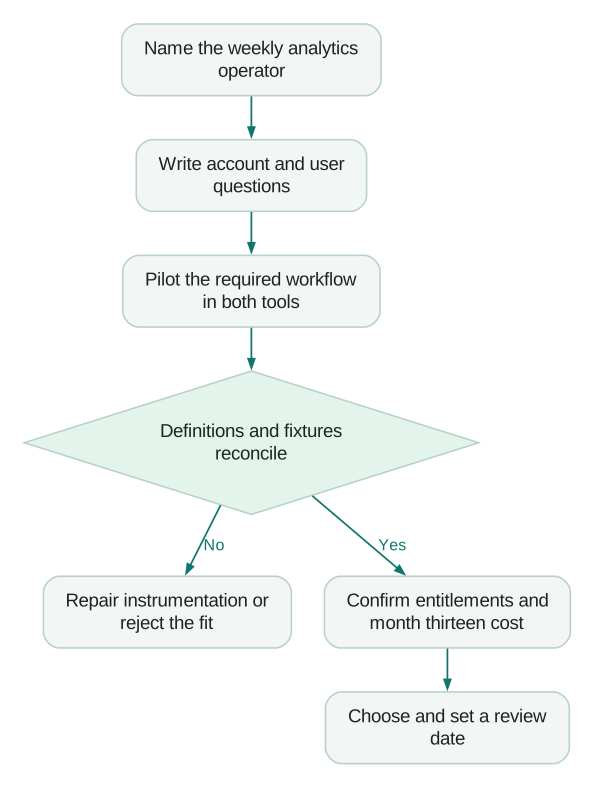
Use our method for comparing two martech tools to retain the evidence behind the decision. For unexplained counts, start with a free martech audit. For a defined pilot or migration, request a product analytics implementation quote with the tracking plan and acceptance cases.
Questions people ask
What should happen when both pilots return the same correct answer?
Compare operator effort, maintenance, required controls and the complete post-discount cost. Ask a second person to reproduce the result without the original builder's help. If both still meet the need, favour the option with a manageable exit and an accountable owner rather than inventing a feature requirement to break the tie.
Can a single customer belong to several accounts in the analysis?
Yes, but the implementation must preserve which account each event concerns. Test a person who belongs to two workspaces with different subscription states and performs actions in both. A current company property on the person can blur that history; use the supported group model and verify the intended account-level result.
Should we copy every old dashboard during a migration?
Copy the decisions and definitions that remain useful, then rebuild the smallest reporting set that supports them. Identify unused dashboards, duplicate metrics and stale filters before estimating the work. Keep an export or record where continuity requires it, but do not make a new implementation harder to maintain by recreating abandoned analysis.
What is a useful thirty-day success measure for the new tool?
Track whether the intended operator made and documented a real product decision, whether critical event counts reconciled and whether spend matched the agreed forecast. Include masking and permission checks alongside usage. A large number of dashboards or captured events does not establish that the team can answer its original question reliably.
Should feature flags move at the same time as analytics?
Only when the application change is understood and independently tested. Analytics collection and runtime feature decisions have different failure consequences. Inventory flags and fallbacks, migrate a bounded path and retain rollback before expanding. A successful event migration does not prove that users receive the correct feature variant after the provider changes.
Sources
- Amplitude: Pricing and plan comparison.
- Amplitude: Plus calculator.
- PostHog: Pricing, calculator and limits.
- Amplitude: Limits and quotas.
- Amplitude: Account-level reporting.
- PostHog: Group analytics.
- Amplitude: Startup Plan.
- PostHog: Startup programme.
- Amplitude: Export API.
- PostHog: API overview and event-export routes.
- Amplitude: MCP server.
- PostHog: MCP server.
- G2: Amplitude Analytics reviews.
- G2: PostHog reviews.
- PostHog: Migrate from Amplitude.
- Amplitude: Self-service data migrations.
- PostHog: Self-hosting.

Written by
Jafrin Akter AloData Engineer and Co-founder at Martechdevs and Growth and Analytics Partners
Jafrin writes practical guides to marketing technology, customer data, analytics and AI workflows. Martechdevs is a Growth and Analytics Partners company.