
How to Set a Useful Marketing Data Freshness SLA
A useful marketing data freshness service-level agreement (SLA) defines which decision the data supports, how current and complete it must be, when it must be available and what happens when it misses that standard. Measure the final report or activation output as well as its source feeds. A successful pipeline run or one recently loaded row does not prove the whole dataset is ready.
On this page
Which decision and deadline should the freshness agreement protect?
Protect the decision at the time its owner must act. Ask the report owner what they will do with the data and when. A weekly budget review, a daily lead-routing process and a customer suppression check have different failure costs. Giving all three an hourly refresh schedule wastes money in some places and creates avoidable risk in others.
For a campaign-budget meeting at 09:00, the useful promise may be that the prior complete business day's cost and accepted-lead data is available by 08:30. For a suppression audience, yesterday's data may already be too old. Define the product and decision before selecting a refresh interval.
Use precise terminology in the agreement. A service-level indicator (SLI) is the measured result, a service-level objective (SLO) is the target and an SLA adds an agreed commitment and response to failure. Google's reliability guidance distinguishes objectives from contractual agreements and recommends indicators tied to the user's experience. Internal teams often call their operating agreement an SLA; make the actual responsibilities explicit rather than relying on the label.
A warehouse and customer data implementation should produce this operational contract alongside the models. Otherwise, the marketing team interprets a green dashboard as current while the data team interprets green as a completed query.
How do freshness, coverage and correctness differ?
Freshness asks how old the usable information is. Coverage asks whether the required accounts, partitions, records or fields are present. Correctness asks whether the values and relationships satisfy the agreed rules. A dataset can pass one and fail the others.
Suppose 99 advertising accounts loaded yesterday's results, but the largest account did not. A global maximum load timestamp may be current, and almost every account may be present, while most spend is missing. Check required accounts individually and distinguish account-count coverage from spend-weighted exposure.
A job that updates an audit timestamp without receiving new source information should not reset the data's age. A dashboard cache refresh should not imply that the underlying warehouse has advanced. Preserve source-through time, ingestion time, model publication time and dashboard or destination refresh time as different observations.
Use a trusted readiness manifest where possible: the source account, report date, extraction configuration, completed pages or cursor ranges, record count, totals and reconciliation result. A manifest is evidence only for the completeness it actually verifies. Calling a batch complete because the last extraction request returned successfully is insufficient if earlier pages were skipped. Use the wider marketing data quality system to combine those freshness checks with correctness, identity and recovery controls.
The data warehouse design guide explains the underlying model boundaries. The freshness agreement should name which boundary the user can rely on.
What does a usable daily-report contract specify?
A usable contract names the consumer, required period, completeness evidence, deadline and response to failure. Here is a hypothetical starting contract for a daily paid-media performance report. It is an example to adapt, not an industry-standard promise.
The consumer is the growth manager making the 09:00 daily budget decision. The report covers all 12 explicitly registered advertising accounts and the accepted commercial lead ledger. The business timezone is Asia/Dhaka. By 08:30 each day, the report must include the prior local calendar day from 00:00 inclusive to the following 00:00 exclusive.
A good delivery requires every expected account-date slice, completed extraction pagination, validated transformations, no duplicate business keys and reconciled control totals under source-specific tolerances. The lead ledger uses exact accepted-submission counts after its documented test exclusions. Advertising cost uses each source's currency and reporting settings before any approved currency conversion.
The target is good delivery on at least 29 of the most recent 30 eligible daily deadlines. The denominator comes from the expected schedule, so a missing job still counts as a failed delivery. Do not calculate success only from runs that happened to produce logs.
The data owner receives an early warning when recovery time is running short. The growth manager sees an explicit stale or incomplete status by 08:30 if the contract is missed. The operating response is to defer automated budget changes for affected accounts and use the last reconciled report with its date clearly shown. Record who is accountable for the agreement separately from who runs the pipeline and who consumes the report.
The agreement names an owner, backup owner, incident channel and next-update interval. It also explains that later source revisions may restate prior days under the separate correction policy. A timely provisional delivery is not a promise that a vendor will never revise a metric.
How should you budget latency across the entire path?
Work backward from the consumer's deadline and budget every stage, including source publication and final destination availability.
Hypothetical serial latency budget, measured in minutes from the original business event through the usable output. The allowances are planning assumptions, not vendor guarantees.
| Stage | Allowance, minutes | Evidence at the stage boundary |
|---|---|---|
| Source publication | 60 | Source makes the required period available |
| Ingestion | 20 | Required account and pagination coverage complete |
| Transformation and checks | 15 | Published model passes its readiness checks |
| Destination refresh | 10 | Report or destination acknowledges the new version |
| Contingency | 15 | Recovery room before the committed deadline |
| Total | 120 | Consumer can use the verified output |
If the source typically publishes after three hours, refreshing the warehouse every five minutes cannot satisfy a two-hour event-to-report promise. Either choose another source or export mode, change the decision window or explicitly promise a narrower source-availability-to-report target. Do not hide source latency by starting the clock after the slowest part.
Measure actual stage durations and the end-to-end duration. Percentiles do not add cleanly: the 95th percentile of each stage summed together is not automatically the end-to-end 95th percentile. The slow events may occur on different runs, and failures may be correlated.
For a daily batch, deadline performance may be more understandable than per-record latency. For a continuous suppression feed, record-level delay and the oldest unprocessed eligible item may matter more. Choose the observation unit according to the decision, then preserve that unit in the numerator and denominator. The Fivetran guide to sync intervals and usable freshness applies this distinction from source change through the final consumer.
A quiet source also needs a rule. No new leads overnight may be normal. A successful poll with a verified source cursor or an explicit zero-record batch can distinguish no activity from a stalled pipeline. A synthetic heartbeat alone proves connectivity, not that all business data was processed.
How can you prove that a fresh batch is complete?
Check source age, expected coverage, uniqueness and time ordering independently; publish only when every required condition passes. For this separate synthetic test, use a fixed evaluation time of 08:30 Coordinated Universal Time (UTC). A model was published at 08:25, its declared source-through time is 08:00 and the agreed maximum data age is 30 minutes. At first glance it meets the age target exactly.
However, its expected batch contains 100 distinct receipt IDs and only 99 are present. The output is incomplete. A different fixture containing all 100 IDs plus one duplicate delivery row is also unacceptable for a model whose grain is one row per receipt, even though its distinct count looks correct.
This original Python acceptance fixture checks those conditions independently. It uses an authoritative expected-ID manifest for a synthetic batch; real sources may require a different completeness control. Its fixed 14 October timestamps are sample inputs, not the current time. Run it with Python 3; passing assertions produce no output.
from datetime import datetime, timedelta, timezone

UTC = timezone.utc
now = datetime(2026, 10, 14, 8, 30, tzinfo=UTC)
through = datetime(2026, 10, 14, 8, 0, tzinfo=UTC)
published = datetime(2026, 10, 14, 8, 25, tzinfo=UTC)
expected = {f"receipt-{i}" for i in range(100)}

def readiness(actual_ids, expected_ids, source_through, published_at, checked_at):
    if any(not isinstance(k, str) or not k.strip()
           for k in list(actual_ids) + list(expected_ids)):
        raise ValueError("Receipt IDs must be nonempty strings")
    times = (source_through, published_at, checked_at)
    if any(t.tzinfo is None or t.utcoffset() is None for t in times):
        raise ValueError("Use timezone-aware timestamps")
    ordered = source_through <= published_at <= checked_at
    age_ok = ordered and checked_at - source_through <= timedelta(minutes=30)
    unique = len(actual_ids) == len(set(actual_ids))
    complete = set(actual_ids) == expected_ids
    return {"fresh": age_ok, "unique": unique,
            "complete": complete, "ready": age_ok and unique and complete}

all_ids = sorted(expected)
assert readiness(all_ids, expected, through, published, now)["ready"]
assert not readiness(all_ids[:-1], expected, through, published, now)["ready"]
assert not readiness(all_ids + [all_ids[0]], expected,
                     through, published, now)["ready"]
assert not readiness(all_ids, expected, through - timedelta(seconds=1),
                     published, now)["ready"]
For this example, supply actual IDs as a list of nonempty receipt identifiers and expected IDs as the independently verified set. Validate that manifest before using it: an empty expected set should mean a confirmed zero-activity batch, not a missing inventory. The checks show why a recent timestamp and matching row count are not sufficient on their own. Equal sets catch missing or unexpected IDs; uniqueness catches repeated rows; time ordering rejects future publication or source-through claims. The inclusive 30-minute boundary is part of this example's contract, not a universal tool default.
A real report also needs correctness checks for monetary totals, required fields and joins. Keep those results separate so an incident tells the operator whether to investigate availability, missing data or transformation logic.
What do dbt and Dataform freshness checks actually prove?
Use the tool's measured timestamp and explicit publication gate, rather than interpreting a successful job as proof of business readiness.
dbt's freshness configuration supports warning and error thresholds and a loaded timestamp field or query. Choose a field that reflects the information you intend to measure. A maximum timestamp measures the newest qualifying observation; it does not by itself verify every required partition or account.
Version matters. Current dbt documentation describes dbt freshness for source and model checks in v2.0 and later, while dbt source freshness remains supported for source-only checks. Use the command and configuration appropriate to the installed version rather than copying a generic snippet into an older project.
A resource without warning or error thresholds is not checked. In v2, an incomplete threshold can warn during dbt build while the explicit freshness command errors; test the installed behavior with a deliberately invalid configuration before trusting a green build.
Also make the publication gate explicit. The following distinctions are documented for dbt deployment jobs:
| Job configuration | Freshness behavior | Publication implication |
|---|---|---|
dbt build alone | Does not include source freshness checks | A passing build is not this readiness gate |
| Run source freshness checkbox | Runs the source check first; failure does not stop later steps | Useful observation, but does not enforce this stop rule |
Explicit dbt source freshness run step | An out-of-date result fails the step and stops subsequent steps | Place it before dependent publication when that is the intended policy |
dbt's source freshness deployment guide documents that job behavior. The table uses its source-only command; choose the version-appropriate source/model command deliberately, and prove the surrounding job stops the output you intend to protect.
For data-quality rules, Dataform's assertion documentation describes assertions that fail when their query returns violating rows. A test existing in the project is not proof that downstream publication waits for it. Inspect dependencies and run a deliberate failure in a safe environment to prove the gate. Compare tools that run freshness and volume checks by their measured signal, permissions and response workflow.
Keep freshness, quality checks and the final destination acknowledgement in one run record. That gives the operator a single place to determine what was safe to publish and what remains unresolved. Check Data Studio's cache and freshness settings as a separate consumer layer; refreshing the report does not establish that its source advanced.
When should an alert fire, and what should it contain?
Fire the warning while the named responder still has enough time to recover or contain the problem. A warning five seconds before a deadline is technically early and operationally useless if recovery takes 20 minutes. Set the warning from observed repair time, the decision deadline and the team's availability.
For the 08:30 daily report, an example warning might fire at 08:00 if any required slice is still missing and typical recovery takes 15 minutes. At 08:30, publish the readiness status even if the team is still investigating. Avoid leaving yesterday's numbers on screen under today's date.
An alert should identify the affected report, source account, missing period, last known usable cutoff, failed check and owner. It should also link to the recovery procedure and explain which business actions should pause. An alert saying only that a model failed forces every responder to rediscover the impact.
Group downstream symptoms under the initiating incident where possible. One failed source can break ten reports; ten unrelated pages do not create ten different root causes. Still verify each consumer after recovery, because a successful source reload may not refresh cached reports or destination audiences.
Test the last mile. If a dashboard cache remains stale after the warehouse recovers, the consumer still has stale data. If a destination rejects an audience update, successful warehouse publication has not fulfilled the activation promise. You can hand a freshness alert to a triage agent for evidence gathering, while keeping restoration and consumer verification with their owners.
How do you measure reliability without hiding missed deliveries?
Divide good, complete deliveries by all scheduled eligible deadlines, including missing runs. Under the example 29-of-30 deadline target, one bad delivery in 30 produces 96.67% and still meets the stated target. Two bad deliveries produce 93.33% and fail it. If the team instead promises at least 99% over only 30 daily observations, even one miss produces a failure. Choose a window and target that express the intended tolerance honestly.
Illustrative daily-deadline reliability. The denominator is thirty scheduled deliveries, not thirty successful job logs.
| Good deliveries | Missed or bad deliveries | Good-delivery rate | Meets the 29-of-30 target? |
|---|---|---|---|
| 30 | 0 | 100% | Yes |
| 29 | 1 | 96.67% | Yes |
| 28 | 2 | 93.33% | No |
Count incomplete or incorrect deliveries as bad when the contract requires readiness, even if they arrived on time. Keep separate failure reasons so the same incident is not counted several times in the overall deadline metric.
Track maximum delay, repeated misses and business impact alongside the ratio. A single missing major-account report can matter more than a harmless low-volume delay. Do not silently remove difficult accounts from the expected inventory to improve the score.
The late-arriving data guide covers historical corrections. For a freshness agreement, record whether recovery restored the promised cutoff, whether a backfill changed previous reports and whether affected activation outputs were reconciled.
When is a faster freshness target worth its cost?
A faster target is worth paying for when earlier usable data changes a valuable decision or avoids a defined harm. A tighter target may require more frequent extraction, larger processing capacity, different source access, more monitoring and someone available to respond. Estimate those costs against the value of the earlier decision. Check why faster Fivetran syncs do not always raise monthly active rows (MAR) while still including transformation and warehouse work.
If a weekly decision cannot change before Friday, a costly five-minute refresh may provide little benefit. If a customer suppression error sends inappropriate messages within minutes, a daily batch is not an adequate design. The warehouse ROI guide helps frame this tradeoff around operational and commercial outcomes.
Start with the smallest set of outputs whose lateness causes real harm. Measure a baseline, agree on an achievable target and run failure drills before expanding the promise to every table. The contract should make decisions safer and responsibilities clearer, not create a collection of alerts nobody trusts.
Freshness is a promise about the usable output at the consumer’s deadline. Check coverage and correctness before refreshing the destination, preserve any missed deadline, and keep a degraded status visible until the final consumer is verified.
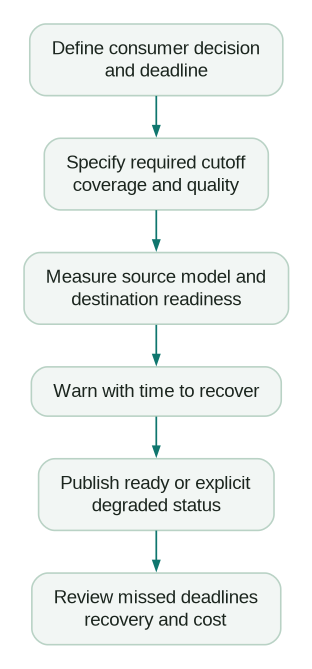
Read diagram as text
- Define the consumer deadline cutoff inventory and quality contract to Measure source and model readiness.
- Measure source and model readiness to Freshness coverage and correctness all pass?.
- Freshness coverage and correctness all pass? to Refresh the final report or destination audience: Yes.
- Freshness coverage and correctness all pass? to Warn the owner and start recovery at the failed boundary: No.
- Refresh the final report or destination audience to The consumer confirms the expected ready version?.
- The consumer confirms the expected ready version? to Warn the owner and start recovery at the failed boundary: No.
- Warn the owner and start recovery at the failed boundary to The agreed consumer deadline has been missed?.
- The agreed consumer deadline has been missed? to Measure source and model readiness: No.
- The agreed consumer deadline has been missed? to Record the miss and show degraded status with the agreed pause: Yes.
- Record the miss and show degraded status with the agreed pause to Measure source and model readiness.
- The consumer confirms the expected ready version? to Mark ready with the actual availability time: Yes.
- Mark ready with the actual availability time to Review all scheduled deadlines recovery and cost
What must pass before the freshness agreement is adopted?
Adopt the agreement after the readiness checks, failure response and final consumer have been demonstrated with controlled cases:
Checklist
- The consumer, decision, timezone, deadline and expected source inventory are explicit.
- Source-through, ingestion, publication and destination refresh timestamps have separate meanings.
- Missing runs remain in the reliability denominator.
- Freshness cannot pass solely because one account or one row updated recently.
- Empty but complete batches can be distinguished from failed or incomplete extraction.
- A controlled missing-row, duplicate-row and stale-cutoff fixture fails publication as intended.
- Warnings leave enough recovery time and identify the affected business action.
- Recovery includes downstream reports or audiences and records any historical restatement.
Want a second pair of eyes on your stack? Get the $99 martech audit or request a detailed warehouse implementation scope with the decision deadline, source inventory and failure drills included.
Keep reading
Browse all Data Warehouse guides
 Data Warehouse
Marketing Analytics Tools: Collection, Channel Data and Reporting
Compare GA4, Plausible, Data Studio and Supermetrics by collection, channel data and reporting needs, with pricing, scenarios and a campaign-join example.
Jafrin Akter AloLast updated 12 min read
 Data Warehouse
dbt Cloud Pricing: Seats, Model Builds and Add-on Costs
dbt Cloud pricing combines seats, successful builds and add-ons. See monthly examples, Starter limits, State charges and a practical cost-control checklist.
Jafrin Akter AloLast updated 12 min read
 Data Warehouse
 Examples: Fact Tables, Dimensions and Reliable Totals
Explore data warehouse examples for sales, inventory and campaign reporting, with fact/dimension grains, runnable SQL and checked aggregation mistakes.
Jafrin Akter AloLast updated 11 min read
Data warehouse & CDP
See the implementation scope, deliverables and acceptance checks.
Questions people ask
How should planned maintenance affect the reliability denominator?
Agree the maintenance rule before the measurement window begins and keep every exclusion visible. A scheduled outage may be excluded only under the policy the consumer accepted, with its scope and notice recorded. Do not reclassify an unexpected failure as maintenance after it occurs. Publish the gross delivery record alongside the adjusted indicator so the team can see the actual interruption.
What if the business changes its reporting timezone?
Version the calendar and deadline rule, then identify which source periods and consumer reports are affected. A local-day boundary can move records between reporting dates even when the timestamps are unchanged. Compare a completed period under both rules and communicate the cutover. Keep the old deadline history interpretable instead of silently evaluating earlier deliveries against the new clock.
Can a source vendor’s SLA stand in for the marketing team’s agreement?
No. A vendor commitment covers its stated service boundary and exclusions, while the marketing team depends on collection, transformations, checks and final delivery as well. Record the vendor promise as one input and identify the gaps the team owns. A contractual remedy for an upstream outage does not make the affected dashboard current or define the permitted business response.
What if a priority account is added after the expected inventory is locked?
Record when the account becomes required and which deadlines include it. Validate access, source coverage and historical requirements before treating the account as a normal slice. Preserve earlier inventories so a later addition does not silently make past reports incomplete. If the business needs the account immediately, expose the temporary gap and agree which actions remain permitted until onboarding is verified.
How should an audience workflow handle a delivery acknowledgement that arrives late?
Keep the acknowledgement time separate from warehouse publication and the audience version's intended cutoff. Determine whether the destination accepted the expected members and removals before releasing the dependent action. A late success can resolve the incident without turning the original missed deadline into an on-time delivery. Preserve both observations so reliability reporting and the current operating state remain accurate.
Sources

Written by
Jafrin Akter AloData Engineer and Co-founder at Martechdevs and Growth and Analytics Partners
Jafrin writes practical guides to marketing technology, customer data, analytics and AI workflows. Martechdevs is a Growth and Analytics Partners company.