
dbt Cloud Pricing: Seats, Model Builds and Add-on Costs
dbt Cloud pricing combines developer seats with usage and optional products. The free Developer plan serves one developer, while Starter lists $100 per developer per month for up to five developers. Two Starter developers cost $200/month before excess usage, add-ons and warehouse compute. Larger teams need an Enterprise quote, and every budget should separate successful builds from dbt State and AI charges.
On this page
dbt Cloud plans and billing units
US public list prices below are in USD; usage overages, optional products and warehouse charges are separate.
| Plan or product | Public price | Included allowance or meter | Main boundary |
|---|---|---|---|
| Developer | Free | One developer; 3,000 successful model builds/month | One project and a monthly build limit |
| Starter | $100/developer/month | 15,000 successful builds and 5,000 queried metrics/month | Up to five developers and one project |
| Enterprise | Custom quote | Listed allowance of 100,000 successful builds and 20,000 queried metrics/month | Contracted seats, usage and features |
| dbt State | $0.094 per billable DATT | Daily active target tables after applicable allowance | Separate reuse meter |
| dbt Wizard | Model-specific token pricing | Managed AI input/output tokens or provider billing through BYOK | Separate AI consumption |
Sources: dbt pricing, Starter seat limits, dbt service consumption table.
A successful model build is a model successfully built in a deployment environment through dbt orchestration. Scheduled jobs, CI and API-triggered runs can contribute. A project with 100 eligible models built twice daily for 30 days produces 6,000 successful builds if every selected model succeeds each time. Build definition.
Use the current product names on the order: dbt's hosted offering is described as the dbt platform, while many teams still search for dbt Cloud. Keep the commercial plan, execution environment and optional products explicit so a familiar name does not hide a different billing meter.
At Martechdevs, we connect warehouse transformation and reporting implementations to a clear data contract. The budget starts with the models that serve business decisions, their required freshness and their deployment schedule. Buying more capacity or a larger plan before examining those inputs can preserve unnecessary work.
dbt cost by company type
These monthly worked examples use Starter's $100/developer list price and remain inside the stated build allowance unless noted.
| Illustrative company | Developer and usage assumptions | Platform estimate | Additional budget |
|---|---|---|---|
| Five-person startup | One Developer-plan user; 2,600 successful builds | $0 | Warehouse and optional products |
| Twenty-person SaaS | Two Starter developers; 9,000 successful builds | $200 | Warehouse, State or Wizard if used |
| B2B SaaS with 50 to 100 staff | Three Starter developers; 12,600 successful builds | $300 | Warehouse and any metric overage |
| Mid-market team with limited authoring | Five Starter developers; 15,000 builds; one project | $500 | Governance requirements may require Enterprise |
| Larger data organization | Eight developers, several projects and Enterprise controls | Custom quote | Contracted usage plus add-ons and warehouse |
Seat rates and plan allowances come from dbt pricing. Starter supports up to five developer licences, so an eight-developer forecast cannot simply multiply the Starter seat price by eight. Starter permissions, billing FAQ.
These examples do not predict a bill from company headcount. They describe the people authoring transformations and the usage they generate. A large company can have a small modeling team, while a small product company can run frequent transformation jobs.
For the first scenario, assume 100 eligible models built once on each of 20 working days, plus 20 CI runs that each successfully build 30 models. That is 2,000 scheduled builds plus 600 CI builds, or 2,600. The model inventory is 100, while the monthly execution total is 2,600.
The third scenario increases scheduled execution to six times per working day: 100 × 6 × 20 = 12,000, plus the same 600 CI builds. It stays below Starter's 15,000 allowance. A move to hourly execution around the clock would produce 72,000 scheduled builds in a 30-day month before CI. Schedule changes deserve a budget review even if no new developer joins.
Main dbt bill drivers
Successful builds and deployment schedules
The build meter counts successful models within a run, including successes before a later failure. If 80 eligible models complete and the next one fails, the 80 successes still count. Development-environment runs, tests, seeds, snapshots and ephemeral models are excluded from the successful-model-build meter. They may still consume warehouse resources or participate in another product's meter. Usage definitions.
Build frequency usually deserves attention before the raw model count. Separate hourly operational models from daily finance outputs and occasional backfills. A single schedule for every model is easy to create, but it makes every model inherit the most demanding freshness requirement.
Retried jobs also deserve a precise count. Record the successful nodes in each attempt and the selection used for the retry. A failed job followed by a full rerun can create more eligible builds than the final successful run suggests.
Usage above the plan allowance
Starter includes 15,000 successful builds per account per month and bills additional usage in arrears. Unused included builds do not roll over. Existing entitlements can differ by the terms under which an account signed up. Plan billing.
Obtain the current successful-build and queried-metric overage rates in the account or written proposal before forecasting excess usage. The current public plan table states the allowances but does not provide a universally applicable excess-build rate in its visible rate details. An old Team-plan price should not become an assumed current contract term.
For an illustrative three-seat Starter account with 72,600 successful builds, the base seat charge is $300 and excess builds are 57,600. At the account's confirmed excess-build rate of r dollars, the platform amount is $300 + 57,600 × r, before any other usage. Keep r as an explicit purchasing input until the vendor confirms it. Overage billing.
dbt State reuse
dbt State has a separate unit called a daily active target table, or DATT. A target counts when State skips, clones or reuses it during a UTC day. Repeated reuse of that same target during the day counts once, while distinct tests can count as separate targets. A model and two reusable tests can therefore produce three DATT in a day. State unit definition.
Use the billable amount after the applicable allowance. For a worked example, 40 models with two distinct tests each produce 120 reusable targets. If all are reused on each of 20 days, the month contains 2,400 DATT. With a 1,000-DATT allowance, 1,400 are billable at $0.094, or $131.60. State rate.
Starter's documented 1,000-DATT monthly allowance is temporary through March 31, 2027. Developer and self-hosted free accounts have a different ongoing allowance policy. Confirm the account's allowance and expiry before treating the example as a permanent price. State allowances.
Evaluate State by net cost and accepted results. If an illustrative month saves $180 of warehouse compute but adds $131.60 of State charges, the direct saving is $48.40 before other changes. If warehouse savings are only $80, the same State charge increases direct spend by $51.60. Reuse may improve delivery as well, but quantify that benefit separately.
Semantic Layer and AI consumption
A successful Semantic Layer request can count more than one queried metric when it requests multiple metrics. SQL rendering can also count, and an empty result does not automatically remove the charge. Estimate the actual request pattern rather than using dashboard count as a proxy. Queried-metric definition.
dbt Wizard uses model-specific token pricing. With managed AI, the selected model and token types determine consumption; bringing your own key sends model billing to your provider. Keep this separate from both developer seats and transformation builds. Wizard consumption terms.
A developer's seat does not establish a fixed monthly AI bill. Forecast the approved usage pattern, choose the appropriate spending controls and include the provider invoice if the team uses its own key.
Developer seats and usage ownership
Both people and usage move this bill. A developer licence supports day-to-day development, while other licence types have different permissions. Starter permits Read-Only licences without an additional licence charge, and an IT licence serves limited administration. Assign the licence that fits the actual work rather than making every stakeholder a developer. Starter licence scope.
Removing a Starter user and reducing billable seats are separate administrative actions. The account's user count and billing seat count both need updating. Otherwise, a removed employee can leave a paid seat on the account. User and billing-seat management.
Keep permission review alongside cost review. A cheaper licence that prevents an on-call engineer from doing required recovery work is a poor saving. Conversely, a stakeholder who only reads model documentation should not be given broad development access merely to simplify billing administration.
dbt plan fit
| Requirement | Starting plan | Upgrade trigger |
|---|---|---|
| One developer and a small deployment workload | Developer | Additional developers or monthly build requirements |
| Small authoring team and one project | Starter | More than five developers or required Enterprise controls |
| Several projects, SSO or more detailed governance | Enterprise | Contracted feature and operating requirements |
| Private networking or hybrid execution requirements | Enterprise+ evaluation | Exact connectivity and deployment boundary |
| Existing self-hosted project with State or Wizard interest | Separate add-on evaluation | Demonstrated benefit against current operating cost |
The pricing comparison lists Enterprise governance and Enterprise+ connectivity capabilities. The job scheduler guide also distinguishes project and run-slot limits. Use the actual plan constraints before choosing a tier from price alone.
Stay with the lower tier when it meets the required team, project, security and delivery needs. Moving to Enterprise is a purchasing decision about capabilities and contract terms, not an automatic consequence of company growth.
Our dbt implementation mistakes guide covers operating problems that a plan upgrade will not resolve, including unclear model ownership and weak validation.
dbt cost controls
Model selection and freshness
Choose the models that must run for each job. dbt's guidance includes selectors and a pattern for avoiding unnecessary view rebuilds while preserving required tests and deploying changed view logic. Dynamic SQL dependencies and other project-specific behavior need care. A blanket exclusion can leave production logic stale. Cost optimization.
For State, freshness rules and environment-specific configuration affect reuse. Test the behavior against the business freshness requirement before extending tolerance. A cheaper model that is too stale for the receiving workflow does not meet the delivery contract.
Our dbt incremental models guide and backfill guide help distinguish routine incremental work from a controlled history repair. Keep a backfill's expected usage separate from normal recurring spend.
Alerts and stop conditions
For successful-model and queried-metric usage estimates, dbt sends alerts at 75%, 90% and 100%, with recipients determined by the plan and permissions. Alerts can lag actual use and do not themselves stop paid activity. To stop new model usage, review scheduled, pull-request and API triggers together. Disabling only the visible schedule can leave other execution paths active. Usage controls.
dbt State has separate notifications at 80% of its DATT allowance and when reuse pauses. On Starter, turning off card billing for State can pause reuse at the allowance rather than permitting paid overage. Review the resulting warehouse work before choosing that control. State controls.
Define a response for each important job: continuation within an approved budget, reduced frequency, or a deliberate pause with a business owner. A finance alert should not silently interrupt a critical operational dataset.
Warehouse and add-on reconciliation
Keep the warehouse invoice beside the dbt usage report. Tests excluded from successful builds can still execute warehouse queries, while a reused node can introduce State charges. The cost review should reconcile the products serving the same outcome instead of optimizing one invoice in isolation.
Compare Snowflake pricing or the Redshift and Snowflake workload comparison where those platforms are in scope. Warehouse choice, job selection and orchestration are related decisions with separate billing units.
Billing terms and renewal review
Starter seats are billed upfront monthly, with usage billed in arrears. Added seats are prorated; removed seats affect the next invoice and do not receive a refund for the current month. Enterprise billing follows its annual contract and applicable additional-usage terms. Plan billing rules.
Read the quote as a list of entitlements: developer seats, projects, successful builds, queried metrics, State allowance or commitment, AI consumption and support. Record overage rates, commitment expiry and the handling of unused allowances. Avoid merging a temporary promotion into the recurring run rate.
The free Developer plan stops subsequent runs after its build allowance is exceeded until the allowance resets or the account upgrades. Existing accounts can carry different entitlements, so check the actual account before scheduling a production dependency around a published free allowance. Developer billing behavior.
The Starter trial is available to eligible new accounts at signup. Upgrading an existing Developer account moves it directly to paid Starter billing. Confirm the transition before inviting collaborators or treating an upgrade as another trial. Upgrade and trial rules.
For State consumption commitments, check the service table's treatment after the prepaid pool is exhausted. Its discount can continue for the first two billing periods in arrears before the full rate applies in the third. The order and applicable consumption terms need to be reviewed together. Consumption terms.
dbt rate card in plain English
| Term | Practical meaning | Budget input |
|---|---|---|
| Developer seat | A purchased licence for development access | Billable seat count |
| Successful model built | An eligible model successfully executed through deployment orchestration | Model selections multiplied by actual successful runs |
| Queried metric | Metric-level Semantic Layer consumption | Metrics requested or rendered across calls |
| DATT | A reusable target active on a UTC day | Distinct reused targets per day, after allowance |
| Wizard consumption | AI tokens priced by selected model and token type | Model, input/output use and billing route |
Use the pricing page, billing definitions and service consumption table together. A useful estimate has an owner and a source for every input, including the warehouse amount.
Transformation budget and next step
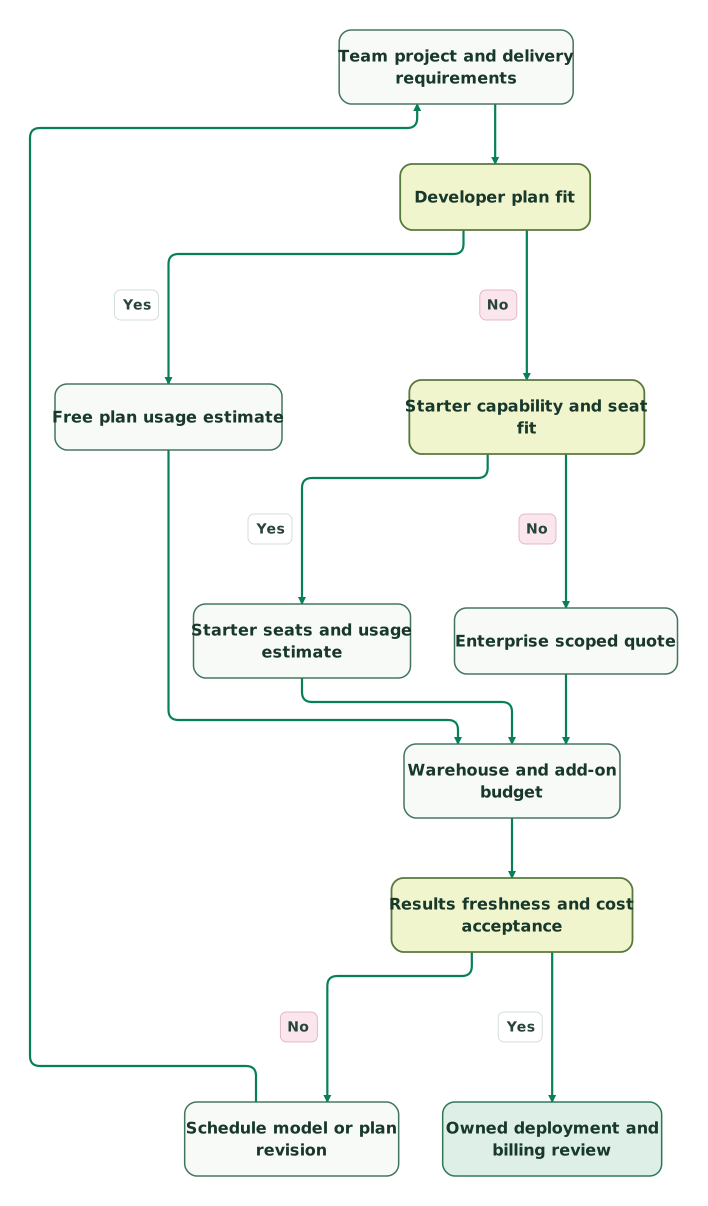
Read diagram as text
- Team project and delivery requirements to Developer plan fit.
- Developer plan fit to Free plan usage estimate: Yes.
- Developer plan fit to Starter capability and seat fit: No.
- Starter capability and seat fit to Starter seats and usage estimate: Yes.
- Starter capability and seat fit to Enterprise scoped quote: No.
- Free plan usage estimate to Warehouse and add-on budget.
- Starter seats and usage estimate to Warehouse and add-on budget.
- Enterprise scoped quote to Warehouse and add-on budget.
- Warehouse and add-on budget to Results freshness and cost acceptance.
- Results freshness and cost acceptance to Schedule model or plan revision: No.
- Schedule model or plan revision to Team project and delivery requirements.
- Results freshness and cost acceptance to Owned deployment and billing review: Yes
dbt budgeting checklist
- Developer licences match the actual authoring team and billing count.
- Successful builds include CI, retries, schedules and API triggers.
- The current account's allowances and excess-usage rates are recorded.
- State DATT and Wizard tokens are separate from successful builds.
- Temporary allowances have expiry dates in the internal budget.
- Warehouse costs remain visible beside the platform estimate.
- Cost changes preserve required tests, freshness and recovery.
- Alerts and deliberate stop conditions have responsible owners.
Use the marketing data audit skill for the data and ownership evidence, and dbt for marketing for the modeling workflow. Our warehouse implementation service connects those decisions to a scoped build. The $99 martech audit includes a written assessment and a one-hour specialist call.
Keep reading
Browse all Data Warehouse guides
 Data Warehouse
dbt Implementation Mistakes: Fix Stale Models, Incremental Errors and Fragile Deployments
Fix stale dbt models, incremental errors, schema backfills and fragile deployments with practical tests, build-cost checks and a reliable handover plan.
Jafrin Akter AloLast updated 15 min read
 Data Warehouse
dbt Incremental Models for Marketing Data: Choose the Strategy Before the First Run
Choose a dbt incremental strategy for ad spend, events and CRM updates. See a DuckDB model, key and lookback checks, adapter differences and rerun tests.
Jafrin Akter AloLast updated 13 min read
 Data Warehouse
dbt Tests for Marketing Data: 12 Checks With SQL and YAML Examples
Build a dbt test suite for spend, CRM and billing data. Copy SQL and YAML examples, catch missing rows, set severity and prove the release gate works.
Jafrin Akter AloLast updated 12 min read
Data warehouse & CDP
See the implementation scope, deliverables and acceptance checks.
Questions people ask
Does a dbt project with 100 models consume only 100 builds each month?
Monthly usage follows eligible successful executions, so repeatedly building the same models increases the count. A hundred models built twice daily for 30 days produce 6,000 successful builds before CI, retries or API-triggered jobs. Use the selected models and execution schedule together, then reconcile the estimate with actual usage rather than treating the project inventory as the billable total. Build definition.
Can a failed dbt job still create successful-model charges?
Models that complete successfully before the job fails count toward the successful-build meter. Inspect node outcomes across the original run and retry when estimating usage. The overall failure status does not erase already completed builds, and a full rerun can execute them again. Keep recovery requirements and model selection together so the repair is both correct and deliberate. Usage rules.
Are tests excluded from every dbt billing meter?
Tests are excluded from successful-model-build usage, but distinct tests can count as targets in dbt State when reused. Tests can also execute queries on your warehouse. Keep the platform's meters and warehouse costs separate when analyzing the cost of validation. Removing useful tests to reduce an unrelated meter can damage data quality without producing the expected saving. Build rules, State targets.
Does deleting a Starter user automatically lower purchased seats?
Starter user access and billable developer seats require separate updates. Removing a user frees the licence assignment, while the Billing settings control the purchased seat count. Review both when someone leaves or changes responsibilities, and check the next invoice. Keep an appropriate administration owner so the cost adjustment does not remove required recovery or billing access. Seat management.
Can eight developers use Starter at eight times the listed seat price?
Starter supports up to five developer licences. A team needing eight developers should request the appropriate Enterprise-tier proposal instead of extending the Starter multiplication beyond its limit. Include project count, governance, execution usage and optional products in that proposal so the comparison reflects the team's actual requirements and the complete recurring cost. Starter limit, upgrade guidance.
Sources
- dbt pricing and plan allowances
- dbt Starter licences and permissions
- dbt successful-build and metric definitions
- dbt plan billing and legacy entitlements
- dbt State usage and allowances
- dbt service consumption table
- dbt user and billing-seat management
- dbt job scheduler and project limits
- dbt cost optimization guidance
- dbt usage notifications and controls
- dbt billing and upgrade FAQs

Written by
Jafrin Akter AloData Engineer and Co-founder at Martechdevs and Growth and Analytics Partners
Jafrin writes practical guides to marketing technology, customer data, analytics and AI workflows. Martechdevs is a Growth and Analytics Partners company.