Data Observability Tools Compared: dbt Tests, Elementary, Soda, Great Expectations, Monte Carlo, Metaplane and Sifflet
Data Engineer and Co-founder at Martechdevs and Growth and Analytics Partners
Last updated 16 min read
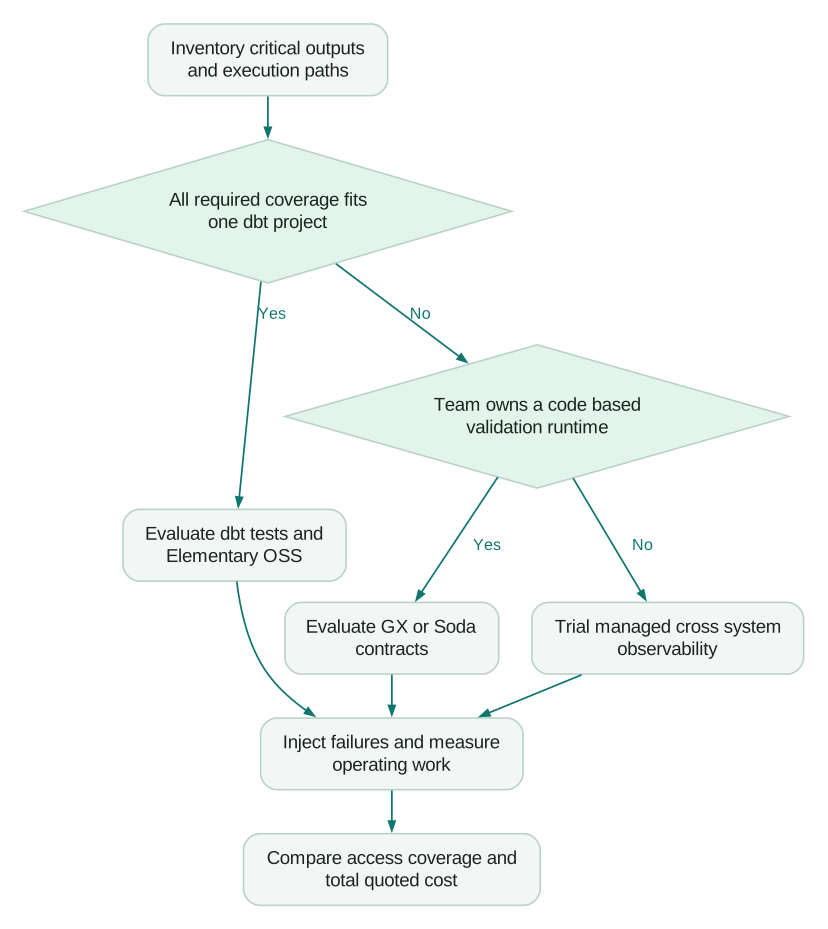
For a small team with one dbt project, start with explicit data tests and evaluate Elementary's open-source reporting and alerts. Use Soda or Great Expectations when checks need to run outside dbt. Trial a managed platform when cross-system coverage, lineage or incident handling exceeds what your team can maintain. Choose using injected failures, operating effort and a quote in the vendor's actual billing units.
What does observability add to a data-quality test?
Observability adds evidence about how data changes and where a failure affects consumers. Depending on the product, that can include learned baselines, lineage, test history, alert routing and incident tracking. An explicit test still matters when the business rule is already known.
A uniqueness test can reject repeated payment keys. A volume monitor can flag an unexpected drop without knowing which payment should exist. A reconciliation test can identify the missing payment using an independent ledger. These checks answer different questions.
The marketing data quality monitoring plan explains how collection checks, warehouse tests and reconciliation work together. This comparison focuses on choosing and operating the warehouse-side tools.
A single dbt project with a few critical outputs and a clear owner may need little more than maintained assertions, run visibility and reliable notifications. A larger estate can justify automatic coverage and impact analysis. Neither choice removes the need to define what “correct” means for revenue, identity or campaign eligibility.
What should decide the shortlist before a demo?
Choose the shortlist from the location of your critical data, the way checks run and the person who will maintain them. Compare the total operating workload alongside the subscription.
| Decision | Evidence to collect | Why it changes the choice |
|---|---|---|
| Coverage | Critical tables, pipelines, projects and consumers | A dbt-only view may miss a separately loaded source |
| Execution | Schedule, credentials, query location and overdue-run detection | A monitor must still expose an outage when the normal job stops |
| Authoring | SQL, YAML, Python, UI or learned baseline | Someone must maintain the logic after the pilot |
| Response | Owner routing, acknowledgement, suppression and recovery history | Detection has little value when alerts have no operating path |
| Commercial scope | Tables, assets, monitors, seats, environments and usage | Similar feature lists can produce very different bills |
Ask for the exact access model. Distinguish permission to query customer tables from exporting raw records, samples or query results to a vendor. Inspect what appears in logs and alert payloads as well as where checks execute. A statement about metadata access does not automatically describe every optional feature.
Our warehouse monitoring implementation work can help define the first protected outputs and acceptance cases before you buy a platform.
How do the billing models compare?
The main commercial difference is what grows the bill: user access, monitored objects or consumption. Get the vendor to price the same inventory and enabled features before comparing totals.
Prices and plan facts below were checked on 17 October 2026. Dollar amounts are USD as used for this comparison; Soda displays “$” per month. Confirm contract currency, taxes, commitment and usage allowances. Quote-based prices have no assumed billing period. Warehouse compute and operating labour are additional.
| Option | Free or local starting point | Paid billing model | Quote or scope question |
|---|---|---|---|
| dbt tests | Free local dbt distributions | Hosted platform and optional services are separate | Which runtime, scheduler and paid features will run the checks? |
| Elementary | Apache-2.0 OSS package/CLI route | Cloud seats, environments and table caps; AI credits extra | Count environments and monitored tables, then price the AI layer separately |
| Soda | Free Cloud at USD 0/month with included SPUs | Team USD 750/month; additional SPUs; Enterprise quote | How many processing units are included and what consumes them? |
| Great Expectations | Apache-2.0 GX Core; free Cloud Developer option | Cloud Team/Enterprise terms require confirmation | Current Cloud allowance, support and commercial availability |
| Metaplane | Free: 10 monitored tables, 3 custom SQL monitors | Pro per monitored table; Enterprise quote | Resolve conflicting public user/table limits in writing |
| Monte Carlo | No general free data-monitoring plan stated on the cited pricing page | Credits consumed by monitor type; dollar price per credit quoted | Contract version, active monitor inventory and agent consumption |
| Sifflet | No free plan stated on the cited pricing page | Entry, Growth and Enterprise asset tiers | Definition of an asset, minimum commitment and deployment cost |
Primary commercial sources: dbt distributions, Elementary, Soda, GX Cloud, Metaplane, Monte Carlo and Sifflet.
No startup programme is specified on these cited observability pricing pages. Ask about an available offer, but evaluate the normal operating bill too. A trial is not evidence that the tested allowance continues after the trial ends.
Which tools fit different ways of working?
Use the tool whose operating model matches your team. The choices below are our assessment of the documented capabilities, not results from a head-to-head performance benchmark.
dbt tests and test packages
dbt's four built-in data tests cover uniqueness, nulls, accepted values and relationships. Singular SQL tests express additional business rules. Severity and failure thresholds determine whether a result warns or errors; storing failures helps investigation, but the default failure table replaces the previous result for that test. Data tests, severity configuration.
Packages extend the assertions. dbt-utils includes recency, combined-key uniqueness, accepted ranges and non-null proportions. The maintained Metaplane dbt-expectations fork documents dbt 1.7 or later; verify compatibility with your installed runtime and adapter before upgrading.
- Best for: an analytics engineer whose business logic already lives in dbt.
- Pros: assertions sit beside the models and are reviewable with the change.
- Cons: you own coverage, schedules, retained history and response routing.
- Free tier and startup offer: local dbt options are free; hosted services have separate terms.
- Choose it if: a known rule and a named operator cover the failure you care about.
- Skip it if: the missing capability is broad automatic discovery across independent systems.
The dbt cost and implementation guide separates the engine, hosted platform, warehouse computation and optional services. In current v2 naming, dbt OSS is the Apache-2.0 distribution; the full local dbt distribution has its own licence. dbt distribution explanation.
Elementary
Elementary OSS combines a dbt package with a CLI for reports and alerts. Its documented scope is one dbt project; Cloud addresses wider project and non-dbt coverage. The CLI is Apache-2.0. OSS scope, repository and licence.
Its volume anomaly test evaluates completed buckets, using fourteen training days and two detection days by default. Use explicit volume thresholds when you already know the acceptable range. Volume tests. Alerts can carry owner, subscriber and descriptive context to Slack or Teams. Alert configuration.
Cloud Scale lists ten editors and 1,000 tables. Enterprise lists twenty editors, forty viewers and 3,000 tables; Unlimited removes seat limits but still lists a 3,000-table allowance. Extra tables and the AI layer affect the quote. The thirty-day trial FAQ names an older “Essentials” plan, so confirm trial entitlements. Elementary pricing.
Elementary says Cloud reads its logs, results and metadata schema rather than raw tables. Inspect what your configuration writes into that schema before treating the access boundary as a complete privacy assessment.
- Best for: one dbt project needing usable history and alerting around its tests.
- Pros: extends an existing project rather than requiring a separate rule language.
- Cons: operating the OSS CLI and tuning checks still take engineering time.
- Free tier and startup offer: OSS has no licence charge; Cloud advertises a trial.
- Choose it if: the project boundary matches the data you need to protect.
- Skip it if: the required cross-project workflow is outside the OSS scope and Cloud's quote does not fit.
Soda
Soda Core's current repository describes YAML data contracts, a CLI and a Python API for checking schema and data. The current main-branch licence is Elastic License 2.0; do not assume that every historical release has identical terms. Soda Core, current licence.
The rendered pricing cards put unlimited users and pay-as-you-go additional SPUs under Team. Free includes some SPUs, pipeline testing, metrics observability and alerting integrations. The public card does not quantify its included SPUs. Soda pricing.
- Best for: pipeline owners who want readable contracts outside a dbt-only workflow.
- Pros: the same contract approach can be used from a CLI or Python integration.
- Cons: contract maintenance, runtime compatibility and processing usage need an owner.
- Free tier and startup offer: Cloud Free exists; obtain its actual processing allowance.
- Choose it if: a contract can be run at the point where your pipeline needs a decision.
- Skip it if: you require Apache-licensed software and the selected Soda release does not meet that policy.
Review the selected licence before redistributing or offering a hosted service. The current licence contains restrictions on providing substantial functionality as a managed service; it is a different choice from an Apache-2.0 package.
Great Expectations
GX Core is a Python framework built around Expectations and validation results. The current repository is under Fivetran, lists Apache-2.0 and supports Python 3.10 through 3.14. GX Core repository.
Fivetran announced its planned stewardship of the open-source community and GX Core on 13 May 2026. That announcement does not establish GX Cloud's future commercial terms. The Cloud pricing page still names Developer, Team and Enterprise, but displayed no paid prices or allowances when checked in the browser. Stewardship announcement, GX Cloud pricing.
- Best for: a Python-oriented team integrating validation into its own pipelines.
- Pros: programmable expectations and a maintained validation framework.
- Cons: the team must operate its execution, result storage and response path.
- Free tier and startup offer: GX Core is open source; Cloud advertises free Developer.
- Choose it if: a developer will maintain reusable expectations and failure handling.
- Skip it if: nobody owns Python operations and your immediate need is a ready-made cross-stack incident workflow.
Metaplane
Datadog acquired Metaplane in April 2025. Datadog's announcement provides that ownership context; use current plan terms for the purchase.
The pricing page lists Free at ten tables and three custom SQL monitors. Pro adds column-level lineage and PagerDuty; Enterprise adds access and integration options. Its cards and comparison grid disagree on user counts, and the grid gives Pro a hundred-table limit. Resolve the entitlement and any add-on costs in writing. Metaplane pricing.
- Best for: a small team trialling managed warehouse monitoring.
- Pros: a bounded free starting point and documented notification integrations.
- Cons: public entitlement inconsistencies prevent a reliable larger-team estimate.
- Free tier and startup offer: Free is available; no startup offer is stated on the cited page.
- Choose it if: its monitored-table and custom-query limits cover your pilot.
- Skip it if: the confirmed allowance or required integrations make the quote unsuitable.
Snowflake-credit procurement is also advertised; confirm eligibility and scope.
Monte Carlo
Monte Carlo's current pricing spans data, ML and agent observability. Start lists up to ten users, 1,000 monitors and 10,000 API calls daily. Higher tiers add governance, deployment and operating options. Credit prices require a quote, while consumption rates are published separately. Monte Carlo pricing.
- Best for: a team needing managed impact analysis and incident workflows across several data systems.
- Pros: published consumption rules make a scoped usage estimate possible.
- Cons: a dollar estimate needs contract rates, enabled features and minimum commitments.
- Free tier and startup offer: the pricing page does not specify a general free data-monitoring tier.
- Choose it if: a trial reduces a measured detection or investigation burden worth the quoted cost.
- Skip it if: a small, well-owned test suite already covers the relevant failures.
Treat AI triage and remediation as separate features to evaluate. Require supporting records for a suggested cause and human approval for consequential repair. An assistant's explanation does not replace reconciliation.
Sifflet
Sifflet groups plans by monitored assets: Entry up to 500, Growth up to 1,000 and Enterprise above that. Enterprise lists SaaS, hybrid and self-hosted options. Prices are requested rather than published; the page also advertises Snowflake-credit purchasing. Sifflet pricing.
- Best for: teams evaluating observability together with a catalog and business impact view.
- Pros: asset tiers and deployment choices make the procurement conversation concrete.
- Cons: the meaning of an asset and the commercial minimum need confirmation.
- Free tier and startup offer: neither is specified on the cited pricing page.
- Choose it if: linking incidents to business consumers is a demonstrated need.
- Skip it if: your pilot mainly needs a few deterministic assertions in one project.
Confirm how tables, views and other objects count toward the asset allowance.
Can Snowflake or BigQuery cover the need natively?
Yes, native checks can be enough when your critical data is concentrated in one warehouse and you can operate the alerting. Compare their edition and compute costs with adding another subscription.
Snowflake's managed data-quality checks require Enterprise Edition. DMFs measure properties; expectations determine pass or fail. The documented default schedule is hourly, with scheduled runs consuming serverless resources and logging billed separately. Volume and freshness anomaly detection is also available. Snowflake quality checks. See the Snowflake pricing guide before treating an edition upgrade as free monitoring.
Google Cloud's Knowledge Catalog provides BigQuery data-quality scans with row-level, aggregate and SQL assertion rules, result export and email notifications. Scans use billed processing resources. Knowledge Catalog documentation. Include scan costs alongside the warehouse workload described in the BigQuery pricing guide.
Native monitoring still needs an owner, a scope inventory and a tested response. It will not establish that a browser event which never arrived was correctly collected.
What would a small-team cost comparison look like?
Price the protected outputs and the full monitoring workload. A model count alone does not describe how many checks, environments or people need coverage.
Consider a hypothetical eight-person company with sixty dbt models in BigQuery. Fifteen models feed decisions or customer syncs. One analytics engineer owns the project. The first trial uses explicit tests plus Elementary OSS on those critical outputs, with no licence charge for Elementary OSS. Warehouse queries, a scheduler, alert execution and maintenance still cost money or staff time.
Measure the monitoring workload separately from transformation: queries scanned, execution time, retained results and time spent tuning alerts. A second project, non-dbt data or an unresolved incident-routing burden is a reason to revisit the choice. It is not an automatic instruction to buy the largest platform.
For a managed alternative, Monte Carlo's published v2.1 rates allow a limited credit calculation. This hypothetical example uses fifteen Table Monitors and five single-variation Custom SQL Validation Monitors, all billable for thirty days. Rates were checked on 17 October 2026; units below are credits, not USD. The contract's dollar rate, minimums, other monitors, agents and warehouse compute are excluded. Consumption rates v2.1.
| Component | Quantity | Credits per unit per day | Days | Total credits |
|---|---|---|---|---|
| Table Monitors within the first 1,000 bracket | 15 | 1.75 | 30 | 787.50 |
| Custom SQL Validation Monitors, one variation each | 5 | 2.00 | 30 | 300.00 |
| Combined illustrative scope | 1,087.50 |
Multiply 1,087.50 by the quoted dollar price per credit, then apply the actual contract terms. The documented monitor rates are measured daily; changing the check schedule does not itself change those rates. Disabling a monitor and silencing its notification are different actions.
Use the same scope in the competing quote. A table-priced vendor, an asset-priced vendor and a credit-priced vendor may count different parts of it.
Which option should different small teams trial first?
Start with the least operational complexity that can pass your required failure tests. The scenarios below are recommendations, not measured rankings.
| Team situation | First evaluation | Runner-up | Why |
|---|---|---|---|
| One analytics engineer, one dbt project | dbt tests plus Elementary OSS | Native warehouse checks | Reuses the project's logic and ownership |
| Python pipelines across several sources | GX Core | Soda Core | Validation can run within the existing execution path |
| Engineers and analysts sharing YAML contracts | Soda | dbt tests where transformations already use dbt | Contract authoring is the main operating need |
| Small warehouse, limited monitoring inventory | Metaplane Free | Elementary OSS | A bounded managed pilot can expose setup and alert behaviour |
| Several teams need impact analysis and incident coordination | Monte Carlo or Sifflet trial | Elementary Cloud | Evaluate the required cross-system workflow and full quote |
For the first scenario, a broad enterprise platform is a weaker fit when it introduces a buying process and operating surface without closing a specific gap. For the last, a single-project package is a weaker fit if the incident begins outside that project and the team cannot trace its consumers.
At Martechdevs, we can scope the checks, ownership and integration needed around your first protected outputs. Request a warehouse implementation quote.
How do you run a trial that proves detection and recovery?
Use a safe copy with known failures and acceptance deadlines. Record detection, delivery and recovery separately so a polished alert screen cannot hide a missed operational step.
- Select representative critical outputs and record their expected grain, cutoff, sources and owners.
- Give each candidate the same permitted data scope and test schedule. Confirm what leaves your environment.
- Establish a baseline long enough for the chosen detector. Extend a two-week pilot if its training requirements or business seasonality need more history.
- Inject the failures below individually, recording their exact start and end times.
- Test acknowledgement, escalation and the recovery notification. Export results and configuration before deciding whether to subscribe.
| Injected failure in a safe copy | Expected detection | Evidence to retain | Recovery check |
|---|---|---|---|
| Remove one completed account-day slice | Coverage or reconciliation failure | Missing scope and first notification time | All required slices return |
| Duplicate a known business key | Deterministic uniqueness failure | Offending key and impacted model | Duplicate removed without losing the original |
| Change a required column's type | Schema or contract violation | Old/new type and downstream impact | Consumers accept the corrected schema |
| Stop the source or monitor schedule | Freshness or overdue-execution alarm | Last good cutoff and absent expected run | Source and monitor resume; missed period reconciles |
A daily detector's timing should be judged against its schedule and completed-bucket semantics. Do not compare it with a minute-level deterministic check as though both promised the same detection delay.
Also include one expected variation, such as a quiet weekend or an approved campaign surge. Record unnecessary alerts, missed failures, setup hours and investigation time. Ask whether the normal operator can explain and tune the result without the vendor's trial engineer.
What should be confirmed before signing?
Buy only after the chosen tool detects the required failures, reaches the operating owner and fits a written commercial scope.
Checklist
- The trial covers the outputs people act on, including a source outside the normal happy path.
- Missing schedules and stale previous outputs have been tested.
- Known failures and expected business variation have separate recorded results.
- Required users, environments, custom queries and alert integrations are included in writing.
- Processing units, credits, tables or assets have an agreed counting rule and overage price.
- Raw data, samples, logs and credentials have an approved access and retention design.
- Configuration, evidence and unresolved incidents can be exported or handed over.
- The normal operator can acknowledge, investigate and close a test incident.
Want a second pair of eyes on your stack? Book a free audit with the critical outputs, current checks and one failure your monitoring missed.
Questions people ask
Should every table be monitored from the first day?
Begin with the tables and sources behind important decisions or customer actions, then expand from observed failures and dependency gaps. Monitoring unused staging copies can add cost and noise without protecting another outcome. Keep a complete inventory, but distinguish discovered objects from actively monitored ones and document why each monitor exists.
What should a quote say about development environments?
A quote should identify whether development copies, temporary schemas, CI runs and separate warehouses count toward seats, tables, assets or usage. Ask how discovery exclusions and short-lived objects are handled. Price the expected development workflow as well as production so routine testing does not unexpectedly consume the allowance intended for critical outputs.
Can an alert be muted while its monitor continues to cost money?
Yes, depending on the product's billing rules. Notification suppression, paused execution and disabled monitoring can be separate states. Monte Carlo's cited consumption rules distinguish disabled monitors from other statuses at daily measurement. For any vendor, confirm which state stops billing and which merely stops messages before using muting as a cost-control technique.
How should we compare AI investigation features during the trial?
Give each assistant an incident with a known cause and inspect the evidence it uses. Record whether it separates observed facts from suggested explanations, identifies affected outputs and proposes a safe validation step. Require approval for consequential repairs. Include agent usage in the quote because investigation or triage consumption can have a separate meter from monitoring.
What evidence should we keep if we decide to leave the vendor?
Keep the monitor inventory, rule definitions, owner mappings, baseline settings, incident history and recovery procedures in a usable export. Identify which learned baselines or vendor-specific checks cannot be transferred directly. Run replacement checks before cancelling the old service, then remove access through the agreed offboarding process after verifying the new notification and response path.
Sources
- dbt: Data tests. Accessed 17 October 2026.
- dbt: Severity, error_if and warn_if. Accessed 17 October 2026.
- dbt Labs: dbt-utils repository. Accessed 17 October 2026.
- Metaplane: dbt-expectations repository. Accessed 17 October 2026.
- dbt: Difference between dbt and dbt OSS. Accessed 17 October 2026.
- Elementary: OSS introduction. Accessed 17 October 2026.
- Elementary: OSS repository and licence. Accessed 17 October 2026.
- Elementary: Volume anomalies. Accessed 17 October 2026.
- Elementary: Alerts. Accessed 17 October 2026.
- Elementary: Pricing. Accessed 17 October 2026.
- Soda: Pricing. Accessed 17 October 2026.
- Soda: Core repository. Accessed 17 October 2026.
- Soda: Current Core licence. Accessed 17 October 2026.
- Fivetran: GX Core repository. Accessed 17 October 2026.
- Fivetran: Planned GX Core stewardship. Accessed 17 October 2026.
- Great Expectations: GX Cloud pricing. Accessed 17 October 2026.
- Datadog: Metaplane acquisition. Accessed 17 October 2026.
- Metaplane: Pricing. Accessed 17 October 2026.
- Monte Carlo: Pricing. Accessed 17 October 2026.
- Monte Carlo: Consumption rates v2.1. Accessed 17 October 2026.
- Sifflet: Pricing. Accessed 17 October 2026.
- Snowflake: Introduction to data quality checks. Accessed 17 October 2026.
- Google Cloud: Auto data quality overview. Accessed 17 October 2026.

Written by
Jafrin Akter AloData Engineer and Co-founder at Martechdevs and Growth and Analytics Partners
Jafrin writes practical guides to marketing technology, customer data, analytics and AI workflows. Martechdevs is a Growth and Analytics Partners company.