
Customer.io vs Klaviyo: choose by your journeys, data model and billable audience
Data Engineer and Co-founder, martechdevs
Last updated 13 min read
Customer.io is a strong shortlist candidate when messages depend on product activity and account relationships. Klaviyo deserves an early look when customer, order and catalog data drive the work. Neither label settles the decision. The useful comparison is whether your team can build its real journeys correctly, maintain them and afford the bill as the audience changes.
Last updated: 8 October 2026.
Make the shortlist from the work you need to do
For a B2B SaaS product, the hard case might be contacting an account owner when their workspace has not reached first value, while leaving other members alone. For a retailer, it might be coordinating checkout recovery with a recent purchase and current product availability. For a mobile app, it might be reaching a returning user across several devices without repeating a notification.
These are different data and delivery problems. A tool that makes one easy may still require custom work for another.
My starting shortlist would be:
- Product-led SaaS with account-based journeys: evaluate Customer.io, then test any alternative against the same account and membership cases.
- Commerce with a supported store integration: evaluate Klaviyo early, using your actual catalog, order states and subscription preferences.
- An app where push and in-app messaging dominate: include OneSignal and compare its channel model with the broader platforms.
- A substantial cross-channel programme with multiple teams: include Braze or Iterable when the required operating model justifies a contract-based evaluation.
These are recommendations about where to begin, not a claim that a vendor is restricted to one industry. Klaviyo can hold custom objects. Customer.io can send commerce journeys. The cost of making the specific workflow reliable matters more than the category on a comparison page.
If the team cannot yet name its highest-value journeys, use the customer journey prioritisation guide first. Buying more automation capacity will not choose the right intervention for you.
Compare Customer.io and Klaviyo on one difficult journey
Imagine a reporting SaaS with users who can belong to several workspaces. You want to send a setup reminder to the owner of Workspace A when A has no successful report. The same person also belongs to Workspace B, which is fully activated.
A global activated = true on the person cannot answer this question. You need the workspace that triggered the journey, the person's relationship to it and the current state of that workspace.
Customer.io documents object- and relationship-triggered automations, audiences selected from related people, and branches tied to the object that started a journey. A person can have concurrent journeys for different related objects. That makes it a relevant candidate for this account-based use case. Its documentation also warns that relationship imports do not preserve historical relationship timing, which matters when activating triggers around a backfill. Customer.io objects and relationships.
For the trial, use two workspaces with opposite states. Check that the email names Workspace A, goes to A's owner and stops when A completes setup. Then change the person's role and repeat the test. A preview with one user and one workspace proves very little.
Klaviyo has custom objects, so test the actual limitations
It is inaccurate to dismiss Klaviyo as having only flat profile properties. Its custom objects can represent multiple subscriptions or other records related to a profile. Access and limits depend on the plan; current documentation requires at least a paid email plan or an Advanced KDP trial. The documented object update replaces the whole record, so sending only one changed property can clear omitted fields. Klaviyo custom objects.
Klaviyo also documents date-triggered object flows and object-aware filters and splits. Trigger-object conditions and profile-wide conditions answer different questions. Custom objects in Klaviyo flows.
For the SaaS reminder, ask the evaluator to show exactly how the workspace state triggers entry, how the owner is selected and how completion stops the message. Record any upstream event or additional data transformation needed. Do not award a passing score merely because the feature list says “custom objects.”
Commerce changes which integration work matters
Klaviyo's Shopify integration brings customer and order data into the platform and supports configuring onsite tracking and subscriber sync. Its documentation warns that editing Shopify-sourced properties in Klaviyo can be overwritten by a later integration sync. Klaviyo's Shopify setup.
That is a useful head start when those are your source systems. Your evaluation still needs canceled orders, refunds, missing product data and a purchase that arrives while a recovery message is waiting.
For either platform, write down which system owns each field. An excellent journey editor cannot fix a purchase event that arrives twice or a preference that the next integration sync overwrites.
Understand what each platform means by a billable user
“We have 50,000 users” is not a usable pricing input. It could mean registered people, email-reachable profiles, devices active this month or everyone ever stored in the database.
Count the records that the platform will actually receive, then apply its billing definition. Do not replace that work with your product analytics MAU chart.
Customer.io counts people and object profiles
Customer.io's billing documentation counts people and objects together. A profile that exists at any point in the billing period counts for that period, even if deleted before month-end. Recreating a deleted profile can add another billable profile. Its label “high watermark” therefore needs the documented definition; it is not simply your ending record count. Customer.io billing.
As checked on 8 October 2026, the public Essentials plan starts at $100 per month with 5,000 profiles, one million monthly emails and two object types. Additional profiles are listed at $0.009 each. Premium starts at $1,000 per month billed annually, with custom volumes. Warehouse destinations and some other capabilities have plan restrictions. Confirm the required feature tier before calculating overages. Customer.io pricing.
An account object is not free storage just because it never receives an email. Model the accounts, bookings or subscriptions you need, then include them in the forecast.
Klaviyo's active email profile is not an engaged customer
Klaviyo defines an active email profile as one that can be emailed through the platform. This includes subscribed people and some people added through general engagement who did not explicitly subscribe. Suppressed profiles do not count toward the email plan's profile allowance. A customer can therefore be inactive in your product but active for email billing. Klaviyo active profile management.
Billing eligibility is not permission to send marketing. Keep consent and suppression status explicit in the data model.
Klaviyo has separate products and plan components beyond profiles and email, including mobile messaging, analytics and service offerings. Its billing documentation distinguishes self-service arrangements from manually billed contracts. Price the components you actually need rather than taking a calculator's default bundle as a universal quote. Klaviyo billing.
The public free plan lists 250 active profiles and 500 monthly email sends. That can support a small evaluation, but it does not establish the price or feature availability of your production workload. Klaviyo pricing.
Braze combines audience capacity with credits and other contract items
Braze's current pricing page describes a contract containing a Platform Edition, MAUs and profiles, Action Credits, CX Services and possible add-ons. Credits cover channels and certain AI capabilities at different consumption rates. This is not adequately described as a single charge per MAU. Braze pricing and packaging.
Request the exact activity window, identity rules, included stored-profile allowance, credit conversion rates and overage terms in the quote. Distinguish the contracted measure from a dashboard metric with a similar name. Model the channels you will send through and the proposed AI workload separately before translating both into credits.
This route is worth evaluating when the needed journeys and operating controls justify it. A large dormant audience alone does not establish that Braze will be cheaper.
Iterable needs a contract-level usage forecast
Iterable's billing documentation tracks multiple categories, including messaging, users, custom events, journey events, catalog and Smart Ingest. Categories and limits depend on the contract. User and custom-event metrics include a high-water-mark view, and usage above contracted allowances can incur charges. Iterable usage and billing.
Ask which dimensions are commercial limits, how each is measured and what happens when a limit is exceeded. A quote with plenty of email capacity may still be a poor fit for an event-heavy product. Conversely, do not assume every displayed usage metric creates an extra invoice line.
OneSignal separates channel billing units
OneSignal's Growth plan currently has a $19 monthly platform fee. Published rates include $0.012 per active mobile subscription record, $0.004 per web push subscriber and $1.50 per thousand emails beyond 20,000 included sends. Mobile activity uses the last 30 days and includes records that have not opted into push. That is different from counting unique humans. OneSignal pricing.
Include this option when the channel requirements fit. Confirm journey, segmentation and integration limits alongside the channel estimate. A low delivery bill is useful only if the team can operate the required programme on that plan.
Work through the same audience before comparing quotes
Here is an illustrative SaaS audience, with invented volumes for calculation rather than a vendor benchmark:
measurement,count,meaning
people_stored,12000,People included throughout the billing cycle
workspace_objects,1500,Account objects needed for messaging
active_email_profiles,9000,Profiles counted under the Klaviyo email definition
suppressed_email_profiles,3000,Remaining stored people suppressed for email
active_mobile_subscription_records,4000,Records meeting the OneSignal mobile definition
web_push_subscribers,2000,Subscribed web devices
monthly_email_sends,40000,Expected sends across the selected programme
Assume no profile deletion or recreation, no additional object types, no separately priced channels or add-ons, and that Essentials supports the required Customer.io implementation.
The Customer.io profile count is 13,500. Applying the published base allowance and profile rate gives $100 + 8,500 × $0.009 = $176.50 per month. The stated email volume is within the included allowance. This is an illustrative estimate using public rates, before taxes and additional requirements.
For Klaviyo, request a plan covering 9,000 active email profiles and 40,000 sends, plus the required custom-object capacity and any selected additional products. The 12,000 stored people are not the email-billing denominator in this example. A quote still needs the actual tier and feature scope; the profile count alone is not a dollar total.
The OneSignal Growth channel calculation is $19 + 4,000 × $0.012 + 2,000 × $0.004 + 20 × $1.50 = $105 per month, before taxes or additional requirements. The last term represents the 20,000 emails beyond the included allowance. This does not establish functional equivalence to Customer.io's account-based implementation.
For Braze and Iterable, send the audience and activity forecast with the same journey requirements. Request a priced mapping to their contract units. Do not invent a comparable price from an anonymous online estimate.
Now change the workload. If each of the 1,500 workspaces has five billable project objects in Customer.io, that adds 7,500 profiles. At the stated Essentials profile rate, the profile-only increment would be $67.50 monthly, provided the object-type and other plan requirements still fit. If the design needs more types than the tier allows, an overage calculation is insufficient.
This is why the data model belongs in procurement. A change that looks like adding one field in a diagram can change the commercial scope.
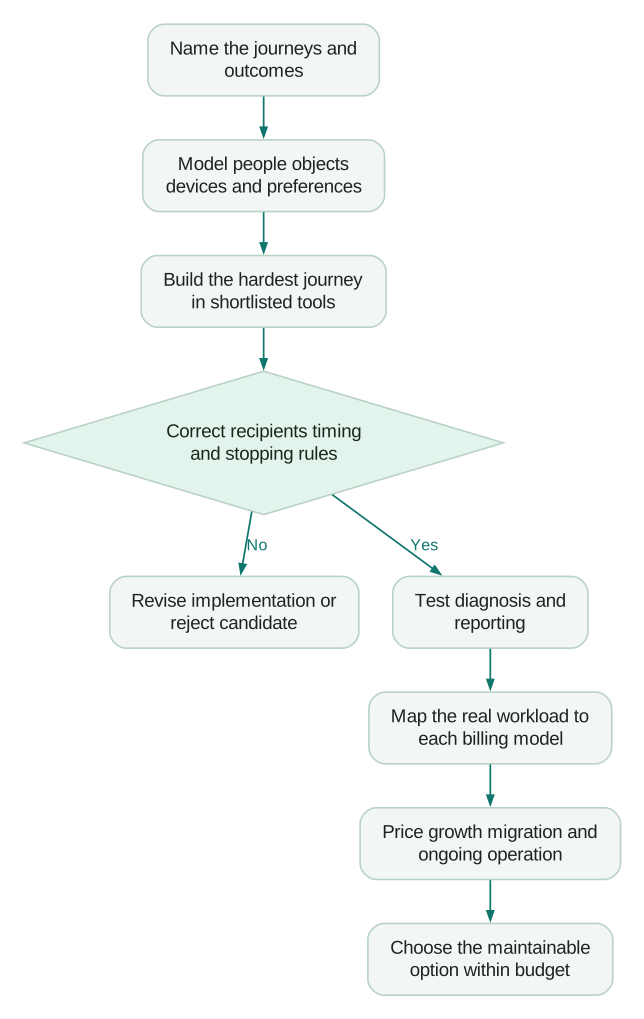
Run four acceptance tasks before signing
Ask the person who will maintain the journeys to run these tasks with representative test records. Keep the result and implementation effort for each candidate.
1. Build the journey that is hardest to express
For SaaS, use the two-workspace owner reminder. For commerce, use a checkout recovery journey that stops after a qualifying order and handles a refund separately. For an app, include a person using two devices and a channel preference change.
Record required source data, transformations, trigger rules, stopping rules and custom code. The SaaS onboarding sequence guide provides concrete send and stop conditions you can adapt.
2. Prove that preferences survive the whole journey
Change a topic preference while a message waits. Test an unsubscribe, a hard bounce and an address change. Verify how marketing and necessary service messages are handled.
For example, Klaviyo requires approval for transactional classification in supported flows on paid accounts. Some suppressed profiles can receive approved transactional email, while bounce- and complaint-related exclusions still apply. Do not treat a label you add to the copy as the platform's approval or a legal classification. Klaviyo transactional messages.
Use your real message categories. A sales reminder does not become transactional because the recipient already has an account.
3. Diagnose a message that did not send
Give the operator a record that should appear eligible but has stale data, a missing relationship or a suppression. Ask them to identify the cause using the available logs and profile history.
Measure the work needed to explain the outcome. “The journey looks correct” will not help the person responsible for a failed renewal reminder next month.
4. Export enough evidence to measure the outcome
Check whether the required delivery, suppression, conversion and experiment data can reach your reporting system on the proposed tier. Define the event that establishes success outside the messaging platform.
A reminder's attributed conversion count can be useful operationally. It does not prove that sending the reminder caused additional activation. The incrementality and attribution guide explains how to separate those questions.
Include the work that the subscription does not cover
Estimate implementation and migration separately from recurring software cost. Include source events, account relationships, template rebuilding, suppression imports, domain setup, mobile SDK releases, testing and the overlap period with the old platform.
Then estimate ongoing ownership: who changes an event definition, fixes a broken data feed, investigates a send failure and updates a message when product behaviour changes?
Suppose one fictional option saves $300 monthly in software but requires six additional engineering hours each month. At an internal planning rate of $100 per hour, that is $600 of capacity for a $300 invoice saving. The difference is $300 monthly in the other direction. This does not mean payroll will fall if you choose the easier tool; it means the team's scarce time has another use.
Use a base case, a growth case and a seasonal peak. Keep the same assumptions for every candidate, including message frequency and channel mix. Otherwise, the lowest estimate may simply be the one with the least complete workload.
Treat startup programmes as temporary economics
Customer.io's current Startup Program offers eligible new customers up to 12 months and 30,000 profiles at no cost. Published requirements include less than $10 million raised, lists obtained through standard methods rather than purchased, and no current or previous Customer.io customer relationship. Acceptance and the free term depend on eligibility. Customer.io Startup Program.
Model the first paid year before applying. Ask about channel costs, allowances and the graduation offer rather than assuming every component remains free. A credit can make implementation affordable; it should not hide an unaffordable production design.
For contract-based alternatives, request any applicable startup or trial terms alongside the regular quote. Keep temporary incentives separate from recurring cost and avoid assigning a discount until it is actually offered.
Decision checklist
- The top journeys have clear recipients, triggering events, stopping rules and business outcomes.
- The data model handles accounts, multiple memberships and devices where needed.
- Billable counts use each vendor's definition, including objects, suppressions and activity windows.
- The hardest journey has passed a representative implementation test.
- Preferences, bounces and transactional-message requirements are covered.
- The operator can diagnose missing or incorrect sends.
- Reporting and export requirements are included in the quoted tier.
- Base, growth and peak workloads include channel usage and add-ons.
- Migration effort, overlap and ongoing ownership are budgeted separately.
- Startup incentives and the first paid year are both documented.
Choose the candidate that passes the required behaviour with an operating cost your team can sustain. Keep a cheaper tool on the shortlist if it solves the problem; reject an expensive one if its additional features do not change your work.
If the evaluation keeps stalling on event quality, account identity or journey design, our CRM and lifecycle work can help define and implement those foundations. A useful engagement starts with the journeys and acceptance tasks above, so the resulting system has a clear job to do.
Questions people ask
Is Customer.io better than Klaviyo for SaaS?
It is a strong candidate when account relationships and product activity drive messages. Klaviyo can also support custom data and objects. Test the specific account-level journey, plan limits, data updates and maintenance work before deciding. Industry labels alone are insufficient.
Which platform is cheaper?
The answer depends on billable profiles, objects, devices, message volume, feature tier and contract terms. Calculate the same workload under each model, then include implementation and ongoing operating effort. Starting prices do not describe a production system.
Does suppressing email in Klaviyo delete the profile?
No. Klaviyo retains suppressed email profiles while excluding them from marketing email and the email plan's active-profile count. Review the exact operation before applying something called suppression in another platform; the term is not a universal data-retention guarantee. Klaviyo email suppression.
Should I use a CRM instead of a lifecycle messaging platform?
Start with the job. Lead ownership, pipeline stages and sales handoffs require a different evaluation from product-triggered onboarding or mobile engagement. The CRM selection guide helps define that first decision. If two tools are needed, make field ownership and preferences consistent across them.
Is a free or startup plan enough to evaluate a platform?
It can validate part of the workflow, provided the required features are included. Record anything the evaluation cannot test, especially production volume, paid-tier objects, exports, support and channel costs. Confirm those gaps before treating the trial as proof of fit.
Sources
- Customer.io: objects and relationships in automations
- Klaviyo: getting started with custom objects
- Klaviyo: custom objects in flows
- Klaviyo: Shopify integration setup
- Customer.io: how billing works
- Customer.io: public pricing
- Klaviyo: active profile management
- Klaviyo: billing products and arrangements
- Klaviyo: public pricing
- Braze: pricing and packaging
- Iterable: usage and billing
- OneSignal: channel pricing and billing definitions
- Klaviyo: transactional messages
- Customer.io: Startup Program
- Klaviyo: suppressed email profiles
Written by
Jafrin Akter AloData Engineer and Co-founder, martechdevs
Jafrin Akter Alo is a data engineer and co-founder of martechdevs, where the team has delivered 74+ martech, data and growth stack implementations.