
AppsFlyer vs Adjust vs Branch for a Small App Team
Data Engineer and Co-founder, martechdevs
Last updated 11 min read
Choose a mobile measurement partner around the campaigns, customer journeys and reporting you need to operate. AppsFlyer, Adjust and Branch can each belong on a small team's shortlist. The useful comparison is whether the proposed plan handles your actual workload, what happens after its introductory allowance, and how much engineering work remains yours.
Last updated: 15 September 2026.
Decide whether you need an MMP yet
An MMP, or mobile measurement partner, helps connect app acquisition and subsequent activity to marketing sources. Buying one is easier to justify when you advertise across networks, need a consistent attribution view, or must return reliable conversion signals to partners.
Start with the decision that is currently difficult. “We cannot compare acquisition cost per retained subscriber across our two paid channels” is a measurement problem. “Our invitation link opens the home screen instead of the invited workspace” is a routing problem. You might need both capabilities, but they deserve separate acceptance tests.
If nearly all acquisition is organic and your immediate question concerns onboarding drop-off, prioritize dependable product events and subscription records. An attribution subscription cannot define activation for you. Our product analytics setup guide covers that foundation.
Likewise, attributed revenue is not proof that an advertisement caused the purchase. Use attribution for an explicitly defined allocation of credit; use a suitable experiment when the decision depends on incremental impact.
Build the shortlist around the constraint
Evaluate AppsFlyer when you want to assess its attribution, OneLink journeys and export options together, and can model conversion charges after the introductory period. Make the required reporting and linking features part of the commercial scope.
Evaluate Adjust when its introductory Base allowance matches your early workload, or you need to assess a quoted package against the exact networks and export process you use. Do not mistake the lack of a public paid rate card for the absence of a free starting option.
Evaluate Branch when link management and app journeys are central to the purchase, alongside attribution. Its entry plan can be accessible, but partner limits, automated exports and branded domains can change which package actually fits.
These are evaluation paths, not results from a hands-on benchmark. None establishes that one vendor is universally more accurate or easier to maintain. Use the same workload and acceptance criteria for every candidate.
Compare ongoing cost, not the free starting point
Public prices below were checked on 15 September 2026. They are starting inputs for a budget, not a quote. Taxes, negotiated terms, additional products and platform-specific billing can change the invoice.
AppsFlyer: a finite welcome allowance
AppsFlyer's pricing lists 12,000 free conversions in the first year under Welcome and a Growth rate of $0.07 per conversion afterward. Zero is aimed at owned media rather than paid acquisition measurement. For an illustrative month entirely outside the allowance, 1,000 billable Growth conversions at that rate cost $70; 20,000 cost $1,400 before other charges.
The account and billing documentation makes the expiry rule explicit: Welcome ends after the allowance is consumed or one year passes, whichever comes first. It also distinguishes billing units and add-ons. Do not interpret every app download as a billable conversion or assume every platform and contract uses the headline rate.
Ask for a sample usage report with the event types that contribute to your bill. Forecast when the introductory allowance runs out, then put the first normal month beside the launch month. A low launch invoice says little about steady-state affordability.
Adjust: the free Base offer is official
Adjust's pricing page publishes a free Base offer with up to 1,500 monthly attributions for up to 12 months. Its FAQ describes access to Core features and English-language email support during that offer. Paid packages require a quote; the page does not provide a dollar rate that supports a like-for-like paid forecast.
A business with 1,000 qualifying attributions per month may fit the stated volume allowance during the introductory period. A business with 20,000 cannot budget from that allowance. Ask what happens when either the monthly threshold or the time limit is reached, including billing, continued data collection and required plan changes.
Get the chargeable attribution definition, treatment of reinstalls and reattribution, and any minimum commitment in writing. Your forecast needs the contracted meter, not a total copied from an unrelated install chart.
Branch: low entry price, several separate limits
Branch Intro is $39 per month with 5,000 volume credits, 500 web links/custom QR codes under a shared cap, and 25,000 tracked clicks. It covers one app and one ad partner with three postbacks. Exports are manual; API exports require an eligible higher plan. A custom branded domain requires Activation Basics.
Intro overages are $0.05 per additional volume credit, $0.05 per additional link/QR code and $0.01 per additional tracked click. At 20,000 volume credits, with the other allowances unexceeded, the illustration is $39 + $750 = $789. That is not a price for 20,000 installs.
Branch's usage explanation defines volume credits around tracked, attributed and reported end-user actions. Ask which actions your implementation produces and how they are counted. A user returning through links can generate a different workload from a newly acquired installer.
The Intro FAQ says overages are not capped. It also describes the trial-to-paid transition. Assign a billing owner and review the chosen subscription before the trial ends; a feature demonstration is not proof that every demonstrated capability belongs to the entry plan.
Give every vendor the same workload
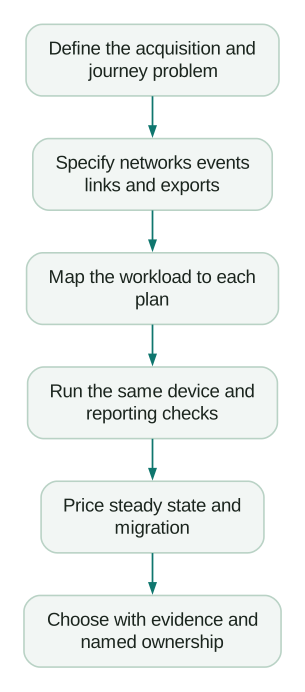
Send a one-page forecast with current, expected and high-growth volumes. Include iOS and Android apps separately, paid networks, organic installs, re-engagement activity, links created, tracked clicks, and required reporting destinations.
Separate estimates from measurements. If you know paid installs but have never counted deferred-link opens, mark that input unknown and measure it during evaluation. Do not fill the blank with installs simply because the number is available.
For each quoted package, record the included quantity, the overage unit, feature access, reporting retention and contract period. Then ask the vendor to explain a sample invoice using your workload. This catches incompatible assumptions earlier than a procurement negotiation over a headline discount.
A useful sensitivity check changes one input at a time. Double paid conversions, then double returning-user link activity, then add a second ad network. Different changes can trigger different costs or force a different plan. Your likely growth path matters more than a single neat monthly total.
Also estimate internal ownership. In an original planning example, eight engineering hours at an internal capacity value of $90 per hour represent $720 of effort per month. That is not necessarily an additional cash payment. Keep staff capacity, subscription charges and one-time migration spending visible separately.
Apple attribution needs an implementation demonstration
A checkbox saying “SKAN supported” is insufficient evidence for your current iOS acquisition paths.
Apple describes AdAttributionKit as privacy-preserving campaign attribution using signed postbacks, with limited information and support that varies by operating-system version and interaction. This is not a promise of a named user and complete purchase history for every ad exposure.
Give the candidate your operating-system mix and actual networks. Ask it to show the SDK configuration, required postback endpoints, conversion mapping and report for each relevant path. Include install attribution and re-engagement separately. Require the implementation owner to explain what remains unknown when privacy conditions reduce the reported detail.
One concrete example is Apple Ads. AppsFlyer's current Apple Ads bulletin distinguishes AdAttributionKit on iOS 26.2 and later from earlier SKAN reporting, and calls for the appropriate postback-copy configuration. Branch's Apple Ads update also describes AdAttributionKit setup and plan requirements.
Use those specifics to ask better questions; they do not prove that another vendor lacks support. Some older vendor pages retain earlier implementation advice. Resolve conflicting documentation against the current SDK, network integration and written support response for the proposed deployment.
Keep Apple's aggregated attribution separate from user-level event records. Do not add two overlapping reporting views as if they represented different customers. Our mobile app attribution guide explains the measurement design behind that distinction.
Test deep links as customer journeys
Firebase Dynamic Links reached its shutdown date on 25 August 2025. A migration plan written as though that deadline is still ahead is already wrong. Inventory old links in email templates, QR codes, paid ads, referral flows and support instructions before selecting a replacement.
AppsFlyer's OneLink onboarding guide covers redirection and deep linking, while distinguishing basic free capabilities from features requiring a paid plan. Adjust documents TrueLink as its deep-linking solution with package-specific capabilities. Branch includes deep and deferred linking in Intro, subject to the separate plan limits described above.
Do not stop at “the link opens the app.” Test the destination and the state carried into it:
- An installed, signed-in customer reaches the intended item or workspace.
- An installed, signed-out customer authenticates and still reaches that destination.
- A new customer goes through the store and first launch, with the expected deferred behavior where supported.
- An unavailable item or expired invitation produces a useful fallback.
- A customer opening a shared link cannot access another person's private resource.
- A desktop visitor receives an appropriate web destination rather than a broken mobile path.
Repeat the applicable cases on supported iOS and Android versions and the browsers or in-app browsers your audience actually uses. Record outcomes by environment. A successful test on one phone is not evidence for every combination.
Separate routing parameters from authorization. An invitation identifier can help the application find a resource, but the application must decide whether the signed-in person may access it. Keep secrets and personal information out of shareable URLs.
If you own the link domain, establish who controls its DNS, associated-domain files, redirects and future migration. If you do not, document which links will remain dependent on the provider. An inexpensive subscription can leave a costly replacement job scattered across years of campaigns.
Check the warehouse path before signing
Ask for a real sample export and its schema, delivery schedule, retention and network restrictions. “Raw data available” is not enough to establish whether the records support your finance reconciliation or retention analysis.
AppsFlyer Data Locker documents cloud destinations including BigQuery and Snowflake. Its Snowflake share has a currently documented 14-day availability period, so retaining history requires loading it into your own tables. Confirm entitlement and the operational work required for the destination you choose.
Adjust's cloud storage setup describes destinations including Amazon S3, Google Cloud Storage, Azure and SFTP. A delivered file still needs ingestion, validation and a maintained business model. For Branch, distinguish a manual export from the automated interfaces included in an eligible package.
Create separate models for first-party product events, commercial transactions and permitted attribution outputs. Preserve event time, receipt time, currency and refund treatment. An attributed purchase amount should not silently become the finance team's definition of collected revenue.
For an export trial, reconcile a small known set of transactions from the authoritative transaction system through the destination. Record missing, duplicate, delayed and restricted records separately. A perfect total can hide offsetting errors, so inspect identifiers and amounts as well as sums.
The marketing data warehouse guide explains how to connect those sources without forcing every system into one unreliable customer record.
AI access is useful after the underlying reports work
AppsFlyer MCP is currently beta. Its documented capabilities include retrieving performance information and creating OneLink links. Do not assume that connecting an assistant is necessarily a read-only operation; check authentication, permissions and the tools exposed.
Adjust MCP is in Early Access and requires package access. It exposes aggregated data, with reasoning performed in the customer's chosen AI environment. A comparison claiming Adjust has no MCP offering is outdated.
Evaluate the exact task: can the assistant reproduce an approved report with the same dates, filters and attribution rules? Require it to show those inputs. Conversational access cannot repair an incorrect conversion mapping or turn limited aggregate data into customer-level certainty.
Make the pilot produce a purchase decision
Select two important acquisition paths and one difficult link journey. Include a real business outcome, such as a valid paid subscription, rather than testing only install counts.
For each candidate, require a demonstrated path from acquisition signal to report, destination event mapping and export. Use a test environment where possible and label test records. Account for expected reporting delays before declaring data missing. Do not run conflicting production SDK setups merely to create a comparison.
Write down each defect with its owner and consequence. A broken invitation destination may block launch. A report available only through a manual download may be tolerable for a short pilot but unacceptable for daily operations. Decide that before someone averages everything into a score.
Review the commercial exit at the same time. AppsFlyer's terms include a 45-day written non-renewal provision and a possible per-unit renewal increase up to 7%, subject to the order form. Use the agreement that actually applies to your purchase; do not assume a public summary overrides negotiated terms.
For every vendor, establish export access on cancellation, link continuity, deletion handling and migration ownership. Put renewal dates in the same operating calendar as SDK and reporting maintenance.
Before you commit
- The purchase solves a named acquisition or customer-journey problem.
- Every forecast uses the vendor's actual billing unit.
- Introductory and ongoing costs are shown separately.
- Required networks, app counts, domains and exports fit the selected plan.
- Apple attribution paths have current configuration evidence.
- Link tests cover authentication, installation and useful fallbacks.
- Export samples reconcile against known commercial events.
- Someone owns billing, SDK changes, reporting definitions and renewal.
- Exit requirements are documented before links and reports depend on the vendor.
If the difficult part is connecting app behavior, attribution and paid customer outcomes, our product analytics work can help define and implement that measurement foundation. Bring the unresolved decision and a sample journey; those are more useful starting points than a preferred vendor logo.
Questions people ask
Is AppsFlyer or Adjust better for a small app?
Use the plan that passes your required campaign, link and reporting tests at an affordable ongoing cost. Compare actual billing units and post-introductory terms. A small install count alone does not reveal the number of partners, returning-user journeys or automated exports you need.
Is Adjust Base free forever?
The published offer is limited by both monthly volume and a period of up to 12 months. Confirm the transition conditions for your account before relying on it for a long-term budget.
Is Branch Intro a full replacement for a larger attribution package?
Only if its capabilities and limits fit your workload. Check partner access, automated exports, domains and usage charges against the specific implementation. A low base subscription is not evidence of equivalent scope.
Does an MMP restore complete iOS user-level attribution?
No. Apple attribution frameworks deliberately limit reported information. An MMP can help implement and organize the available signals, but its presence does not remove platform privacy boundaries or prove that every attributed conversion was caused by advertising.
Should deep linking or attribution drive the choice?
Start with whichever failure is costing customers or preventing a meaningful decision. Evaluate the other requirement separately. A successful campaign report does not prove that a customer reaches the correct screen, and a working link does not establish trustworthy acquisition economics.
Sources
- AppsFlyer pricing
- AppsFlyer account management and billing
- Adjust pricing
- Branch Intro plan
- Branch usage
- Branch Intro FAQs
- Apple ad attribution
- AppsFlyer Apple Ads attribution bulletin
- Branch Apple Ads and AdAttributionKit
- Firebase Dynamic Links shutdown FAQ
- AppsFlyer OneLink onboarding
- Adjust TrueLink
- AppsFlyer Data Locker cloud setup
- Adjust cloud storage uploads setup
- AppsFlyer MCP beta
- Adjust MCP
- AppsFlyer terms of use
Written by
Jafrin Akter AloData Engineer and Co-founder, martechdevs
Jafrin Akter Alo is a data engineer and co-founder of martechdevs, where the team has delivered 74+ martech, data and growth stack implementations.