
Mixpanel vs Amplitude: choose with your data and your questions
Data Engineer and Co-founder, martechdevs
Last updated 8 min read
Mixpanel and Amplitude both provide event-based product analytics, replay, experimentation and AI access. For a small SaaS team, choose by testing the questions your team needs to answer, the account model behind them and the cost at realistic event volume. Mixpanel is a sensible first pilot for focused product analysis; Amplitude deserves equal consideration when its broader workflows fit your operating needs.
Last updated: 21 September 2026.
Two tools can show the same activation funnel and produce different numbers because one groups by person, another by account, or their conversion windows differ. A feature comparison will not reveal that problem. A shared dataset and a written question will.
Start with five questions, not a feature checklist
For a B2B SaaS product, a useful evaluation set is:
- What percentage of new workspaces reach the first meaningful result within seven days?
- Which acquisition sources produce accounts that remain active in week four?
- Where do administrators get stuck when connecting the first integration?
- Does the new onboarding experience improve activation without increasing errors?
- Which paid accounts have several users but only one active contributor?
These questions require funnels, retention, segmentation, account relationships and experimental interpretation. They also require definitions that the tool cannot infer safely from a button label.
Martechdevs' product analytics service establishes that measurement model and the instrumentation behind it. The detailed Mixpanel pricing guide and Amplitude pricing guide cover the billing decisions separately.
Use the same definitions in each pilot. Specify the population, event, entity, date range, timezone and conversion window. Let the intended users build the reports themselves after a short introduction. Vendor-led demos are useful, but they do not measure your team's ability to repeat the work.
The free plans count events, with different allowances
Mixpanel's Free plan includes one million monthly events. Amplitude's Free plan includes two million. Those allowances describe data volume, not the number of employees who can use the tool or the number of active customers your product can support. Mixpanel pricing, Amplitude pricing.
A product with 5,000 active users and 100 tracked events per user produces 500,000 events. A product with the same users and 800 events each produces four million. Autocapture settings, repeated technical events and background activity can move the bill more than customer growth does.
Calculate a normal month, a growth month and an import month. Keep session replay and other separately metered products in their own lines. Do not assume that every included product has unlimited usage because the pricing page says the platform is included.
An illustrative volume model
Suppose 8,000 monthly users generate 20 sessions each, with 15 tracked events per session:
8,000 users × 20 sessions × 15 events = 2.4 million eventsNow add 600,000 server events. The actual planning volume is three million. If browser and server tracking accidentally duplicate 300,000 actions, the invoice may reflect those events even when an analyst filters them out of a chart.
The commercial comparison must use the same three-million-event scenario, the same replay requirement and the same account-analysis requirement. A lower base price can disappear when a required capability sits in a different package.
Account analytics is a buying requirement for B2B
A company can activate even when no individual employee completes every step. One person connects the data source; another builds the first report; a third shares it. A person-level funnel can show zero completed journeys while the account has succeeded.
Send the relevant account or workspace identifier with the event. Define how events should behave when a person belongs to several accounts. Historical activity should remain associated with the account where it happened rather than moving whenever a profile's current company changes.
Mixpanel offers Group Analytics for business-level analysis; Amplitude lists group behaviour analysis in its plan comparison. Confirm the required entitlement and prove the desired account funnel during the pilot. Mixpanel Group Analytics, Amplitude plan comparison.
Use a deliberately difficult test: two people, two workspaces, one paid subscription and a user switching workspaces midway through a session. The correct result matters more than the simplicity of the first sample dashboard.
Evaluate analytical work, not just chart availability
Ask a product manager to build a funnel, change the conversion window, exclude staff and compare two cohorts. Ask a marketer to connect acquisition source to retained usage. Ask an engineer to locate the event behind an unexpected number.
Measure time to a correct answer, how often someone needs help, and whether another person can reproduce the result. A tool that feels quick for a trained analyst may be confusing for an occasional user. The reverse can also be true when advanced analysis is the main job.
Include the cost of maintaining definitions. If every dashboard has a slightly different activation rule, a friendly interface has only made inconsistency easier to spread. Assign an owner to shared events, cohorts and metrics and make the approved definition easy to find.
Do not turn subjective preference into a universal ranking. “Our lifecycle manager completed these tasks without help” is evidence. “This tool is more intuitive” without a tested audience and task is weak advice.
Warehouse connections are not all the same architecture
There are three distinct routes: collect into the analytics platform and export to a warehouse; import warehouse models into the platform; or query warehouse data through a supported native arrangement. Each has different freshness, compute, duplication and access implications.
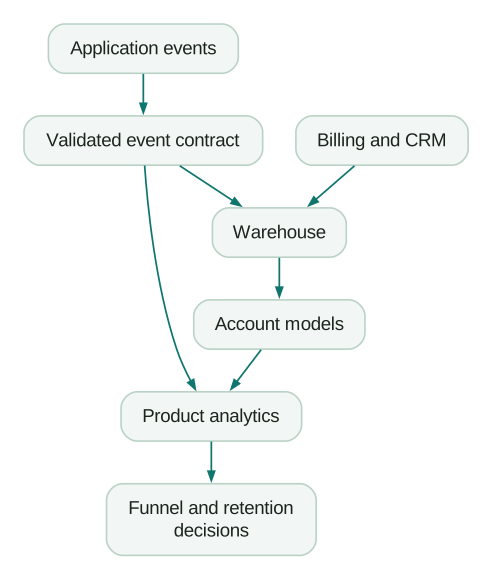
Mixpanel's warehouse connectors support importing data, including a Mirror mode that reflects changes. Amplitude documents warehouse integration patterns and separately markets Snowflake-native analysis. Ask which exact route the proposed package uses. A connector logo does not answer where a query runs. Mixpanel warehouse connectors, Amplitude common patterns, Amplitude warehouse-native offering.
Test a late-arriving event, a corrected account property and a deletion. Verify what changes in historical charts, how long the sync takes and whether the change generates additional usage. Keep authoritative subscription and revenue definitions in a controlled model, as described in data warehouse design.
Experiments need a valid assignment and exposure model
Both products now offer experimentation capabilities, so “Amplitude has experiments and Mixpanel does not” is no longer a sound comparison. The relevant questions are which experiment types, limits, integrations and analysis controls your plan supports. Mixpanel Experiments, Amplitude pricing and product coverage.
In a pilot, assign a test variant, record when the user actually encounters the changed experience, and connect that exposure to an outcome. A feature flag assignment is not always an exposure. Someone can be assigned a variant and never visit the affected screen.
For team products, decide whether assignment belongs to a person or account. Users in the same workspace should not receive incompatible experiences merely because the SDK randomises independently by user ID.
Inspect guardrail metrics and uncertainty. An activation increase accompanied by more failed connections may not be a product improvement. A small positive difference in a small sample should remain an uncertain result rather than becoming a launch claim.
Replay is a diagnostic sample
Use replay to investigate why a measured failure happens: a form resets, a button is hidden, or an error gives no recovery path. It complements the event data by showing interaction context.
Check which sessions are captured, the sampling policy, retention and masking. A replay allowance does not mean every failure will have a recording. Build a test that includes a sensitive field and verify its treatment before enabling recording broadly.
When an analyst watches five frustrating sessions, they have found a plausible mechanism. They have not measured its prevalence. Return to events or a targeted measurement to estimate how many customers are affected.
AI and MCP make permissions more important
Both platforms expose analytics through MCP. Mixpanel's current policy says MCP is enabled by default on Free and Growth and disabled by default on Enterprise. Amplitude enables it by default and provides organisational and role-based controls. The defaults are not identical across every plan. Mixpanel AI policy, Amplitude MCP documentation.
Evaluate AI with a question whose answer you already know. Require the agent to state the project, date range, population, filters and metric definition. Then deliberately ask an ambiguous question such as “Which customers are most engaged?” A useful response should clarify the definition or state a defensible assumption.
Separate reading data from changing charts, cohorts or taxonomy. Amplitude's MCP includes write capabilities, and the client receives the authority of the connected identity within the configured controls. A connection that succeeds is not proof that its scope is appropriate.
The MCP security checklist provides a broader review. Good context and permissions matter more than whether the first natural-language chart looks impressive.
How I would choose for a 10 to 50 person SaaS team
For a team whose immediate job is answering activation, retention and feature-use questions, I would begin with a small Mixpanel pilot and a clearly priced account-analysis requirement. Its focused evaluation can be quick when the event model is already sound.
I would run Amplitude alongside it when experimentation, broader customer-experience workflows or its startup programme could change the decision. The free allowance is larger, but the long-term choice should survive the end of a promotional year.
Choose the tool that lets the people responsible for decisions answer the agreed questions correctly, with acceptable governance and a credible year-two cost. If neither tool produces trustworthy results, fix the data model before extending the procurement exercise.
Pilot checklist
- Five business questions have explicit definitions.
- Both tools receive equivalent data and identity rules.
- Account-level funnels are tested with multiple users.
- Staff, bots and test environments are handled consistently.
- Normal volume, growth and backfills are priced separately.
- Replay capture and masking are verified.
- Experiment exposure and assignment are distinct.
- Warehouse updates and deletions are tested.
- AI answers expose their assumptions and query scope.
- The budget includes the period after startup benefits expire.
At Martechdevs, we build product tracking around useful events, dependable identity and questions the team can act on. Start with the free martech AI audit, or explore an AI assistant built around your approved workflows.
Questions people ask
Which is cheaper, Mixpanel or Amplitude?
It depends on billable volume, required features and the contract. Compare the same events, account analytics, replay, exports and access controls. Amplitude's larger free event allowance does not establish the price of a paid implementation.
Should we compare PostHog or Heap as well?
Include another product when it addresses a concrete requirement your shortlist does not resolve. Run the same identity, funnel and operational tests. Expanding the comparison without a clear decision criterion creates more demos without improving the choice.
Which is easier for non-analysts?
Test your actual users. Give them a written question and observe whether they produce a correct, reproducible answer without assistance. Familiarity, event naming and the quality of shared definitions often matter as much as the interface.
What do Reddit discussions recommend?
There is no reliable universal Reddit verdict. Posts mix different plans, company sizes and implementation quality. Use anecdotes to identify questions about support, billing or usability, then test those questions against your own data and current vendor terms.
Can we replace GA4 with either tool?
They can cover many product behaviour questions, but replacing GA4 requires reviewing acquisition reporting, advertising integrations and existing measurement dependencies. A product analytics decision and a marketing attribution decision may need different acceptance criteria.
Sources
- Mixpanel pricing. Accessed 21 September 2026.
- Amplitude pricing. Accessed 21 September 2026.
- Mixpanel billing and Group Analytics. Accessed 21 September 2026.
- Mixpanel warehouse connectors. Accessed 21 September 2026.
- Amplitude integration patterns. Accessed 21 September 2026.
- Amplitude warehouse-native offering. Accessed 21 September 2026.
- Mixpanel experiments. Accessed 21 September 2026.
- Mixpanel AI policy. Accessed 21 September 2026.
- Amplitude MCP. Accessed 21 September 2026.
Written by
Jafrin Akter AloData Engineer and Co-founder, martechdevs
Jafrin Akter Alo is a data engineer and co-founder of martechdevs, where the team has delivered 74+ martech, data and growth stack implementations.