
Hightouch vs Census, now Fivetran Activations: pricing and migration decisions
Data Engineer and Co-founder, martechdevs
Last updated 12 min read
Choose between Hightouch and Fivetran Activations by pricing the same working syncs and testing the same destination outcomes. If you already use Census, inspect your migration status first. A changed billing model, an expired storage feature or an outdated network allowlist can matter more than the differences in a product demo.
Last updated: 14 September 2026.
What happened to Census?
Census's reverse ETL capabilities are now part of Fivetran Activations, which moves warehouse or lake data into operational destinations such as CRM and marketing tools. Fivetran Activations FAQ
That makes this a comparison between Hightouch and the current Fivetran offering. Old Census destination-based quotes and plan names can still matter to an existing contract, but they are a poor starting point for a new purchase.
Hightouch offers a free Basic Reverse ETL entry point alongside broader Composable CDP and Agentic Marketing Platform products. Those broader packages are separate buying decisions; a warehouse-to-CRM sync does not automatically require the full platform. Hightouch pricing
Both products deserve evaluation against your actual workflow. For the underlying design questions, including identity, field ownership and audience exits, read the reverse ETL implementation guide.
Existing Census customers: check these changes first
Fivetran's migration FAQ says month-to-month Census plans ended in March 2026. Paid annual Census contracts continue through their individual end dates, then move to Fivetran's MAR pricing. Select the successor plan before expiry; the FAQ says an account without a selected plan may be frozen. Census migration FAQ
Record your actual contract end date, current entitlements and next billing arrangement. Do not assume a colleague's migration date applies to your account.
Census Store's published shutdown date was 1 August 2026, after datasets became read-only on 1 July. The announcement covers CSV Datasets, Mesh Datasets and Iceberg catalog access, including deletion of data in Census-managed S3 buckets. These dates have already passed. Census Store retirement announcement
If a workflow depended on those features, verify its replacement source and recovery records now. An old CSV tutorial remaining online does not establish that the retired storage service remains usable. Do not assume deleted data can be recovered.
The migration also changes outbound IP addresses and relevant cloud IAM identities. Fivetran instructs affected customers to add its new network access alongside legacy access during transition. Its FAQ now describes a move toward source-based access controls and API changes, with some deprecation dates still unconfirmed. Census migration and networking details
Inventory network rules, orchestrators, API integrations and permissions against the account's current notices. Validate connectivity and permissions before removing legacy access. Recheck exact addresses in the maintained documentation instead of copying a static IP list from a comparison article.
Treat commercial migration and technical migration as separate tasks. A paid invoice does not prove that a scheduled sync still runs, and a successful sync does not prove that next month's rate is understood.
How Hightouch pricing works
The free tier is limited by active syncs
Hightouch's self-serve documentation lists two active syncs on Free and ten on the Self-serve plan. Both have hourly sync frequency, one workspace per organisation and a cap of 100 million operations per month. A sync that ran successfully during the month still counts if you later disable or delete it. Hightouch self-serve limits
Count distinct syncs, not just destination vendors. Updating HubSpot contacts and HubSpot companies generally means separate sync definitions. So does delivering the same audience to separate destination objects or lists.
The published free allowance is useful for testing one or two narrow workflows. It does not establish that visual audience creation, advanced governance or every observability feature is included. Check those requirements before designing your rollout around a zero-dollar platform bill.
Paid pricing needs a scoped quote
Hightouch's Business documentation describes a platform fee, potentially including consumption based on active syncs, plus optional features. It does not publish a universal Business dollar rate. Hightouch Business pricing
Its pricing explanation distinguishes Monthly Active Syncs, collected events and AI actions for the relevant modules. Frequency and row volume do not change the Monthly Active Sync count, although committed tiers and operational limits still matter. Hightouch's pricing explanation
Ask for the baseline fee, included units, overage rates, renewal terms and the definition of an active unit. Include development syncs, seasonal campaigns and journeys in the discussion. Do not multiply an old advertised destination price by today's destination count and call it a quote.
A team running a few large syncs and a team running many tiny audiences can have the same total customer population and very different commercial needs.
How Fivetran Activations pricing works
Fivetran's Free plan includes up to 3,500 activation MAR per month. That allowance is separate from the Free plan's connection and transformation limits. Fivetran plans and billing
MAR means Monthly Active Rows. For Activations, usage follows the configured sync or matching key, with keys counted separately by activation sync. Repeated changes to a counted key in that scope during the month do not create another MAR. Fivetran usage-based pricing
Usage is priced per activation, which groups syncs between a source and destination. Activations has its own consumption curve and a 14-day trial for each new activation. Fivetran activation pricing
The consequence is practical: a customer sent through several syncs is not necessarily billed once across your entire company. Group usage by the actual configured sync and activation before estimating cost.
Use the Activations pricing estimator with the correct plan and source-destination arrangement. Do not apply an ingestion connector's MAR price to activation usage. The Fivetran pricing guide explains how the wider bill separates connections, activations and transformations.
Also separate initial loading from steady-state changes. A trial full of setup work is not a clean forecast for an ordinary month, while a quiet test week can miss a seasonal audience rebuild. Confirm which usage is chargeable under your account terms before annualising a trial estimate.
Compare the same workload before comparing a monthly bill
The following are illustrative steady-state inputs, not vendor quotes. Assume each listed sync has stable keys, the listed records generate qualifying usage in the month, and no other syncs contribute usage.
Two large syncs
A CRM profile sync activates 50,000 distinct keys. A lifecycle profile sync activates the same 50,000 people in another destination.
That is two active syncs for Hightouch. Under Fivetran's separate sync-key scope, it represents 100,000 activation MAR across the two paths. The overlap in people does not reduce the sum to 50,000.
Hightouch's two-sync allowance makes its free tier worth checking for this shape of workload, provided the required features, cadence and operation volume fit. Fivetran's 3,500-MAR free allowance would not cover this steady-state usage. That still does not tell you the paid price or the total operating cost.
Eight small syncs
Eight separate syncs each activate 250 keys during the month. The total is 2,000 activation MAR. Even if the people overlap across syncs, the separate sync scopes remain part of the calculation.
The Hightouch Free sync limit is insufficient. The Fivetran Free activation allowance could fit the volume, provided the account's other usage and required features also fit that plan. This is why “our database has only a few hundred customers” is not enough information to select a vendor.
A third workflow pushes the small account over the free limit
Two workflows activate 2,000 and 1,000 keys respectively, totalling 3,000. Add a third workflow with 800 qualifying keys and the account reaches 3,800 activation MAR.
That exceeds 3,500 by 300, but do not assume the paid invoice charges only those 300. A free-plan eligibility threshold is not automatically a credit against a paid plan. Check the applicable paid rate and treatment in the account estimate.
Build your own workload sheet with one row per sync:
sync,source,destination,object,monthly_distinct_active_keys,required_interval_minutes
account_signal,warehouse_prod,crm_prod,company,2000,60
lifecycle_status,warehouse_prod,lifecycle_prod,person,1000,60
renewal_queue,warehouse_prod,crm_prod,task,800,1440
These are planning fields, not a configuration file for either vendor. In this example, the two CRM operations share a source-destination pair but remain separate syncs. Group them correctly when requesting an activation estimate.
Avoid mapping a changing run timestamp into every destination row unless the workflow needs it. A field that changes every run can make otherwise stable rows appear changed, increasing writes and potentially the set of active keys. Keep operational freshness available through monitoring or deliberately designed destination fields.
Compare the features your users will actually operate
Marketing audience creation
Hightouch Customer Studio provides visual audience creation and journeys over warehouse data; its documentation limits Customer Studio to Business plans. Fivetran Audience Hub also offers visual segmentation and related-data conditions, and its documentation lists Enterprise availability. Hightouch Customer Studio, Fivetran Audience Hub
Do not compare a free SQL sync in one product with an enterprise marketing workspace in the other.
Give the marketer who will own the workflow a realistic task: find accounts with three active users, no completed setup milestone and a renewal in thirty days. Ask them to explain the result, inspect exclusions and change one condition. Observe where they need a data engineer and whether the prepared schema expresses the business correctly.
An easy interface cannot correct an account model that counts every event as a different customer. Settle the identity resolution contract before scoring either builder.
Destination semantics
Hightouch's HubSpot connector exposes choices for sending nulls, skipping nulls and writing only to empty fields. It also distinguishes clearing mapped fields, archiving records and permanent contact deletion where the selected mode supports them. Hightouch HubSpot connector
Fivetran Activations documents update, create, upsert, mirror and other behaviours, with availability depending on the destination. Removing a field mapping stops updates but does not clear existing destination values. Fivetran sync behaviour
Use these details to test the exact object and operation. “Supports HubSpot” is not an acceptance criterion. A CRM enrichment should preserve sales-owned notes; an audience exit should not accidentally delete the customer's CRM record.
Scheduling and freshness
Hightouch supports scheduled and orchestrator-triggered syncs, including Fivetran and dbt Cloud scheduling paths. Fivetran Activations also supports dependencies on upstream connections, transformations and activation syncs. Hightouch sync overview, Fivetran scheduling
Buying ingestion and activation from one vendor may simplify administration, but it is not the only way to coordinate them. Test the available scheduling features on the plan you would buy.
Measure freshness from the original source change to the correct destination state. A fifteen-minute schedule says nothing about an upstream model that is twelve hours old. If the use case needs a response in seconds, evaluate the specific real-time path separately from this batch reverse ETL comparison.
Observability and recovery
Hightouch documents warehouse sync logs as a Business-tier feature. Fivetran's Sync Tracking documentation describes row-level results with a 14-day viewing window and an option to retain tracking data in your own bucket. Hightouch sync logs, Fivetran Sync Tracking
Ask the operator to find one rejected customer, explain the error and repair it. Compare the time and permissions required. Long-term evidence retention matters if a customer raises an issue after the built-in viewing window closes.
A green run can still contain a result the business did not intend. Verify important fields in the destination and check whether another integration overwrote them afterward.
Run a pilot that can disqualify either product
Start with a small controlled dataset and a test destination. Keep the expected results independent of either vendor's sync log.
Test a new record, an existing record, an unchanged record, a changed field, a null, an audience exit and a destination rejection. Add a shared or missing identifier case. These transitions reveal more than a large first upload.
Use a written acceptance contract such as this illustrative CRM pilot:
pilot: warehouse_account_signal
entity: account
source_key: account_id
destination_match: existing_company_id
write_policy: update_existing_only
protected_fields:
  - company_owner
  - sales_notes
required_cases:
  - valid_update
  - unchanged_record
  - unknown_value
  - explicit_signal_removal
  - missing_destination_key
  - destination_rejection
  - source_outage
  - retry_after_ambiguous_response
acceptance:
  unexpected_record_creation: 0
  protected_field_changes: 0
  unresolved_failures_have_owner: true
  destination_readback_required: true
This specifies what to configure and test; it is not executable vendor configuration. Define the allowed age of each signal separately and measure it through the whole delivery path.
The review should produce a destination comparison, an exception list, observed operating effort and a usage estimate. Do not turn a vendor demo into a claim that the production integration has passed these cases.
Staying or switching needs a first-year calculation
For an existing Census customer, retaining working models and mappings can have real value. For a team whose workflows no longer fit the product or commercial terms, that history is not a reason to keep paying indefinitely.
Use a first-year comparison that includes platform charges, warehouse compute, monitoring, implementation and migration overlap. Separate internal capacity cost from cash expenditure.
For an illustrative decision, a replacement's all-in steady-state cost is $400 per month lower. Migration takes 50 internal hours valued at $80 per hour, and parallel operation adds $800. The transition cost is $4,800, so the cost-only break-even is twelve months.
If the actual saving is $200 per month, break-even becomes twenty-four months. Neither figure includes uncertain revenue improvements. If migration fixes a material reliability problem, document that benefit separately rather than inventing a revenue multiplier.
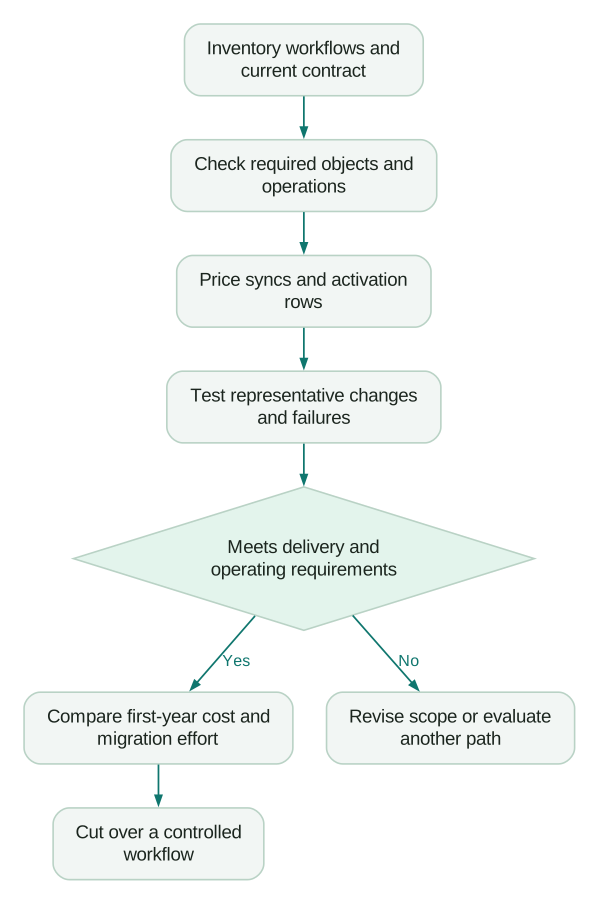
For a new implementation, test one small workflow in each shortlisted product before committing to a broader package. For a migration, compare models and proposed outputs first, then cut over a limited scope. Avoid two tools writing competing values into the same production fields during the comparison.
When an alternative is more appropriate
If your existing CDP already has the required warehouse-to-destination operation, include it in the evaluation before adding another platform. Confirm the exact plan and connector rather than assuming an installed product makes the marginal work free.
A small maintained integration can make sense for one stable operation with clear ownership, monitoring and recovery. Its attraction disappears when every new destination requires another bespoke implementation and nobody owns the exceptions.
If the destination can use the warehouse data through a supported direct connection without copying it into operational fields, test that route against the same business action. A dashboard query alone cannot replace an audience membership or CRM workflow trigger.
Choose Hightouch when its sync-based commercial shape and required marketing capabilities fit your tested workload. Choose Fivetran Activations when its MAR economics, operational capabilities and existing platform relationship fit better. Stay open to either outcome until the pilot and scoped commercial terms agree.
Buying and migration checklist
- Record the current Census contract end date and successor plan, if applicable.
- Confirm replacement sources for any retired Census Store workflows.
- Review current network, IAM, API and access-control migration notices.
- Count individual syncs and monthly active keys in their proper scopes.
- Quote the exact audience, logging, support and governance features needed.
- Test matching, nulls, exits, failures and destination readback.
- Include warehouse compute, operating effort and transition overlap in cost.
- Assign one owner to approve the limited cutover and verify the result.
Our data warehouse and CDP service can help turn a vague tool comparison into a scoped pilot, with model definitions, destination behaviour and commercial assumptions you can inspect before choosing.
Questions people ask
Is Census still a separate reverse ETL product?
Its reverse ETL capabilities are now offered through Fivetran Activations. Existing customers should inspect their account's migration and contract state; the product transition does not mean every legacy configuration or commercial arrangement changes on the same day.
When does an annual Census contract move to MAR pricing?
Fivetran says paid annual Census plans continue through the current contract end date before moving to usage-based pricing. Check the account's legacy billing information and successor plan. Month-to-month Census plans ended in March 2026.
Which free plan is better for a startup?
It depends on workload shape and features. Hightouch's two-active-sync allowance can suit a small number of larger workflows. Fivetran's 3,500 activation MAR allowance can suit several small workflows. Evaluate cadence, other account usage and required entitlements before treating either as sufficient.
Does Fivetran charge again every time the same customer is updated?
Within the relevant activation-sync key scope, repeated qualifying changes during the month do not repeatedly count that key as new MAR. The same person in different syncs can contribute separately. Estimate using configured keys and scopes rather than a global customer count.
Should we migrate from Census to Hightouch because of the acquisition?
Only if the replacement better meets your requirements after accounting for commercial terms, operating effort and migration cost. First establish whether the existing implementation still works and what it will cost. Then use a limited pilot to test the alternative against the same outputs.
Sources
- Fivetran Activations FAQ
- Hightouch pricing
- Census migration FAQ
- Census Store retirement announcement
- Hightouch self-serve pricing
- Hightouch Business pricing
- Hightouch pricing explanation
- Fivetran plans and billing
- Fivetran usage-based pricing
- Hightouch Customer Studio
- Fivetran Audience Hub
- Hightouch HubSpot connector
- Fivetran sync behaviour
- Hightouch sync overview
- Fivetran scheduling
- Fivetran Sync Tracking
- Fivetran activation pricing
Written by
Jafrin Akter AloData Engineer and Co-founder, martechdevs
Jafrin Akter Alo is a data engineer and co-founder of martechdevs, where the team has delivered 74+ martech, data and growth stack implementations.