Customer.io vs Iterable: choose by data model, warehouse sync and API fit
Data Engineer and Co-founder at Martechdevs and Growth and Analytics Partners
Last updated 15 min read
Customer.io is a strong first evaluation for a SaaS team that wants account-aware messaging, published entry pricing and direct control of product events. Iterable deserves a trial when cross-channel operations and a contract buying process fit the team. The useful comparison is how each handles your identities, payment updates, scheduled data and failure cases, not which editor makes the nicest journey diagram.
Which should a SaaS team pick?
Start with Customer.io when a small lifecycle team needs to explain its data model and forecast an initial bill without a sales quote. Include Iterable when the programme has enough operational scope to justify a deeper contract and implementation evaluation. These are selection judgments, not claims that either product is restricted to one company size.
Customer.io
- Best for: A small SaaS team with explicit account relationships and event ownership.
- Pros: Published entry pricing and object-aware journeys make the first pilot easier to scope.
- Cons: Stored profiles and objects count commercially; engineering still owns identity and event quality.
- Free tier and startup offer: A limited trial and an eligible-startup free year; budget the following year separately.
- Choose it if: The operator can diagnose the two-workspace payment test without custom intervention for every failure.
- Skip it if: A required account, channel or control needs a package or workaround the team cannot maintain.
Iterable
- Best for: An established cross-channel programme with marketing operations capacity.
- Pros: Warehouse activation and configurable journeys support a detailed operating trial.
- Cons: A matched quote and project-identity design are needed before cost or migration can be judged.
- Free tier and startup offer: Confirm evaluation access; Smart Ingest's free integration capacity is not a free messaging plan.
- Choose it if: Its operators can explain the required customer decisions and the commercial proposal fits the workload.
- Skip it if: The buying and maintenance scope exceeds the programme's actual needs.
| Situation | First evaluation | Runner-up | What would change the decision? |
|---|---|---|---|
| Small SaaS team with workspace relationships | Customer.io | Iterable | Required controls or channels fail the trial |
| Established cross-channel programme | Iterable | Customer.io | Operator effort and the itemized quote |
| Events already in PostHog; few journeys | PostHog Workflows | Customer.io | Required channel maturity or governance |
| Store-led rather than product-led lifecycle | Klaviyo | Customer.io | Account-aware product journeys dominate instead |
The first trial should involve a person who belongs to two workspaces, a payment during a delay and an opt-out before sending. Lifecycle messaging implementation connects those customer decisions to their data sources and owners.
If Braze is also on the shortlist, use Customer.io versus Braze for that broader platform comparison. If orders, returns and replenishment drive the programme, examine Klaviyo compared with Customer.io. Avoid adding vendors that do not change the question you need to answer.
How do Customer.io and Iterable bill?
Customer.io publishes an entry model. Iterable requires a scoped commercial proposal; its former pricing URL currently redirects to its main site, which routes buyers to a demo. Do not convert conflicting third-party estimates into an official Iterable price. Customer.io pricing, Iterable
Checked on 17 October 2026, Customer.io Essentials starts at USD 100/month for 5,000 people-and-object profiles and one million emails. Extra profiles cost USD 0.009 and extra emails USD 0.12 per 1,000. Essentials includes two object types and excludes anonymous messages; Premium starts at USD 1,000/month billed annually with ten object types. Enterprise is negotiated. Published plans
The meter includes profiles across workspaces, including records present during the billing cycle that were later deleted. Do not treat a test workspace or end-of-month deletion as an automatic billing exclusion. Customer.io billing mechanics
Price a workload, not a contact count
Consider a fictional SaaS account with 30,000 people, 2,000 account objects and 1.4 million emails monthly. Assume the public Essentials rates apply and its features meet the requirements. The table uses rates checked on 17 October 2026 and shows monthly costs in USD.
| Component | Calculation | Monthly USD |
|---|---|---|
| Base | First 5,000 profiles | 100.00 |
| Extra profiles | 27,000 × USD 0.009 | 243.00 |
| Extra emails | 400,000 ÷ 1,000 × USD 0.12 | 48.00 |
| Illustrative subtotal | Base plus usage | 391.00 |
At unchanged usage, twelve months would total USD 4,692 before other services, paid usage and implementation. A third required object type or anonymous-message requirement can invalidate this Essentials scenario. The full Customer.io pricing breakdown explains the surrounding billing decisions.
Send Iterable the same workload and ask for each charge separately: audience capacity, email and other channels, event ingestion, warehouse sync definitions, data export, required access controls, support and renewal terms. Include a peak month and a growth scenario. Ask which limits are contractual and what happens when one is exceeded.
Customer.io's startup programme offers eligible businesses that raised under USD 10 million up to 12 months, subject to the approved term. It can change first-year cash flow, but the post-offer workload still needs a budget. Startup programme terms
Which handles real-time behavioral triggers better?
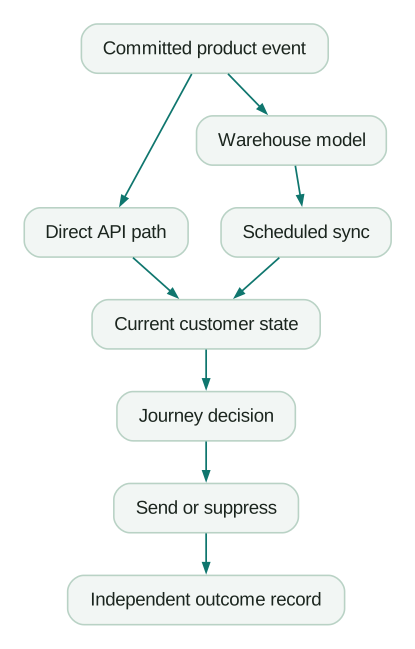
Neither a marketing claim nor a warehouse schedule establishes end-to-end latency. Trace the same event through four timestamps in both pilots.
| Timestamp | Evidence | Delay it helps explain |
|---|---|---|
| Business event occurred | Application transaction or event ledger | When the fact became true |
| Relevant state became available | Profile, object or integration record | Ingestion and processing |
| Journey decision occurred | Entry, branch or exit evidence | Orchestration evaluation |
| Message sent or suppressed | Delivery record and reason | Scheduling and permission checks |
A successful API response belongs in the evidence too, but it is not identical to a visible profile update or a delivered message. Record the acknowledgment separately if you need to investigate processing delay.
Use the same event contract, clock basis and test identities for each platform. Do not compare a direct API integration in one with an hourly warehouse export in the other and attribute the entire difference to the messaging vendor.
Preserve the account relationship
Customer.io supports objects and relationships in automations. A relationship-triggered journey can target the person associated with that trigger; a broader relationship condition can match a different account. Test the distinction with your actual workspace model. Customer.io relationship behavior
Iterable's user identity depends on the project type. Hybrid projects enforce email and user-ID uniqueness; user-ID projects permit distinct users sharing an email. This setting is chosen when the project is created and cannot simply be changed later. Iterable project types
Iterable also has Catalog for separately stored data used in send-time personalization, subject to plan access. That is not evidence that a Customer.io object-triggered workflow transfers unchanged. Require a demonstrated design for selecting the correct workspace and reading its current state. Iterable Catalog
Do not duplicate a person merely to make a difficult relationship disappear without assessing consent, frequency and reporting consequences. A design can pass the same behavioral test using different representations, provided the team can maintain it.
How does each connect to your data warehouse?
Both support warehouse-fed activation. The meaningful distinction is the complete path from a source change to the decision, including query duration and field ownership.
| Dimension | Customer.io reverse ETL | Iterable Smart Ingest |
|---|---|---|
| Fastest documented scheduled interval | One minute | Fifteen minutes |
| Scope to count | Sync query and extracted records | Configured sync definitions and their runs |
| Published capacity detail | 40 million extracted records and 300 columns per sync | Five configured production syncs in the standard free allowance |
| If the previous run is slow | An overlapping scheduled run is skipped | Measure completion and throughput for the model |
| Typical evaluation | Incremental query, identity and deduplication | Model, matching key, field mapping and schedule |
Customer.io reverse ETL supports identify, track, page, screen and group mappings. Its last_sync_time represents the previous successful sync's start. Use a suitable indexed update timestamp and test late arrivals with an overlap window and stable deduplication keys.
Iterable's Smart Ingest overview lists sources including Snowflake, BigQuery, Redshift and Databricks. It detects changed rows after the first run. The five-sync allowance concerns configurations, not five executions: each sync can run repeatedly, and a used sync deleted during the month still counts until the next month. Creating and scheduling a sync
A one-minute schedule is not a one-minute freshness guarantee. A model refreshed overnight remains old even if its output is imported every minute. Measure source occurrence, model completion, sync completion and decision time separately.
For both tools, define whether a sync updates existing people or can create new ones. Test duplicate source keys and records that no longer appear in the query. Removing a row from a warehouse result is not automatically a documented unsubscribe, deletion or journey exit.
The composable CDP design guide helps assign ownership. Warehouse and CDP implementation should include late-arriving data and stop-condition freshness, not only successful audience creation.
Get message outcomes back out
Customer.io reporting webhooks expose message-status events to your endpoint. Their documented timeout and retry behavior needs receiver monitoring; do not assume an enabled webhook guarantees a complete warehouse table. Customer.io reporting webhooks
Iterable explicitly says system webhooks can be duplicated, arrive out of order or be dropped after failed retries. It recommends dedicated exports such as Data Sync or Export APIs when a definitive export is required. Iterable system webhooks
Keep campaign or journey identity, recipient identity, message identity, event time and outcome. Reconcile the export against platform totals and explain the metric definitions. An email open is not product activation, and a send acknowledgment is not an inbox receipt.
Which API is easier for developers?
Judge the API your team will actually use. Authentication, identifiers, error bodies, schema rules and repeat behavior are more useful criteria than the number of endpoints.
| Test | Customer.io | Iterable |
|---|---|---|
| Integration family | Choose Pipelines or Track deliberately | Choose project type and regional API deliberately |
| Retry identity | Pipelines messageId; Track event IDs have their own format | Optional custom-event id updates an existing event |
| Rate planning | Track publishes a guideline rather than a fixed hard cap | Limits are endpoint-specific, with project/key/org scope |
| Schema change | Validate the chosen API's object and event contract | Existing field types are enforced; new fields establish types |
| Batch acceptance | Inspect per-record results and downstream effects | Bulk event processing is asynchronous |
Customer.io recommends Pipelines for new direct integrations; Track v2 supports objects and batching. Its current Track guide states no fixed rate limit and gives approximately 3,000 requests per three seconds as a general volume guideline, subject to change. That is not a throughput SLA or a limit to apply automatically to other APIs. Track API reference
For Pipelines, messageId deduplicates ingress calls for 12–24 hours, while workspace events have a separate 30-day check. Those windows start at receipt, so old backfills can still require your own duplicate control. Pipelines common fields
Iterable's custom-event endpoint can update an event with the same supplied id; missing IDs are generated. Field creation settings can drop unrecognized fields, and types must match the established schema. Inspect the response and test whether repeating or updating the event causes another journey decision. Iterable event API
Iterable documents 429 handling with exponential backoff, and notes that API traffic and Smart Ingest can share an endpoint's project-level budget. Obtain the limit for the actual endpoints from its API Explorer and the proposed account. There is no useful universal “Iterable requests per second” number for every integration. Iterable API operations
Run a corrected-field test, a duplicate occurrence, a genuine second occurrence and an ambiguous timeout. Persist the business occurrence ID before retrying. A new random ID on every retry defeats a destination's duplicate handling even when the API itself behaves correctly.
How do you test a payment that arrives during a reminder delay?
The trial must prove that a verified payment stops the reminder for the correct workspace, even when warehouse state arrives later. Consider a fictional product where one person administers Alpha, already paid, and Beta, currently trialing. A Beta reminder is scheduled for 09:06 UTC. A successful payment happens at 09:02.
The payment event travels through an API path. A warehouse model also computes trial dates and segment attributes. Assign payment state to one authoritative path so an older warehouse row cannot overwrite a newer paid state.
These times are explicit test assumptions, not measured vendor performance:
| Stage | API payment path | One-minute warehouse schedule | Fifteen-minute warehouse schedule |
|---|---|---|---|
| Payment occurs | 09:02:00 | 09:02:00 | 09:02:00 |
| Source becomes available | 09:02:00 | Model ready just after 09:04 run cutoff | Model ready just after 09:04 |
| Next relevant processing | State visible 09:02:05 | Run at 09:05 | Run at 09:15 |
| Updated state visible | 09:02:05 | 09:05:20 | 09:15:20 |
| Warehouse-only check at 09:06 | Not applicable | Payment can be visible | Payment still absent |
The modeled event-to-state delays are five seconds, three minutes twenty seconds and thirteen minutes twenty seconds. A faster schedule helps, but the stronger design is to avoid making an urgent payment stop depend solely on a slower model.
In both trials, the reminder should be suppressed after the verified Beta payment. Alpha's status must neither suppress Beta prematurely nor restart Alpha's onboarding. If a delayed warehouse update arrives afterward, it must not revert the payment decision.
Use these ten cases as a shared acceptance packet:
- Normal Beta trial reminder, with no payment and valid permission.
- Beta payment before the reminder decision.
- Duplicate delivery of the same payment event.
- A genuine later payment with a different occurrence ID.
- Payment present in the API path but absent from the latest warehouse result.
- An older warehouse row arrives after the payment update.
- The person loses the Beta administrator role while waiting.
- The person opts out before the send.
- A required workspace identifier is missing.
- A historical replay must not start a new trial journey.
For each, save expected and observed entry, exit, message context and send or suppression. An untested case remains untested. The Customer.io implementation checks add examples of re-entry and queued-message behavior.
Where does PostHog Workflows fit?
PostHog Workflows is worth evaluating when your product events already live in PostHog and the required journeys are limited enough to test completely. Reusing a proven event feed can reduce integration work, but it does not remove the need for preferences, diagnosis and a maintained delivery path.
PostHog Workflows
- Best for: A product team already using PostHog's events and cohorts.
- Pros: The pilot can reuse its existing behavioral data.
- Cons: Native mobile push is in open beta; evaluate delivery ownership and operational controls.
- Free tier and startup offer: The current channel allowance is described below; confirm any separate startup credit terms.
- Choose it if: The required journeys pass without a second unowned messaging system.
- Skip it if: Missing failure handling or governance makes the combined setup harder to operate.
Checked on 17 October 2026, pricing provides 10,000 messages per channel per month. The channel guide documents email, Slack, Twilio SMS and native mobile push; native push is currently open beta and requires mobile SDK/device-token setup. Do not use an old combined allowance or one universal message rate to price every channel. PostHog pricing, channel guide
Run the same Beta payment test, then inspect who owns sender setup, failures and permissions. Use PostHog alternatives by job to understand what other product capabilities would be retained or replaced. It is a credible option when the complete workload passes, not merely because the first message is inexpensive.
What do users of each platform report?
The inspected Customer.io reviews value flexible automation and onboarding but raise integration and reporting questions; Iterable reviewers value journey building and support while asking for better reporting and experiment management. The following G2 snapshots were checked on 17 October 2026. These inspected reviews do not represent all customers.
| Platform | Rating | Review count | Questions raised by inspected reviews |
|---|---|---|---|
| Customer.io | 4.4/5 | 972 | Flexible automation and onboarding; technical integration effort and reporting needs |
| Iterable | 4.4/5 | 839 | Usable journey building and support; deeper reporting and experiment-management friction |
Customer.io reviews include both praise for AI assistance and complaints about incorrect recommendations. Iterable reviews include positive journey-building experiences and requests for better report customization. Visible source labels include incentivized invitations, organic submissions and promotional campaigns; these are not controlled benchmarks.
A community discussion about changing email platforms also raised engagement-history search and migration support. Treat those as demo questions, not verified current limitations. Ask your operator to investigate a missed message and export its evidence while you watch. That is more relevant than comparing identical average ratings.
What does migration look like in either direction?
Preserve person identity, account context, channel and topic preferences, delivery exclusions, templates and journeys already in progress. A contact import does not transfer a person's position inside a delay or establish which platform should send next.
Customer.io objects may require a different representation in Iterable. Conversely, an Iterable project may have identity, catalog and schema choices that need explicit destination mappings. Prove the difficult relationships in a small fixture before estimating a full migration.
Choose a policy for each active journey: let the source finish, stop and restart only eligible people, or resume from explicit business state. During overlap, keep one owner for each logical message and synchronize preference changes. Our migration playbook explains the workstreams, while the wider Customer.io alternatives guide helps if neither finalist fits.
What should approve the final choice?
Approve the platform whose observed journey outcomes, operating effort and complete quote meet the agreed requirement. These checks make the decision reviewable beyond the demo.
Checklist
- Both pilots use the same event contract and synthetic customer identities.
- The ten-case packet has observed results and explanations for every exception.
- Event, state, decision and message timestamps meet the actual customer promise.
- Payment and permission updates cannot be overwritten by stale warehouse data.
- API retries preserve occurrence identity and expose partial or unknown outcomes.
- Warehouse runs handle late arrivals, duplicate keys and disappearing rows deliberately.
- Message outcomes can be exported and reconciled independently.
- The quote covers the same profiles, objects, channels, peak usage and governance.
- The operator can diagnose a missed message without a bespoke engineering investigation.
- Year-two cost and the post-launch integration owner are documented.
Bring the event contract and one difficult journey to a free Martech AI audit, or request a scoped lifecycle implementation quote. The useful deliverable is a system your team can explain and maintain after the demonstration ends.
Questions people ask
Does Iterable offer a free trial or free plan?
The public buying route inspected here directs buyers to a demo rather than a universal published messaging-plan price or trial allowance. Smart Ingest's free sync capacity is a specific integration allowance, not a free messaging platform. Request a sandbox or controlled evaluation where your own event fixtures can run before signing.
Can I run Customer.io and Iterable side by side during a trial?
Yes, using synthetic identities and controlled destinations. Feed both the same event stream and define expected results before configuration. Keep production sends disabled until ownership is explicit; allowing both systems to receive data is different from allowing both to send the same reminder to a real customer.
Do I need a CDP in front of either platform?
Not necessarily. Both accept application data and support warehouse activation. A CDP can help when several destinations need shared identity, consent and routing rules. Include its cost and maintenance in the comparison, and avoid inserting another system solely to connect two tools that already support the required route.
Which is better for mobile push?
Test both inside your application. Compare token registration, login and logout, shared-device switching, reinstall, deep links and delivery evidence. The best fit is the one that supports those behaviors with an owner your team can sustain, alongside the cross-channel journeys and permissions you actually need.
Is Customer.io's startup offer a fair basis for comparison?
It is a legitimate first-year funding advantage for an eligible company. It should not replace a year-two forecast or a capability test. Model the expected people, objects and sends after the offer, including any feature requirement that moves the account beyond the entry package.
Sources
- Customer.io: Pricing
- Iterable: Current buying route
- Customer.io: Billing mechanics
- Customer.io: Relationships in automations
- Iterable: Project types and identifiers
- Iterable: Catalog
- Customer.io: Reverse ETL
- Iterable: Smart Ingest overview
- Iterable: Creating and scheduling a sync
- Customer.io: Reporting webhooks
- Iterable: System webhooks
- Customer.io: Track API
- Customer.io: Pipelines common fields
- Iterable: API endpoints and payloads
- Iterable: API operations
- PostHog: Pricing
- PostHog: Workflow channels
- G2: Customer.io reviews
- G2: Iterable reviews
- Reddit: Feedback on ESPs
- Customer.io: Startup programme terms

Written by
Jafrin Akter AloData Engineer and Co-founder at Martechdevs and Growth and Analytics Partners
Jafrin writes practical guides to marketing technology, customer data, analytics and AI workflows. Martechdevs is a Growth and Analytics Partners company.