
Snowflake vs Databricks for Marketing Data: Workloads, Costs and Team Fit
Data Engineer and Co-founder, martechdevs
Last updated 11 min read
Choose between Snowflake and Databricks by testing the marketing work your team must deliver: reliable revenue reporting, customer cohorts and usable audience data. Both can support SQL analytics. The deciding factors are usually the platform you already operate, the workloads around marketing and the cost of maintaining the complete system.
Last updated: 8 September 2026.
A small team with a few SaaS sources and daily reports should start with a small, well-defined implementation. That might run on Snowflake, Databricks SQL or another warehouse. Company headcount alone does not tell you which is appropriate. A ten-person product can generate a demanding event workload, while a much larger business can have straightforward reporting needs.
If you already have one of these platforms working well, give it a serious advantage in the comparison. A second data platform adds another place to manage access, definitions, pipelines and cost. Require a specific benefit before accepting that burden.
Start with three marketing outputs
Define the outputs before comparing architecture diagrams. The following original workload brief is a useful starting point for a SaaS marketing team:
output,grain,required_freshness,acceptance_check
campaign_performance,one_campaign_per_day,daily_by_0800_UTC,reconcile_spend_and_preserve_unknown_attribution
paid_customer_cohorts,one_account_per_acquisition_cohort,daily_by_0900_UTC,reconcile_successful_payments_and_refunds
lifecycle_audience,one_account_per_audience_version,hourly,apply_identity_and_current_eligibility_rules
Replace those example deadlines with your own. They are business requirements, not platform guarantees.
For each output, record source volume, historical depth, transformation logic, simultaneous readers and the consequences of stale data. An hourly lifecycle audience has a different operating requirement from a monthly board report, even if both read the same customer table.
Add the dependencies around the query: ingestion, identity resolution, metric definitions, tests, BI and destination delivery. A warehouse that returns a query quickly still needs those parts to produce a useful result. The marketing data warehouse guide explains that underlying model in more detail.
Where Snowflake is a sensible candidate
Snowflake is worth shortlisting when the team wants to organize its reporting around SQL models and managed data services, especially if relevant data or expertise already lives there.
Its virtual warehouse documentation describes separately sized compute resources with automatic suspension and resumption. This gives you a way to assign compute to ingestion, transformation or interactive work according to the workload. The design still needs sensible sizing, schedules and access ownership.
For marketing, test the mundane jobs first: loading updated ad costs, handling a CRM deletion, rebuilding a customer cohort and refreshing a dashboard while a transformation is running. Those jobs determine whether the platform supports the operating week.
Do not evaluate Snowflake as SQL-only. Its Python APIs for Snowflake ML support machine-learning workflow components and model building and training. If a future propensity or churn model matters, specify its requirements and test the relevant feature rather than assuming the platform category answers the question.
The main reason to prefer Snowflake should be that the complete workflow fits your team and economics. Familiarity is a legitimate advantage when it translates into fewer implementation errors and faster recovery, but measure that through actual work.
Where Databricks is a sensible candidate
Databricks deserves a strong place on the shortlist when your product or data team already runs substantial engineering, streaming or machine-learning work there. Reusing governed customer data and existing operating skills may be much easier than copying the marketing subset to another platform.
It also supports ordinary warehouse workloads. The current Databricks SQL warehouse guide distinguishes serverless, Pro and Classic warehouses. It identifies serverless SQL as suitable for ETL, business intelligence and exploratory analysis, with managed scaling behaviour. A marketing analyst does not need to write Spark code simply to query a SQL reporting model.
The warehouse type matters. In the AWS documentation, Pro and Classic compute run in the customer's AWS account, while serverless uses Databricks' serverless architecture. Compare the option available in your actual cloud and region, including networking requirements, rather than assigning one operating model to all Databricks deployments.
For a small team, the question is who will maintain the data products. A supported serverless SQL workflow may fit well. An elaborate collection of custom pipelines, storage paths and one-off notebooks may be difficult to hand over, regardless of which platform hosts it.
The surrounding data model matters more than the product label
Both candidates must produce the same business meaning. Give them identical account identity rules, payment definitions, source cutoffs and treatment of missing data.
For a paid-customer cohort, require one row per commercial account before aggregation. An account with several contacts must not multiply its payments. A refund must follow the agreed treatment. An immature cohort must not look worse merely because it has had less time to produce revenue.
For a lifecycle audience, preserve the eligibility rule and audience version. A successfully exported list is not enough if it contains merged accounts, stale subscription states or people who should be excluded from the action.
For campaign reporting, retain the ad account and platform alongside campaign ID. Keep an unknown attribution category. Do not let a platform-specific demo quietly eliminate the difficult records so the dashboard looks clean.
This is the first acceptance gate. If the two implementations disagree on the output, resolve that before comparing query speed. A fast incorrect result has not won the benchmark.
Understand managed storage and open formats precisely
Databricks' managed-versus-external documentation distinguishes Unity Catalog governance from file-lifecycle ownership. Managed tables put lifecycle management with Unity Catalog; external tables leave more responsibility with the owner of the storage. Dropping an external table does not delete its underlying files. These are operating differences, not just naming preferences.
Snowflake also supports open table formats. Its current Iceberg storage documentation distinguishes Snowflake-provided storage from external-volume storage in your cloud account. Bucket configuration, file protection and cleanup responsibilities differ between those choices. Avoid assuming that every Iceberg table in Snowflake requires you to operate an external bucket.
For portability, inspect the whole dependency chain: table format, catalog, access policy, transformation code, functions, jobs and downstream tools. Being able to read files with another engine does not automatically recreate the production workflow there.
Use a concrete exit test. Export the required definitions and run one important transformation through the proposed alternative access path. Record what must be rewritten or reconfigured. That is more informative than a general claim that one platform has no lock-in.
Compare Snowflake credits with Databricks DBUs correctly
Credits and Databricks Units are different billing units. A lower unit count does not establish a lower dollar cost, and a lower query cost does not establish a lower total operating cost.
For Snowflake warehouse compute, record warehouse generation, size, cluster count, running periods and your contracted credit price. Storage and additional services belong in separate lines. The warehouse billing considerations include a 60-second minimum when compute is provisioned, followed by per-second charging. Frequent resumes can therefore matter for short jobs. Suspension also discards the warehouse's data cache, which can affect subsequent queries.
For Databricks, record the exact product SKU, cloud, region, billable usage and applicable rate. Its pricing overview defines DBUs as a processing usage unit and explains that storage, networking and related costs vary with the chosen services and cloud. Include infrastructure that is billed separately for your deployment, without double-counting resources already covered by a managed SKU.
Keep SQL serving, transformations, ingestion, model work and storage visible. Databricks' data-warehousing pricing page notes that materialized-view and streaming-table creation and updates use Automated Serverless billing. Pricing a SQL warehouse alone can therefore omit work that maintains the data it queries.
For either platform, use your actual bill or contractual rate for a commercial decision. A public list price from a different region or service is a poor substitute.
A worked example of why workload shape changes cost
Consider a hypothetical Snowflake Gen1 X-Small warehouse, which the warehouse overview lists at one credit per hour. Assume 60 separate running periods per day, each lasting 20 seconds, with the warehouse fully suspended between them. Ignore any additional idle time for this calculation.
The work occupies 1,200 seconds, or 20 minutes, each day. Because every start is subject to the 60-second minimum, the billable running time is 60 × 60 seconds = one hour per day. Across 30 days, that is 30 credits.
If the same work could instead complete in one continuous 20-minute running period per day, it would consume 10 credits over 30 days under the same warehouse assumptions. At an explicitly hypothetical rate of $3 per credit, the two compute figures would be $90 and $30.
These are arithmetic scenarios, not observed performance, a current Snowflake price quote or a comparison with Databricks. Real billing can include extra running time and other services. Combining work may change runtime, concurrency and cache behaviour.
More importantly, a daily batch is not a valid substitute if the business needs updates throughout the day. Choose the freshness requirement first, then optimize its implementation. Saving $60 by breaking the audience's timing requirement is not a useful improvement.
Apply the same discipline to a Databricks trial: measure the billable usage of the actual refresh pattern, including maintained tables and background processing. Do not assume that one interactive query represents the daily workload.
Include operator time in the decision
Budget for source changes, backfills, incident recovery, permissions, cost review and definition changes. Include the ingestion and activation services the platform choice requires. Those costs may be larger than the difference in query compute for a modest marketing workload.
Use a sensitivity test before treating a small infrastructure saving as decisive. For example, two additional maintenance hours a month at an assumed internal value of $100 an hour consume $200 of capacity. That can exceed a modest compute saving without appearing on the warehouse invoice.
Keep external spending and internal capacity separate. A team can prefer a slightly larger bill when it buys dependable operation and more time for work that improves the product or customer journey. The warehouse ROI guide provides the broader business-case structure.
Run a proof of concept that resembles the operating week
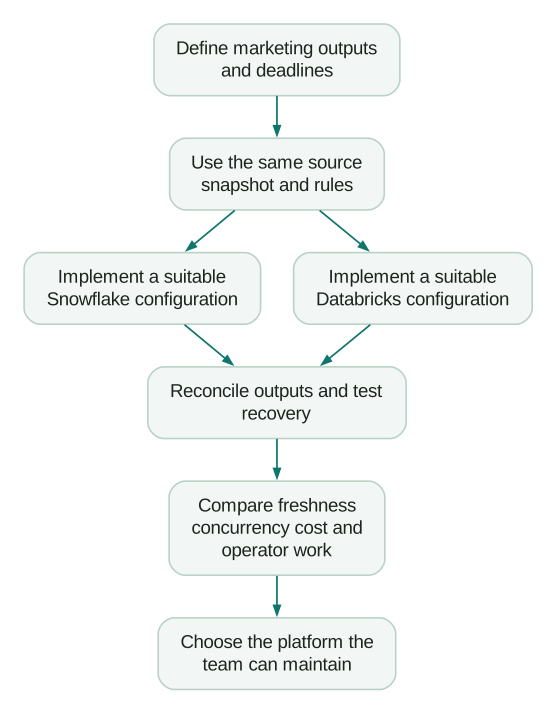
Use the same approved data snapshot, historical window and expected results. Select comparable regions and record the platform settings. Do not tune one implementation extensively while leaving the other at an unsuitable default, then call the result a neutral comparison.
The test should include these jobs:
- Initial load and backfill: load the chosen history and record elapsed time, data completeness and cost.
- Incremental change: process a late ad-cost correction, an updated CRM record and a deleted or merged identity.
- Transformation: produce the three agreed marketing outputs and reconcile their totals.
- Concurrent use: refresh a dashboard while scheduled transformations and representative analyst queries run.
- Audience delivery: export the defined eligible population and verify IDs, exclusions and destination acknowledgement.
- Recovery: interrupt a non-production run, resume it and prove that the result does not duplicate or omit business records.
Keep a repeatable run record with input versions, configuration, output checks, elapsed time, billed usage and operator minutes. Distinguish cold starts from warm runs and record whether result caching was used. Include the slowest meaningful cases, not only the best run.
A benchmark's business unit should be a completed, correct workload at the required freshness. A query that finishes after the morning reporting deadline is not equivalent to one that finishes before it.
Where Microsoft Fabric and BigQuery fit
If your team already operates Microsoft Fabric and Power BI, include that existing environment before introducing another platform. Microsoft's capacity-planning guidance recommends evaluating the relevant workload and reviewing capacity metrics. Look at concurrent warehouse, BI and engineering use, not just whether an unused capacity is available today.
Fabric capacity does not make all storage costs disappear. Microsoft's OneLake consumption documentation separates applicable storage charges from capacity consumption. It also announces that certain Spark-related OneLake operations will be included in reported CU consumption from 15 October 2026. Recheck the resulting utilization before extrapolating an older bill; additional cost depends on the capacity's utilization and configuration.
If your data and operating skills are already centred on Google Cloud, include BigQuery in the shortlist too. The Snowflake-versus-BigQuery comparison covers that decision separately. You do not need to migrate every marketing dataset to the platform with the most appealing new feature.
Which should a small marketing team choose?
For a team starting from a few SaaS sources, prioritize a short implementation path: dependable ingestion, a compact SQL model, tested definitions and one owner. Test Snowflake and Databricks serverless SQL if both are realistic candidates. If only one matches the team's existing expertise and integrations, the other needs a measurable advantage to justify its extra learning and setup.
When Databricks already supports the product's engineering and model workloads, first test marketing reporting there. When Snowflake already contains reconciled finance and customer models, first test reusing them. Avoid paying to maintain duplicate definitions without a clear operating reason.
Treat advice on Reddit and vendor benchmarks as hypotheses to investigate. Record the workload, cloud, configuration, date, tuning effort and commercial assumptions behind each claim. A result without those details should not decide your purchase.
A platform-selection checklist
- Name the marketing outputs, owners and freshness requirements.
- Reuse an existing supported platform where it meets the need.
- Verify cloud, region, network and feature availability.
- Test the same business definitions and difficult source records.
- Reconcile outputs before comparing performance.
- Measure backfills, incremental work, concurrency and recovery.
- Separate compute, maintained data products, storage and transfer costs.
- Include ingestion, activation, support and operator effort.
- Test export and rebuild requirements for an important workflow.
- Choose based on a correct completed workload and an accountable owner.
If the hard part is connecting customer, campaign and revenue data, start with the warehouse and CDP implementation scope. A clear first data product makes both the platform decision and the eventual handover easier to evaluate.
Questions people ask
Is Snowflake or Databricks cheaper for marketing data?
Neither is universally cheaper. Compare the full refresh and reporting workload using the actual cloud, region, configuration and contractual rates. Include ingestion, transformations, storage, networking and maintenance. Credits and DBUs cannot be compared directly as if they were the same unit.
Is Databricks too complicated for a small team?
Team size alone is not the deciding factor. Databricks SQL can support ordinary reporting without requiring every analyst to write Spark code. Evaluate who will maintain the chosen data model and operating setup. Reusing an existing supported environment can be simpler than starting a second platform.
Does Snowflake support data science and machine learning?
Yes. Snowflake provides Python APIs for machine-learning workflows, including model building and training. Specify the actual training, deployment, access and cost requirements before choosing a platform. A requirement for machine learning does not automatically determine the winner.
Should we choose Fabric instead of Snowflake or Databricks?
Include Fabric when your existing Microsoft data and BI environment makes it a realistic option. Test the intended workloads together and inspect capacity utilization and storage costs. An existing license is an input to the comparison, not proof that the additional workload is free or adequately provisioned.
Should we migrate from one platform to the other?
Migrate when a verified benefit outweighs conversion, dual operation, revalidation and ongoing maintenance costs. First test whether better modelling, scheduling or configuration resolves the problem on the current platform. Preserve metric definitions and compare outputs during a controlled transition if migration remains justified.
Sources
- Snowflake virtual warehouse overview.
- Snowflake ML Python APIs.
- Databricks SQL warehouse types.
- Databricks managed and external assets.
- Snowflake Iceberg storage options.
- Snowflake warehouse billing considerations.
- Databricks pricing overview.
- Databricks data-warehousing pricing.
- Microsoft Fabric capacity planning.
- Microsoft OneLake consumption.
Written by
Jafrin Akter AloData Engineer and Co-founder, martechdevs
Jafrin Akter Alo is a data engineer and co-founder of martechdevs, where the team has delivered 74+ martech, data and growth stack implementations.