
Intercom Pricing Explained: Plans, Seat Prices and Fin AI Costs
Intercom costs $29, $85 or $132 per seat a month on annual billing for its Essential, Advanced and Expert plans, or $39, $99 and $139 billed monthly, and new customers currently pay $19 for Essential. Fin, its AI agent, adds $0.99 per resolution or other outcome. Build the budget around the people who need full access and the outcomes your workflows generate, then add channel usage, operating work and any contractual minimums.
On this page
How much does Intercom cost per seat?
Start with full seats, then price Fin, add-ons and channels separately. The $19 Essential offer is an annual-billing monthly equivalent for eligible new customers; the corresponding new-customer monthly price is $29. It is different from the standard $29 annual and $39 monthly seat rates.
USD per teammate per month before tax. Annual prices are monthly equivalents. The table shows published seat prices, not a promise that every subscription has the same commitment or cancellation terms.
| Plan or add-on | Standard annual equivalent | Published monthly price | New-customer Essential offer | Included Lite seats |
|---|---|---|---|---|
| Essential | $29 | $39 | $19 annual equivalent or $29 monthly | 0 |
| Advanced | $85 | $99 | Not this offer | 20 |
| Expert | $132 | $139 | Not this offer | 50 |
| Copilot, optional per agent | $29 | $35 | Not this offer | Not applicable |
The plan guide supplies the standard prices and Lite counts; the pricing page and calculator show the Essential offer and Copilot terms. Expert has a published monthly seat price, while the pricing FAQ describes monthly self-serve availability specifically for Essential and Advanced. Confirm Expert's payment frequency and commitment before treating $139 as a monthly cancellation option. Subscription FAQs.
Go to Fin costs, 5-, 10- and 25-seat budgets, survey pricing or the 1 December WhatsApp change.
At standard rates, twelve monthly Essential payments total $468 per seat, versus $348 for an annual subscription: a $120 difference, or 25.6%. Advanced compares $1,188 with $1,020, saving $168 or 14.1%. Expert's published rate comparison is $1,668 versus $1,584, an $84 difference or 5.0%; it does not establish which monthly terms your order permits.
Does the new-customer offer end at the first renewal?
Do not assume an automatic return to list price. The current Essential offer text says the discount applies to all seats for as long as you remain subscribed. Use the eligible offer in its own scenario and the standard price for an account that does not qualify. Confirm the effect of changing plans, cancelling or signing a different agreement; a price comparison is not a guarantee that future terms can never change. Essential offer.
Who needs a full seat rather than a Lite seat?
Count people by the actions they need to perform. Full seats are for teammates who reply to customers and use the plan's core features. Lite seats provide limited internal collaboration; they do not replace full access for customer replies or outbound work. Advanced includes 20 Lite seats and Expert includes 50, while Essential has none. All full seats in a workspace use the same core plan. Test a required action with the proposed role before buying seats on that assumption. Before switching a full seat to Lite, preserve any needed Personal Macros: the guide says the switch deletes them and switching back does not restore them. Seat definitions and changes.
Choose the plan by operating requirements. Essential covers a shared inbox and core support; Advanced adds Workflows and multiple team inboxes; Expert adds controls such as SLAs, SSO and multibrand. An annual seat discount is not useful if the chosen plan lacks a required routing or access feature.
At the implementation stage, customer support automation should give the team reliable account context and clear ownership. Paying for workflow features will not repair a field that arrives late or means different things in billing and support. For the platform itself, see our Intercom and Fin implementation.
What does Fin AI cost, and which outcomes are billable?
Fin access and Fin usage are separate. On Intercom's documented chat/email pricing, ordinary support outcomes cost $0.99, while full sales qualifications cost $9.99. Count the final outcome type, not every question or AI action in the conversation. Fin outcome definitions.
| Outcome on the stated Intercom route | Published price | What makes it billable |
|---|---|---|
| Resolution | $0.99 | The customer confirms the answer helped, or does not request further assistance after an answer |
| Procedure handoff | $0.99 | Fin successfully completes a Procedure configured to end with a human or workflow handoff |
| Sales disqualification | $0.99 | Fin determines the prospect does not meet the configured criteria |
| Full sales qualification | $9.99 | Fin qualifies and routes the prospect under the defined criteria |
| Self-serve routing | $0.99 | The configured sales route is marked self-serve |
| Fin Voice | $1.99 per outcome in the public comparison, via Sales | Confirm the voice agreement and separate phone/channel charges |
The chat/email rates do not establish every voice or negotiated-volume rate. The public feature comparison lists Fin Voice through Sales. Early Stage has its own availability rules, discussed below.
A successful configured Procedure handoff can incur a charge even though a person still needs to finish the customer's job. Ordinary escalation because Fin cannot answer, a customer asks for a person, or a workspace-level escalation rule applies is different. A Procedure that fails to complete is not a successful billable Procedure handoff. Preserve these categories in both the usage forecast and the operational report.
The documentation caps outcomes at one per conversation under the described billing rules. Do not count a qualification and a resolution from the same conversation as two independent outcomes without checking its final classification. A customer returning to the same conversation for more help can reverse a resolution charge; creating a separate conversation is a different record to investigate.
Keep billable outcomes separate from automation success. A handoff may save an agent time by gathering context, but it is not the same result as resolving the request without human work. Likewise, 50 full-rate qualifications cost $499.50, not $49.50: pricing them at the support rate understates that line by $450.
Can you use Fin without paying for the Intercom helpdesk?
Yes. Fin can work with an existing helpdesk, with no additional Intercom helpdesk seats required for that route. Keep the underlying Zendesk, Salesforce or other helpdesk bill in the comparison, along with implementation and applicable channel costs.
Confirm which offer your order uses. Fin's dedicated platform help describes a $49 monthly base including 50 resolutions, then $0.99 for each additional outcome. Its public pricing page also presents $0.99 per outcome with a 50-outcome monthly minimum. These descriptions do not produce identical totals. The examples below make each interpretation explicit rather than treating either as a universal order. Fin platform billing, Fin pricing.
For an ordinary paid month with only eligible resolution outcomes, the help-page bundle is 49 + max(resolutions − 50, 0) × 0.99. If an order instead specifies 50 minimum outcomes at $0.99, the corresponding arithmetic is max(resolutions, 50) × 0.99. Trial or negotiated commitments need their own inputs.
| Resolutions in the month | $49 bundle including 50 | 50 minimum outcomes at $0.99 |
|---|---|---|
| 0 | $49.00 | $49.50 |
| 50 | $49.00 | $49.50 |
| 100 | $98.50 | $99.00 |
| 400 | $395.50 | $396.00 |
For example, 100 resolutions under the bundle cost 49 + 50 × 0.99 = $98.50. Do not multiply all 100 by $0.99 and then add the base again. Unused included monthly resolutions do not roll over. The platform help also says Fin for sales qualifications and disqualifications is not available outside Intercom, so do not transfer the entire Intercom sales rate card to an existing-helpdesk order.
Use the Intercom versus Zendesk comparison when the decision includes replacing the helpdesk. Compare Zendesk's own AI pricing and its seat and add-on costs against the same eligible workload.
What will 5, 10 or 25 full seats cost with Fin?
Start with conversation volume and a stated outcome assumption. For example, 2,000 eligible conversations at an illustrative 60% Fin resolution rate produce 1,200 resolutions, costing $1,188 at $0.99. This is a planning assumption, not a vendor benchmark or a prediction for your inbox. Add any separate billable categories without counting the same conversation twice. Separate knowledge answers, account lookups, operational requests and deliberate handoffs; keep uncertain categories as ranges until a pilot supplies evidence.
The following fictional teams use standard annual-billing seat and Copilot equivalents. Usage is a monthly forecast. These totals are not a promise that every charge is invoiced monthly: annual commitments and usage-in-arrears have different payment timing.
| Configuration | Full seats | Fin support outcomes | Selected add-ons/channels | Monthly equivalent |
|---|---|---|---|---|
| 5 Advanced seats | $425 | 500 × $0.99 = $495 | 5 Copilot seats: $145 | $1,065 |
| 10 Advanced seats | $850 | 1,500 × $0.99 = $1,485 | Copilot $116; Proactive Support Plus $99; SMS $24 | $2,574 |
| 25 Expert seats | $3,300 | 4,000 × $0.99 = $3,960 | Copilot $290; Pro $1,600 | $9,150 |
Five seats: price the necessary assistance
Assume 1,000 eligible conversations and a 50% resolution assumption: 500 Fin outcomes. Five Advanced seats plus Fin total $920. Buying Copilot for all five adds $145, making $1,065. If only two agents need unlimited Copilot, price those two rather than every full seat. The annual seat commitment alone is $5,100 before Copilot and usage.
Ten seats: include the actual channel units
Assume 2,500 eligible conversations and 1,500 Fin support outcomes. Four agents need unlimited Copilot. Proactive Support Plus stays within its shared 500 Messages Sent allowance, and the workspace uses 400 total US SMS segments sent and received, not 400 conversations or necessarily 400 long text messages.
| Component | Calculation | Monthly equivalent |
|---|---|---|
| Advanced full seats | 10 × $85 | $850 |
| Fin support outcomes | 1,500 × $0.99 | $1,485 |
| Copilot | 4 × $29 | $116 |
| Proactive Support Plus | Within the included 500 Messages Sent | $99 |
| US SMS | 400 × $0.06 | $24 |
| Total | Sum of the five lines | $2,574 |
Seats are about 33.0% of this forecast. It includes no Pro add-on, Operator overage, paid email campaign, voice, WhatsApp or other channel usage. Add those when the workload uses them. SMS rates are taken from the usage-based channel schedule.
Twenty-five seats: Pro follows conversation volume
Assume 8,000 counted Pro conversations, 4,000 Fin support outcomes and ten Copilot agents. The dedicated latest-model Pro guide prices Pro at $0.20 per counted conversation with a 500-conversation minimum. Pro therefore contributes $1,600, not a flat $100, and the total is $9,150. This case assumes Operator stays within its separate included credits and has no other paid-channel usage. Current Pro model.
Seats are about 36.1% of this forecast. If the incident scenario doubles both the counted conversations and Fin outcomes at the same assumed mix, Fin becomes $7,920 and Pro becomes $3,200. Seats and the ten Copilot licences stay at $3,590 together, producing $14,710 before other usage. A lower resolution rate or more handoffs would change that result.
The peak case needs an operational response: allow the extra usage, narrow the eligible cases, or route more work to people with an explicit staffing plan. Include the likely effect on wait times and repeat contact. Employee count alone is a weak estimator of those requirements.
How should you use the Intercom pricing calculator?
Use the calculator to compare a recorded configuration, then reconcile it to the applicable offer and contract. Its displayed Essential starting point can use the new-customer price; an existing account should not inherit that assumption automatically. Intercom pricing calculator.
- Choose the plan, billing period, full-seat count and actual offer eligibility.
- Convert eligible conversation volume into expected billable outcomes, with support, sales and voice separated. Do not enter every conversation as a paid Fin outcome.
- Add only the Copilot agents who need it, the applicable Pro conversation model and Operator credits, and the shared Proactive Support Plus message volume.
- Enter SMS segments, paid emails and phone or WhatsApp usage using their own country, category and unit rules.
- Save a normal and incident scenario, with the selected minimums, exclusions and billing terms beside them.
An estimate does not verify your future resolution rate, entitlement or destination handoff. The support AI pricing guide helps normalize different vendors' meters before comparing totals.
How much do Intercom surveys and product tours cost?
Surveys and Product Tours are part of Proactive Support Plus, which costs $99/month including 500 Messages Sent shared with Posts, Mobile Push and Mobile Carousels. The allowance is not 500 for each feature, and it is not a quota of completed survey responses. Proactive Support Plus.
A survey can count when it is shown through audience rules, when someone interacts with its first question embedded in an email, or when they click its shareable link. Completion is not the condition for every charge. Emails, SMS and WhatsApp use separate meters, even when they are part of the same campaign.
For an illustrative 3,000 Messages Sent in one month, the first 500 are included. The next 500 cost $35 at $0.07, the next 1,000 cost $60 at $0.06, and the last 1,000 cost $50 at $0.05. Usage adds $145, giving $244 including the $99 add-on. Apply marginal tiers; do not price every message at the final tier's rate.
Which add-ons and channels need separate budget lines?
Copilot assists human agents; Fin handles customer-facing work. Copilot is optional at $29 per agent/month billed annually or $35 monthly for unlimited usage. Each agent gets 10 Copilot and 10 AI Auto-translation conversations free monthly. Buy the paid add-on for the agents whose workflow justifies it. Copilot pricing.
Pro is a different meter again. Its dedicated current guide uses $0.20 × max(counted conversations, 500), giving a $100 minimum. It counts a conversation once under the channel's engagement rule: for example, chat or email counts when the team, workflow or Fin replies; an answered phone call counts when it ends. It is not charged per seat or per Fin outcome.
Intercom's general usage article also publishes a different Pro tier schedule. The examples here explicitly use the dedicated latest-model Pro guide; confirm the version on an existing or contracted workspace before applying it. Do not combine one version's base fee with another version's allowance or marginal rate.
On the documented monthly Operator plan, Pro includes 6,000 credits. The default credit limit stops Operator at that inclusion; additional usage at $0.01 per credit requires opting in by raising or removing the limit. For 8,000 credits under that setup, the extra 2,000 cost $20, not $80. Credits reset without rollover. Monthly Operator credits.
Contracted Pro credit inclusions scale with committed conversation volume, while Early Stage uses its own inclusion. Do not derive credits from actual conversations or count them as interchangeable with Fin outcomes. Contracted Operator credits.
| Channel or product | Billing unit | What to keep separate |
|---|---|---|
| Support inbox email | Included inbound support and replies | Paid outbound email campaigns |
| Email campaigns | Bulk Emails Sent | Proactive Support Plus Messages Sent |
| SMS | Sent and received segments, by region and marginal tier | Conversations and long messages that split into segments |
| Phone | Numbers, inbound/outbound minutes, recordings and other listed call usage | Fin Voice outcome charges |
| Applicable country/category rate card | Fin outcomes and the phone-number service allowance |
For example, 1,500 US SMS segments cost 500 × $0.06 + 500 × $0.03 + 500 × $0.025 = $57.50. The first segment is chargeable; there is no included SMS allowance in the stated schedule. At 1,200 Bulk Emails Sent, the listed bands total $25.50. Confirm phone geography, direction, number type and recording usage from the applicable schedule rather than applying one universal call rate. Channel billing.
What changes for WhatsApp on 1 December 2026?
Existing customers move to Intercom's published country/category WhatsApp rates from 1 December 2026. New customers may already use those rates from their order date. The applicable plan or contract matters, so do not apply the change as though every workspace switches on the same day. WhatsApp messaging rates.
The new card charges outbound messages by recipient country and category. Inbound customer messages are not charged. Service messages belong within the 24-hour customer-service window, and the published service allowance is 1,000 delivered messages per business phone number per calendar month. It is shared, resets monthly and does not roll over.
Illustrative US recipients, one business phone number, and no other service-message usage in that calendar month:
| Outbound category | Published US cents per message | Example delivered quantity | Charge, USD |
|---|---|---|---|
| Marketing | 2.92¢ | 1,000 | $29.20 |
| Utility | 0.40¢ | 1,000 | $4.00 |
| Authentication | 0.40¢ | 0 | $0.00 |
| Service | 0.40¢ after the included service allocation | 1,500, of which 500 are chargeable | $2.00 |
| Total | Category-specific rates | 3,500 | $35.20 |
Convert cents to dollars before multiplying: 0.40 US cents is $0.004, not $0.40. The allowance is per phone number, not per country line, so a mixed-country forecast must not deduct it repeatedly. Fin outcomes are billed separately and are not included in this $35.20 channel example. The older bulk/inbox pricing descriptions should not be used to price every message under the new card.
Is Intercom worth it for an eligible startup?
The Early Stage program can substantially reduce the initial bundle cost when the required features fit. Its dedicated eligibility page specifies up to $10 million raised, fewer than 15 employees and a new Intercom customer. Application and approval still matter; do not assume a marketing headline grants the discount. Early Stage eligibility.
The current documented cohort includes six Advanced full seats, six unlimited Copilot seats, 20 Lite seats, Proactive Support Plus and Pro. The first-year Fin benefit is 300 ordinary outcomes plus 15 qualifications per month, not unlimited Fin. Standard channel fees and excess Fin usage remain separate. The program's Operator inclusion is 2,000 credits, not the ordinary monthly Pro plan's 6,000. Early Stage terms.
The help article applies to customers who joined before 29 June 2026 and from 8 October 2026; it also distinguishes older cohorts and dates of progression. Use the table only for the described current allowance path. It preserves 15 qualifications separately from the ordinary outcomes below.
| Program year | Published monthly bundle | Ordinary Fin outcomes included | Example: 600 ordinary outcomes, no qualifications |
|---|---|---|---|
| Year 1 | $65.00 | 300 | $65 + 300 × $0.99 = $362.00 |
| Year 2 | $451.50 | 150 | $451.50 + 450 × $0.99 = $897.00 |
| Year 3 | $677.25 | 75 | $677.25 + 525 × $0.99 = $1,197.00 |
The published $903 monthly bundle list value is 6 × $99 + 6 × $35 + $99. Its 50% and 25% later-year discounts produce $451.50 and $677.25. Use the published $65 first-year fee rather than treating the rounded “93%” headline as an exact formula. Additional outcomes and qualifications, SMS, WhatsApp, Phone and Operator overages are not covered by that percentage discount.
You cannot reduce the six included seats to lower the bundle fee. Expert features and Fin Voice are not included in this Early Stage offer. The help page contains inconsistent wording about monthly cancellation versus an annual commitment billed monthly, so get the actual subscription term and downgrade date confirmed before treating monthly payment as unrestricted flexibility. Compare startup programs across the stack and keep the ordinary post-program cost visible.
How do you prevent an unexpected usage bill?
Set a forecast, an owner and a response policy. An alert asks someone to investigate; a hard limit changes what the customer experiences. A Fin outcome cap does not cap Pro, Copilot, phone or messaging charges.
Intercom documents Fin alerts and hard limits. New conversations follow the configured handover after the limit is reached; in-progress conversations hand over on the customer's next interaction. Conversation-state changes and timing can make the limit slightly imprecise. Some workflow predicates are recalculated periodically rather than immediately. Usage controls.
Test the boundary with a restricted scenario. Confirm the receiving team, information carried into the handoff and what customers see outside staffed hours. A limit with no operating fallback can turn cost control into a service failure.
Reconcile the usage report with ordinary resolutions, assumed resolutions, completed Procedure handoffs and sales outcomes separately. Investigate reopened conversations and new conversation creation. Keep a second report of remaining human work and repeat contact; a lower AI bill alone does not prove a better customer result.
How can you reduce Intercom costs without weakening support?
Right-size the required work before removing useful coverage. Use the shared case definition to distinguish a wasteful charge from a service outcome the team still needs.
- Map full-seat actions to people, and use Lite collaboration where its restrictions fit.
- Compare annual and monthly commitments using the same eligibility; preserve a valid new-customer offer instead of assuming it expires at renewal.
- Buy unlimited Copilot only for agents who need more than the included use.
- Improve content and Procedure design where they create repeat contact or unnecessary handoffs. A resolved request and a charged handoff can have different remaining labor.
- Forecast Pro conversations and Operator credits separately, using the workspace's actual model and enabled limits.
- Combine all Proactive Support Plus message types before applying its allowance and tiers.
- Model WhatsApp by country, category, phone number and effective date; price SMS in segments.
- Test the human fallback before reducing Fin limits or changing supported channels.
If the resulting economics still do not fit, compare Intercom alternatives against the same service workload. A cheaper licence can still leave more integration, maintenance or handling work.
What should the commitment and ownership budget include?
Separate the annual commitment, monthly usage estimate and work required to operate the service. Self-serve seats and add-ons can be billed ahead while usage is billed in arrears; a contracted allowance has its own frequency and overage treatment. Billing treatment.
Do not apply “downgrades only at renewal” to every change. The subscription guide describes credits and feature loss when downgrading, prorated monthly seat changes, and annual seat commitments that continue until renewal. Contracted reductions need the applicable contract process. Removing access is not automatically the same as reducing a prepaid commitment. Manage subscriptions.
Name the owners of knowledge quality, authenticated identity, account relationships, routing, permitted actions and monthly evaluation. Include migration, content cleanup, testing and a manual recovery path. The Intercom implementation guide explains where those handoffs can fail.
For a fictional ownership budget, repeat the $2,574 configuration for twelve months at unchanged rates and usage: platform cost is $30,888. Value six internal maintenance hours a month at an assumed $90/hour, or $6,480 annually, and 40 setup hours at $3,600. The first-year economic total is $40,968; the later unchanged year is $37,368. These are internal planning assumptions, not service-provider quotes. Existing staff time is not automatically new cash spend or a cash saving when reduced. State whether the benefit is improved service, avoided hiring, lower handling cost or a combination, and recheck it when a product or policy changes.
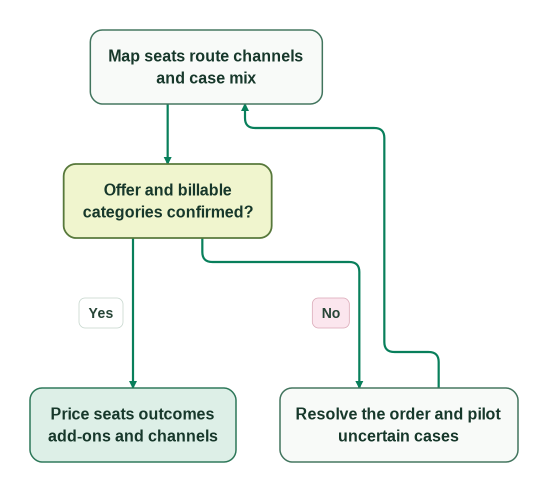
Build the forecast from confirmed outcome categories and test the peak before approving the configuration:
Confirm the offer before pricing
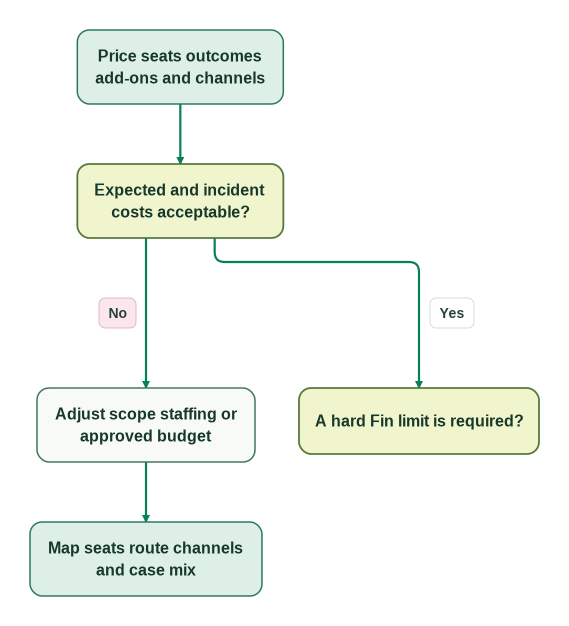
The pricing step continues to the normal and incident budget check in the next view.
Test expected and incident costs
The return to case mapping repeats the preceding offer and category checks.
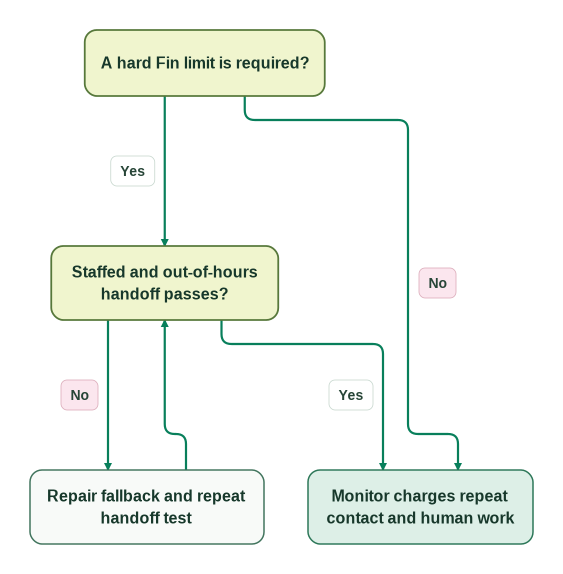
Test a required hard-limit handoff
Every failed handoff returns to the same test; neither branch bypasses the preceding budget checks.
Read diagram as text
- Map seats route channels and case mix to Offer and billable categories confirmed?.
- Offer and billable categories confirmed? to Resolve the order and pilot uncertain cases: No.
- Resolve the order and pilot uncertain cases to Map seats route channels and case mix.
- Offer and billable categories confirmed? to Price seats outcomes add-ons and channels: Yes.
- Price seats outcomes add-ons and channels to Expected and incident costs acceptable?.
- Expected and incident costs acceptable? to Adjust scope staffing or approved budget: No.
- Adjust scope staffing or approved budget to Map seats route channels and case mix.
- Expected and incident costs acceptable? to A hard Fin limit is required?: Yes.
- A hard Fin limit is required? to Monitor charges repeat contact and human work: No.
- A hard Fin limit is required? to Staffed and out-of-hours handoff passes?: Yes.
- Staffed and out-of-hours handoff passes? to Repair fallback and repeat handoff test: No.
- Repair fallback and repeat handoff test to Staffed and out-of-hours handoff passes?.
- Staffed and out-of-hours handoff passes? to Monitor charges repeat contact and human work: Yes
Checklist
- Record the actual seat offer, payment frequency and commitment.
- Distinguish Intercom helpdesk usage from Fin on an existing helpdesk.
- Count billable outcome categories without double-counting conversations.
- Price normal and incident workloads, including Pro and paid channels.
- Verify allowances, overages and the relevant program or contract version.
- Test alerts, hard limits and staffed/out-of-hours handover.
- Assign knowledge, data, routing and monthly reconciliation owners.
- Record downgrade timing, feature loss and the recovery plan.
What happened to the Starter plan and the Intercom name?
Starter is not one of the current public helpdesk packages: Intercom now lists Essential, Advanced and Expert. If an existing invoice uses an older plan name, apply its actual legacy terms rather than copying a new-account price table. Current plans and legacy-plan boundary.
Salesforce announced completion of its acquisition of Fin, formerly Intercom, on 10 September 2026. Intercom remains the helpdesk brand on the current pricing page. The acquisition announcement is evidence of ownership, not a promise about an individual customer's next renewal price. Salesforce announcement.
For a defined implementation, request a detailed Intercom scope. Bring the current plan, case mix, usage report and one difficult handoff. The $99 martech audit includes a written assessment and a one-hour specialist call when the problem across support, CRM and billing is still unclear.
Keep reading
Browse all CRM & Lifecycle guides
 CRM & Lifecycle
Intercom vs Zendesk: Key Differences, AI, Pricing and Which to Choose
Intercom starts at $29 per seat and bills $0.99 per Fin outcome; Zendesk starts at $19 with account-specific AI pricing. Compare features and fit.
Jafrin Akter AloLast updated 23 min read
 CRM & Lifecycle
Intercom Alternatives: Choose Around the Work You Need to Keep
Compare Zendesk, Help Scout, Freshdesk, HubSpot and Gorgias around support jobs, AI evaluation, migration work and real operating cost.
Jafrin Akter AloLast updated 13 min read
 CRM & Lifecycle
Intercom Implementation Mistakes: Identity, Inbox and Automation
Fix Intercom identity, account context, inbox ownership and Fin handovers with a practical launch scenario and release acceptance checklist.
Jafrin Akter AloLast updated 12 min read
Intercom and Fin implementation
See the implementation scope, deliverables and acceptance checks.
Questions people ask
How much does Intercom cost per month?
Intercom's standard annual-billing equivalents are $29, $85 or $132 per full seat for Essential, Advanced and Expert, before Fin, add-ons and paid channels. Eligible new Essential customers have a separate offer. A complete forecast needs the actual seat commitment, billable outcomes, Copilot agents, Pro conversations and channel units. The worked ten-seat configuration here totals $2,574 monthly equivalent under its stated assumptions.
Does Intercom have a free plan?
No. Intercom has no free plan, but every plan starts with a 14-day free trial that needs no credit card and includes Fin. After the trial, the cheapest option is Essential at $29 per seat a month on annual billing, or $19 for new customers, plus $0.99 per Fin outcome. Eligible early-stage startups can get up to 93% off.
How much does Fin AI cost?
Fin's documented Intercom chat/email support outcomes cost $0.99, including successful configured Procedure handoffs; full sales qualifications cost $9.99. Ordinary escalation and a failed Procedure are different from a completed billable outcome. The public comparison lists Fin Voice through Sales at $1.99 per outcome, with its own agreement and channel charges. Classify the actual route and final outcome before assigning a rate to every conversation.
Can I use Fin without the Intercom helpdesk?
Yes. Fin can work with an existing helpdesk without adding Intercom helpdesk seats, while that helpdesk's own costs remain. Fin's platform help describes a $49 bundle including 50 resolutions and $0.99 for additional outcomes; its public pricing also shows a 50-outcome minimum at $0.99. Confirm the offer in your order. The article calculates both and keeps voice, sales availability and other usage separate.
Did Salesforce buy Intercom, and does that change my price?
Salesforce announced that it completed its acquisition of Fin, formerly Intercom, on 10 September 2026. Intercom is still used for the helpdesk product. Ownership alone does not establish a new seat price, remove a commitment or guarantee a future discount. Use the current rate card, your eligible offer and the actual renewal terms; review any product or usage changes separately from the acquisition announcement.
Sources
- Intercom pricing.
- Intercom pricing calculator.
- Intercom pricing FAQs.
- Intercom plans explained.
- Fin AI Agent outcomes.
- Fin platform pricing and outcomes.
- Fin pricing.
- Pro add-on: latest model.
- Usage-based channels.
- Proactive Support Plus.
- Monthly Operator credits.
- Contracted Operator credits.
- WhatsApp messaging rates.
- Early Stage offer.
- Early Stage program terms.
- Manage usage and Fin limits.
- Manage subscriptions.
- Salesforce completes acquisition of Fin.
- Full and Lite seats.

Written by
Jafrin Akter AloData Engineer and Co-founder at Martechdevs and Growth and Analytics Partners
Jafrin writes practical guides to marketing technology, customer data, analytics and AI workflows. Martechdevs is a Growth and Analytics Partners company.