
Klaviyo Alternatives: Choose Around Your Store and Messaging Needs
Data Engineer and Co-founder, martechdevs
Last updated 9 min read
Choose a Klaviyo alternative by proving that it can reproduce your store's important customer journeys with less cost or operational friction. Omnisend, Brevo and Attentive deserve different evaluations: store automation, WooCommerce integration and coordinated messaging programmes. The deciding test is how each handles your actual orders, preferences and exceptions, not how many features appear on its homepage.
Last updated: 4 September 2026.
A replacement can reduce a software bill and still increase total workload. It can also improve a team's operating model enough to justify a higher bill. Both outcomes depend on what you need the system to do.
This guide shortlists three alternatives for distinct ecommerce situations. It is based on current product documentation, not hands-on performance testing or a claim that one platform wins for every store.
What problem are you asking the replacement to solve?
Write one measurable reason for considering a move.
“We need fewer manual fixes when subscription orders change” is useful. “We want better automation” is too broad to compare.
Typical reasons fall into four groups:
- The bill grows faster than the useful, reachable audience.
- The team cannot maintain the existing flow logic confidently.
- Commerce data needed for a journey arrives incorrectly or too late.
- Separate messaging tools create conflicting customer experiences.
Before shopping, inspect Klaviyo active profiles and implementation mistakes. An avoidable audience or integration problem may be cheaper to fix than to migrate.
If several systems own the same customer status, our martech integration work can help define the data contract the replacement must satisfy. Carrying conflicting definitions into another platform simply changes where the disagreement appears.
Define success before requesting quotes. Examples include eliminating a weekly manual export, reproducing a post-purchase exclusion reliably, or making the lifecycle manager independently able to diagnose a skipped message.
When should you evaluate Omnisend?
Omnisend is a sensible candidate when the central job is running store-led email, SMS and web-push automation through a shared visual workflow. Its documented builder includes conditions, delays, channel branching and prebuilt commerce journeys. Omnisend automation
Evaluate it with the person who will maintain the flows. Ask that person to change an offer, exclude a product category, preview the affected audience and explain a customer's path without a consultant narrating every click.
The useful question is whether the operating workflow becomes simpler while preserving the behaviour you actually need.
Prove exit behaviour before migration
Omnisend distinguishes entry audience filters from continuously evaluated exit conditions. Its documentation also says newly added or changed exit conditions apply to contacts who enter after the change, while existing contacts continue under their original settings. Omnisend exit conditions
That is a specific acceptance test: put a controlled contact into a delayed journey, change an exit rule, and inspect what happens to that existing contact versus a new entrant.
Do not assume copying a Klaviyo filter produces identical lifecycle behaviour. Translate the intended outcome into the destination platform's entry, exit and message rules.
Choose Omnisend only after the team can handle your difficult case, such as a cancelled order during a post-purchase sequence. A beautiful welcome flow is an incomplete evaluation for a store whose support load comes from order exceptions.
When should you evaluate Brevo?
Brevo deserves a close look for a WooCommerce-led team that wants its store data and communications connected through a documented plugin.
The current WooCommerce integration supports contact and ecommerce-data sync, tracking of store activity and automation uses. Its settings also include an “Import contacts as subscribed” option, which Brevo explicitly warns should only be enabled for contacts with appropriate verifiable permission. Brevo WooCommerce integration
The integration's existence is not enough. Examine the exact plugin version, settings, checkout customisations and order statuses your store uses.
Treat subscription mapping as a separate workstream
Give the evaluation team three controlled records: a subscribed purchaser, an unsubscribed purchaser and a guest checkout without marketing permission. Specify the expected destination state before syncing.
Then update the source record and repeat. An initial migration that looks correct can still be undermined by a later sync.
For the commerce side, choose one order that changes state after creation. Confirm which event should drive the message and how that event relates to payment, fulfilment and cancellation.
Brevo may be a good fit when its documented integration covers the intended workflow and the team can operate the remaining exceptions. It is a weaker choice if the business case depends on undocumented assumptions about a custom checkout or extension.
When should you evaluate Attentive?
Attentive is worth evaluating when coordinated mobile messaging and email are central to the commercial programme, especially where the team wants to review channels, identity and programme support together.
The current platform offers SMS, email, RCS and push. Its pricing page describes a tailored plan influenced by message volume, subscriber count, selected channels and AI products; it does not provide one universal public price for this comparison. Attentive pricing
Ask for a quote against your sending pattern, including destinations, message formats and peak periods. A contact count alone does not describe the workload of an SMS-heavy store.
Prevent duplicate post-purchase paths
Attentive documents SMS and email post-purchase journeys and warns Shopify users against running duplicate Shopify and non-Shopify journeys for the same purchase. Attentive post-purchase documentation
That warning translates into a migration requirement: one owner for each customer-facing purpose during cutover.
Map the order confirmation, shipping update, review request and cross-sell separately. Some may remain in the commerce platform while others move. Name the system that sends each message and the condition that stops it.
Choose Attentive when the channel programme and operating support justify the full quoted scope. Do not add channels merely to make a bundled plan look more valuable; each channel needs a useful customer purpose and a team capable of running it.
How do you compare costs without inventing a winner?
Use the same workload for every supplier. Provide:
- Reachable contacts by channel, with the precise source counts.
- Monthly campaign sends and triggered sends separately.
- SMS destinations and expected message formats.
- Seasonal peak demand, not just an average month.
- Required integrations, analytics, support and account access.
- The migration work you need included and the work you will perform.
Ask how each line is billed and what happens above the allowance. Record contract term, currency, taxes, discounts, renewal terms and any minimum commitment. Do not compare an introductory rate with another supplier's undiscounted ongoing price.
Public pricing and packages change. Obtain a dated quote for the actual requirement instead of using a generic monthly figure as a promise.
An illustrative total-cost calculation
Suppose the current system costs USD900 per month and requires eight hours of monthly maintenance. An alternative quote is USD650 and is expected to require twelve hours. Use an internal planning rate of USD60 per hour, not a vendor fee.
The current operating cost is USD1,380. The alternative is USD1,370. The apparent USD250 software saving becomes USD10 after the extra work.
If migration costs USD3,000, a savings-only justification would take 300 months at that assumed difference. That does not rule out the move if it solves an important capability problem. It does rule out presenting the move as an obvious cost reduction.
These figures are hypothetical. Replace the maintenance assumptions with measured work from your own team, and include temporary dual subscriptions or contractor support where relevant.
What should the proof of concept actually contain?
Build one representative journey and a small set of commerce exceptions. Use synthetic or authorised test data, controlled recipients and disabled production sends until the path is verified.
An illustrative “refill reminder” trial is more revealing than a welcome email:
- A customer purchases a replenishable item.
- A reminder becomes eligible after a business-chosen interval.
- A refund, repeat purchase or changed preference can make it irrelevant.
- The next message must use the correct product and current eligibility.
Do not require every alternative to reproduce the old canvas node for node. Require it to reproduce the customer's intended experience and produce enough evidence to explain that experience.
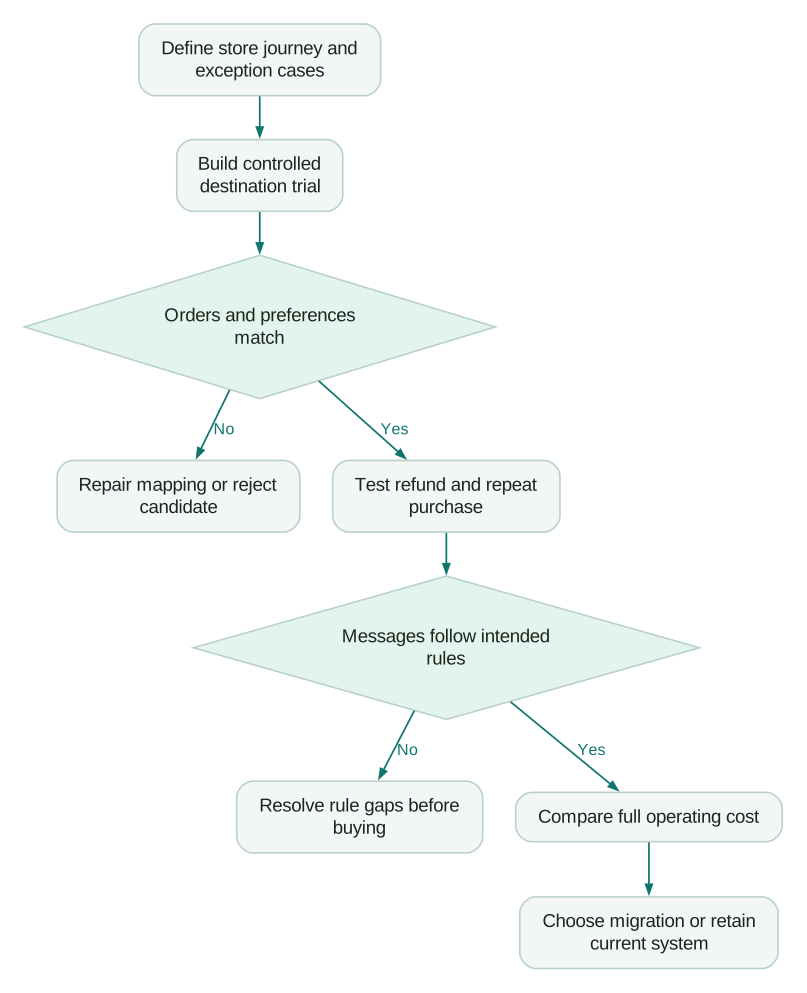
Give each candidate the same acceptance cases. Let the vendor explain native behaviour, then have your operator repeat the relevant change and diagnose a failed case.
What must survive the move?
The valuable migration unit is the customer relationship, including what the customer has declined.
Transfer only the data you can legitimately use and retain, but do not confuse a permission record with an engagement score. Email and SMS preferences require their own mappings. Use the customer preference centre guide to design these controls coherently.
Preserve the fields necessary to interpret purchase history: source customer and order IDs, timestamps, currency, relevant product identifiers and meaningful status changes. Decide how historical events enter the destination without unexpectedly restarting old journeys.
Archive the old reporting basis. New platforms may assign different credit to the same sale, so “revenue increased after migration” is not automatically a business result. Compare store outcomes separately from platform-attributed outcomes.
For a business combining ecommerce with product usage, review Customer.io versus Klaviyo. The important question may be whether the customer model should centre on orders, subscriptions or application behaviour.
How do you cut over without messaging twice?
Create a purpose-level ownership list before changing senders. “Email has moved” is too vague if confirmations remain in the store and promotional journeys move elsewhere.
Use this acceptance checklist:
Checklist
- Every active journey has one named sending owner at cutover.
- Consent and suppression states survive initial sync and later updates.
- Existing delayed contacts have an explicit finish, exit or migration decision.
- Product links, offer codes and checkout recovery links resolve correctly.
- Refund and repeat-purchase cases stop or change reminders as intended.
- The team can identify a customer's entry, skip, exit and delivery evidence.
- The destination quote includes the tested channels and required features.
- A rollback plan names which system resumes each purpose and how new opt-outs are preserved.
Start with a bounded audience or journey whose results you can inspect. Keep a decision log for discrepancies rather than silently rewriting expected outcomes to match the new product.
The right alternative is the one your team can run accurately through an ordinary week and an awkward order exception. If no candidate improves that operating reality enough to justify the move, keeping Klaviyo and fixing the specific weakness is a valid decision.
Questions people ask
Which Klaviyo alternative is cheapest?
There is no defensible universal winner without a contact, send and channel specification. Compare a dated quote plus migration and ongoing maintenance, because a smaller subscription can create more operational work.
Is Omnisend automatically equivalent to Klaviyo for flows?
No. Similar visual building blocks do not guarantee identical entry, exit or re-evaluation behaviour. Rebuild one important journey around its intended outcome and inspect contacts already waiting when rules change.
Should a WooCommerce store choose Brevo by default?
A documented plugin makes it a candidate, not an automatic decision. Test the store's checkout, order-status changes, extensions and subscription mapping before committing.
Is Attentive only an SMS replacement?
Its current offering includes email and other messaging channels alongside SMS. Evaluate the specific quoted package and which customer-facing purposes should move, rather than assuming either an SMS-only or all-channel migration.
Can we keep both platforms temporarily?
Yes, if every journey has clear sending ownership and preferences remain consistent. Budget for the overlap and define an end condition, because an indefinite split can recreate the coordination problem you intended to solve.
Sources
- Omnisend: Marketing automation. Accessed 4 September 2026.
- Omnisend: Exit conditions for automations. Accessed 4 September 2026.
- Brevo: WooCommerce plugin and synchronisation. Accessed 4 September 2026.
- Attentive: Pricing. Accessed 4 September 2026.
- Attentive: Post-purchase journeys with triggered emails. Accessed 4 September 2026.
Written by
Jafrin Akter AloData Engineer and Co-founder, martechdevs
Jafrin Akter Alo is a data engineer and co-founder of martechdevs, where the team has delivered 74+ martech, data and growth stack implementations.