
GA4 Refund Tracking: Reconcile Purchases, Returns and Revenue
Data Engineer and Co-founder, martechdevs
Last updated 9 min read
GA4 refund tracking needs a confirmed refund event, the original order ID and the amount actually refunded. Partial refunds also need the correct items and quantities. Build the event from your commerce records, control duplicate deliveries and reconcile merchandise value separately from tax, shipping and cash returned. Seeing a refund in Analytics is only the first check.
Last updated: 29 September 2026.
Decide which business event deserves a refund event
A return request is not a refund. Neither is a support agent opening an order, a label being printed or a payment provider acknowledging an API request. Those are useful operational states, but they do not establish that money was returned.
Choose a documented authoritative state in your commerce or payment system, such as a successfully completed refund. Record how pending, failed, cancelled and reversed refund attempts are handled. If the commerce platform and payment provider disagree, route the discrepancy to an exception queue before creating two analytics events.
Google's ecommerce implementation guide uses the recommended refund event and links it to the relevant transaction_id. It recommends item information for item-level reporting. The tracking design still has to decide which source can confirm that a refund occurred.
This belongs in the same analytics tracking implementation as purchase tracking. A browser purchase tag and a support-team refund workflow are two sides of the same revenue measurement contract. Assign one owner for the relationship between them.
Write the trigger in language that support, finance and engineering can all interpret: “Send one eligible analytics event for each newly confirmed refund occurrence, using the original order ID and the incremental amounts refunded by that occurrence.” The word incremental prevents a common error when multiple partial refunds occur.
Keep the order ID and refund ID separate
The original order might have an internal identifier such as ORD-DEMO-1042. It can subsequently have refund occurrences RF-DEMO-A and RF-DEMO-B. Those refund IDs belong in your delivery ledger; both analytics events still refer to the original order through transaction_id.
Do not replace the order ID with the refund ID to make an event appear unique. That loses the purchase relationship. Do not deduplicate your backend queue by order ID either: it would suppress a legitimate second partial refund.
A useful delivery key is the combination of source system, merchant account, confirmed refund ID and destination. Merchant account matters when different stores can issue the same local identifier. Persist this key in a durable store, with the refund state, payload version, attempted delivery time and reconciliation status.
Google documents purchase deduplication with transaction IDs for web streams and warns that an empty transaction ID can cause purchase undercounting. That is not a general guarantee that every repeated refund request will be safely deduplicated. Keep the refund delivery control in your implementation and explicitly test repeated partial refunds.
Use opaque identifiers without personal information. An email address plus an order number is not an acceptable shortcut to uniqueness.
Separate merchandise value from cash returned
The GA4 refund reference defines value from item price multiplied by quantity, excluding tax and shipping. Send the currency when sending value. Keep tax and shipping in their own fields, and use the relevant discounted unit price when a discount applies.
Consider a hypothetical USD order:
- Two units of item A at $25 each.
- One unit of item B at $40.
- Merchandise value of $90, tax of $9 and shipping of $5.
- Total cash charged of $104.
The customer first returns one unit of A. The business refunds $25 of merchandise and $2.50 of tax, with no shipping refund. Cash returned is $27.50. The analytics refund value is $25.
Later, the business refunds item B: $40 of merchandise plus $4 of tax. This second occurrence returns $44 cash, while its analytics value is $40. Across both occurrences, merchandise refunds total $65, tax refunds total $6.50 and cash returned totals $71.50. Remaining merchandise value is $25; remaining cash from the original charge is $32.50.
These are different measures with different valid answers. A dashboard showing $65 in merchandise refunds should not be declared broken because the payment system shows $71.50 returned. Reconcile components before comparing totals.
If the final unit of A is later refunded, the new merchandise amount is $25. Sending the original $90 as a “full refund” after the earlier $65 would overstate cumulative merchandise refunds to $155. Your order ledger should prevent this before any event leaves the server.
Build a payload from the refund occurrence
This synthetic JSON is an event fragment for the first partial refund above. It is not a complete Measurement Protocol request and does not send anything by itself:
{
  "name": "refund",
  "params": {
    "transaction_id": "ORD-DEMO-1042",
    "currency": "USD",
    "value": 25,
    "tax": 2.5,
    "shipping": 0,
    "items": [
      {
        "item_id": "DEMO-A",
        "item_name": "Example Item A",
        "price": 25,
        "quantity": 1
      }
    ]
  }
}
The quantity is the quantity refunded now, not the original quantity purchased. Use a positive refund amount with the refund event, following Google's documented format; do not invent a negative purchase to reverse the sale.
Before building this fragment, verify that the order exists, the currency agrees, the refunded units do not exceed the remaining eligible units and the allocated amounts reconcile with the confirmed refund record. Use decimal currency arithmetic or integer minor units internally, then serialize the appropriate decimal amount. Avoid multiplying floating-point money repeatedly through several transformation layers.
Retain the original item identity even if the product was renamed or removed from the current catalogue. Rebuilding a historical refund using today's price can produce a perfectly valid event with the wrong value. Store the purchase-line snapshot or retrieve the historical order line.
A goodwill credit that is not tied to a returned unit needs a deliberate policy. Do not manufacture item quantities simply to satisfy a template. Preserve the commercial adjustment in your warehouse and define how, or whether, it maps to ecommerce measurement. Exchanges, store credit and chargebacks also need explicit treatment rather than silently being lumped into ordinary merchandise returns.
Send from the appropriate system with the appropriate context
A refund often happens while the customer is absent. Firing a browser tag from the staff refund screen would associate the event with the staff member's browser context. The backend commerce workflow is usually a better place to establish the business occurrence.
For server collection, follow the Measurement Protocol sending requirements, including the relevant identity, secret handling and event timestamp. Our GA4 Measurement Protocol guide explains validation and the difference between event validity and session attribution.
Do not backdate a new refund to the original purchase date simply to make a monthly report look tidy. Record the refund's actual occurrence time. Also do not attach a weeks-old purchase session as though the refund just occurred inside it. Preserve the original order relationship in your business data and evaluate the destination's current identity and attribution requirements separately.
Keep the collection eligibility decision with the event. A backend integration does not eliminate consent, privacy or data minimization requirements. Missing eligible identity should produce a documented exception, not a fabricated browser identifier.
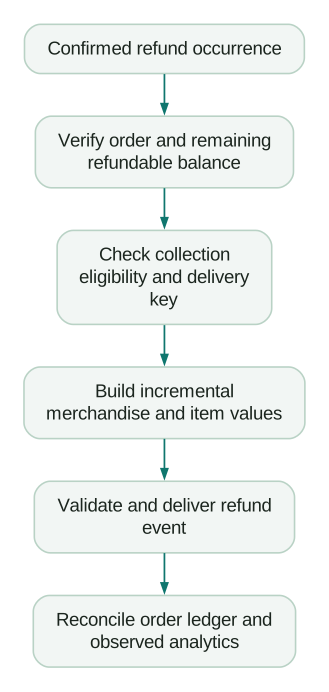
Reconcile in three passes
Start with occurrence completeness. For a selected day, list confirmed refunds in the commerce system, exclusions with reasons, eligible events, delivery records and observed analytics events. Inspect the individual missing or extra records before calculating a percentage.
Next reconcile monetary components by currency. Compare merchandise with merchandise, tax with tax and shipping with shipping. Do not add USD and EUR amounts into a single number without an explicit conversion convention. For a small diagnostic sample, keep the original currency to avoid introducing an exchange-rate question while investigating a payload issue.
Finally reconcile items and order history. One order with two partial refunds is one refunded order, two refund occurrences and potentially several refunded units. Those counts should differ. Google's ecommerce metric definitions distinguish event-scoped and item-scoped metrics; the Refunds metric counts refund events. The Transactions metric can also include refunds, so it should not be casually renamed “orders.”
For the worked example, expect one original order, two refund occurrences, two refunded units and $65 refunded merchandise. If your report shows two refunded orders, check its aggregation key. If it shows three refunded units, check whether the first refund copied the original quantity of two.
A GA4 BigQuery export can make event-level investigation easier, but it does not replace the commerce ledger. Preserve the source's refund IDs and delivery evidence so a discrepancy can be traced back to an actual business occurrence.
Answer two different revenue questions with two different views
“Which orders eventually produced valuable customers?” and “How much was refunded this month?” are different questions.
For order-cohort analysis, attach subsequent refunds to the original order in your warehouse and declare the observation window. A September order with a $30 refund in October has a different final value from its value at the end of September. Mark immature cohorts so a recent campaign is not flattered by returns that have not happened yet.
For refund operations, group refunds by their actual occurrence date. This reveals current return volume, support load and cash movement. Keep the original purchase date available as another dimension, not as a replacement for the refund date.
If comparing campaigns, choose a common maturity window, such as a business-approved return horizon, and compare net merchandise contribution on that basis. Do not assume the same horizon works for every product category. A business with lengthy trials or seasonal returns needs a different definition from one selling instantly consumed services.
The same discipline helps investigate a GA4 and Shopify purchase mismatch: align business meaning, scope and time before trying to force two headline totals to match.
Test the cases that can lose money in the report
Use synthetic orders in an approved test environment and retain the expected ledger beside the event evidence. DebugView helps inspect collected events and parameters; it is not proof that every production report has reconciled.
Checklist
- A full refund without earlier partial refunds carries the correct original order ID and refundable amounts.
- Two partial refunds on one order remain distinct occurrences without repeating cumulative totals.
- A duplicated provider notification does not create a second delivery record for the same refund.
- A pending or failed refund produces no confirmed-refund event under the chosen policy.
- Item quantities, discounts, tax and shipping match the historical order and actual refund.
- Missing order identity or collection eligibility enters an explicit exception queue.
- A refund in a later month appears correctly in both the operational and order-cohort warehouse views.
- A processed analytics sample reconciles occurrence counts, units and amounts independently.
For an ambiguous network outcome, keep enough evidence to investigate before blindly replaying a financial event. A delivery system should distinguish queued, attempted, acknowledged and reconciled states. “The webhook ran” is not a revenue control.
Once these cases pass, review exceptions regularly with the person who owns commerce data. Start with a small set of real, eligible orders and expand the reconciliation after the mappings are stable. That gives marketing a dependable net revenue view and finance an explanation for the remaining differences.
Questions people ask
Should a GA4 refund use the original transaction ID?
Yes. The refund refers to the original order through transaction_id. Keep a separate refund occurrence ID in your own system to distinguish partial refunds and control delivery retries.
Should refund value include tax and shipping?
The documented refund value is based on item price multiplied by refunded quantity, excluding tax and shipping. Send those components separately and compare merchandise value with the equivalent commerce measure.
Can one order have several partial refunds?
Design your source ledger to preserve each confirmed occurrence and its incremental amounts. Test how each event is collected and reported in your implementation, and do not deduplicate legitimate occurrences merely because they share an order ID.
Why does my refund count differ from refunded orders?
An order can generate multiple refund events, and each event can include multiple units. Count distinct order IDs for refunded orders and use separate measures for occurrences, units and monetary value.
Can I use GA4 as my accounting refund ledger?
Use your commerce and payment records as the authoritative financial record. Analytics collection eligibility, delivery, identity and reporting scope can differ, so GA4 is useful for measurement and investigation but should be reconciled against that record.
Sources
- Google: Measure ecommerce. Accessed 29 September 2026.
- Google: GA4 refund event reference. Accessed 29 September 2026.
- Google: Minimize duplicate key events with transaction IDs. Accessed 29 September 2026.
- Google: Send Measurement Protocol events. Accessed 29 September 2026.
- Google: About ecommerce metrics. Accessed 29 September 2026.
- Google: Monitor events in DebugView. Accessed 29 September 2026.
Written by
Jafrin Akter AloData Engineer and Co-founder, martechdevs
Jafrin Akter Alo is a data engineer and co-founder of martechdevs, where the team has delivered 74+ martech, data and growth stack implementations.