
Why Meta reports more conversions than GA4
Data Engineer and Co-founder, martechdevs
Last updated 11 min read
Meta can report more conversions than GA4 because the two reports observe different signals and apply different rules for credit, timing and identity. A genuine duplicate implementation can also inflate results. Compare the same business outcome and reporting scope first, then separate collection gaps from attribution differences. A larger Meta number does not by itself prove overcounting, and a smaller GA4 number does not automatically make GA4 the correct answer.
Last updated: 30 September 2026.
Start with three different questions
Before comparing totals, decide which question each system is answering:
- What actually happened in the business? Use the order, payment, subscription or CRM record with an explicit success definition.
- What events did our measurement implementation collect? Inspect event delivery and processing, including duplicates and missing records.
- Which marketing activity receives credit? Inspect each platform's attribution settings and reporting model.
For ecommerce, an order created, a payment captured and a completed non-refunded sale are different outcomes. For SaaS, a user registration, new trial workspace and first paid account are different outcomes. Make the comparison about one of them.
Do not compare Meta's attributed Purchase count with every GA4 key event. Select the equivalent event and check whether both implementations trigger from the same evidence of success. Use the key-event and conversion guide if the selected metrics are unclear.
Build a comparison record before changing tags
Save the Meta report and GA4 report settings together. Record the event, data source, account or property, date range, time zone, attribution window, reporting time basis, filters and selected columns. Include whether the report covers web, app or offline activity and whether its outcome represents new or returning customers.
For an API or dashboard export, record the request parameters too. Meta's Insights reference exposes attribution-window, reporting-time and account/ad-set attribution controls. A connector can query a different combination from the one a person sees in Ads Manager.
In GA4, distinguish first-user, session and event-scoped traffic dimensions. Changing the reporting attribution model affects reports using event-scoped traffic dimensions; it does not redefine Session source or First user medium. Google's attribution settings guide explains that scope difference.
A useful comparison note might say: “Website purchases only, completed days in the account's agreed time zone, Meta's saved attribution settings, and GA4 purchase credit for the defined Meta campaign group using the recorded attribution model.” Keep a separate all-channel purchase total to assess collection coverage.
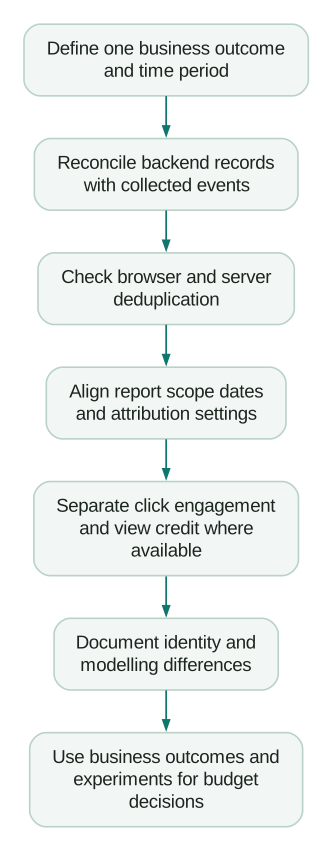
Follow the branches in that order. Attribution settings cannot repair a Purchase event that fires when someone merely opens checkout.
View-through and engagement credit can exist without a tracked website click
A person can see an ad, later visit through another route and buy. If the selected Meta attribution setting gives credit for an eligible view, Meta can credit that outcome even though the buying session does not carry a Meta campaign click in GA4.
The same principle applies to eligible engagement-based credit. A website-only click comparison excludes interactions that did not send the person to the site at that moment. Confirm which interaction types the selected report includes before calling the difference a tracking error.
There is a relevant change in current guidance. In its March 2026 measurement announcement, Meta said it was narrowing click-through attribution for website and physical-store conversions to link clicks. Other social interactions were moving into a category renamed engage-through attribution, with rollout timing varying across advertisers. Do not apply an old “all clicks count as click-through” explanation to every current report.
Inspect the available attribution comparisons for the account and period. Compare a click-focused view with the broader configured view without changing the campaign's optimisation setting solely for reporting convenience. Record the effective definitions, especially when comparing periods across a measurement change.
Do not add overlapping window columns. A seven-day click result can contain outcomes also counted in a one-day click result. Treat them as alternative reporting windows unless the export explicitly supplies mutually exclusive groups.
Different windows and date bases move credit
Two reports can disagree even when both received the same purchase. If one includes an eligible earlier interaction and the other excludes it, they have different evidence available for assigning credit.
Use a simple illustrative timeline. A person clicks a Meta ad on Monday, reads a comparison through another channel on Thursday and purchases on Friday. A Meta report with an eligible click window can credit the ad. A cross-channel GA4 attribution view can assign credit differently, depending on the collected path and selected model. Neither total by itself reveals whether the Monday ad caused an additional sale.
Google's attribution overview explains how its models assign credit among eligible touchpoints. Its data-driven model can distribute fractional credit, so a channel's credited purchases need not be a count of whole, independently matched orders.
Then align the reporting date. Meta's Insights API supports an action_report_time that can report an action against impression time or conversion time. The API reference gives an example of the same action appearing on different days under those choices. Check what your connector requests and how the interface report is defined.
For monthly reconciliation, a purchase near the boundary can be especially confusing. Save both the actual outcome date in business records and the platform's reporting basis. Do not move the underlying business timestamp to make the monthly charts agree.
Identity and modelling give the platforms different observable paths
A browser identifier is one part of the evidence. Meta's Conversions API verification guidance describes matching customer-information parameters to Meta accounts and monitoring Event Match Quality separately from event deduplication. Its verification documentation explains those measures.
That distinction matters: matching asks whose activity an event may belong to, while deduplication asks whether two deliveries represent the same event. A stronger matching input does not prove that a purchase was unique or that an ad caused it.
GA4 can also connect activity across devices when the implementation supplies an appropriate User-ID. Its reporting identity can use User-ID, device ID and, for eligible blended reporting, modelling. Google's reporting-identity documentation describes those options. Do not reduce the comparison to “Meta knows people, GA4 only knows cookies.”
Check whether the metric you selected is observed, estimated or modelled and whether a special attribution mode is involved. Meta also offers incremental attribution alongside standard attribution, as described in its 2026 product update. A modelled output is not an order-by-order ledger you can necessarily join back to every payment record.
Keep the inference modest. Different identifiers and models can produce different credited totals; they do not establish which platform overstates this particular account. Use available implementation evidence and retain an unresolved category where the reporting surface does not expose enough detail.
Check whether GA4 missed the purchase or just credited another channel
Start with GA4's all-channel purchase collection for a completed period. Reconcile it with the same business transaction population where retained identifiers allow that comparison. If an order is present in GA4 but credited elsewhere, that is a different issue from a purchase event that never arrived.
Investigate missing records by collection path. Relevant hypotheses include a checkout return that never happens, a browser tag that does not run, a changed consent flow, a purchase sent to the wrong property or an application error before the event is emitted. Verify the hypothesis on actual eligible examples instead of assigning every missing order to ad blockers.
Check duplicate and failed transactions too. GA4 can also be wrong through overcollection. Compare transaction identifiers, success status, value, currency and relevant timestamps; a total that happens to match the backend can conceal offsetting duplicates and missing orders.
For missing campaign fields or broken navigation, use the GA4 (not set) guide and SaaS setup checks. Preserve campaign parameters and the intended cross-domain context through the real journey.
Use processed data. Google says reports can change while processing over 24–48 hours. Its data-freshness guidance is a reason to avoid diagnosing a permanent discrepancy from today's partial counts.
Verify that Pixel and CAPI describe the same purchase once
Sending the same outcome through the browser and server can improve delivery coverage, but the two deliveries need a shared event identity. Meta recommends matching the Pixel's eventID with CAPI's event_id, and matching the event name, for the same Pixel. Its documentation describes a 48-hour receipt window for that matching method. See Meta's deduplication rules.
The following is an illustrative inspection fixture, not a complete Pixel or API payload. Both records describe the same successful order, and the field spelling differs by delivery path as Meta requires.
business_outcome: confirmed_purchase
order_id: order_demo_1042
destination_pixel: SAME_PIXEL_ID
browser:
  event: Purchase
  eventID: purchase_order_demo_1042
  value: 99
  currency: USD
server:
  event_name: Purchase
  event_id: purchase_order_demo_1042
  value: 99
  currency: USD
Generate the identity from a stable, unique business outcome and pass it to both senders. If the browser and server independently generate random IDs, two individually valid requests can fail to match. If every purchase shares one constant ID, genuinely different outcomes can be mistaken for repeats.
Inspect the exact payloads, not just a plugin's “deduplication enabled” switch. Confirm the destination, event name, identifier and delivery timing for a known event pair. Keep retries associated with the same business outcome rather than generating a fresh identity each time.
Meta's verification guide exposes deduplication and key-usage information separately from matching quality. It also explains that the Overview can show received events before deduplication and other processing. A raw received count is not the same as attributed purchases in Ads Manager.
Look for extra senders
Inventory the native ecommerce integration, GTM, hardcoded Pixel, a server-side container and any CAPI gateway or custom webhook. A team can accidentally retain an old integration after adding a new one.
Give each business event a documented owner and delivery design. Two purchase events with different IDs can both pass a superficial payload check. Trace them back to the same order to identify the duplicate trigger.
For tests, use a controlled data source and understand its effect on production reporting. Meta's current CAPI usage documentation states that events carrying test_event_code are not automatically discarded and can be used for targeting and measurement. Do not assume a test label alone makes a production purchase harmless.
Work through a reconciliation without inventing an explanation
Imagine an illustrative period with 100 eligible paid orders in the backend. Your transaction-level audit finds 90 unique corresponding purchases in the GA4 export. The selected GA4 attribution report credits 35 purchases to your defined Meta campaign group. Meta reports 70 attributed purchases under its saved settings.
There are at least two separate investigations:
- Why did the 10 backend orders not appear in the audited GA4 dataset?
- Why do the two attribution reports credit different amounts to Meta activity?
The 90% transaction coverage describes the first investigation's observed join, not GA4's accuracy for every metric. The 70 versus 35 comparison does not show that Meta duplicated 35 orders. It also does not show that Meta generated twice the incremental value. You need the window, interaction, identity and collection checks above.
Now suppose another advertising platform credits itself with 50 purchases in the same broad business period. Adding 70 and 50 produces 120 platform-attributed purchases against 100 backend orders. The platforms can claim overlapping outcomes under their own models. Their totals are not mutually exclusive buckets in a shared accounting system.
Do not calculate a blended customer-acquisition cost by summing those conversion totals as if they were distinct new customers. Use a deduplicated business denominator with a clear new-customer definition, then use platform metrics for their intended optimisation and reporting purposes.
Choose the evidence that fits the decision
For billing and recognised revenue, use the relevant financial records and definitions. For measurement quality, use event-level delivery and transaction reconciliation where available. For campaign operation, use platform metrics while keeping settings and limitations visible.
For a material budget decision, ask the causal question: what would happen to the business outcome without the advertising change? A platform attribution total is evidence about credited activity under a model. It is not, on its own, your controlled experiment.
Where feasible, design an incrementality experiment with a defined outcome, population, test period and decision rule. Account for uncertainty and changes outside the test. Meta's measurement announcement itself identifies lift experiments as the stronger route to understanding additional outcomes. Do not substitute an account's modelled incremental-attribution setting for evidence that your specific budget test was randomised and adequately measured.
You do not need every dashboard to agree before making a decision. You need to know which differences are explained, which implementation defects remain and whether the conclusion survives the unresolved uncertainty.
Use this checklist before escalating the discrepancy
- Both reports refer to the same business outcome and eligible population.
- Web, app, offline and returning-customer activity are scoped deliberately.
- Date basis, time zone, processing maturity and attribution settings are saved.
- Click, engagement and view credit are compared using current definitions.
- GA4 collection gaps are separated from allocation to another channel.
- Browser/server event names, IDs, destinations and timing are checked.
- Raw received events are not confused with processed attributed outcomes.
- Extra integrations and duplicate triggers have been investigated.
- The final conclusion distinguishes observed facts, modelled credit and unresolved differences.
An analytics and tracking review should produce this reconciliation and repair the demonstrated collection defects. Ask for a repeatable comparison with saved definitions, rather than a promise to force Meta and GA4 to display the same total.
Questions people ask
Which number should I trust, Meta or GA4?
Choose the source that answers the question. Business records establish the defined outcomes; event audits establish collection quality; platform reports allocate credit under their settings. Verify each layer instead of declaring one tool authoritative for every decision.
Does CAPI automatically double-count Pixel purchases?
No. A correctly matched browser/server implementation can deduplicate the same outcome. Inspect the documented identifiers, event names, destination and timing, and check the deduplication results. Extra senders or independently generated event IDs can still create problems.
Will matching the attribution windows make the totals equal?
It removes one difference, but the platforms can still differ in observed events, identity, interaction types, reporting time and attribution model. Record the remaining causes instead of assuming a residual gap must be fraud or a broken tag.
Can I add Meta and Google Ads conversions to report total customers?
Not as a deduplicated customer total. Both platforms may credit the same business outcome. Count distinct eligible customers in your business data, and keep each platform's attributed result labelled separately.
Is there a normal acceptable discrepancy percentage?
There is no universal percentage that validates an implementation. Investigate the affected outcomes and the mechanisms behind the gap. A small overall difference can hide serious duplicates and omissions, while a large attribution difference may be explained by deliberately different reporting rules.
Sources
- Meta: Ads Insights reference
- Google: Select attribution settings
- Meta: March 2026 measurement changes
- Google: Get started with attribution
- Meta: Verify Conversions API setup
- Google: Reporting identity
- Meta: 2026 AI and advertising product update
- Google: Data freshness
- Meta: Deduplicate Pixel and Conversions API events
- Meta: Use the Conversions API
Written by
Jafrin Akter AloData Engineer and Co-founder, martechdevs
Jafrin Akter Alo is a data engineer and co-founder of martechdevs, where the team has delivered 74+ martech, data and growth stack implementations.