Marketing analytics MCP servers: Supermetrics, Funnel, Windsor.ai, direct platform servers or your warehouse
Data Engineer and Co-founder at Martechdevs and Growth and Analytics Partners
Last updated 15 min read
Marketing analytics Model Context Protocol (MCP) servers give an AI assistant tools for retrieving and analysing marketing data. Choose a reporting connector for a small cross-channel workload, direct platform servers for focused account questions, or a warehouse server for governed joins and history. Accept the connection only after its answers reconcile to known results, and separate reporting permission from any campaign-changing tools it also exposes.
The official MCP servers for individual marketing tools cover platform access. This guide owns the reporting decision: which connection route can answer your cross-channel question, under which permissions, and at what operating cost.
What is a marketing analytics MCP server?
A marketing analytics MCP server exposes tools an assistant can call to discover accounts, inspect fields and retrieve report data. The connection supplies access; metric definitions, joins and acceptance checks determine whether the resulting answer is useful.
| Reporting route | Where the assistant gets data | Main responsibility your team retains |
|---|---|---|
| Reporting connector MCP | A connector's supported sources and reporting model | Source/account selection, field meaning, subscription and access controls |
| Direct platform MCP servers | Separate Google Ads, Meta, Google Analytics 4 (GA4) or other platform interfaces | Multiple credentials, cross-platform reconciliation and joins |
| Warehouse MCP | Approved tables, views or analytical tools over retained data | Ingestion, identity, model quality, permissions and query cost |
For example, “Why did acquisition cost rise?” requires more than advertising spend. You need an agreed customer outcome, its observation period and the relationship between the customer relationship management (CRM) system and billing. An assistant can otherwise divide a plausible spend figure by the wrong denominator.
Our tracking and attribution implementation establishes those definitions and collection checks before the reporting interface is expanded. A fluent explanation should lead back to the accounts, fields and rows used to produce it.
Which reporting MCP options should you evaluate?
Evaluate the connection that fits your existing data and permissions, then test the intended report. The products below differ in commercial entitlement, data preparation and ability to change systems.
Supermetrics MCP and packaged AI Chats
- Best for: teams already using Supermetrics sources or its application programming interface (API) in a custom workflow.
- Pros: supported marketing sources can share one connection, with per-user OAuth or server-to-server API-key access.
- Cons: standalone MCP and packaged AI Chats have different entitlement paths; campaign writes need separate review.
- Free tier and trial: the MCP product page advertises a 14-day trial. Confirm the purchased route after it ends.
- Choose it if: the required source accounts, fields and API entitlement are included in your actual subscription.
- Skip it if: the proposed package does not include the route or source scope your report requires.
Use the narrower standalone MCP setup requirement: a valid subscription with Supermetrics API access. The product page also has a broader any-subscription headline. Packaged AI Chats is a separate destination or trial; adding, swapping or upgrading that destination is a different purchase decision from standalone MCP.
Supermetrics can create and modify campaigns. Its campaign controls include account-specific write grants and configurable approval levels, including a setting without human approval. For a reporting pilot, keep campaign writes outside the permitted tool set and verify the underlying account access. A paused new campaign is still a created object.
Funnel MCP
- Best for: querying marketing data and definitions already organized in Funnel workspaces.
- Pros: the MCP tools are read-only and use the workspace context and fields available to the login.
- Cons: connected-source health and partial metric coverage still need checking.
- Free tier and trial: MCP is included across Funnel plans and consumes no flexpoints; the Funnel subscription and sources remain separate costs.
- Choose it if: a read-only endpoint and maintained workspace definitions fit the reporting job.
- Skip it if: the required source or historical evidence is absent from the workspace.
The Funnel quick start uses OAuth and regional endpoints. Copy the correct connection from Funnel AI: the global server is https://mcp.ai.funnel.io/mcp, while EU subscriptions use https://mcp.eu.ai.funnel.io/mcp. Load the intended workspace and its context before field discovery. The default query response returns up to 500 rows, so a displayed table can require a narrower query rather than being the complete result.
Windsor.ai MCP
- Best for: evaluating a hosted connection across advertising, analytics and other supported business sources.
- Pros: one endpoint supports source discovery, field inspection and data retrieval.
- Cons: the server also exposes platform changes and configuration mutations; reporting access needs an enforced boundary.
- Free tier and trial: permanent free access is much narrower than the temporary multi-source trial, as the cost table below shows.
- Choose it if: the account/source allowance fits and you can restrict the host to the required reporting tools.
- Skip it if: the only available controls leave unwanted writes reachable by the reporting workflow.
The Windsor MCP reference uses OAuth with an API-key fallback and exposes more than advertising queries. Platform actions, custom-field creation and export-task creation are separate operations. Hiding actions from discovery with include_actions=False is not a documented revocation of write authority. Use an actual host tool allowlist and restricted source permissions, then test a denied operation. Its GA4 connection is a third-party hosted route.
Direct Google Ads, Meta and GA4 servers
- Best for: narrow questions where the operating team already owns the platform credentials and definitions.
- Pros: platform-specific tools provide direct access to the relevant reporting surface.
- Cons: you retain cross-system reconciliation and the hosting/authentication work each route requires.
- Free tier and trial: distinguish source access from client subscriptions and any infrastructure you run.
- Choose it if: one or two platform questions justify focused connections.
- Skip it if: the real job is a recurring customer-revenue join spread across several systems.
Google's Ads MCP implementation is read-only. It supports local operation and a team-operated remote deployment; Google's hosted endpoint is described as an allowlisted pilot. Use Google Ads MCP setup for that distinction.
Meta's developer announcement covers reporting and campaign-changing capabilities. Agency apps serving other businesses have additional review/access requirements. Follow the Meta Ads MCP setup and controls instead of assuming a reporting prompt disables writes.
Google's GA4 repository describes a local, experimental server, and its official introduction limits it to read requests. That documented route differs from a third-party hosted connector. The Google Analytics MCP guide covers its setup and reporting limitations.
BigQuery and Snowflake warehouse servers
- Best for: reports requiring governed CRM, billing and product joins with retained history.
- Pros: the assistant can use the same maintained definitions as other reporting consumers.
- Cons: ingestion, model ownership and effective tool permissions remain your responsibility.
- Free tier and trial: budget the warehouse's applicable compute/storage and AI-client costs; a server connection does not remove them.
- Choose it if: a trustworthy model already exists or the recurring reporting need justifies building it.
- Skip it if: a small standalone platform question would create an unnecessary warehouse project.
BigQuery's remote MCP uses OAuth and Identity and Access Management (IAM); execute_sql can do more than read when permissions allow it. Snowflake's managed server exposes a configured tool set. Neither should be called universally read-only. Use BigQuery MCP setup or Snowflake's managed MCP guide to restrict the actual tools, roles and data.
How should you choose between a connector, direct servers and a warehouse?
For a small team using two or three advertising platforms without a warehouse, start with a reporting connector and one completed-week acceptance test. Our preference is Funnel when a read-only endpoint and existing workspace definitions are decisive; an API-entitled Supermetrics setup or a suitably restricted Windsor configuration can be the better fit when their sources and commercial terms match the job.
Use a defined scenario to decide the shortlist:
| Situation | Starting route | Runner-up | What should decide |
|---|---|---|---|
| Two or three ad platforms, no recurring CRM join | Reporting connector | Direct platform servers | Supported fields, permission boundary and total connector cost |
| One Google Ads account with a specific diagnostic question | Direct Ads MCP | Existing reporting connector | Setup already owned and the required fields available |
| Repeated CRM, billing and product reconciliation | Warehouse MCP over a maintained model | Connector plus controlled intermediate model | Identity, history and reproducibility of the commercial outcome |
| Agency with separate client businesses | Workspace/account-separated connector access | Separate direct connections | Tested client isolation, ownership and offboarding |
| Finance-approved monthly figures | Governed pipeline and retained report | Connector export into the same controlled model | Reconciliation, restatement policy and reproducible snapshots |
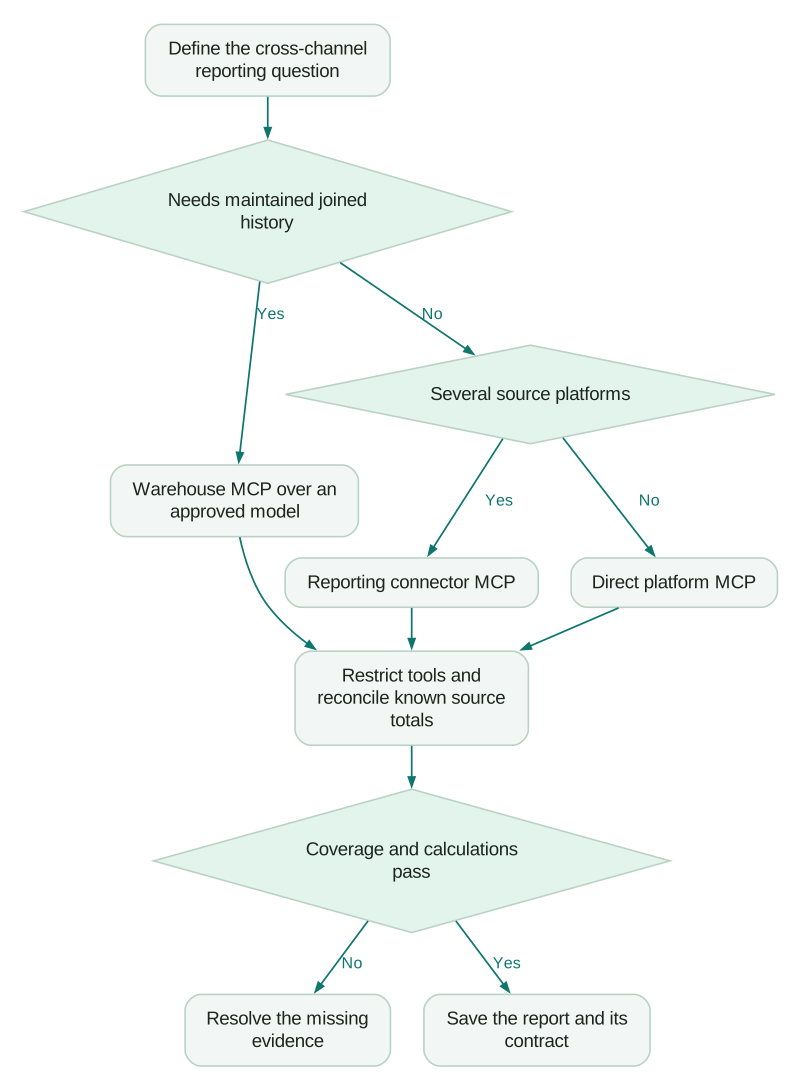
Account isolation needs more than a client name in a prompt. Supermetrics says MCP and AI Chats source connections are shared by default, so individual OAuth does not automatically isolate every client's data. Inspect subscription membership, shared connections and allowed accounts, and test the exact user who will produce the report.
For the client-side workflow, use connecting marketing data to ChatGPT. Keep the reporting route decision separate from which chat interface the analyst prefers.
Should Google Ads reporting use MCP, a pipeline or a dashboard?
Use a dashboard for a stable set of weekly numbers that many people read. Use a pipeline into a warehouse when you need preserved history, CRM revenue joins or figures finance can reconcile. Use MCP for exploratory questions on top of the appropriate data source or model.
These can work together: the pipeline maintains an approved account-level dataset, the dashboard publishes repeatable metrics, and the assistant investigates a change without redefining the metric. Check what the Google Ads MCP server can answer for the direct route and what a Data Studio dashboard costs to run for the recurring presentation layer.
Why do MCP answers disagree with the advertising platforms?
Most disagreements need a data-definition investigation before another prompt. Compare the exact account, field, period and attribution scope used by both results.
Which attribution definition is being compared?
Platform-attributed conversions, GA4 key events and CRM customers can all be valid measures of different things. A channel's credited conversion count should not replace distinct paid customers in an acquisition-cost denominator. Use why Google Ads and GA4 conversions differ to inspect collection, windows and reporting scope.
Which currency and date boundaries apply?
Keep spend in its source currency until an approved conversion rule is applied. Pin the reporting time zone, start/end boundaries, conversion time basis and data-completeness cutoff. A week split at different local midnights can produce different totals even when both queries succeed.
If a platform later revises conversions, retain the original report's extraction time and label any restatement. An assistant repeating last week's answer from conversation memory has not necessarily fetched the revised data.
Do similarly named fields mean the same thing?
Require a field dictionary. “Revenue” might mean attributed purchase value, paid invoice amount or contract value. “Conversions” might include multiple configured actions. A field normalized across connectors still needs its source definition and supported population.
Validate coverage as well as arithmetic. An unavailable metric should remain unavailable, and a truncated result should remain incomplete. Do not let a successful query envelope turn partial data into a complete cross-channel conclusion.
What costs belong in the reporting MCP budget?
Budget the source/connector entitlement, AI client, hosting and operating work separately. These are access and allowance distinctions, not comparable vendor subscription quotes.
| Route | Access or allowance to establish | Cost boundary |
|---|---|---|
| Supermetrics standalone MCP | Valid subscription with API access; advertised 14-day trial | Packaged AI Chats is a separate entitlement path |
| Funnel MCP | Included across Funnel plans; no flexpoint use for MCP | Existing subscription, sources and client access still matter |
| Windsor trial | 30 days, one user, ten sources and fifteen accounts | Temporary evaluation allowances |
| Windsor Forever Free | One user, one source and one account after trial; Free card states 30-day history | A three-source report exceeds the permanent source allowance |
| Direct or warehouse server | Source permissions, client plan and any deployed infrastructure | Queries, storage, model maintenance and operating time |
The Windsor allowances come from its pricing page. Confirm the paid configuration for the accounts, history and refresh needs you intend to keep after the trial. The reporting connector budget guide helps separate the data-access bill from the dashboard itself.
For custom ChatGPT connections, OpenAI's plan and workspace guidance describes full MCP on Business and Enterprise/Edu web accounts, with Pro limited to custom read/fetch access. Business creation and publishing are restricted to admins/owners. Enterprise/Edu can authorize selected members to create and test connections, but only admins/owners can publish them. A packaged app and a custom server can have different access requirements. Confirm the actual route and workspace policy before buying a connector for it.
How do you calculate blended acquisition cost without hiding unknown customers?
Use a reconciled customer count and label the cost basis. For this hypothetical completed week, Google Ads spend is USD 12,000 and Meta spend is USD 8,000. HubSpot supplies fifty distinct newly paying accounts under an agreed, billing-reconciled definition. Total paid-media spend per new customer is 20,000 / 50 = USD 400.
This is blended paid-media acquisition cost, not fully loaded customer acquisition cost (CAC): staff, agency, tools and other acquisition costs are excluded. A same-week ratio also does not establish that the week's spend caused those customers to buy; sales cycles can cross reporting periods.
Assume the fixed acquisition mapping assigns thirty customers to Google Ads, fourteen to Meta and leaves six unknown. All values below are hypothetical USD inputs for the same reporting scope.
| Reporting group | Media spend, USD | New customers | Spend per mapped customer, USD |
|---|---|---|---|
| Google Ads | 12,000 | 30 | 400.00 |
| Meta | 8,000 | 14 | 571.43 |
| Unknown acquisition source | Not allocated to this group | 6 | Not calculated |
| All new customers | 20,000 | 50 | 400.00 blended |
The six unknowns are 6 / 50 = 12% of the customer population. Keep them in the overall denominator. Per-channel ratios use their mapped customer counts, so missing source evidence can change the channel comparison. Dividing all spend by only the forty-four mapped customers would produce USD 454.55 and answer a different question.
Do not distribute the unknowns in proportion to spend to make the table complete. Resolve their source where retained evidence supports it, or keep the uncertainty visible.
Use a prompt that makes the reporting contract explicit:
For the approved Google Ads, Meta and HubSpot accounts, report the completed period [start inclusive, end exclusive] in [time zone]. Use USD spend and the billing-reconciled definition of first paid account. Return source totals before joining them. Count each new customer account once. Show the chosen acquisition mapping, mapped and unknown customer counts, and any unavailable or truncated result. Calculate total paid-media spend divided by all eligible new customers; show channel ratios separately. Do not change campaigns, fields, exports or account settings. Cite the account IDs, fields, filters and retrieved evidence supporting the result.The prompt is an analytical request. Actual tools, permissions and deterministic checks must enforce the reporting boundary and reject a missing source or duplicated customer denominator.
How do you set up a reporting connection that reconciles?
Start with one narrow report and an explicit pass/fail result. Expand sources only after the original report remains reproducible.
- Name the source accounts. List the accounts or workspaces the login can access and select the intended client explicitly. Keep the account inventory with the report.
- Restrict the tools. Permit the required discovery and read operations. Exclude campaign changes, custom-field creation, exports, messaging and other mutations unless they have a separately approved workflow.
- Write the reporting contract. Define metrics, customer unit, source fields, currency, time zone, period, attribution scope, missing-data handling and duplicate rules.
- Run a known-answer test per source. Reproduce one completed period against the source report with the same filters. Investigate any difference before combining platforms.
- Test the joins. Include a repeated CRM deal, an unmatched customer, an unavailable source and a partial result. The report should expose the exception and preserve the correct denominator.
- Save the evidence. Retain the contract, prompt, source outputs, reconciliation and extraction time with the approved report. Record the owner who can repair a failed refresh.
An instruction such as “do not write” is useful context, but the connection's permissions must carry the restriction. Use the MCP access and action checks before sharing advertising accounts with an assistant. If the available host cannot enforce the required tool boundary, choose a route that can.
When should reporting move into a warehouse?
Move the recurring data preparation into a warehouse when maintained joins, history or several consuming reports justify the work. A warehouse becomes particularly useful when CRM revenue, product activity and advertising data must share definitions across a team.
Design the model's grain before connecting an assistant. One row per customer account for a weekly report needs a different aggregation from one row per campaign/day. Joining raw deals to raw campaign rows can multiply both spend and customer counts.
An internal MCP server over warehouse models can expose a limited set of approved questions or views. Our data warehouse implementation includes the source reconciliation, modelling and operating handover needed to make that interface dependable. Keep query permissions and spending controls aligned with the assistant's actual job.
Checklist
- Every required source, account and reporting owner is identified.
- The selected route has the necessary source and client entitlements.
- Reporting tools cannot invoke unwanted writes or configuration changes.
- Shared workspace and connection access matches each client's boundary.
- Currency, time zone, period, metric definitions and attribution scope are fixed.
- Known source totals reconcile before cross-channel calculations run.
- Customer counts deduplicate at the intended commercial unit.
- Unknown source, unavailable fields and truncated results stay visible.
- Trial expiry, source allowances and continuing operating costs are included.
- The saved report has its contract, evidence and repair owner.
Want a second pair of eyes on your reporting stack? Book a free audit, or request a scoped analytics and tracking quote with the source accounts, definitions and acceptance cases included.
Questions people ask
How should an agency transfer a reporting connection when its engagement ends?
Agree on the customer's continuing account, subscription and credential ownership before the handover. Export the reporting contract and approved query definitions, then reconnect under the authorized receiving owner where the vendor requires it. Verify a known report and the intended account boundary before removing agency access. Copying a dashboard or conversation does not transfer the underlying source permissions or continuing subscription entitlement.
Can we average daily return on ad spend (ROAS) to produce a monthly result?
Calculate the ratio from the period's summed eligible revenue and spend, using the same definitions throughout. In a hypothetical USD example, one day spends 100 and receives 200 of credit; another spends 1,000 and receives 1,000. Their daily ratios are 2 and 1, but the combined ratio is 1,200 divided by 1,100, approximately 1.09. The simple average of 1.5 gives the small day too much weight.
Should a retried query append its rows to the first response?
Reconcile the query and pagination state before combining results. A retry may return records already present in the earlier response, so appending everything can multiply spending or outcomes. Keep one accepted result for the defined query scope, or deduplicate using a justified row key when the source requires it. Equal amounts are not a deduplication key: two different campaigns can legitimately report the same spending.
Can we compare a campaign launched on Friday with one running all week?
Show each campaign's active coverage and choose the comparison according to the decision. Whole-week totals answer a spending question; a rate over comparable active periods can answer another operational question. Keep the partial period visible, preserve the denominators and avoid filling pre-launch days with invented activity. A shorter exposure window can explain a difference without establishing that either campaign is more effective.
Can two USD fields use different monetary units?
Yes. Read the unit from each source field before adding amounts. In an illustrative dataset, 1,000,000 micro-units and USD 1 can represent the same amount, while summing their raw numbers would be meaningless. Apply one explicit conversion into the reporting unit, retain the original values and check a known source total. Confirm the unit again when a connector or API field changes so the conversion is not applied twice.
Sources
- Supermetrics: MCP product and trial.
- Supermetrics: Standalone MCP setup and entitlement.
- Supermetrics: Packaged AI Chats setup.
- Supermetrics: Campaign-management controls.
- Supermetrics: Shared and private connections.
- Funnel: MCP quick start.
- Windsor.ai: MCP tools and authentication.
- Windsor.ai: GA4 connection.
- Windsor.ai: Pricing and trial allowances.
- Google: Ads MCP developer integration.
- Meta: Ads MCP availability and capabilities.
- Google Analytics: MCP repository.
- Google Analytics: MCP introduction.
- Google Cloud: Remote BigQuery MCP.
- Snowflake: Managed MCP server.
- OpenAI: Custom MCP connections and workspace permissions.

Written by
Jafrin Akter AloData Engineer and Co-founder at Martechdevs and Growth and Analytics Partners
Jafrin writes practical guides to marketing technology, customer data, analytics and AI workflows. Martechdevs is a Growth and Analytics Partners company.