
Internal MCP server for RevOps: what to build and how to scope it
Data Engineer and Co-founder, martechdevs
Last updated 9 min read
An internal MCP server exposes your company’s approved data queries and operational actions to compatible AI applications. It is useful when a task needs information from several systems, company-specific metric definitions or tighter controls than a vendor connector provides. Start with a narrow business workflow, prepare its data, then expose only the tools needed to complete it.
Last updated: 3 September 2026.
A question about renewal risk can require HubSpot account ownership, Stripe subscription status and product activity from a warehouse. Each system has part of the answer. An internal server gives the assistant a controlled way to request the combined result.
The difficult work is deciding what the result means and proving that the records match. That is why our internal MCP implementation work starts with the business question and the data model. Once those are stable, the connection has a clear job.
When does an internal server make sense?
Build one when a repeatable task needs logic or access boundaries that the available connectors cannot express cleanly. The task should be valuable enough to justify ongoing ownership.
Useful candidates include:
- Explaining campaign revenue using ad spend, CRM attribution and paid invoices.
- Preparing renewal reviews using subscriptions, account ownership and usage.
- Finding product-qualified accounts using agreed activation rules.
- Producing a weekly pipeline report using finance-approved definitions.
- Preparing a narrow set of CRM changes from validated warehouse outputs.
A single-system question may already be served by an official connector. HubSpot’s remote MCP documentation describes access to supported CRM data through compatible clients. Building another server around the same operations adds maintenance unless it supplies a clear missing control or workflow.
Write the gap in one sentence: “We need account-level renewal risk using billing and usage, with access limited to the requester’s accounts.” If the gap remains vague, scope the workflow before choosing infrastructure.
What should the architecture look like?
Keep the business logic in maintained models and services. Let MCP expose a small, documented interface to those capabilities.
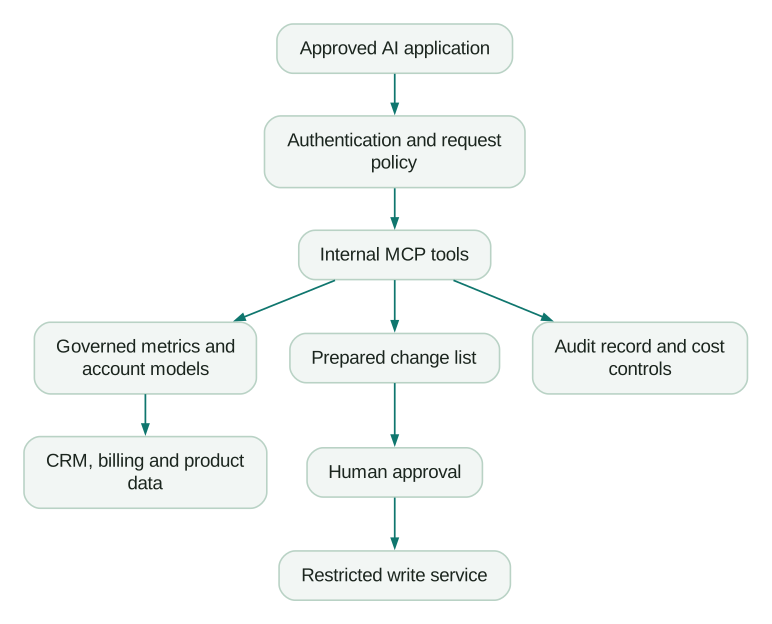
This design lets the same definition support dashboards, scheduled reports and AI questions. If monthly recurring revenue changes meaning, update the governed calculation and its tests. Maintaining separate definitions inside several prompts makes disagreement harder to trace.
A semantic layer is a maintained set of business definitions and relationships used to query data consistently. Snowflake’s semantic views, for example, can define metrics, entities and their relationships in the database. The specific technology can vary; the requirement is a calculation the team can inspect and reuse.
How do you choose the first tools?
Design each tool around a bounded business request. It should have clear inputs, a predictable output and a defined reason to refuse.
For a renewal workflow, the initial tool set might be:
- Get account renewal summary: return renewal date, subscription state, owner, usage period and missing-data warnings for an allowed account.
- Explain usage change: compare two specified windows using the agreed activity definition.
- Prepare follow-up tasks: produce proposed tasks with owners and reasons, without creating them.
These names describe a proposed design. They are not built-in tools you can expect from every MCP server.
Avoid making the first interface a general-purpose request such as “run anything against every system.” Flexible access makes it harder to test permissions, contain costs and reproduce an answer.
If analysts need exploratory SQL, consider a separate connection and role from the one business users employ for routine reporting. Snowflake’s managed MCP guidance recommends a governed agent for business questions and careful separation of direct SQL access.
What goes into a tool contract?
A tool contract describes what the caller supplies, what the service returns and how it behaves when the request cannot be completed.
For the proposed renewal summary, specify:
- Inputs: an account reference and an explicit reporting date.
- Allowed scope: accounts the authenticated requester may access.
- Definitions: the subscription states and usage events included.
- Output: renewal date, owner, subscription summary, usage comparison and evidence references.
- Freshness: the last successful refresh time for each contributing source.
- Completeness: whether any required source or identity match is missing.
- Errors: unknown account, denied account, stale source or unavailable system.
Keep “unknown” separate from zero. A missing usage feed cannot establish that a customer stopped using the product. Returning zero would turn an integration failure into a churn signal.
Make truncated results explicit too. If a request exceeds the permitted output size, return a continuation mechanism or a clear partial-result flag. The assistant should never infer completeness from a neat-looking list.
How do you prepare the underlying data?
Start with identity, event meaning and time. An assistant can only join records reliably when those foundations are explicit.
Resolve account identity
Choose the stable account reference that links CRM companies, billing customers and product workspaces. Preserve the mapping and the cases it cannot resolve.
One billing customer may pay for several workspaces. One CRM company may represent several legal entities. Decide whether renewal reporting is about a contract, a workspace or the overall account before aggregating usage.
Keep unmatched and ambiguous records visible. A report that silently excludes the hardest accounts can look accurate while missing the accounts most in need of attention.
Define the signal
“Active” needs a business definition. Logging in, inviting a teammate and completing the product’s core workflow describe different levels of engagement.
For a usage trend, specify the included events, eligible users, account exclusions and comparison windows. Exclude internal test activity deliberately and document the rule.
Define the clock
Record the source event time, the time it reached the warehouse and the reporting time zone. A late batch can change yesterday’s number. The tool should show when the data was last complete for the requested period.
Our small-company warehouse design guide explains how to keep source records, cleaned models and reporting outputs separate enough to investigate these issues.
How should authentication and access work?
Authenticate the requester, then apply their permitted scope to every tool call. Treat authentication and authorisation as separate checks: identity establishes who is calling; authorisation determines what they may do.
For a custom implementation, the MCP TypeScript SDK authorisation guide describes protecting a server through token verification and scope checks. Use the current SDK guidance for the version you deploy rather than copying an old authentication example unchanged.
The access decision should happen before sensitive records are returned. Asking the model to hide records after retrieval leaves those records inside the conversation context.
For background workflows, use a service identity with a defined business purpose. Give it a narrower role than the administrator who built the integration. Log the workflow and requesting actor where relevant.
Test two users with different account access. Confirm that the same question returns only each user’s permitted records. Then test an expired credential and a removed user. The MCP security checklist provides the broader set of denial and revocation tests.
How do you keep query costs under control?
Put limits in the execution path and the underlying platform. A prompt asking the assistant to “be economical” provides too little control over a costly query.
For each tool, decide the permitted date range, result size, query duration and number of retries. Reject requests outside that envelope or ask the user to narrow them.
Google’s BigQuery cost-control documentation describes estimating query size, limiting bytes billed for individual on-demand queries and using query quotas. Choose controls appropriate to the platform’s billing model.
A row limit and a scan limit solve different problems. Returning ten rows can still require scanning a large dataset. A smaller prepared reporting model can make a routine business tool more predictable than repeated queries across raw event history.
Log usage by tool and workflow. A sudden increase may come from a retry loop, a broader query or an assistant repeatedly asking variations of the same question. Cache only where the data scope, permissions and freshness requirements make reuse valid.
How do you add write actions safely?
Separate preparing a change from applying it. This gives the user a concrete result to review and gives the service a defined action to enforce.
For a proposed task-creation workflow:
- Retrieve the permitted renewal-risk records.
- Produce a change list with account, owner, task text and reason.
- Validate that the owner still exists and the task is still appropriate.
- Obtain approval for that exact list.
- Apply through a restricted service.
- Read back the resulting tasks and record their references.
Include duplicate handling. A retry after a timeout should check whether the task already exists before creating another one. Record enough information to reverse or correct a mistaken change through the destination’s supported process.
Also inspect existing automations. A CRM field update can trigger a lifecycle journey or internal notification. The visible update may be only the beginning of its business effect.
What does a worked example look like?
Illustrative example: a 25-person SaaS company wants to identify customers renewing next month whose core product activity has fallen. The stack includes HubSpot, Stripe and a BigQuery product dataset.
The team models one row per subscription renewal candidate. Each row links to the owning account and includes a comparison of completed core workflows over two equal periods. Records with missing account matches or incomplete activity data go into an exception list.
The MCP tool returns candidates, the agreed usage calculation, source refresh times and the exception count. The assistant writes a review brief. The customer success lead decides which accounts need follow-up.
For a modelled cost check, assume the old preparation takes four hours a week. The new process needs one hour of review and half an hour of average maintenance. At an assumed $65 an hour, the saved 2.5 hours are worth $162.50 weekly. Across four weeks, that is $650 before hosting, model and query charges.
A hypothetical $6,000 initial build would therefore take more than nine months to recover through those time savings alone, even before running costs. These are planning assumptions, not a Martechdevs quote. Additional value from earlier renewals needs separate evidence and should not be counted as guaranteed revenue.
What should you test before launch?
Build a small set of known questions with expected answers and failure behaviour. Keep the evidence alongside the tool definitions so changes can be checked against the same cases.
Checklist
- A normal request matches a manually checked result.
- An account with several subscriptions is counted correctly.
- An unmatched account appears as an exception.
- Missing data stays distinct from zero activity.
- Time-zone and reporting-window boundaries behave as specified.
- An unauthorised account request returns no sensitive record.
- A stale source is visible in the result.
- A large request is rejected or bounded before expensive execution.
- A partial result is labelled clearly.
- A repeated write request does not create duplicates.
- Revoking access prevents further authorised use as designed.
Measure accepted answers, correction time, failed calls and cost per completed workflow. A tool that connects reliably can still produce a report people spend too long repairing.
At Martechdevs, we build the data access, definitions and working instructions behind repeatable AI workflows. Start with the free martech AI audit, or explore an AI assistant built around your approved workflows.
Questions people ask
Does an internal MCP server need a warehouse?
No. It can call approved APIs or other services directly. A warehouse becomes useful when the task needs historical joins, shared definitions or analysis across several sources. Choose the data architecture around the question.
Can it work with several AI applications?
MCP is designed for compatible clients, but support for authentication, transport and particular features varies. Test each intended application against the deployed server. Compatibility with one client does not prove the same user experience in another.
Should we expose raw SQL to marketing users?
Routine business questions usually benefit from narrower tools over prepared models. Analysts may need exploratory access under a separate role with query controls. Make that choice according to the work and the data boundary.
Who should own it after launch?
Assign a technical owner for credentials, infrastructure and failures, and a business owner for definitions and workflow acceptance. They can be the same person in a small team. Ownership needs to survive the person who first built the prototype.
How long does the build take?
The answer depends on data readiness, authentication, client compatibility and write requirements. A connector over prepared data has a different scope from joining unreliable billing and CRM histories. Estimate those work packages separately after inspecting the actual systems.
Sources
- HubSpot, Integrate AI tools with the HubSpot MCP server, current documentation, accessed September 2026.
- Snowflake, Overview of semantic views, current documentation, accessed September 2026.
- Snowflake, Snowflake-managed MCP server, current documentation, accessed September 2026.
- Model Context Protocol, Require authorisation in the TypeScript SDK, current documentation, accessed September 2026.
- Google Cloud, Estimate and control BigQuery costs, current documentation, accessed September 2026.
Written by
Jafrin Akter AloData Engineer and Co-founder, martechdevs
Jafrin Akter Alo is a data engineer and co-founder of martechdevs, where the team has delivered 74+ martech, data and growth stack implementations.