
Intercom vs Customer.io: Choose Who Owns Support and Lifecycle Messages
Choose Intercom when the immediate job is answering customers, routing conversations and guiding people through the product beside that support experience. Choose Customer.io when the job is coordinating lifecycle messages around product events, account data and progression. Run both when those jobs have separate owners and enough value to justify the integration, with one sender responsible for each message purpose.
On this page
The wrong comparison starts with “both send email.” A support reply, an activation reminder and a guided product tour have different triggers, owners and completion signals. Buying one platform does not make those operating decisions disappear.
Martechdevs implements CRM and lifecycle workflows; the tools' subscriptions and usage charges are separate from our customer support automation. Our default is to solve the current bottleneck first, then add a second platform only when its distinct work and ongoing owner are clear.
Which tool fits your team's current job?
Choose the platform around the customer task and team that must operate it. For a small company, fewer systems can be valuable; for a growing company, forcing every journey into the support team's tool can create a different maintenance burden.
| Situation | First fit to evaluate | Runner-up or complement | Decisive test |
|---|---|---|---|
| Founders answer customer questions and deliver guided onboarding | Intercom | Existing email tooling until lifecycle complexity justifies more | Can the team resolve and hand over the customer's issue? |
| Growth owns event-driven activation and retention across channels | Customer.io | Intercom for the human support conversation | Can each journey enter, stop and resume from trustworthy product state? |
| Support and lifecycle have distinct owners and recurring workloads | Both, with explicit purpose ownership | Consolidate only if one platform passes both operating tests | Can an open setup problem pause the correct reminder without losing support? |
| A team already has a suitable helpdesk and mainly needs lifecycle orchestration | Customer.io | Keep the current helpdesk | Does the new platform cover necessary journeys without duplicating the existing inbox? |
Intercom's Series can run multi-step journeys containing emails, in-app content and Product Tours. It is not limited to live chat. Customer.io's pricing includes a visual workflow builder and multiple messaging channels. Evaluate the actual workflow rather than deciding from a generic feature label. Intercom Series, Customer.io plans.
Use Intercom versus Zendesk for a helpdesk decision and Braze versus Customer.io when the shortlist is primarily lifecycle platforms. Those are different comparisons from deciding whether support and growth should share a sender.
What are the practical strengths and tradeoffs of each tool?
Intercom's strength is the operating environment around customer conversations. Customer.io's strength is turning maintained customer data into coordinated journeys. The right tradeoff depends on who owns configuration, data quality and the response when something fails.
Intercom
Best for: a support-led product experience where the Inbox, knowledge, human handoff and proactive guidance belong together.
Pros:
- Shared inbox, ticketing and Help Center sit beside customer messaging.
- Series can combine timed paths and several outbound content types.
- Eligible startups can evaluate an Advanced bundle at a substantial introductory discount.
Cons:
- The bill can include seats, Fin outcomes, channel usage and add-ons.
- A conversation's closure is not automatically proof of product activation.
- Lifecycle logic still needs disciplined event timing, exit rules and message ownership.
Free tier and startup offer: distinguish a trial from the eligible Early Stage programme. Its discount and included usage change over time; the three-year example below shows why year one alone is an incomplete budget.
Choose it if the support team's daily work and product guidance are the main purchase requirement. Skip it as the sole platform if the required lifecycle model cannot be operated reliably by the team responsible for it. Intercom product and pricing scope.
Customer.io
Best for: a growth or lifecycle team coordinating messages from customer events, attributes and account-level context.
Pros:
- Journeys can span email, mobile push, in-app and other configured channels.
- People and objects support a model broader than an email list.
- Unlimited user seats can let lifecycle, data and product colleagues collaborate without a per-seat line item.
Cons:
- A messaging workflow does not replace the shared service inbox and staffing process your support team needs.
- People and object profiles both contribute to the bill.
- SDKs, event definitions, templates and integration ownership remain implementation work.
Free tier and startup offer: a trial and the application-based Startup Program have different conditions. Eligible startups can receive up to twelve months with a defined profile allowance; budget the paid state before enrolling.
Choose it if product-state-driven messaging is the team's main job and someone owns its data contract. Skip it as a helpdesk replacement if the requirement is managing live support conversations and human service queues. Customer.io channel setup, plan features.
Where do onboarding messages and support conversations belong?
Assign ownership by purpose, not by the channel both tools happen to support. An email can be a service response, a transactional notice or a lifecycle nudge, each with different rules.
| Customer moment | Proposed owner when using both | Required evidence |
|---|---|---|
| Customer asks why setup failed | Intercom support workflow | Verified person/account, issue, next responder and expected response |
| Account has not completed the activation milestone | Customer.io lifecycle journey | Current milestone, elapsed time, eligible recipient and permitted channel |
| User needs contextual instructions on a product screen | One selected in-app owner | Correct screen, identity, content and completion event |
| Blocking support issue is resolved | Support publishes state; lifecycle re-evaluates need | Resolution and freshness, followed by current activation status |
| Product sends a security or billing notice | The separately approved transactional owner | Purpose-specific eligibility and delivery evidence |
The support system should publish a narrow state such as “this account has an unresolved setup blocker,” with its observation time. Lifecycle decides which reminders that state should pause. The support customer-context guide explains why the affected account and the person asking for help must remain distinct.
Avoid using every open conversation as a global marketing stop. A harmless feature question and a blocked implementation are different states. Equally, do not let “no matching support record” become “no blocker” when the identity join failed.
An in-app message is also not automatically a product tour. Customer.io supports web and mobile in-app messaging through the corresponding integration; web messages require a suitable page and identified person unless an eligible anonymous-message path is used. Test the placement your product needs. Customer.io web in-app setup.
Customer.io's native push setup covers mobile applications, not web push. A web-push requirement needs a separately supported integration route. Channel requirements.
How is each subscription bill built?
Intercom combines teammate access with usage and optional capabilities. Customer.io combines profile capacity and email volume with the chosen plan and additional services. Compare the scope you will operate, not the lowest number on either page.
Published USD starting points, before tax and additional usage. These entries describe different capabilities and are not equivalent bundles.
| Price component | Public starting point | What to include in the comparison |
|---|---|---|
| Intercom Advanced | USD 85 per full seat/month on the annual display | Required support seats and commitment |
| Intercom Proactive Support Plus | USD 99/month | Product Tours, Checklists, Series and other included capabilities |
| Intercom Pro add-on | From USD 100/month | Whether the required advanced features justify another line item |
| Customer.io Essentials | USD 100/month, billed monthly | 5,000 people-plus-object profiles and one million monthly emails |
| Customer.io Premium | From USD 1,000/month, billed yearly | Negotiated volume and additional operating requirements |
Intercom also displays a new-customer Essential promotion; do not apply that offer to every renewal or billing arrangement. Check the actual order and included scope. Intercom pricing, Customer.io pricing.
For Fin over chat and email with Intercom, USD 0.99 applies to specified outcomes, including resolutions and completed Procedure handoffs. Full-rate qualifications are USD 9.99. A default escalation or unsuccessful Procedure has different treatment. Count the actual outcome category; a human receiving the conversation does not by itself determine the charge. Fin outcome definitions.
Customer.io Essentials lists additional profiles at USD 0.009 each and additional emails at USD 0.12 per thousand. Profiles include people and objects across workspaces. A profile present during the billing period still counts if later deleted, and deleting then recreating it can add another billable profile instance. Count billable profiles rather than a convenient end-of-month active-user total. Customer.io billing.
Use the detailed Intercom pricing guide and Customer.io pricing guide for the wider commercial questions. Include implementation, maintenance, a retained helpdesk and any channel-provider costs separately.
How do the startup offers change after the first year?
Intercom's Early Stage discount decreases over three years, while Customer.io's eligible free term ends after up to twelve months. Neither introductory offer should become a permanent cost assumption.
For a newly eligible Early Stage enrolment, Intercom advertises 93%, 50% and 25% discounts in successive years, with 300, 150 and 75 included Fin outcomes per month. Fifteen qualifications are a separate included allowance. The bundle includes six Advanced seats, six Copilot seats and twenty Lite seats. Eligibility includes fewer than fifteen employees, up to USD 10 million raised and not being a current Intercom customer. Early Stage offer.
The current programme help lists the monthly bundle fees explicitly as USD 65, USD 451.50 and USD 677.25. Use those published fees rather than deriving the first-year amount from a rounded discount headline. The programme's inclusion rules depend on enrolment history, so an older partner or startup quote should be checked against its actual terms. Early Stage pricing details.
Customer.io's Startup Program includes up to 30,000 people-plus-object profiles for up to twelve months. It requires an application, less than USD 10 million raised, no previous Customer.io customer relationship and appropriately obtained contact lists. A card is required for this programme, and additional profiles cost USD 0.007 each. Its graduation offer is individualized; do not invent a fixed second-year discount. Customer.io Startup Program.
Link the programme end date to a commercial decision owner. Check expected usage, required capabilities and the cost of staying before the introductory period ends. If a different tool is necessary, leave time to rebuild templates, consent, identities and active journeys.
What does a three-year cost model show for a small SaaS?
A constant-usage model exposes discount expiry and falling allowances even before business growth increases usage. The example below is hypothetical and compares platform line items, not equivalent complete support systems.
Assume a ten-person SaaS with three support operators, 20,000 total billable Customer.io profiles, email volume within the included allowance and 400 qualifying USD 0.99 Fin outcomes each month. Assume approval for Intercom's current Early Stage programme and a full twelve-month Customer.io startup term. No full-rate Fin qualifications, additional outbound charges, SMS, WhatsApp, Phone, tax or implementation costs are included. The three operators fit inside Intercom's six-seat bundle; we do not divide its fixed fee by the number of seats used.
For Customer.io years two and three, use standard Essentials arithmetic at unchanged public rates, without assuming a graduation discount: 100 + (20,000 − 5,000) × 0.009 = USD 235/month. This is a planning scenario, not a renewal quote.
| Monthly line item | Year one | Year two | Year three |
|---|---|---|---|
| Intercom startup bundle | USD 65.00 | USD 451.50 | USD 677.25 |
| Fin outcomes above the included allowance | USD 99.00 | USD 247.50 | USD 321.75 |
| Selected Intercom subtotal | USD 164.00 | USD 699.00 | USD 999.00 |
| Customer.io selected lifecycle line | USD 0.00 | USD 235.00 | USD 235.00 |
| Both selected platform lines | USD 164.00 | USD 934.00 | USD 1,234.00 |
The Fin calculation is max(400 − included_outcomes, 0) × 0.99. For example, year two charges 250 excess outcomes: 250 × 0.99 = USD 247.50.
| Twelve unchanged months | Year one | Year two | Year three |
|---|---|---|---|
| Selected Intercom subtotal | USD 1,968 | USD 8,388 | USD 11,988 |
| Customer.io selected lifecycle line | USD 0 | USD 2,820 | USD 2,820 |
| Both selected platform lines | USD 1,968 | USD 11,208 | USD 14,808 |
The three-year combined total is USD 27,984 under these assumptions. Customer.io's line does not include a replacement for the human support operation. Intercom's subtotal does not prove that every required lifecycle workflow is covered. Add retained systems and the cost of operating each arrangement before selecting one.
Stress-test the two biggest drivers independently. More billable Fin outcomes increase the usage line; more people, accounts or duplicated workspace profiles increase Customer.io's profile line. A cheaper programme year can also conceal an expensive implementation that nobody maintains. Use actual expected volumes rather than assuming the current sample remains constant for three years.
How should you test the same onboarding journey in both platforms?
Use one product milestone, one audience and the same exit and suppression rules. The useful test is whether the customer receives the right next step and stops receiving it after progress.
Consider an illustrative activation journey: a workspace was created, the customer has not connected a data source, and a reminder becomes eligible after an agreed delay. A current blocking support issue pauses that reminder. A completed connection ends it. If support resolves the issue later, the journey rechecks whether a reminder is still needed.
| Test case | Expected behaviour | Evidence to inspect |
|---|---|---|
| Eligible account with no current blocker | One approved reminder | Correct person, account, purpose and sender |
| Connection completes before the reminder | No setup reminder | Product milestone and exit decision |
| Current setup blocker | Hold the affected nudge; support continues | Reviewed issue state and receiving owner |
| Support state is missing or stale | Follow the defined hold or review policy | Freshness failure, not an invented “no issue” result |
| Issue resolved after activation | Do not restart an obsolete reminder | Current milestone rechecked after resolution |
| Same event is delivered twice | One business message for that episode | Durable event/episode identity and dispatch record |
Intercom's event-triggered Series entry checks the person's attributes when the event arrives. If a required attribute is written afterward, the person may miss entry even though the profile looks correct later. Update prerequisites first or evaluate later-arriving state after entry. Repeated entries waiting for a person to come online can also accumulate messages. Series timing and re-entry.
Customer.io's current automation exit settings can use profile attributes, events and segments. Conditions are combined as alternatives: meeting any configured exit condition can end the journey. Review the actual automation and trigger type rather than copying an old campaign screenshot. Customer.io automation exits.
Test the real browser or app placement as well as message eligibility. A delivery request does not prove that the identified user saw the in-app message on the intended screen. The onboarding sequence guide helps tie each message to the next useful product action.
How do you run both without duplicate messages?
Maintain one purpose owner, shared person/account identities and an enforceable dispatch decision. Two local frequency caps do not automatically form one cross-platform cap.
The following is an original application-owned policy record, not a vendor API payload. It gives one platform ownership of each purpose and makes a lifecycle reminder depend on current support and product state.
{
  "policy_version": "onboarding-v1",
  "purpose_owners": {
    "setup_reminder": "customer_io",
    "support_reply": "intercom",
    "guided_setup_tour": "intercom"
  },
  "setup_reminder": {
    "identity_grain": "workspace_and_selected_recipient",
    "episode_key": "workspace_id + activation_episode_id + purpose",
    "requires": [
      "recipient_authorized",
      "channel_permission",
      "support_state_current",
      "activation_incomplete",
      "no_blocking_setup_issue",
      "frequency_budget_available"
    ],
    "on_unknown": "hold_for_review"
  }
}
Publish product events from one maintained source and retain their identity through delivery. Do not create a second business event merely because two destinations consume it. Support-state updates should carry a reviewed meaning and observation time, rather than requiring an AI assistant to reinterpret conversation text before every send.
Place duplicate protection and eligibility checks at the point that authorizes dispatch. A shared spreadsheet saying “Customer.io owns this” cannot prevent an active Intercom Series from sending the same reminder. Disable competing paths, test their absence and record which component enforces the rule.
Reserve the message episode durably before dispatching. If the sender response is uncertain, reconcile its outcome before retrying; releasing the reservation immediately can allow a second delivery. Re-evaluate current eligibility for a delayed retry, including completed activation and changed preferences.
Use the lifecycle frequency-cap guide for cross-journey limits and the Customer.io–Intercom MCP guide for a bounded internal investigation. MCP access is not a substitute for the operational state and dispatch controls that the customer journey needs.
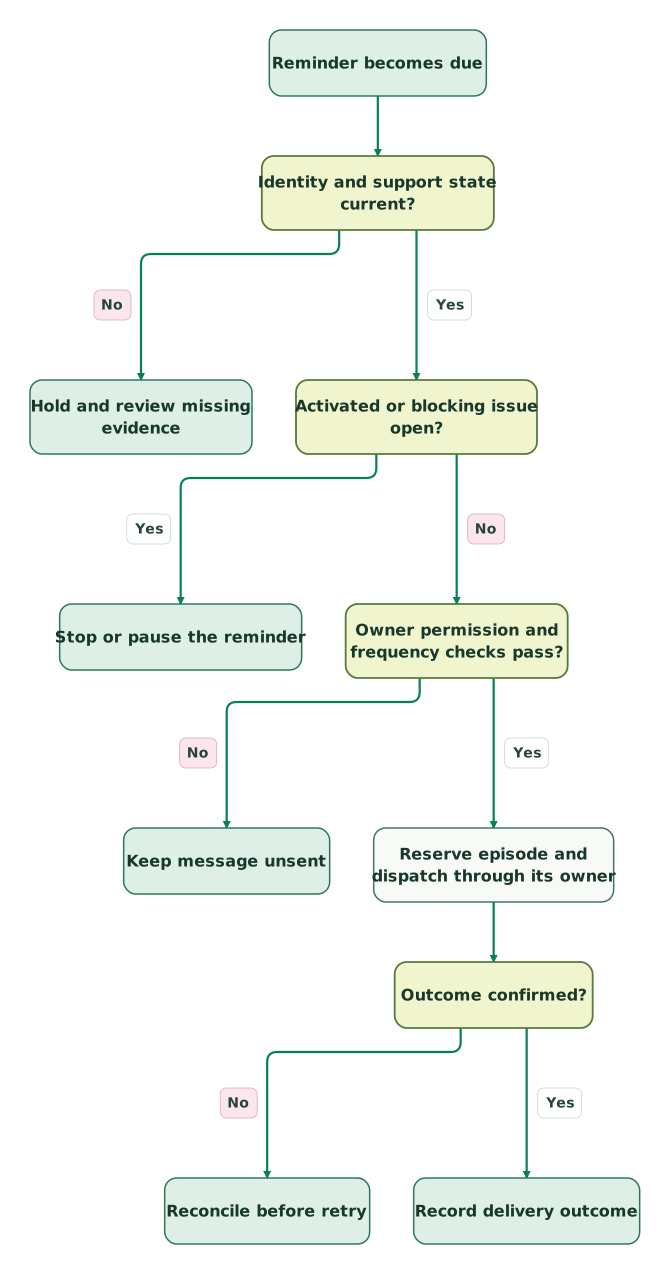
Read diagram as text
- Reminder becomes due to Identity and support state current?.
- Identity and support state current? to Hold and review missing evidence: No.
- Identity and support state current? to Activated or blocking issue open?: Yes.
- Activated or blocking issue open? to Stop or pause the reminder: Yes.
- Activated or blocking issue open? to Owner permission and frequency checks pass?: No.
- Owner permission and frequency checks pass? to Keep message unsent: No.
- Owner permission and frequency checks pass? to Reserve episode and dispatch through its owner: Yes.
- Reserve episode and dispatch through its owner to Outcome confirmed?.
- Outcome confirmed? to Reconcile before retry: No.
- Outcome confirmed? to Record delivery outcome: Yes
What do user reviews suggest you should test?
Use reviews to generate evaluation questions, then reproduce the relevant workflow in your own context. A review score does not establish performance for your product, team or message volume.
| G2 listing | Displayed aggregate | Useful evaluation prompt |
|---|---|---|
| Fin, the destination of G2's Intercom listing | 4.5/5 from 3,938 reviews | Test specialized support questions, configuration effort and human handoff |
| Customer.io | 4.4/5 from 977 reviews | Test event-driven personalization, schema maintenance and template rendering |
The Fin listing includes feedback about AI support as well as the broader operating experience, so the aggregates are not a controlled comparison of the same job. One technical-project-manager review praises routine support handling while noting the work needed for specialized knowledge and customization. G2 Fin reviews.
A Customer.io automation-manager review praises accessible event payloads and personalization but describes warehouse costs, schema cleanup and older Outlook rendering as concerns. Those are questions to test, not universal costs or limitations established by a single review. The cited entries include seller-invited or incentivized feedback, which is another reason to use them as qualitative evidence. G2 Customer.io reviews.
What should a migration preserve before either tool is removed?
Preserve the customer state, permission and in-flight message decision before replacing templates or interfaces. An audience export is only one part of the move.
Inventory each live purpose, its current sender, trigger, recipients, wait state, exit conditions and message history. Decide whether each in-flight customer finishes in the old system, restarts under a new episode or is deliberately held. Do not import historical events into active triggers without an explicit backfill design.
When moving lifecycle messages to Customer.io, rebuild the event/attribute contract, sending domains, subscription handling, templates and in-app integration. Keep the support inbox and its history available for the work that remains in Intercom. When consolidating onboarding into Intercom, validate Series timing, product-tour placement, support ownership and the resulting usage bill.
During parallel operation, give every message purpose one active sender and synchronize the state needed for suppression. Retain before-and-after evidence and a switch that stops new sends without pretending it can recall messages already handed to a delivery provider.
Measure activation in the product's own data for the same eligible cohort. A platform's message engagement is useful diagnostic evidence, but it does not by itself prove that the new journey caused more successful onboarding. If a holdout is appropriate, assign it consistently and compare activation, support demand and unwanted-message incidents together.
Checklist
- Conversation and lifecycle owners are named.
- The same activation test passes in the proposed operating model.
- People, account objects and billable profile counts are reconciled.
- Fin outcome categories and included allowances are separated.
- Startup approval and the paid years have a written budget.
- Only one sender owns each message purpose and episode.
- Support blockers, stale state, preferences and completed activation affect dispatch correctly.
- Retries and uncertain outcomes cannot silently create duplicate messages.
- Templates and in-app placements pass the actual client checks.
- Migration and recovery preserve active support and customer context.
Use our tool-selection method to turn those checks into a decision. If the hard part is the shared data and messaging contract, request a scoped lifecycle implementation or start with the $99 martech audit.
Keep reading
Browse all CRM & Lifecycle guides
 CRM & Lifecycle
Customer.io Pricing: Count Profiles, Objects and Messages Correctly
Estimate Customer.io costs using people, objects, billing-cycle history and message volume. Includes worked pricing examples and a practical budget checklist.
Jafrin Akter AloLast updated 11 min read
 CRM & Lifecycle
Intercom Pricing Explained: Plans, Seat Prices and Fin AI Costs
Intercom costs $29, $85 or $132 per seat a month billed yearly ($19 for new Essential customers), plus $0.99 per Fin outcome. See plans, add-ons and budgets.
Jafrin Akter AloLast updated 9 min read
 CRM & Lifecycle
Braze to Customer.io migration: preserve preferences, journeys and delivery
Migrate from Braze to Customer.io with verified exports, an identity crosswalk, preference mapping, push re-registration, a safe cutover and tool checks.
Jafrin Akter AloLast updated 17 min read
Customer support automation
See the implementation scope, deliverables and acceptance checks.
Questions people ask
Can we start with Intercom and add Customer.io after onboarding becomes more complex?
Yes. Keep product events, identity and message purpose independent of the first tool so the later move is manageable. Record each Series' trigger, recipient, exit and ownership while it is still easy to inspect. Add Customer.io when a specific lifecycle workload justifies its implementation and maintenance, then move that purpose through a controlled cutover instead of leaving both senders active.
Does adding company objects increase Customer.io's bill even if we send only to people?
Yes. Customer.io counts people and objects together as profiles, even though a message may ultimately reach a person. Include account, subscription or other object records in the capacity forecast, along with copies across workspaces. Use the billing count rather than the number of email addresses in one campaign, and check retained or recreated profiles before assuming cleanup reduces the current period's bill.
Does every Intercom handoff to a human count as a paid Fin outcome?
No. A successfully completed Procedure configured to hand off is a billable outcome, while default or workspace-level escalation has different treatment. Inspect the recorded path rather than inferring the charge from the presence of a teammate. Keep full-rate qualifications separate from the USD 0.99 outcome category, and reconcile usage against the programme's included allowances and the actual channels used.
Should a resolved support issue automatically restart every paused lifecycle message?
No. Resolution should trigger a fresh eligibility decision for the affected purpose. The account may already be activated, the recipient may have changed preference, or the reminder may no longer be useful. Recheck current product state, account membership and message history before dispatching. Preserve the original episode so a resumed workflow cannot accidentally recreate a message that was already sent.
What should we request before relying on a startup discount in the budget?
Request written approval, the exact start and end dates, included seats or profiles, usage allowances, overage rates and what happens at graduation. Separate a generic trial from a startup programme and an older partner arrangement. Build a paid-state scenario without an assumed renewal discount, then update it when the vendor supplies the actual offer for your account and intended usage.
Sources
- Intercom: Series explained.
- Customer.io: Pricing and plan features.
- Intercom: Pricing and add-ons.
- Customer.io: Set up message channels.
- Customer.io: Web in-app messaging.
- Intercom: Fin outcome definitions.
- Customer.io: Billing units and overages.
- Intercom: Early Stage offer.
- Intercom: Early Stage programme pricing.
- Customer.io: Startup Program.
- Intercom: Series timing and re-entry.
- Customer.io: Automation exit conditions.
- G2: Fin reviews.
- G2: Customer.io reviews.

Written by
Jafrin Akter AloData Engineer and Co-founder at Martechdevs and Growth and Analytics Partners
Jafrin writes practical guides to marketing technology, customer data, analytics and AI workflows. Martechdevs is a Growth and Analytics Partners company.