
Customer.io Alternatives for Behaviour-Based Messaging
Data Engineer and Co-founder, martechdevs
Last updated 9 min read
A Customer.io alternative should reproduce the behaviour your journeys depend on: event triggers, current customer state, message permissions, delays, exits and account relationships. Compare those mechanics before choosing by email volume or editor appearance. Braze, Iterable, Klaviyo and Loops serve different operating needs, so the right shortlist starts with your product and customer journey.
Last updated: 9 October 2026.
Replacing a newsletter tool can be relatively contained. Replacing a lifecycle system can change when customers receive reminders, how account data reaches marketing and whether completed actions stop future messages.
This guide helps product and growth teams choose an appropriate evaluation, including when keeping Customer.io and simplifying the implementation is the better decision.
What must the replacement do?
Choose one valuable journey that represents your actual complexity.
For a SaaS product, it might involve an account with several members, a setup event, a delay and a reminder to the correct administrator. For a retailer, it might involve an order, a replenishment interval and product availability. For a mobile app, it may require coordinated email, push and in-app messaging.
CRM and lifecycle implementation connects these requirements to their data sources and owners. The platform selection becomes easier when you can say precisely which action a customer needs help completing.
Write down the journey's contract:
- The source event and its business meaning.
- The stable person identifier and any related account or order.
- The properties available at entry.
- The current state that must be checked later.
- Permission and channel eligibility.
- Repetition and exit rules.
- How an operator diagnoses a skipped or failed message.
This is more informative than a list containing “segmentation,” “automation” and “personalisation.” Almost every product can claim those labels while implementing them differently.
When is the problem your implementation rather than Customer.io?
Look for a defined limitation before deciding to migrate.
If the wrong people enter because events use inconsistent names, a new platform will receive the same inconsistent events. If customers keep receiving setup reminders after activation because the success state never arrives, a new workflow editor will not repair that missing signal.
Customer.io implementation mistakes covers identity, event handling and eligibility problems worth checking first.
The commercial problem also needs a precise definition. Customer.io's published pricing distinguishes profiles, email usage, objects and other capabilities. A growing bill could reflect a wider data footprint rather than additional valuable messaging. Customer.io pricing.
Review unused profiles, workspaces, objects and journeys within the platform's billing rules. Do not delete useful history simply to produce an attractive screenshot of a smaller audience.
A justified replacement might need a different channel strategy, a more suitable ecommerce integration, simpler email operations or an enterprise orchestration model. Name that requirement so the trial can prove whether it is met.
Which alternatives should you evaluate?
Braze for a broader cross-channel lifecycle programme
Braze is a candidate when lifecycle messaging is closely tied to a consumer product and the team needs coordinated customer journeys. Its Canvas documentation describes scheduled, action-based and API-triggered entry, audience controls, re-entry and exit criteria. Braze Canvas.
The evaluation should include the full operating system around those journeys: SDK ownership, identity, channel permissions, quality assurance and experimentation.
Ask the team to reproduce the same customer path in both systems. Include a customer who completes the goal during a delay and another who triggers the entry event twice.
Do not treat an impressive orchestration canvas as proof that the data is ready. The implementation responsibility can be substantial when mobile applications, backend services and marketing all contribute state.
The focused Braze versus Customer.io comparison helps frame that decision without assuming one vendor suits every stage of growth.
Iterable for cross-channel journeys with explicit data and operating requirements
Iterable is also a relevant candidate for a cross-channel engagement programme. Its product documentation describes Studio journeys with entry rules, messages, delays and profile updates, alongside multiple messaging channels and system webhooks. Iterable product overview.
Use the evaluation to establish how the proposed project represents identity, event data, message eligibility and measurement. These details matter more than whether the journey diagram uses familiar names.
If your current workflows depend on account objects or many-to-many relationships, ask for a demonstrated equivalent. Flattening everything into one person's latest profile fields can change behaviour when they belong to several accounts.
Also test an operator's diagnostic workflow. They should be able to explain why a specific person did or did not receive a message without asking engineering to reconstruct the entire pipeline each time.
Klaviyo for commerce-centred lifecycle work
Klaviyo deserves evaluation when messaging revolves around shopping, product interest, purchases, returns and repeat buying. Its current marketing automation offering describes multi-channel flows, segmentation and integrations that connect customer activity to messaging. Klaviyo marketing automation.
Bring a real commerce exception to the trial. For example, a customer starts checkout, purchases a different item, later returns part of the order and becomes eligible for a replenishment message.
Verify which events your actual store integration supplies, when they arrive and which properties can be used in each step. “Integrated with the store” does not define the meaning of a purchase or refund event.
For a SaaS company, product telemetry and account relationships need their own justification. Commerce-oriented workflows can be helpful where they match the business, but they are not substitutes for a clear product data model.
Customer.io versus Klaviyo explores this distinction in more detail.
Loops for a focused SaaS email programme
Loops is worth evaluating when email is the intended scope and the team wants a focused way to run product-related email sequences.
Its current documentation calls the automation builder Workflows. It supports event and contact-change triggers, timers, branches and audience filters. Filters can apply to the next node only or to following nodes, which makes the placement of ongoing eligibility checks important. Loops workflows.
Test the specific email sequence you need rather than assuming a smaller product is automatically too limited. Equally, do not select an email-centred replacement while leaving required mobile or in-app channels without an owner.
Keep transactional delivery separate in the scope. Loops documents a distinct transactional email path. Confirm how it interacts with contacts and subscriptions before moving operational messages into it. Loops transactional email.
The useful question is whether this focused approach covers the required journeys with less maintenance. A simpler system that forces essential logic into unowned scripts may not be simpler overall.
How do you run a fair journey trial?
Use the same synthetic customer records and event sequence in each candidate. Define expected outcomes before asking the vendor to configure the workflow.
A useful test packet includes a normal path and deliberately awkward variations:
- The event arrives once and the customer remains eligible.
- The same business event is delivered again.
- The customer completes the goal during the delay.
- The customer changes their email address.
- The customer opts out before the scheduled message.
- Two different account-related events occur for the same person.
- A required attribute is missing.
- A backend update arrives later than expected.
Do not send this trial to real customers. Use controlled test identities and the vendor's supported test mode or isolated configuration.
Record the actual outcome, diagnostic evidence and any custom work needed. A candidate that passes through a maintained native configuration is different from one that passes only through a temporary script nobody plans to own.
A worked trial: remind the right workspace administrator
Imagine a SaaS product where one person administers two workspaces. Workspace Alpha has completed setup. Workspace Beta has not.
The intended message is about Beta only. The reminder should stop if Beta completes setup, even if the original trigger happened two days earlier. It should not restart Alpha's onboarding.
Define the following illustrative data:
- Person: one stable application user.
- Workspace: a separate ID for Alpha and Beta.
- Entry event: setup started for a specified workspace.
- Success state: backend-confirmed setup complete for that workspace.
- Recipient relationship: current administrator of that workspace.
- Stop condition: success, lost administrator role or cancelled workspace.
The failure to detect is a profile containing only setup_complete: true. That value may describe Alpha and incorrectly suppress Beta. The opposite failure is a later Beta update setting it false and restarting Alpha's reminders.
You can solve the representation differently in different systems. The evaluation should accept any supported design that preserves the intended behaviour and has a maintainable owner.
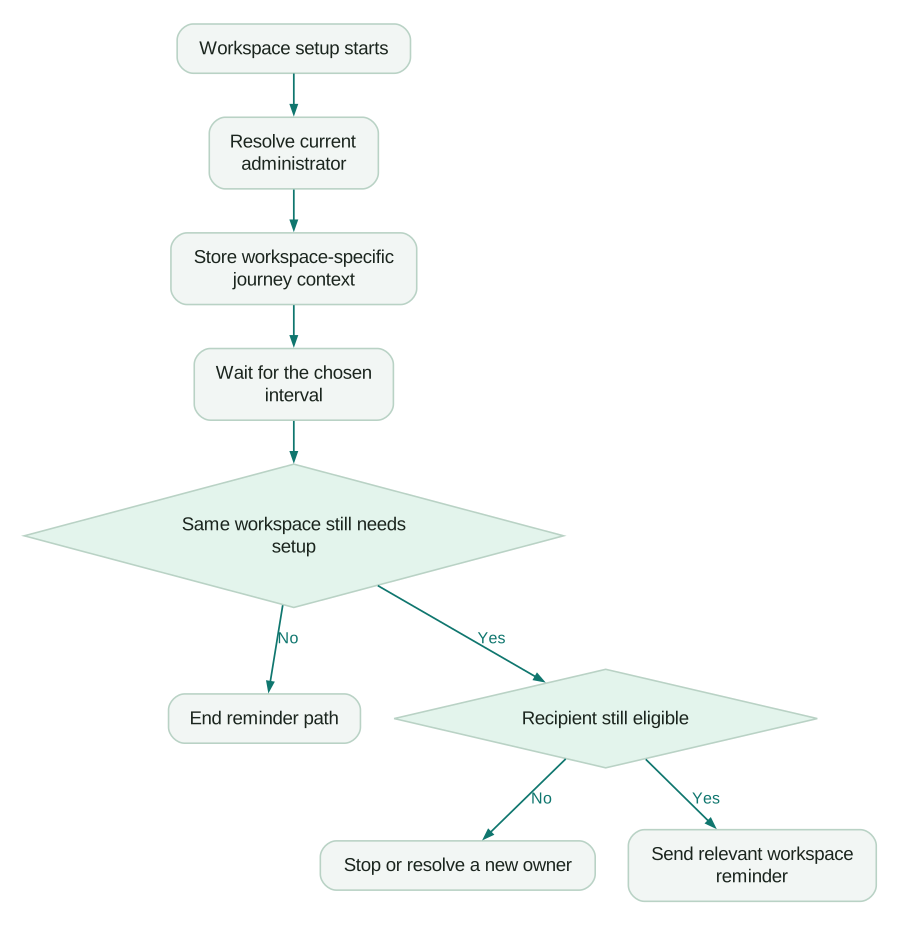
The key customer journeys guide helps choose a trial with real commercial value. Do not spend the evaluation demonstrating a birthday campaign when account setup is the reason customers fail to activate.
How should pricing enter the decision?
First establish the minimum configuration that passes the journey trial.
Then give every vendor the same workload description: stored people, related objects, active users if relevant, expected sends by channel, seasonal peaks, event volume, workspaces and required access controls. Ask how each input affects the contract.
Do not compare “contacts” with “active users” as if they are interchangeable. A product may count stored records while another commercial model depends on activity, channel usage or committed capacity.
Customer.io pricing explains the current platform's billing mechanics. Use the actual account and contract as the baseline, then include the work required to replace it.
Migration costs can include rewriting event producers, translating templates, moving subscription preferences, rebuilding reports and operating both systems temporarily. Ongoing cost includes the person maintaining the integration and reviewing journey failures.
Avoid invented savings from unused features. If a new product is cheaper because it omits a needed channel, the missing channel's replacement cost belongs in the comparison.
What should happen to people already inside journeys?
A contact import does not automatically transfer their position in a running workflow.
Choose a policy for each active journey: let it finish in Customer.io, stop it and restart only eligible people, or migrate a deliberately modelled state to the new platform. Document why that policy is appropriate.
For a time-sensitive reminder, restarting everyone at step one could be harmful. For an obsolete campaign, finishing the old path may be unnecessary.
Keep suppression and permission updates flowing to whichever system can still send. During overlap, one preference change may need to affect both platforms. Assign one source of truth and monitor whether each destination received the change.
Define a final reconciliation: remaining active participants, queued sends, failed updates and retired triggers. Only remove the old sending path after you can explain those states.
What should make the team approve an alternative?
The decision should combine customer behaviour, operator effort and complete cost.
Checklist
- The candidate reproduces the representative journey and its failure variations.
- Person and account-related state remain distinguishable.
- Duplicate business events do not create unintended messages.
- Updated eligibility and permission stop stale sends.
- Operators can explain a skipped message from available evidence.
- Required channels and transactional paths have explicit owners.
- Pricing uses the same workload assumptions across proposals.
- Existing journey participants have a documented cutover policy.
- The integration has a maintenance owner after launch.
Choose the tool that makes the important customer journeys reliable and operable. The strongest result may be a smaller platform, a broader platform or a repaired Customer.io implementation, depending on what the trial reveals.
Questions people ask
What is the best Customer.io alternative for SaaS?
It depends on channel scope, account relationships and workflow complexity. Use one important SaaS journey as the evaluation contract instead of choosing from a generic ranking.
Is Loops a complete replacement for Customer.io?
It can be a candidate for an email-focused scope. Confirm every required journey and assign any channels or data relationships outside that scope before treating it as a complete replacement.
Should an ecommerce business evaluate Klaviyo?
Yes, when commerce events and repeat-purchase journeys drive the requirements. Validate the actual store integration and exception cases rather than relying only on a prebuilt flow catalogue.
Can we migrate active journeys by importing contacts?
A contact record does not establish where someone belongs in a running sequence. Define whether each existing journey finishes, stops or transfers using an explicit state model.
Should we select the cheapest platform that supports events?
Event support is only one requirement. Evaluate eligibility, repetition, permission, diagnostics and integration ownership before comparing the complete operating cost.
Sources
- Customer.io pricing. Accessed 9 October 2026.
- Braze: Creating a Canvas. Accessed 9 October 2026.
- Iterable product overview. Accessed 9 October 2026.
- Klaviyo marketing automation. Accessed 9 October 2026.
- Loops workflows. Accessed 9 October 2026.
- Loops transactional email. Accessed 9 October 2026.
Written by
Jafrin Akter AloData Engineer and Co-founder, martechdevs
Jafrin Akter Alo is a data engineer and co-founder of martechdevs, where the team has delivered 74+ martech, data and growth stack implementations.