
Braze Pricing: Build a Quote Your Team Can Evaluate
Data Engineer and Co-founder, martechdevs
Last updated 9 min read
Braze pricing requires a custom quote. Build yours around the customer population, planned channel activity and operating requirements your team actually needs. Ask the vendor to price base, growth and peak scenarios, itemise every billing unit, and separate the subscription commitment from the work required to launch and maintain your journeys.
Last updated: 17 September 2026.
A Braze quote can look affordable while leaving the expensive questions unanswered. Which visitors count toward usage? What happens during a seasonal spike? Does the proposed service package include rebuilding your journeys, or does your own team still have that work?
This guide gives a founder or lifecycle lead a specification to send with a quote request, a way to challenge the assumptions, and a budget model that keeps vendor charges separate from implementation work. The product facts below come from Braze's public pages; the worked scenarios are planning examples.
What does Braze charge for?
Braze lists Go, Select, Pro and Enterprise editions. Contracts combine packaging, MAU and profiles, Action Credits, services and add-ons. Public dollar rates are unavailable. Trials and startup programmes are available; a free plan is not. Braze pricing.
Ask for an itemised proposal. Each line should have a billing unit, included quantity, unit rate where applicable, billing period, minimum commitment and excess-usage rule. A total annual number gives finance too little information to model a change in your business.
Write the buying requirement before choosing an edition. For example: two lifecycle marketers must operate onboarding and renewal journeys, an engineer must maintain the event feed, and a security administrator must control access. Ask the vendor to demonstrate those tasks in the proposed edition and attach the relevant entitlements to the order form.
Implementation is a separate workstream. Our CRM and lifecycle work covers the customer data, eligibility rules and integrations that make these journeys operate. A platform subscription alone does not specify who will build or maintain them.
Which audience count belongs in the estimate?
Prepare three audience counts: stored customer records, people generating qualifying activity, and people reachable on each channel. They answer different budget questions. A person can have a stored profile, no recent app activity and a valid email subscription.
Resolve a definition difference: the pricing page describes calendar-month MAU, while Home dashboard documentation uses a rolling 30-day measure. Ask Braze to identify the contractual definition and its billing report. A dashboard label alone is insufficient for a financial commitment. Pricing definitions, Home dashboard definitions.
The Home dashboard documentation also explains that anonymous session activity can count, imports can affect activity when session dates are supplied, and summing app-level counts can count the same person across several apps. These are reasons to reconcile identity and scope before agreeing to a forecast. MAU calculation rules.
Build an audience brief with these fields:
- The websites and apps where Braze will collect activity.
- Whether tracking begins before or after login, and the business reason for that choice.
- Stored identified and anonymous profiles, with the duplicate-removal policy.
- Recent active audience using a stated time window and time zone.
- The expected overlap between web and mobile users.
- The forecast peak month and its cause, such as a launch or annual campaign.
- Reachable email, push and SMS audiences, separately from all stored records.
Changing collection solely to make a forecast smaller can remove the signals a journey needs. Decide which activity supports a customer decision, then price that design. The customer identity guide helps establish the person and account model behind those counts.
How should you forecast Action Credits?
Model your planned actions, then apply the quoted rates. Braze describes pooled Action Credits across channels and certain AI products. Treat the public sample conversion ratios as illustrations; obtain the binding schedule for your contract. Action Credit model.
For each journey, capture the eligible audience, expected entries, maximum sends per entry, channel, region where relevant, and suppressions. Separately list campaigns, testing, operational messages and any AI usage. Ask the vendor which of those actions consumes credits and exactly when consumption occurs.
An onboarding journey with five possible steps will rarely send all five steps to every entrant. People may convert, unsubscribe, fail a channel check or be excluded by another rule. Forecast a likely case and a maximum eligible-send case. Treat the maximum as a capacity question and the likely case as a budget estimate.
Use this reusable calculation:
Expected action volume per journey
= expected entries × average eligible actions per entry

Expected credits
= sum of action volume × contracted credit rate

Forecast remaining credits
= contracted allowance - actual use - forecast remaining use
Keep each contracted rate next to its effective date. If a new channel becomes part of the plan halfway through the year, reprice the remaining mix before the campaign goes live. A flexible pool still has a finite allowance.
What does a worked buying scenario look like?
Consider an illustrative SaaS company with 25 employees, two lifecycle operators, 80,000 stored people, 20,000 recently active people and 45,000 email-reachable people. These are assumptions for the example, not Braze thresholds or a typical customer's bill.
The team plans four monthly workloads:
- Onboarding: 3,000 entries and an average of three eligible emails, producing 9,000 emails.
- Product adoption: 8,000 eligible people and one email each, producing 8,000 emails.
- Newsletter: two sends to 40,000 eligible people, producing 80,000 emails.
- Renewal reminders: 1,000 entries and an average of two emails, producing 2,000 emails.
The base estimate is 99,000 emails. A planning allowance of 10% for controlled tests and operational variance adds 9,900, giving 108,900 emails. That allowance is our example assumption; your programme may justify a different amount. It is not a deliverability target or a recommendation to send extra messages.
Now add planned push, in-app and other actions on separate lines, even when a proposed package includes them. Ask Braze to price the complete mix and state which actions consume the credit pool. You cannot turn 108,900 emails into a reliable dollar subtotal without the applicable contract terms.
Send three versions of the scenario:
- Base: the audience and action plan above.
- Growth: 50% more active people, with newsletter volume rising 25% and onboarding entries doubling.
- Peak: a temporary campaign month with twice the normal reachable audience and a defined send schedule.
These different growth rates matter. Acquisition can double onboarding traffic while the established customer newsletter grows slowly. Multiplying every line by the same percentage hides the source of the cost.
Company headcount also needs separate treatment. A 10-person business and a 50-person business can have the same customer audience. Compare the additional operators, permissions, approval steps and support requirements at each team size, then ask which requirement changes the edition. Headcount alone cannot produce a defensible Braze price.
What should go into the first-year cost?
Build two budgets: vendor commitment and internal delivery cost. Add them only after each is visible.
The vendor commitment should include the platform, usage allowances, add-ons, services and agreed excess-usage assumptions. Request payment dates, renewal mechanics, permitted volume changes and treatment of unused credits. If a condition is absent from the public site, obtain it in writing instead of assuming favourable terms.
The delivery budget should assign work and an owner for:
- Mapping identifiers and reconciling existing profiles.
- Instrumenting and validating the events your journeys require.
- Migrating subscriptions, suppression records and templates.
- Configuring sending domains and channel credentials.
- Rebuilding active journeys and resolving migration overlap.
- Testing personalisation, exits, quiet hours and message priorities.
- Connecting delivery and outcome data to reporting.
- Training the team that will investigate problems after launch.
Braze markets several service categories, including onboarding and migration, implementation support, training and deliverability. Confirm the deliverables and exclusions of your quoted service package. A service category name does not establish how many journeys or integrations the engagement covers. Braze customer services.
Use the Braze and Customer.io comparison when comparing implementation requirements across vendors. The alternative needs the same audience assumptions, consent handling, channels and support coverage to make the comparison useful.
How do you control spend after launch?
Assign one named owner to reconcile planned actions, actual usage and the remaining allowance. Review the result alongside the campaign calendar, because a static remaining balance says little about whether enough capacity remains for a seasonal event.
An illustrative annual allowance of 1,200,000 credits with 360,000 consumed after two months has used 30% of the allowance in about 17% of the year. A flat extrapolation would suggest 2,160,000 credits over 12 months. That is a warning to investigate the plan, not a reliable forecast when usage is seasonal.
Braze's documented usage alerts are currently early access. They warn at fixed consumption thresholds and do not stop messaging when the allowance reaches 100%. The documentation also says alerts measure consumption rather than future pacing. Confirm availability and recipient permissions, then maintain a forecast that includes remaining campaigns. Usage alerts.
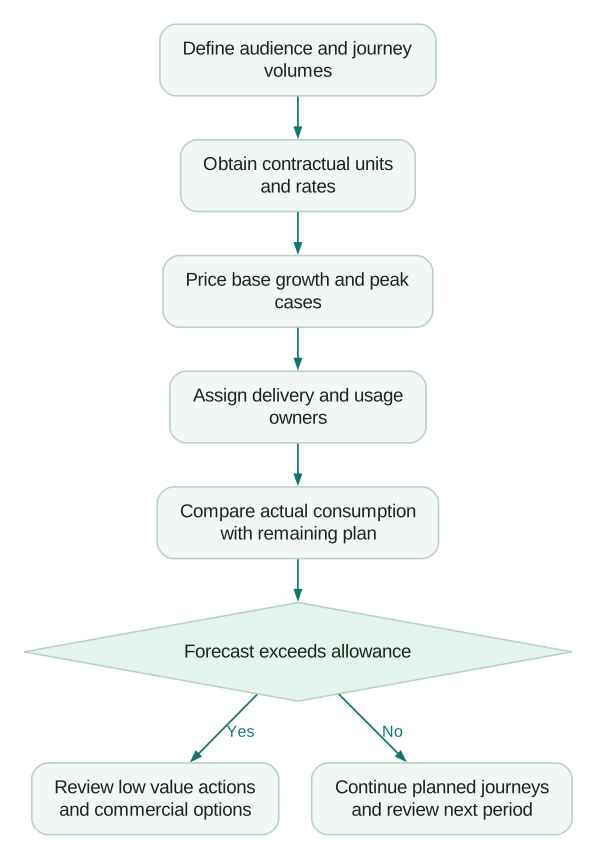
Reduce waste by fixing duplicate identities, unintended repeat entry and overlapping journeys. Then review messages with weak customer value. Cutting an essential payment or security message to protect a marketing budget is a poor operational decision; agree service-critical priorities before reaching the allowance.
For older contracts, check whether data-point billing still applies. Braze explicitly calls that a legacy metric and says new customers have not been billed on it since spring 2025. Removing redundant attribute updates can reduce legacy usage; the documentation says it does not change invoices under the newer non-data-point models. Legacy data-point billing.
Which questions should finance approve before signing?
- Which written definition and report determine billable activity?
- What stored-profile allowance applies, and how are excess profiles handled?
- Which actions consume credits, at what rate, and at which processing step?
- What happens when actual use exceeds the allowance?
- Which entitlements are included in the proposed edition and which are separate?
- Can the team change the channel mix without an amended commercial agreement?
- Which support hours, response commitments and implementation deliverables are included?
- How do renewal, cancellation, data export and deletion work?
- Who can see usage and who is accountable for acting on it?
- Does the forecast cover the next product launch, acquisition campaign and migration overlap?
Attach the completed scenario model to the buying decision. Then run one real journey through the proposed design before committing to a wider rollout. The lifecycle journey guide provides candidate workflows; select one with a clear customer outcome and enough edge cases to test the implementation.
Questions people ask
How much does Braze cost per month?
Braze does not publish a universal monthly dollar price on its pricing page. Request an itemised quote using your active audience, stored profiles, channel actions, edition requirements and service scope. Dividing an annual quote by 12 can help budgeting, but it does not establish monthly payment or cancellation terms.
Is Braze priced by the number of employees?
A small team can operate a large customer audience. Use headcount to describe administration, approval and support needs, then forecast customer activity independently. Ask which specific requirement changes the quoted package.
Do inactive profiles increase the bill?
Ask the vendor to price your stored population explicitly, including dormant records. Model cleanup only after you understand the contractual allowances and the customer history you need to retain. A smaller database should follow an agreed data policy.
Will Braze stop sending when credits run out?
The current usage-alert documentation says messaging continues at the 100% threshold and excess use may be billed under the contract. Establish your own approval and escalation rules for forecast overruns. Confirm the exact behaviour for your agreement and products before launch.
What should we compare with Braze?
Compare the platforms that can run your required journeys with the team available to operate them. Customer.io is a useful evaluation for many event-based SaaS programmes, while other channel or governance requirements can change the shortlist. Use equivalent audience, action, implementation and support assumptions for every quote.
Sources
- Braze pricing and packaging. Accessed 17 September 2026.
- Braze Home dashboard and MAU rules. Accessed 17 September 2026.
- Braze customer support services. Accessed 17 September 2026.
- Braze usage alerts. Accessed 17 September 2026.
- Braze legacy data points. Accessed 17 September 2026.
Written by
Jafrin Akter AloData Engineer and Co-founder, martechdevs
Jafrin Akter Alo is a data engineer and co-founder of martechdevs, where the team has delivered 74+ martech, data and growth stack implementations.