
Pipedrive alternatives: when a sales pipeline is not enough
Choose a Pipedrive alternative around the constraint you need to remove: HubSpot for cross-team customer journeys, Attio for account relationships, Close for calling, Zoho CRM for controlled processes, Freshsales for a lower-cost sales suite, monday CRM for delivery handoffs, or folk for relationship-led selling. Compare the edition and full ten-seller bill, then prove the difficult workflow before migrating.
On this page
A replacement customer relationship management (CRM) system should remove an operating constraint. Start with one recent failure: conflicting follow-ups, a renewal without an owner, or a forecast nobody can reconcile. Establish whether the cause is missing functionality, configuration or an undefined process. Moving the same ambiguity into a new subscription will not fix it.
Our CRM and lifecycle design work starts with the records, ownership rules and customer journeys the system must support. Use those requirements to narrow the shortlist before booking demonstrations.
Which Pipedrive alternative should you shortlist first?
Shortlist the tool whose strengths match the failed workflow, then keep one credible alternative for the same job. The cheapest starting plan can help you explore a product without including the automation your sellers actually need.
Selected starting subscriptions per user per month, with annual billing. USD and GBP are kept separate; no currency conversion, tax, usage or startup discount is included. HubSpot's starting offer is distinct from its standard catalog price.
| Candidate | Starting paid reference | Evaluate it for | First upgrade question |
|---|---|---|---|
| HubSpot | Starter from USD 7 | Marketing, sales and service sharing context | Does the job require Professional sales tools? |
| Attio | Plus USD 35 | A richer account and relationship model | Do you need Pro sequences or custom objects? |
| Close | Essentials USD 35 for a team | Calling and follow-up in the seller's workspace | Do you need Growth Workflows? |
| Zoho CRM | Standard USD 14 | Defined process and broader configuration | Do you need Professional Blueprint controls? |
| Freshsales | Growth USD 9 | A conventional sales suite at a lower entry price | Do you need Pro sequences? |
| folk | Standard USD 24 | Relationship-led pipelines and shared communication | Do you need Premium sequences, objects or API access? |
| monday CRM | Basic GBP 10; minimum three seats | Sales connected to delivery work | Do you need Pro sequences and higher automation capacity? |
Sources: HubSpot Sales, Attio USD plans, Close, Zoho's CRM guide, Freshsales, folk and monday CRM.
The USD order in this entry table is not a ranking of equivalent capabilities. A USD 9 plan without the required sequence workflow can be a weaker purchase than a more expensive plan that completes it.
When should you keep Pipedrive instead of switching?
Keep Pipedrive when an appropriate configuration supports the sales process with less ongoing work than a replacement. Check the current feature boundaries before treating an old limitation as a migration requirement.
Pipedrive Growth includes email sync, automations, sequences and forecast view. Premium adds required fields, automatic assignment, custom-field reports and custom permission sets; Projects is included from Premium and available as a paid add-on below it. Pipedrive plan features.
Run a repair test first:
- Define the missing field and its source of truth.
- Assign one accountable owner to every active deal.
- Build the necessary handover in the proposed paid configuration.
- Reconcile the manager's report against known deals and stage definitions.
- Remove an external tool only after its required job works in the replacement configuration.
Price the repair alongside migration. The Pipedrive pricing guide separates seats, add-ons and limits. A more expensive Pipedrive edition can still cost less than a new CRM plus rebuilding, parallel subscriptions and training. Conversely, a cheap repair that duplicates account records or hides manual reconciliation may preserve the underlying problem.
What are the strengths and limitations of each alternative?
Each alternative changes a different part of the operating model. Use the following decision blocks to choose a trial, then test the same difficult records and follow-up rules across candidates.
HubSpot: shared customer work across teams
- Best for: an inbound business where marketing, sales and service must coordinate around the same customer.
- Pros: a wider customer platform can connect acquisition, opportunities and service context.
- Cons: the required features can span subscriptions, seat types and contact billing.
- Free tier and startup offer: free tools support up to two users; eligible startups can apply for discounted paid products.
- Choose it if: the cross-team journey is valuable enough to justify its configuration and operating cost.
- Skip it if: the team mainly needs a clear queue of deals and next actions.
The customer platform establishes its breadth; the free-tools catalog defines the free edition. Demonstrate a form submission, owner assignment, progressed opportunity, support issue and renewal. Then change the email address, add a second deal and withdraw marketing consent. Shared branding does not prove those handovers work.
HubSpot has separate standard seat guidance and limited-release seat guidance. Confirm which commercial model applies. Use the implementation checklist for setup dependencies and the wider list of HubSpot alternatives when the decision extends beyond sales.
Attio: relationships beyond one company and one deal
- Best for: a business whose work involves companies, workspaces, subscriptions or partnerships that cannot share one status field.
- Pros: custom relationships can make the actual commercial model visible.
- Cons: someone must maintain entity definitions, permissions and synchronization rules.
- Free tier and startup offer: Free supports three seats; the startup program offers an approved discount on annual Pro.
- Choose it if: a relationship prototype answers the renewal or ownership question cleanly.
- Skip it if: the team cannot name who will own the model after setup.
Attio's plan guide places sequences on Pro. Custom objects are available on Pro and Enterprise, but email sending still targets people, and email synchronization attaches to people and companies. Keep those communication entities rather than replacing everything with a new custom object.
Test one account with three workspaces, two renewal dates and different commercial owners. Move one workspace to another company and close one deal while the other remains open. The Attio implementation guide covers merge and update failures; Attio and HubSpot head to head adds reporting and access tradeoffs.
Close: the calling-heavy seller's working day
- Best for: teams that spend substantial time calling, emailing and managing follow-up.
- Pros: calling, text messaging (SMS), email and sales tasks share a workspace; Growth adds Workflows and a power dialer.
- Cons: telephony and artificial intelligence (AI) usage add to the seat bill, and broader customer operations still need connections.
- Free tier and startup offer: a 14-day trial is available; no startup concession is included in this budget.
- Choose it if: the seller can complete the call-to-next-action sequence with fewer manual handovers.
- Skip it if: the main problem is a complex post-sale relationship model.
Close pricing separates subscription, telephony and AI credits. Its Workflow guide limits Workflows to Growth and Scale and explains that they finish when the steps complete or a defined goal is met.
Test reply and opt-out handling alongside a permitted call, logged outcome and next task. Confirm number availability and regional calling requirements. Faster dialing is useful only when the next contact is eligible and the outcome reaches the right record.
Zoho CRM: enforce a defined process
- Best for: teams that need consistent commercial approvals and stage transitions.
- Pros: Blueprint can require evidence and actions before a record progresses.
- Cons: too many mandatory steps can create workarounds and a maintenance burden.
- Free tier and startup offer: the free edition supports three users; do not assume it includes paid process controls.
- Choose it if: the same exceptions and approval rules can be implemented and owned clearly.
- Skip it if: the business has not agreed what each stage actually means.
Blueprint models conditions and transitions; its tutorial requires Professional, Enterprise or Ultimate. A proposal should fail its transition when pricing approval or the decision contact is missing. Test that as an ordinary seller, then test the authorized exception path.
Zoho's feature comparison also lists follow-up Cadences on paid editions. Cadences and Blueprint solve different jobs: scheduling follow-up does not itself enforce a commercial approval.
Freshsales: a lower-cost sales suite
- Best for: a team that needs ordinary contact, deal and follow-up work without a broad platform purchase.
- Pros: Growth combines communication and basic workflows; Pro adds sequences and territory management.
- Cons: forecasting insights, field-level permissions and custom modules require Enterprise.
- Free tier and startup offer: the public paid-plan trial lasts 21 days; this comparison assumes no ongoing free or startup entitlement.
- Choose it if: the Pro configuration handles the required seller tasks and reports.
- Skip it if: essential control requirements move the team into a more expensive edition without solving its model problem.
The Freshsales schedule lists annual Growth, Pro and Enterprise rates of USD 9, 39 and 59 per user per month. AI and document add-ons are separate. Include a failed automation and an unavailable owner in the trial; a low starting price does not excuse an unowned recovery path.
monday CRM: sales connected to delivery
- Best for: agencies or service businesses where a won deal must become organized delivery work.
- Pros: boards and connected work can make the handover visible; Pro includes email sequences.
- Cons: seat bundles, contact/deal capacity and automation limits affect the useful configuration.
- Free tier and startup offer: the CRM has a trial rather than a continuing free plan; no startup award is assumed.
- Choose it if: the delivery owner receives the sold scope without rebuilding it in another spreadsheet.
- Skip it if: connected boards become competing records for the same commercial fact.
The CRM pricing page lists 250 custom automations/month on Standard and 25,000 on Pro. Its ten-seat yearly selector displays GBP 14 and GBP 24 respectively. Pricing depends on billing country; verify the charged seat bundle rather than multiplying an assumed USD rate by actual headcount.
Test a won deal whose scope changes before kickoff. The delivery record should preserve what was approved, who accepted the change and which system owns the final value.
folk: relationship-led selling with lighter pipelines
- Best for: partnership, founder-led or service sales where relationship history drives the next action.
- Pros: shared communication context and simple pipelines can keep relationship work accessible.
- Cons: application programming interface (API) access, sequences, dashboards and custom objects are Premium capabilities.
- Free tier and startup offer: the pricing page describes a two-week trial and blocked access if it is not upgraded; do not budget an unconfirmed continuing free workspace.
- Choose it if: the team can manage the important relationships without a complex process engine.
- Skip it if: the decision depends on advanced governance that the chosen edition cannot demonstrate.
folk's pricing distinguishes Standard USD 24 and Premium USD 48 annually from USD 30 and USD 60 on monthly billing. Test shared interaction visibility with a normal user, including a sensitive conversation, before assuming that a shared contact means every colleague should see the same history.
What would ten sellers pay for the required workflow?
For ten sellers needing synchronized email and repeatable follow-up automation, compare the relevant paid editions rather than each vendor's cheapest card. These configurations are candidates for the same acceptance test, not a claim that every feature or usage allowance is identical.
USD monthly equivalents on the stated annual billing basis, before tax, telephony, AI usage, extra products, implementation or discounts. All ten people are paid sellers. Year two assumes unchanged prices, seats and scope; HubSpot's required USD 1,500 onboarding appears only in year one.
| Configuration | Monthly equivalent, USD | Year one, USD | Year two, USD |
|---|---|---|---|
| Zoho CRM Professional, 10 × 23 | 230 | 2,760 | 2,760 |
| Freshsales Pro, 10 × 39 | 390 | 4,680 | 4,680 |
| folk Premium, 10 × 48 | 480 | 5,760 | 5,760 |
| Attio Pro, 10 × 79 | 790 | 9,480 | 9,480 |
| Close Growth, 10 × 99 | 990 | 11,880 | 11,880 |
| HubSpot Sales Hub Professional, 10 × 90 | 900 | 12,300 | 10,800 |
The USD rows are ordered by this year-one calculation. HubSpot has a lower recurring amount than Close in this example but a higher first-year subtotal because of onboarding. Sources: Zoho, Freshsales, folk, Attio, Close and HubSpot's annual offer and onboarding.
HubSpot's catalog lists Professional from USD 100 per Sales seat per month. Its public annual selector shows USD 90, while monthly payment with an annual commitment shows USD 100. At USD 100, the same ten-seat calculation is USD 13,500 in year one and USD 12,000 thereafter. Use the rate in the actual order. The HubSpot pricing guide explains why other seats and marketing contacts may add costs.
GBP annual-billing comparison, before tax and extras. These are the currencies actually displayed in the regional selectors; they are not converted USD figures.
| Configuration | Monthly equivalent, GBP | Annual subscription, GBP |
|---|---|---|
| monday CRM Pro, ten-seat bundle × 24 | 240 | 2,880 |
| Pipedrive Growth, ten seats × 39 | 390 | 4,680 |
Sources: monday CRM and Pipedrive. Keep these rows outside the USD order. A checkout in another country can produce a different currency or offer.
Price exclusions matter. Close passes calling and SMS usage through at cost. Attio credits and synchronization requirements, folk message limits, monday automation capacity and Freshsales add-ons can alter the bill. A narrower plan may still be enough, but prove the missing capability is unnecessary before taking the saving.
How should startup discounts change the forecast?
Show an approved award separately from the normal-rate budget. Attio's startup program offers 80% off annual Pro in year one and 30% in year two, capped at ten seats. Its eligibility text includes both partner-affiliation and venture-capital-backed wording, so obtain approval instead of assuming a partner introduction qualifies.
Applied to the ten-seat USD 9,480 annual Pro example, those discounts produce USD 1,896 in year one and USD 6,636 in year two, before extras. Year three at an unchanged full rate is USD 9,480. These are calculations for an approved eligible workspace, not an award promise.
HubSpot for Startups offers different eligibility paths with annual commitments and discounts that step down. Confirm the eligible products, discount base and onboarding treatment; do not stack a startup percentage onto an unrelated promotional selector price. The startup CRM comparison gives a wider price and capability ranking.
Which scenario should determine the final shortlist?
Use the operating failure to choose the first candidate and the runner-up. Keep Pipedrive in the comparison whenever a repair remains credible.
| Situation | First candidate | Runner-up | Deciding evidence |
|---|---|---|---|
| Inbound acquisition, sales and service lose context | HubSpot | Zoho CRM | A complete journey preserves ownership and preferences |
| One customer has several workspaces and renewals | Attio | HubSpot with the required model | Concurrent relationships remain unambiguous |
| Sellers switch repeatedly between calling and follow-up tools | Close | Pipedrive with the required calling route | Eligible outreach and next actions stay complete |
| A prescribed approval process is repeatedly skipped | Zoho CRM | HubSpot | Ordinary users cannot bypass required evidence |
| Lower-cost conventional sales automation is the main need | Freshsales | Zoho CRM | The chosen edition passes reports and exception cases |
| Won deals must become delivery work | monday CRM | Pipedrive with Projects | Approved scope reaches an accountable delivery owner |
| Relationships drive a light sales process | folk | Attio | Shared context remains useful and appropriately restricted |
Consider a hypothetical six-person sales team with inconsistent follow-up tasks and poor visibility of workspace renewals. The first problem may be repairable through ownership and automation. The second needs an account model plus product or billing data.
Use one company with three workspaces, two subscription terms and two commercial owners. Ask every candidate to identify the next renewal and the responsible person. If each solution requires duplicate company records and manual copying, investigate the model before changing the subscription.
Now change the scenario: the account model is simple, but sellers spend hours switching between a dialer, email and CRM. Close becomes a more relevant candidate than a custom-object redesign. The shortlist follows the failure you need to eliminate.
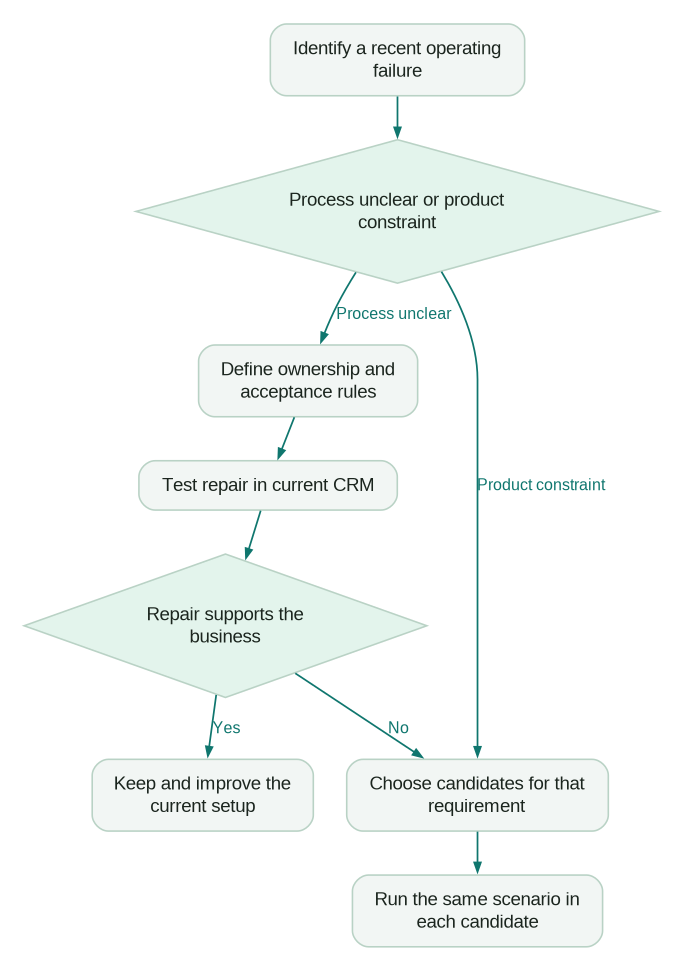
Read diagram as text
- Identify a recent operating failure to Process unclear or product constraint.
- Process unclear or product constraint to Define ownership and acceptance rules: Process unclear.
- Define ownership and acceptance rules to Test repair in current CRM.
- Process unclear or product constraint to Choose candidates for that requirement: Product constraint.
- Test repair in current CRM to Repair supports the business.
- Repair supports the business to Keep and improve the current setup: Yes.
- Repair supports the business to Choose candidates for that requirement: No.
- Choose candidates for that requirement to Run the same scenario in each candidate
How do you compare migration cost honestly?
Compare the full replacement inventory with the cost of a working Pipedrive repair. Contacts are only one part of the move: reports may depend on historical stage changes, and automations may depend on fields written by another system.
Classify pipelines, fields, automations, forms, documents, reports, integrations, consent information and activity history as migrate, rebuild, archive or retire. Include training, parallel subscriptions and ongoing integration ownership. Do not count a tool as removed until its required job works elsewhere.
Preserve original IDs, timestamps and associations in a representative test import. Reconcile a customer with multiple deals and an activity linked to the wrong record. Define which system will own each shared property after cutover using the CRM property ownership guide.
What should the final trial prove?
The trial should prove that ordinary users can complete the required work in the paid configuration you intend to buy, including exceptions and recovery.
Checklist
- A seller finds the next eligible action without another spreadsheet.
- Simultaneous deals for one customer remain distinct.
- Commercial context reaches the next team.
- A reply, opt-out or closed opportunity stops the appropriate follow-up.
- The manager's report reconciles to the test records.
- Normal users cannot access restricted records or actions.
- Failed integrations have an owner and a recovery procedure.
- The purchased edition includes everything used in the trial.
- Exported data remains usable if the company later leaves.
If assistants are part of the workflow, compare each CRM's MCP server, where Model Context Protocol provides tool access to an assistant. Include a known-record read and a denied-write case. Record recurring manual repairs alongside pass/fail results; a configuration that needs weekly rescue has an operating cost.
At Martechdevs, we connect the CRM to the customer journey and the systems that supply its context. Get the $99 martech audit or request a detailed CRM implementation scope with the failed workflow and the records needed to prove the repair.
Keep reading
Browse all CRM & Lifecycle guides
 CRM & Lifecycle
Pipedrive Pricing: Seats, Add-Ons and the Cost of Your Workflow
Compare Pipedrive plans by paid seats, add-ons, Projects access and usage limits. See annual cost examples and a practical Growth versus Premium calculation.
Jafrin Akter AloLast updated 9 min read
 CRM & Lifecycle
Pipedrive Webhooks: Fix Missing Deal Updates, Retries and Integration Loops
Configure Pipedrive webhooks v2, check owner visibility and payload changes, and recover missed deal updates after retries, bans or deleted subscriptions.
Jafrin Akter AloLast updated 12 min read
 CRM & Lifecycle
Pipedrive vs Zoho CRM: Sales Workflow, Process Controls and Cost
Compare Pipedrive and Zoho CRM on sales workflow, Blueprint, required-field limits, record capacity and migration cost. Includes budgets and practical acceptance tests.
Jafrin Akter AloLast updated 11 min read
CRM & marketing automation
See the implementation scope, deliverables and acceptance checks.
Questions people ask
Is there a free alternative to Pipedrive for all ten sellers?
The free editions discussed here do not cover ten active sellers. HubSpot permits two free users; Attio and Zoho permit three. Avoid splitting one sales process across disconnected free workspaces merely to bypass that limit. Zoho's free API allowance is 5,000 credits per rolling 24 hours, not necessarily 5,000 calls, because operations can consume different credit amounts. Zoho API limits.
Who should own deals left by former employees after the move?
Assign an accountable current owner while preserving the historical seller where it supports reporting or customer continuity. Do not map every departed employee to the migration administrator simply because that user imported the file. Agree the reassignment policy before migration, apply it to a known sample and inspect the resulting tasks and notifications. Ownership changes can trigger automation as well as alter reports.
How should paused Pipedrive sequences be handled at cutover?
Keep paused follow-up paused until its owner explicitly approves a restart in the new system. Importing a contact does not establish that it should receive the next message. Preserve the reason for the pause, previous responses, suppression state and completed steps where available. Test that the old and new senders cannot both resume the same outreach, and give unresolved cases a manual review queue.
What happens to links to old deals in emails and documents?
Treat old deal links as a migration dependency, because external references may outlive the original CRM subscription. Keep a controlled old-ID-to-new-ID crosswalk and decide how authorized staff will resolve historical links after cutover. Test a sample from proposals, support tickets and internal documents. Do not assume a destination import automatically redirects links hosted by the previous vendor or preserves access for every former user.
How should a new seller join while the CRM trial is running?
Give the new seller the same training materials and approved task set used in the evaluation, then record any additional help they need. This tests whether the configuration can be learned and operated beyond its original builder. Keep their results separate from an experienced administrator's results, and avoid changing the trial's acceptance criteria halfway through merely because one candidate looks easier in a familiar user's hands.
Sources
- Pipedrive: Plan features.
- Pipedrive: Pricing.
- HubSpot: Sales pricing.
- HubSpot: CRM and customer platform.
- HubSpot: Free tools.
- HubSpot: Product catalog.
- HubSpot: Standard seat management.
- HubSpot: Limited-release seat management.
- HubSpot for Startups.
- Attio: USD pricing.
- Attio: Plans and features.
- Attio: Custom objects.
- Attio: Startup program.
- Close: Pricing.
- Close: Workflows.
- Zoho: CRM guide and pricing.
- Zoho: Edition feature comparison.
- Zoho: Blueprint.
- Zoho: Blueprint tutorial.
- Zoho: API limits.
- Freshworks: Freshsales pricing.
- monday: CRM pricing.
- folk: Pricing.

Written by
Jafrin Akter AloData Engineer and Co-founder at Martechdevs and Growth and Analytics Partners
Jafrin writes practical guides to marketing technology, customer data, analytics and AI workflows. Martechdevs is a Growth and Analytics Partners company.