
HubSpot Renewal Price Increases: 7 Contract Checks
HubSpot can increase subscription fees at renewal under its standard terms, including up to its then-current list price. Before accepting an increase, check the applicable agreement, notice mechanism, billable quantities, expiring discounts and options to reduce scope. These seven checks turn a renewal conversation into a decision you can price, execute and verify across the martech stack.
On this page
Can HubSpot raise your price at renewal?
Yes. HubSpot's general terms allow renewal fees to rise to its then-current list price, with at least 30 days' advance notice of that increase. Product-specific fee rules and your order can change the applicable conditions. Downgrades generally take effect at the next renewal through a new order, rather than during the current term. HubSpot Customer Terms
Keep the supplier's price-increase notice separate from your non-renewal action. Under the default general terms, customers prevent renewal by turning off auto-renewal in Account & Billing before the current term ends, unless their agreement or order specifies otherwise. That is not a universal requirement to send cancellation 30 days early. HubSpot non-renewal terms
Collect the executed order, amendments, incorporated terms and proposed renewal before arguing about the percentage. Ask the contract owner to establish which documents govern the account and resolve any conflict. A public pricing page cannot establish a negotiated exception, and a sales conversation cannot substitute for the written amendment your organization needs.
Then separate these questions:
| Question | Evidence to request | Why it matters |
|---|---|---|
| Did the unit price change? | Old and proposed net rate for the same product | Isolates a price increase from growth |
| Did a discount end? | Discount duration and renewal basis | A low first-year price may not carry forward |
| Did the quantity change? | Seats, marketing contacts and capacity packs | Usage and commitment can differ |
| Did the package change? | Edition, features, add-ons and migration terms | A renamed bundle may not be like-for-like |
| What action preserves our options? | Applicable notice clause and account confirmation | Negotiating does not itself stop renewal |
HubSpot distinguishes commitment term from payment frequency. Monthly instalments can still pay for an annual commitment. Its renewal guidance also says that using fewer seats, contacts or credits does not automatically downgrade the subscription. Confirm the commercial change as well as the operating cleanup. Review your HubSpot renewal
Use the HubSpot pricing guide to identify the meters and seats in the proposal. If the package is oversized because workflows or ownership are unclear, a CRM and lifecycle audit can establish which capabilities the team actually needs before the next order is signed. If the right-sized package still costs too much, compare HubSpot alternatives priced per seat before the term ends.
Which renewal rules differ across Salesforce, AppsFlyer, Zendesk and other tools?
Use each product's applicable agreement rather than applying one notice window to the whole stack. The important differences concern the deadline, reduction mechanics, renewal price basis and what happens to temporary benefits.
Salesforce: a smaller renewal can have a different unit price
Salesforce's current Main Services Agreement bases fees on purchased subscriptions, not actual use, and generally prevents quantity reductions during the term. Its default is another one-year renewal unless written notice, including email, arrives at least 30 days before term end. Promotional pricing can reset to list price, and reduced subscription volume or duration can trigger repricing without preserving the prior per-unit rate. Order-form exceptions matter. Salesforce Main Services Agreement, sections 5.1 and 11.2
Request two complete quotes: the required smaller scope and the existing scope. Compare annual payable amounts, retained features and future adjustment rights. A favourable discount percentage on unwanted licences is not the same thing as the lowest useful commitment. The Salesforce pricing guide helps identify edition and integration dependencies before removing seats or add-ons.
AppsFlyer: the unit-price cap is not a cap on the invoice
AppsFlyer's public terms set a default 45-day written non-renewal notice. Unless the order specifies otherwise, renewal unit fees may increase by up to 7%, and a free period from the expiring package does not continue. Additional orders align with the existing subscription term. AppsFlyer Terms of Use
The total renewal can therefore change by more than 7% when volume, scope or a free period changes. Ask for the same workload under both terms and show the effect of each change separately. Do not present an allowed maximum as a guaranteed increase either; the actual proposal still needs review.
Zendesk: requesting fewer agents and removing them are separate steps
Zendesk's current Customer Agreement prevents mid-term plan or pricing-metric reductions. For a future reduction, it requires 30 days' written notice to revops@zendesk.com and removal or deactivation of the affected agents before the next term. If a new order is not signed before term end, the renewal clause applies. That clause generally renews for an equivalent term at potentially current rates unless the required non-renewal notice is given or the order differs. Zendesk Customer Agreement, sections 4.2 and 7.2
Assign the commercial request to procurement and the user changes to an account administrator, with one owner checking both. Removing access without changing purchased quantity can leave the bill intact; signing a reduction without completing its required account changes can also fail.
If renewal triggers a replacement review, shortlist Zendesk alternatives early enough to verify ticket history and plan the overlap.
Treat legacy packaging as a separate change. Zendesk's legacy-to-Suite guidance describes eligibility and feature-loss warnings; its adding-seats guidance describes a separate purchase process. Neither establishes that every seat addition automatically removes a legacy plan. Inspect the proposed SKU, retained features, storage consequences and any return path before accepting the amendment. Legacy upgrades, adding agent seats
Amplitude Plus: cancel the renewal, not an imaginary monthly commitment
Amplitude Plus can have a one-month or twelve-month term selected at checkout. Its addendum renews at the then-current fees and requires cancellation before the current term ends through Plans & Billing, Manage Billing, Cancel Plan. Existing payment obligations remain separate from stopping the next renewal. Add-ons share the Plus subscription term. Amplitude Plus Addendum
Capture the chosen term and checkout details when a product team buys self-service software. The person who tested the tool may not be the person responsible for its annual commitment. Amplitude's billing guidance says the original purchaser and organization admins can access the cancellation option, so confirm an appropriate owner still has access. Amplitude billing and plans
ZoomInfo: obtain the actual renewal formula
ZoomInfo's current public Licence Terms make the ordering document, service-specific terms and general terms parts of the agreement. They place the initial term and fees in the ordering document and describe the agreement as non-cancellable except through its terms. Do not insert a universal 60-day notice or 10% escalator into the forecast without finding it in the documents governing your account. ZoomInfo Licence Terms
Request the notice deadline, renewal formula, treatment of discounts and reduced-scope pricing together. The ZoomInfo pricing guide separates paid packages and credit questions that otherwise get hidden inside one annual number. An unanswered renewal field should stay marked unresolved, not become a convenient industry assumption.
When should you start the renewal review?
Start before the earlier of the commercial decision deadline and the time needed to implement an alternative. A notice period is a final contractual boundary; it is not enough time to discover that a replacement requires a data migration, new integrations and user training.
Before relying on a cancellation deadline, check what a switch would break and allow time to test the replacement.
Maintain one renewal record per relevant contract or order. Record the legal entity, product, term end, next term, payment schedule, notice mechanism, required recipient, pricing basis, decision owner and evidence link. Distinguish the last day of the current term from the first day of the next one; a one-day mistake can matter at a boundary.
Use relative planning dates to avoid confusing supplier rules with your internal buffer. This hypothetical calendar assumes calendar-day subtraction from the current term-end date, called T.
| Milestone | Example planning point | Owner's evidence |
|---|---|---|
| Alternative must begin | T minus 75 days | Approved migration estimate and capacity |
| Commercial decision target | T minus 59 days | Decision completed 14 days before notice boundary |
| Notice boundary | T minus 45 days | Applicable clause, delivery method and acknowledgement |
| Term ends | T | Replacement or renewal is operationally ready |
The 75-day migration requirement starts work before the 59-day commercial target. Waiting for the supplier's reminder would lose useful options even if the notice window remained open.
This original Python helper calculates those planning points. It uses calendar days only. The contract owner must separately confirm deadlines, inclusive counting, time of day, timezone, business-day rules and what constitutes valid notice.
from datetime import date, timedelta

def renewal_plan(term_end, notice_days, decision_buffer_days,
                 migration_days):
    if type(term_end) is not date:
        raise ValueError("term_end must be a date, not a datetime")
    counts = {
        "notice_days": notice_days,
        "decision_buffer_days": decision_buffer_days,
        "migration_days": migration_days,
    }
    for name, value in counts.items():
        if type(value) is not int or value < 0:
            raise ValueError(f"{name} must be a nonnegative integer")
    try:
        notice_boundary = term_end - timedelta(days=notice_days)
        decision_target = notice_boundary - timedelta(
            days=decision_buffer_days)
        migration_start = term_end - timedelta(days=migration_days)
    except OverflowError as exc:
        raise ValueError("planning dates exceed the supported range") from exc
    return {
        "notice_boundary": notice_boundary,
        "decision_target": decision_target,
        "migration_start": migration_start,
        "review_by": min(decision_target, migration_start),
    }
Do not use a zero-day notice input as permission to wait until the last moment. An account-toggle rule still needs an internal target, authorized access and retained confirmation. Put the action in an owned calendar with a backup person; a reminder sent to a former employee is not a control.
How do you explain a renewal increase without hiding its causes?
Build a bridge from the current payable amount to the proposed amount, changing one driver at a time. Keep quantity, unit price, discount, package and one-time work separate.
Consider a hypothetical annual subscription with 50 seats at USD 100 per seat/month before a 20% introductory discount. Its current annual fee is USD 48,000. The proposed renewal has 40 seats, no discount and a USD 140 monthly unit price. These are invented planning inputs, not prices or a reported customer deal from any named vendor.
| Bridge step | Annual USD effect | Running annual USD |
|---|---|---|
| Current 50-seat fee after discount | Starting point | 48,000 |
| Remove the 20% introductory discount | +12,000 | 60,000 |
| Change the unit rate from 100 to 140 at 50 seats | +24,000 | 84,000 |
| Reduce quantity from 50 to 40 at the new rate | −16,800 | 67,200 |
The bill rises USD 19,200, or 40%, while seat quantity falls 20%. Saying “we cut ten seats” does not explain the commercial result. The final amount reconciles to 40 × USD 140 × 12 = USD 67,200.
The allocation between price and quantity effects depends on the order used in the bridge. State that order and keep it consistent; the final reconciled difference does not change. For multi-currency contracts, show exchange-rate effects separately rather than calling them supplier price increases.
Also compare the exact basis of a proposed cap. In another hypothetical negotiation, a 5% cap on the expiring net unit rate of USD 80 produces USD 84. A 5% cap on the old USD 100 list rate with the discount removed produces USD 105. At 40 seats for a year, those are USD 40,320 and USD 50,400. The words identifying the base change the result by USD 10,080.
Move implementation, migration overlap and ongoing operating work into the full martech stack cost model. A renewal quote can be cheaper while the replacement creates more support work. Conversely, accepting a modest software increase can be reasonable if it avoids a larger, well-evidenced operating cost.
How do credits, unused capacity and legacy features change the decision?
Separate paid commitment, consumed usage, remaining entitlement and expiry. A lower usage graph does not necessarily reduce an invoice, and unused credits do not necessarily survive into the next period.
HubSpot Credits reset monthly, and unused credits expire rather than roll over. After additional capacity is purchased, the account can use auto-upgrades or pay-as-you-go overages. Auto-upgrades can increase capacity for the rest of the commitment; overages return to the original monthly allowance at reset. Additional capacity packs can only be cancelled or downgraded at term end. Inspect the account's actual setting rather than assuming every account uses the same mode. Manage HubSpot Credits
For a hypothetical USD 12,000 annual prepaid commitment with USD 3,000 of unused entitlement, do not report USD 3,000 of cash savings. First establish whether the entitlement can still be used, expires, transfers or has a refund right. Then decide whether the next commitment can be reduced without disrupting required work.
Use the same discipline for startup benefits and legacy packages:
| Situation | What to verify | Decision to document |
|---|---|---|
| Introductory discount ends | Full-price schedule and any next-stage offer | Year-two budget and approval |
| Credits remain unused | Expiry, eligible products and rollover rights | Reduce future commitment or retain for a justified workload |
| Capacity auto-expanded | Trigger, new committed level and reduction point | Account settings and permitted renewal change |
| Legacy plan is replaced | Feature mapping, add-ons, rates and reversibility | Accept the amendment only after required workflows pass |
| Free add-on becomes paid | Exact end of benefit and cancellation mechanism | Keep, remove or replace before commitment |
Keep the service owner involved. A legacy export permission or automation limit may matter more than a newly bundled feature list. Check startup-program terms for benefit expiry and stack rationalization for removing duplicated tools without breaking the workflow they support.
Which protections should you request in the renewal order?
Request precise commercial outcomes and make the proposed order reflect them. “We will look after you next year” is not a price formula; “you can adjust seats” is incomplete without a timing rule and minimum quantity.
The following are negotiation requests to have procurement and legal translate into the applicable agreement. They are not standard rights promised by every vendor.
| Protection | Make the request specific | Acceptance test |
|---|---|---|
| Renewal price cap | State the percentage, net-price basis, covered products and exceptions | Recalculate next term from the signed formula |
| Flex-down right | Specify minimum quantity, adjustment dates and unit-price treatment | Price a realistic smaller team |
| Discount continuity | Define which discounts persist and when others expire | Model each committed year separately |
| Additional capacity | Agree unit rates, approval thresholds and co-termination | Simulate one expected growth increment |
| Onboarding or services waiver | List the exact deliverables and waived charges | Confirm no essential scope is merely omitted |
| Package protection | Name required features and consequences of migration | Run the key workflows under the new package |
| Exit and data access | Agree export formats, access period, assistance and charges | Demonstrate that the required data can be retrieved |
A multi-year deal exchanges flexibility for commercial certainty. Compare the total committed amount and adjustment rights under low, expected and high usage. Do not justify it using an aggressive growth forecast that nobody owns.
Bring a credible alternative, including migration effort and the customer workflows it must preserve. An alternative becomes useful negotiating evidence when it works for your requirements. Inventing a competing quote or threatening a migration the team cannot execute weakens the decision rather than improving it.
Keep concessions connected. A lower annual price may come with a longer commitment, a higher minimum or a weaker reduction right. Record each change in one comparison so an attractive discount cannot conceal a more expensive constraint.
What makes a renewal decision complete?
A renewal decision is complete when the commercial action, required account changes and operating plan all agree. Keep evidence of notice or the signed renewal, then verify the resulting subscription and invoice.
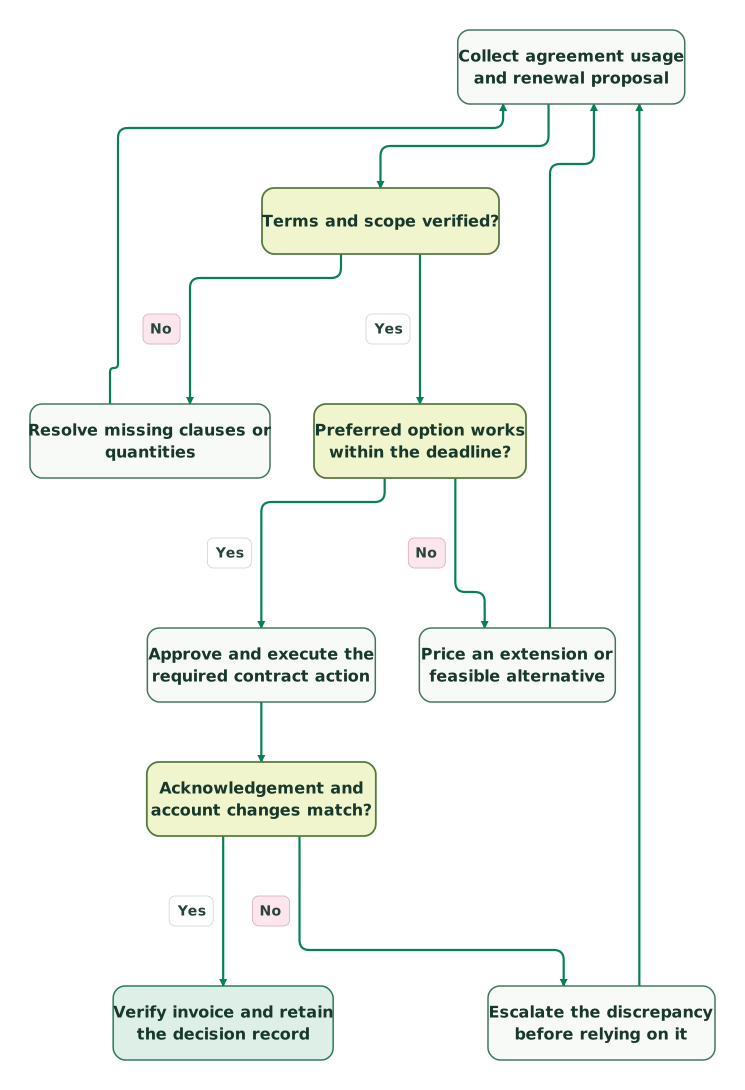
Read diagram as text
- Collect agreement usage and renewal proposal to Terms and scope verified?.
- Terms and scope verified? to Resolve missing clauses or quantities: No.
- Resolve missing clauses or quantities to Collect agreement usage and renewal proposal.
- Terms and scope verified? to Preferred option works within the deadline?: Yes.
- Preferred option works within the deadline? to Price an extension or feasible alternative: No.
- Price an extension or feasible alternative to Collect agreement usage and renewal proposal.
- Preferred option works within the deadline? to Approve and execute the required contract action: Yes.
- Approve and execute the required contract action to Acknowledgement and account changes match?.
- Acknowledgement and account changes match? to Escalate the discrepancy before relying on it: No.
- Escalate the discrepancy before relying on it to Collect agreement usage and renewal proposal.
- Acknowledgement and account changes match? to Verify invoice and retain the decision record: Yes
If a deadline has already passed, establish the current obligation before choosing the next action. Ask for a written accommodation or amendment where appropriate; do not assume an unanswered cancellation email, removed payment card or unused account has ended the commitment. Route a dispute through the actual contract process with the relevant evidence.
Checklist
- Executed orders, amendments and incorporated terms are available to the owner.
- Term end, next term, notice mechanism and recipient are confirmed.
- Decision and migration targets precede the relevant boundaries.
- Price, quantity, discount and package changes reconcile to the proposed total.
- Credits, temporary offers and legacy entitlements have explicit treatment.
- Required workflow and integration access survives the preferred option.
- Negotiated caps and adjustment rights appear in the executed order.
- Notices or account actions have retained confirmation and a backup owner.
- Required agent, seat or capacity changes are completed at the right time.
- The resulting subscription and invoice match the approved decision.
For an unclear stack, get the $99 martech audit to identify unused scope, ownership gaps and fragile dependencies. If the viable option requires a rebuild, request a detailed integration scope before using a migration saving in the renewal decision. Price the work required to exercise the option, not just the new tool.
Keep reading
Browse all CRM & Lifecycle guides
 CRM & Lifecycle
HubSpot for Startups: Eligibility, Discounts and the Four-Year Cost
Check HubSpot for Startups eligibility, covered products and renewal costs. Compare both discount tracks with free CRM, Starter and Attio before buying.
Jafrin Akter AloLast updated 12 min read
 CRM & Lifecycle
HubSpot vs Mailchimp: Choose by the Sales Handoff and the Renewal Bill
Compare HubSpot and Mailchimp for CRM-led marketing or email campaigns. See free limits, 2,000/10,000-contact costs, renewal bills and a lead-to-deal test.
Jafrin Akter AloLast updated 16 min read
 CRM & Lifecycle
HubSpot vs Pipedrive: Costs and 6 Tests Before You Buy
Compare HubSpot and Pipedrive with equal user roles, real subscription costs, renewal assumptions and six practical sales workflow tests.
Jafrin Akter AloLast updated 15 min read
CRM & marketing automation
See the implementation scope, deliverables and acceptance checks.
Questions people ask
Does HubSpot's 30-day price notice mean I must cancel 30 days early?
Not under the general default described here. The 30-day provision concerns HubSpot's notice of a renewal fee increase; the ordinary non-renewal mechanism is the account setting before term end, unless your agreement or order differs. Confirm the applicable rule, then set an earlier internal action target so access problems or unresolved terms do not leave you relying on the boundary. HubSpot terms
Can we reduce a bill simply by deleting inactive users?
Deleting or deactivating a user changes access, while the subscription can still contain the purchased seat. Check the permitted adjustment point, required commercial request and any account changes that must accompany it. Keep the access cleanup and billing change as separate tasks with evidence for both. Do not leave an inactive person's access open just because the seat remains committed.
Does AppsFlyer's 7% renewal allowance limit total spending growth?
No. The published provision concerns the applicable unit fees, subject to the order, rather than guaranteeing a ceiling on the complete invoice. More usage, different scope or the end of a free period can change the total separately. Reprice the same workload first, then add growth assumptions so finance can distinguish the rate change from the business decision. AppsFlyer terms
Will adding Zendesk seats automatically remove a legacy plan?
Do not assume that it will. Adding seats and upgrading a legacy account to Suite are separately described operations. Review the actual purchase or amendment for its product, features, storage and price effects, and obtain confirmation of any legacy rights that matter. A general help article cannot promise that your particular negotiated package survives every change. Zendesk seat changes
Is a lower renewal quote always worth a longer contract?
No. Compare the complete commitment under realistic growth and contraction scenarios, including reduction rights, price changes, minimums and exit work. A lower first-year amount can be outweighed by unused capacity in later years. The stronger choice is the package that supports required workflows at an acceptable risk and total cost, with assumptions an owner is willing to maintain.
Sources
- HubSpot Customer Terms of Service.
- Review your HubSpot renewal.
- Salesforce Main Services Agreement.
- AppsFlyer Terms of Use.
- Zendesk Customer Agreement.
- Upgrading legacy plans to Zendesk Suite.
- Adding Zendesk agent seats.
- Amplitude Plus Addendum.
- Amplitude billing and plans.
- ZoomInfo Licence Terms.
- Manage HubSpot Credits.

Written by
Jafrin Akter AloData Engineer and Co-founder at Martechdevs and Growth and Analytics Partners
Jafrin writes practical guides to marketing technology, customer data, analytics and AI workflows. Martechdevs is a Growth and Analytics Partners company.