
HubSpot for Startups: Eligibility, Discounts and the Four-Year Cost
HubSpot for Startups can reduce the cost of qualifying Professional or Enterprise products, but the first-year discount is only the starting point. Confirm your eligibility and covered products before purchasing, get the year-by-year terms in writing, and model the package after the discount ends. A subsidised edition is useful when its workflows matter now and its later operating cost remains affordable.
On this page
The decision should begin with a customer process, not a coupon. A founder managing ten active deals may need clean records and a reliable next task. A growing team may need routing, automation, permissions and reporting. Those are different requirements even if both qualify for the same programme.
Use the programme to fund the right setup. Our HubSpot and lifecycle implementation work connects the properties, product activity and billing data behind that process. Buying a discounted licence does not define who will maintain the system after launch.
Who qualifies for HubSpot for Startups?
HubSpot publishes two routes. The funding route covers pre-seed, seed or Series A companies, excluding Series B or later, with an approved partner affiliation or verified venture funding. The entrepreneurial-organisation route requires an approved affiliation. Offers apply to net-new Professional or Enterprise products and require an annual commitment. Programme eligibility.
| Published route | Year-one discount | Later published discounts |
|---|---|---|
| Eligible funding route | 90% | 50% in year two; 25% in year three |
| Approved entrepreneurial-organisation route | 30% | 15% in year two |
These are the programme's advertised schedules, subject to approval. Its generic FAQ also describes a discount period of “typically two years,” so confirm the schedule attached to your award. The page names Crunchbase/Harmonic in one section and Pitchbook/Crunchbase in another; supply verifiable funding evidence rather than assuming one database listing guarantees acceptance. Published tracks and FAQ.
Check the approved partner directory against the organisation you actually belong to. Keep a record of the affiliation and the contact who can confirm it. A startup event invitation is not necessarily evidence of the relationship the programme requires.
If you already use HubSpot, include the portal, current subscriptions and proposed new products in the application. Ask for a written product-level decision before upgrading. Do not assume an existing free or Starter account either guarantees or prevents approval for a new paid product.
What should the approved offer specify?
The offer should identify the exact products, quantities, rates and commitment. A headline percentage does not establish which invoice lines it reduces.
Send a short purchase specification with the application:
| Line item | What to establish | Why it changes the budget |
|---|---|---|
| Products and edition | Which named subscriptions qualify | One approved product does not establish the whole account's treatment |
| Seats | Type, count and rate for later additions | Hiring can change spend while the discount percentage stays unchanged |
| Audience and usage | Contact capacity, credits and other metered work | Consumption can grow faster than the team |
| Services | Onboarding, migration and ongoing support | A software award may leave delivery work separately payable |
| Time and renewal | Start, step-down, payment and renewal terms | Monthly equivalents can conceal an annual cash commitment |
Identify the pricing model too. HubSpot's main catalogue uses Hub-based seat categories, while selected flexible seats-and-credits arrangements use a different structure. Do not apply the four-Sales-seat example below to an order with GTM/Ops seats or a different usage model. Catalogue pricing-model distinction.
Use HubSpot's seat, contact and credit pricing for the full operating calculation. The startup programme changes the agreed discount; it does not make those underlying units interchangeable.
Ask how additional seats or products are priced during the term, whether onboarding is discounted, and what happens when usage exceeds the included amount. Keep answers beside the relevant line item. “The startup discount applies” is too vague to settle a later invoice dispute.
What does the programme cost over four years?
Calculate each year's eligible subscription using that year's discount, then add costs outside the award. Keep the underlying package fixed first so you can see the discount's effect; add growth as a separate scenario.
Consider four Sales Hub Professional seats at the ordinary Hub-based catalogue rate of USD 100 per seat per month. The annual list reference is 4 × 100 × 12 = USD 4,800. Sales-seat reference.
The following hypothetical USD subscription model assumes all four seats qualify, the written award confirms the advertised schedule, rates and seat count stay unchanged, and the following undiscounted years use the same list reference. It excludes tax, onboarding, implementation, credits, other products and additional usage. It does not stack a separate annual-prepayment promotion on the startup discount.
| Subscription scenario | Year one | Year two | Year three | Year four |
|---|---|---|---|---|
| Unchanged list reference | 4,800 | 4,800 | 4,800 | 4,800 |
| Funding-track example | 480 | 2,400 | 3,600 | 4,800 |
| Partner-track example | 3,360 | 4,080 | 4,800 | 4,800 |
The funding-track total is USD 11,280 over four years, compared with USD 19,200 at the unchanged list reference: a conditional USD 7,920 reduction. The partner-track total is USD 17,040, a USD 2,160 reduction. These are software-subscription comparisons, not a claim about the total implementation budget.
The first step-up deserves attention. In the funding example, the annual subscription rises from USD 480 to USD 2,400, a fivefold bill, even though the package does not change. The extra USD 1,920 needs to be funded by the business; the headline discount does not explain it to the team managing cash.
Until the year-three award is confirmed, also model a conservative variant with no third-year discount. The same four-seat example becomes USD 12,480 across four years, USD 1,200 above the illustrated funding schedule. Keep both columns in the buying model rather than selecting the more favourable wording without confirmation.
What changes if the team grows?
Separate the discount change from the quantity change. Suppose the same business grows from four to six eligible Sales seats for the whole second year, and the written offer applies the same year-two rate to those seats. Its second-year subscription becomes 6 × 100 × 12 × 50% = USD 3,600.
That is USD 1,200 more than the fixed-seat example. If the new seats are added halfway through the year, obtain the actual prorated and commitment rules instead of automatically charging or discounting twelve months. Headcount growth is only one driver: contacts, automation usage and new products can change independently.
What about Marketing Hub Professional?
The product catalogue lists Marketing Hub Professional from USD 890 monthly, including three Core seats and 2,000 marketing contacts. Its pricing page also shows an annual-payment offer from USD 800 monthly. Use the base that actually appears in your startup proposal; do not combine two discounts without written approval. Marketing catalogue, payment-based offer.
At the USD 890 reference, the annual base is USD 10,680. Applying the confirmed funding schedule to that entire base would produce USD 1,068, USD 5,340, USD 8,010 and USD 10,680 across four years, totalling USD 25,098. This is a conditional calculation for an unchanged base package; extra contacts, seats and usage need their own approved treatment.
The catalogue separately lists required one-time onboarding of USD 1,500 for Sales Hub Professional and USD 3,000 for Marketing Hub Professional. Leave those fees outside the discount calculation until the offer establishes their treatment. Onboarding catalogue.
For example, an undiscounted USD 1,500 onboarding fee would make the four-seat funding example's first-year software-plus-onboarding amount USD 1,980. It would still exclude implementation labour, tax and extra usage. Vendor onboarding and the work of cleaning data, building integrations and validating reports need separate scopes.
When is free CRM or Starter the better choice?
Use a lower tier when it already supports the required process. A large discount on unused functionality can cost more than a small package the team actually operates.
If a lower tier still misses the required workflow, compare HubSpot alternatives with free plans before expanding the commitment.
HubSpot's free CRM allows up to two users and 1,000 contacts with no expiration date. Its Starter page advertises a limited new-customer offer of USD 7 per seat monthly with annual payment or USD 10 with monthly payment, against a USD 20 reference. Confirm eligibility and duration; these are separate offers from the startup programme. Free CRM, Starter offer.
| Starting situation | Evaluate first | Reason to move beyond it |
|---|---|---|
| Founder and one colleague proving a basic process | Free CRM within its limits | A required capability or capacity is missing |
| Small team needing basic paid CRM tools | Starter | A specific workflow or report requires a higher edition |
| Team already needing Professional automation | Approved startup package | The required work justifies both the initial and later bill |
| Relationship-led process needing a different data model | Attio alongside HubSpot | The alternative fits the same work with a better total cost |
Use three real tasks to decide: capture and assign a new lead, progress a deal with the right history, and produce the report used in the weekly meeting. List the steps that genuinely require the higher edition. A feature used once in a demo is weak justification for a recurring commitment.
Attio advertises 80% off annual Pro and credits in year one, then 30% off in year two, for up to ten seats. Its FAQ specifies venture backing, signup within 90 days and incorporation less than ten years ago; another section also mentions partner affiliation. Partner-only applicants should confirm acceptance rather than assume it. Attio startup programme.
Compare Attio and HubSpot by the operating job, including the data model, outreach and administration. If Salesforce is also under consideration, use HubSpot versus Salesforce for startups. Compare complete workflows and migration effort instead of choosing the largest advertised percentage.
What order should you apply and implement in?
Confirm eligibility and the proposed purchase before committing to the paid product, then design the data model before bulk import. This is a practical buying sequence that avoids relying on a retrospective discount.
- Write the required process. Name the owners, essential workflows and reports, and identify the edition needed for each.
- Prepare eligibility evidence. Record the company, funding stage, relevant partner and existing HubSpot products. Explain discrepancies rather than creating a second account to conceal them.
- Apply and request a product-level decision. Ask which subscriptions and quantities qualify and which existing account should receive them.
- Approve the four-year budget. Include ordinary usage, growth, onboarding and implementation. Confirm the award and renewal basis in the order.
- Design the CRM. Agree identifiers, lifecycle stages, property ownership and associations before importing production records.
- Test the first operating journey. Verify assignment, duplicate handling, suppression, access and reporting with a controlled sample.
- Reconcile the purchase. Match the first invoice, account entitlements and purchased quantities to the approved offer.
The HubSpot implementation checklist expands the delivery sequence. Assign an owner to each CRM property so an import or connected tool cannot silently overwrite the values the new workflows depend on.
The HubSpot implementation plan skill can check required capabilities and plan the first workflows, record model and import rehearsal before the discount drives the rollout.
Under the marketing-contact model, only contacts marked marketing count toward that tier. Review import and integration defaults before marking the entire database as marketable. A marketing-contact setting is a product/billing classification, not evidence of permission to email. Marketing-contact rules.
How do you keep the discount from hiding avoidable cost?
Review the useful output of the purchased system alongside its invoice. Track whether routing works, records stay reliable and reports support decisions. A low first-year bill can conceal months of unowned implementation work.
| Mistake | Better decision | Evidence to retain |
|---|---|---|
| Buying before the eligibility decision | Confirm the proposed order first | Award and covered-product list |
| Assuming every invoice line is discounted | Review each charge independently | Line-item rate and exclusion schedule |
| Importing every contact as marketing | Match status to approved use | Import defaults and audience estimate |
| Adding users without checking entitlement | Map each person to the work required | Purchased and assigned seat roster |
| Forecasting renewal at the first-year bill | Price later years and growth separately | Budget with confirmed step-down terms |
| Delaying implementation because the licence is cheap | Set an operating acceptance milestone | Named owner and tested workflow |
Schedule an internal review before each discount reduction and renewal decision. Ninety days is a useful planning lead time, not a claim about the contract's notice deadline. Check the actual contractual dates and allow time for procurement, export or redesign if the next package does not fit.
Do not change the timing or truthfulness of a fundraising announcement to preserve a software offer. If funding changes, ask the programme team how the written agreement treats that change. The relevant question is the contract, not whether a public announcement can be delayed.
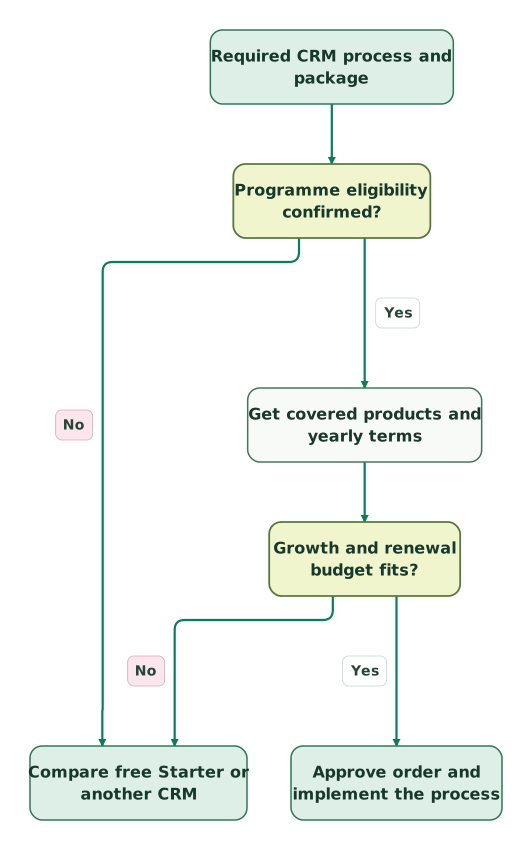
Read diagram as text
- Required CRM process and package to Programme eligibility confirmed?.
- Programme eligibility confirmed? to Compare free Starter or another CRM: No.
- Programme eligibility confirmed? to Get covered products and yearly terms: Yes.
- Get covered products and yearly terms to Growth and renewal budget fits?.
- Growth and renewal budget fits? to Compare free Starter or another CRM: No.
- Growth and renewal budget fits? to Approve order and implement the process: Yes
What should be checked before accepting the offer?
Accept only when the commercial terms and the operating requirement agree. Keep the evidence in a shared buying record so finance, the administrator and the founder are working from the same assumptions.
Checklist
- Funding and partner evidence accurately describe the company.
- Existing subscriptions and the intended account are disclosed.
- Covered products, seats and quantities are identified.
- Payment timing and annual commitment are understood separately.
- Onboarding, contacts, credits and additions have explicit treatment.
- Year-by-year rates and the renewal basis are in writing.
- The budget includes a growth case and a conservative renewal case.
- Property ownership, imports and first-workflow acceptance are assigned.
- The first invoice and enabled entitlements match the order.
- Review dates precede the actual contractual decision deadlines.
For the rest of the stack, compare startup programmes by product and expiry terms. If HubSpot is the right tool but the implementation remains unscoped, request a detailed CRM setup scope covering the required workflow, source data and acceptance tests. The discount should accelerate a useful system, not subsidise an account nobody can trust.
Keep reading
Browse all CRM & Lifecycle guides
 CRM & Lifecycle
Salesforce to HubSpot migration: plan, field mapping and cutover checklist
Plan a Salesforce to HubSpot migration: phases, a field mapping template, load order, Smart Transfer limits, reconciliation checks and a safe cutover.
Jafrin Akter AloLast updated 21 min read
 CRM & Lifecycle
HubSpot implementation: a phased plan, template and launch checklist
Implement HubSpot in five phases: scope, data model, migration, integrations and launch. Includes a plan template, a worked example and a go-live checklist.
Jafrin Akter AloLast updated 22 min read
 Tracking & Attribution
HubSpot Google Ads Integration: 7 Checks for Missing Leads and Conversions
Fix HubSpot Google Ads integration problems across account access, tracking templates, native lead forms, lifecycle events, conversion values and campaign goals.
Jafrin Akter AloLast updated 12 min read
CRM & marketing automation
See the implementation scope, deliverables and acceptance checks.
Questions people ask
Can we apply if we already have a free or Starter account?
Include the existing account and every current subscription in the application, then ask which proposed purchase qualifies. The net-new product restriction should be resolved at the order level before upgrading. Do not assume a fresh portal is necessary or that creating one changes eligibility. Preserve your operational history while the programme team confirms the correct account and purchase route.
Does paying annually mean the discount applies for another year?
Payment frequency, commitment length and discount duration are different terms. An annual payment can settle a year's invoice without extending the award beyond its agreed period. Ask for the effective start and end of each rate and how an amendment is prorated. Reconcile those dates to the order rather than inferring the programme duration from a checkout payment option.
What if a new funding round happens during the programme?
Ask the programme team how the signed terms apply to the changed funding status and retain the response. Application eligibility alone does not establish every mid-term consequence. Keep the company's information accurate and include any revised cost in the next forecast. Do not assume either automatic cancellation or automatic continuation when the published material does not settle your contract's treatment.
Can onboarding and implementation be counted as the same cost?
Only if the written scope actually contains the work you need. List data cleanup, imports, integrations, workflow configuration, reporting and training separately, with an owner and acceptance condition. Compare that list with vendor onboarding and any partner proposal. Otherwise a budget that contains an onboarding fee may still omit substantial delivery work that your team has to fund or perform.
What should we measure before deciding to keep the higher edition?
Review the workflows that depend on it, the useful output they produce and the cost of operating them. Include record quality, accepted handoffs, reporting reliability and staff time alongside revenue measures. Identify what would need rebuilding on a lower tier or another CRM. The decision should compare the next commitment with a working alternative, not defend the original purchase because it was discounted.
Sources

Written by
Jafrin Akter AloData Engineer and Co-founder at Martechdevs and Growth and Analytics Partners
Jafrin writes practical guides to marketing technology, customer data, analytics and AI workflows. Martechdevs is a Growth and Analytics Partners company.