
ZoomInfo Pricing: Evaluate a Quote Without Inventing a Price List
Data Engineer and Co-founder, martechdevs
Last updated 9 min read
ZoomInfo sales workspace pricing requires a quote based on the package, users and consumption. Its separate GTM AI access surface also offers public credit purchases. Budget the exact workflow you need, identify which allowance it consumes and test how many usable records reach your CRM. A low price per exported contact means little if the records do not fit your market.
Last updated: 29 September 2026.
A founder asking for ZoomInfo's price usually wants to know whether the purchase will help the team build enough qualified pipeline. A procurement spreadsheet often answers a narrower question: how much the subscription costs. The gap between those two questions is where expensive surprises happen.
Start by describing the work. Finding new accounts, refreshing existing contacts, researching buying groups and feeding an AI assistant are different workloads. They may need different entitlements, credit pools and implementation effort.
Which ZoomInfo product are you pricing?
The public sales pricing page lists Professional, Copilot Advanced and Copilot Enterprise without a numeric subscription price. Its FAQ identifies licenses, functionality and credit usage as pricing inputs, and says integrations and additional products can affect the package. That is the basis for requesting a scoped proposal, not evidence for a universal annual minimum. ZoomInfo pricing.
Separately, GTM AI publishes pay-as-you-go data and AI credit purchases for API, MCP and CLI access. At the time of review, the page displayed 5,000 data credits for USD1,900 before a limited first-purchase promotion, plus AI credits at USD0.05 each. Those figures describe the displayed credit purchase, not a complete sales workspace subscription. Recheck the live selector and checkout before budgeting. GTM AI pricing.
Ask the vendor to name the product and purchasing route on every line. A quote for seller seats should not be compared directly with a developer credit pack. One may include the working interface your team needs; the other may require you to build that interface and its CRM process.
If the missing piece is defining that process, our GTM engineering work focuses on how accounts become qualified, assigned and actionable. That specification gives you a better purchasing brief than a list of desirable features.
Write a workload before requesting the quote
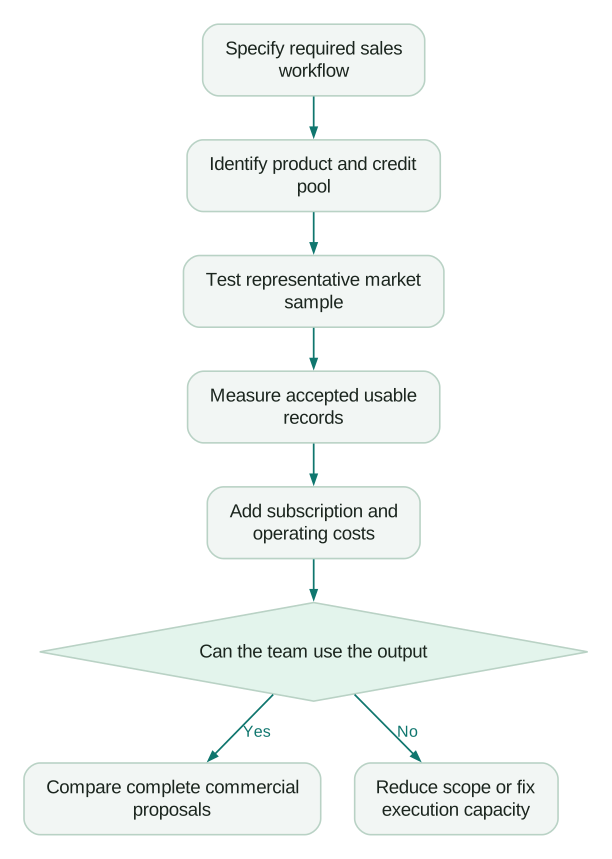
Use a one-page operating specification with five sections.
People and responsibilities. Count daily sellers, occasional researchers, administrators and automated workloads separately. Identify who actually needs access to licensed data. Avoid assuming that every employee needs the same seat or that an administrator account can perform the same work as a seller.
Target market. Specify geography, company size, industry, business model and the roles you sell to. Include awkward cases: subsidiaries, franchise operators, companies with shared domains and buyers whose job titles vary. A data source's overall database size cannot tell you whether those cases are covered.
Required outputs. Name the fields that make a record useful: company identifier, relevant role, current employer, contact route, source timestamp and an owner in the CRM. Separate mandatory fields from optional context. Do not reject a good record because an interesting but unnecessary field is blank.
Volume and frequency. Estimate new records, refreshes and research jobs separately. A monthly list of 2,000 new people is different from refreshing the same 2,000 people every week. Record the expected peak as well as the average, particularly when importing a historical CRM backlog.
Destination and action. Specify whether the output goes to a spreadsheet, CRM, sequencer or agent. State what happens next. Enrichment that lands in an unused custom field has not completed the job.
These details also make an Apollo comparison more useful. Both vendors should be evaluated against the same required outputs, rather than each vendor's strongest demonstration.
How should you read the credit allowance?
Translate every credit line into an operation that your team will perform. Ask for examples using your intended product, endpoint and entitlement. An allowance labeled simply “credits” is insufficient for a mixed workflow.
GTM AI's technical documentation distinguishes data credits from AI credits. It also says MCP uses pooled or bulk data credits and cannot consume recurring monthly allowances on some older subscriptions. Administrators can set user limits, while AI research consumption varies with the work performed. An existing subscription therefore does not automatically mean your proposed MCP workflow has a usable allowance. GTM AI credit documentation.
For each operation, capture:
- The product surface and tool or workflow used.
- The event that creates a charge: lookup, enrichment, export, audience loading or research.
- Whether the unit is a contact, company, signal, request or research action.
- How repeat records, unmatched inputs and retries are treated.
- The applicable credit pool, reset or expiry rule, and additional-purchase mechanism.
Keep the evidence with the commercial proposal. A sales email saying “you have plenty of credits” does not answer which pool a scheduled integration can use.
Resolve the public documentation conflicts explicitly
The GTM AI pricing page currently contains conflicting expiry statements: one section says credits do not expire while an account is active, while its FAQ says they expire after 12 months. It also limits the repeat-enrichment benefit to Enterprise in the FAQ. The credit documentation describes organization-wide repeat enrichment within 12 months more generally. Treat eligibility and expiry as unresolved for your specific purchase until confirmed in writing. Pricing FAQ, credit documentation.
This matters to the model. If you assume every repeat refresh is free and the account does not qualify, a low-volume maintenance workflow can consume substantially more than expected. Model both cases until the vendor confirms which applies.
Do not use promotional purchase prices as the long-term rate. Show the initial cash payment and the recurring replenishment assumptions separately. That keeps a launch offer from silently defining the economics of a year-long process.
Measure accepted records, not just exports
Define an accepted record before running a sample. For a phone-first sales team, a useful record might need the right company, the right role and a reachable direct number. For a partner program, account fit and a relevant partnership contact may matter more than phone coverage.
Use a sample drawn from your actual market. Include your major countries and segments in approximately the mix you expect to buy. Record failed matches and missing data, not only successful exports. Otherwise, the evaluation will overstate coverage.
Here is an illustrative evaluation, not a ZoomInfo result or a vendor quote.
A team examines 500 candidate contacts. Of those, 400 have the required fields. After checking current employment and target-role fit, 320 remain. Removing people already in the CRM and records in excluded accounts leaves 240 net-new accepted contacts.
The useful yield is 240 ÷ 500, or 48%. Reporting only field completion would show 80% and miss the actual constraint.
If the team's planning requirement is 1,200 accepted contacts, a 48% yield implies roughly 2,500 candidates to examine. That is a workload estimate under the sample's assumptions, not a prediction that every future batch will perform identically. Recalculate for markets where coverage differs.
A source can also create value through refreshed existing records. Count those separately. Correcting the employer of an existing buyer is useful, but calling that person a net-new lead inflates acquisition output.
Build a cost model that includes the operating work
Start with the quoted subscription and explicitly add the work required to use it:
- Seats and committed platform fees.
- Additional credit purchases or usage charges under the relevant rules.
- Integration, implementation and migration effort.
- Ongoing data review, exceptions and CRM administration.
- Other tools still needed to complete the workflow.
Separate one-time implementation from ongoing operation. Allocate internal time using a consistent planning rate, even if no additional employee is hired. Time spent resolving duplicates is time unavailable for campaign development or seller support.
For an illustrative comparison, suppose Proposal A costs USD24,000 annually and requires USD6,000 of annual operating work. Proposal B costs USD30,000 and requires USD3,000 of work. These are invented planning amounts, not published ZoomInfo prices.
If both deliver 12,000 accepted records annually, A costs USD2.50 per accepted record and B costs USD2.75. If B produces 15,000 genuinely useful records that the team can work, its cost becomes USD2.20. If the team only has capacity to use 12,000, the extra supply should not receive full economic credit.
Add a second measure for records actually worked. Buying more available data than the team can act on can improve a spreadsheet ratio while worsening cash efficiency.
Which entitlement details belong in the proposal?
List the fields and functions you need in plain language. “API included” does not establish access to every data type. ZoomInfo's MCP security documentation says results respect the signed-in user's package entitlements; intent access depends on the relevant configuration. Access to an interface is therefore separate from access to the data required for your use case. GTM AI security and data.
For a CRM enrichment project, require a demonstration using your actual field rules: keep seller-entered notes, preserve ownership, update selected firmographics and log the source of changed values. For an AI research project, demonstrate the specific research task and inspect the evidence behind its output.
Ask what remains your responsibility. Will the vendor configure the connector, or merely provide access? Who maintains field mappings when the CRM changes? Does a failed batch produce an alert and a recoverable queue? These are implementation questions with cost consequences, regardless of the logo on the data source.
Our guide to Apollo implementation mistakes illustrates why ownership, matching and overwrite rules deserve separate acceptance tests. Apply the same rigor to any provider.
Separate payment schedule from commitment
A monthly invoice describes when money is collected. It does not, by itself, establish a month-to-month cancellation right. Record contract duration, billing cadence, renewal conditions and exit obligations as separate fields in the procurement summary.
ZoomInfo's billing guidance points customers to their contract and agreed billing schedule to clarify services and frequency. Use the actual order form and applicable agreement for your account rather than treating an old contract found online as current policy. ZoomInfo billing guidance.
Have your commercial owner confirm what happens at renewal, when notice is required, whether unused allowances carry forward and what changes if you reduce seats. Record who owns that calendar. Also clarify permitted retention and use of previously exported data when the agreement ends. Do not infer those rights from the technical ability to keep a CSV.
Before approving the purchase:
Checklist
- The product, seat types, required fields and integration route are named.
- Each recurring workload has a documented charge unit and eligible credit pool.
- Repeat enrichment, credit expiry and promotion assumptions are confirmed.
- A representative sample has an accepted-record yield, with rejection reasons.
- Implementation and ongoing operating work are included in the comparison.
- Billing cadence, total commitment and renewal responsibilities are recorded separately.
The strongest negotiation starts with a clear workload and evidence of what the team can use. That gives you a defensible reason to request different allowances, narrower scope or a staged implementation, without relying on an unverified internet price range.
Questions people ask
Does ZoomInfo publish a standard annual subscription price?
The sales pricing page reviewed here does not provide one numeric annual price for every buyer. Request a proposal for your users, required capabilities and usage, and compare the complete operating cost rather than an unsourced minimum.
Is GTM AI pricing the same as a ZoomInfo sales workspace quote?
They describe different purchasing scopes. A public credit purchase can support a technical workflow, while a workspace proposal may include seller access and other capabilities; verify what each offer actually contains before comparing totals.
Can I assume repeat enrichment is free?
No, the current public pages describe eligibility differently. Ask for confirmation covering your account, purchasing route and record types, then keep that evidence with the budget assumptions.
What should a ZoomInfo trial prove?
It should show that your actual target market produces records your team can use, and that those records reach the destination with correct matching and ownership. Measure missing fields, wrong roles, stale employment, existing-record overlap and review time alongside successful results.
How do I decide whether a higher quote is worthwhile?
Compare cost per accepted record and cost per record the team actually works, while keeping implementation effort visible. A higher quote can be reasonable if it reduces meaningful operating work or supplies additional qualified opportunities your team has capacity to pursue; extra unused volume is not enough.
Sources
- ZoomInfo pricing and package FAQ, accessed 29 September 2026.
- GTM AI pricing, accessed 29 September 2026.
- GTM AI credits and billing, accessed 29 September 2026.
- GTM AI security and data, accessed 29 September 2026.
- ZoomInfo billing and payment, accessed 29 September 2026.
Written by
Jafrin Akter AloData Engineer and Co-founder, martechdevs
Jafrin Akter Alo is a data engineer and co-founder of martechdevs, where the team has delivered 74+ martech, data and growth stack implementations.