
Hightouch Alternatives for Warehouse Activation, Audiences and Cost
Choose Fivetran Activations for a managed warehouse-to-tool workflow, RudderStack Lookout for marketer-operated audiences, or Segment when activation belongs inside a wider event and customer-data setup. Hightouch alternatives must preserve matching, removals and destination behavior. A lower entry price is useful only when the replacement sends the correct records, respects field ownership and gives someone a clear way to repair failures.
On this page
Hightouch competitors compared
Public USD entry terms below use different commercial units; paid Hightouch scope and larger activation workloads need a qualified offer.
| Tool | Starting price and billing basis | Best fit | Main tradeoff |
|---|---|---|---|
| Fivetran Activations, formerly Census | Free up to 3,500 activation MAR/month; paid usage-based pricing | Managed activation alongside a data-movement platform | Activation MAR differs from connection MAR and repeated sends |
| RudderStack Lookout | Free limited activations; Growth $1,000/month billed annually | Marketers building and activating warehouse audiences | Audience and destination combinations affect activated records |
| Segment Connections | Free scope; Team from $120/month with 10,000 visitors and stated Reverse ETL allowance | Event collection plus warehouse activation | Full profile and audience CDP scope is separately packaged |
| Hightouch, retained baseline | Basic Reverse ETL free for up to two active syncs | A small existing warehouse activation workflow | Broader CDP and marketing features need their own scope |
See Fivetran pricing, RudderStack pricing, Segment Connections pricing and Hightouch pricing. Fivetran's Activations glossary identifies the current name for the former Census product.
We would begin with the job Hightouch performs today. Updating CRM account attributes is different from maintaining an advertising audience, sending an event or giving marketers a self-service audience builder. A replacement can cover one of those jobs while leaving the others unfinished.
At Martechdevs, we implement those source models and destination rules through our data warehouse and activation service. The acceptance test ends in the destination record or audience, because a successful warehouse query alone does not establish a successful activation.

Hightouch and alternative decisions
Hightouch
- Best for: A team with trusted warehouse models and a working activation process that may need a bounded configuration or scope repair.
- Pros: A sync specifies its model, destination object, matching rule and field mapping. The documented change tracking distinguishes added, changed and removed rows. See sync behavior.
- Cons: Destination modes and deletion behavior vary. A model that drops a customer does not automatically imply that every destination deletes that customer.
- Free plan and startup offer: Basic Reverse ETL includes up to two active syncs, unlimited configured destination count and unlimited users. Broader CDP and marketing scope is usage-based and sales-assisted. No startup concession is assumed. See Hightouch plans.
- Choose it if: The current tool supports the requirement and a matching, model or configuration repair solves the problem at an acceptable complete cost.
- Skip it if: A representative destination case remains unsuitable and another qualified setup demonstrates a better operating result.
Fivetran Activations
- Best for: A data team evaluating managed activation within the same wider platform used for data movement and transformation.
- Pros: The current product is the successor to Census and provides warehouse activation concepts and syncs. That makes it a direct candidate for a reverse-ETL replacement. See Activations and its glossary.
- Cons: The commercial unit is activation MAR under the relevant boundaries. A connection-ingestion allowance is not interchangeable with an activation allowance.
- Free plan and startup offer: Free includes 3,500 activation MAR/month, separately from the 500,000 connection-MAR allowance. New activations are eligible for a fourteen-day free trial. No startup discount is assumed. See pricing and activation trial terms.
- Choose it if: The required destinations and update semantics pass the pilot and the platform relationship reduces useful operating work.
- Skip it if: The quote assumes ingestion and activation have the same usage counter or leaves audience-building requirements outside the selected plan.
RudderStack Lookout
- Best for: Marketers who need to build and activate audiences from warehouse data with a maintained business definition.
- Pros: Lookout can operate on warehouse data without requiring RudderStack Core. Its pricing definition makes the audience-and-destination unit explicit. See RudderStack products and pricing.
- Cons: The same person in several audiences and destinations can produce several activated records. RudderStack Core's event-based reverse ETL is a separate commercial workflow.
- Free plan and startup offer: Lookout Free includes three activations per year with up to 5,000 records per sync. Growth is $12,000/year with 40,000 activated records included. No startup concession is assumed. See Lookout pricing.
- Choose it if: Marketers will own audience exploration and activation while a data owner maintains the source definitions and permission boundaries.
- Skip it if: The team only needs a narrow scheduled table sync and the wider audience workflow adds little value.
Segment
- Best for: A company evaluating reverse ETL as part of an existing or planned Segment Connections environment.
- Pros: Reverse ETL computes changes in the warehouse and sends mapped records to destinations. Its documented system tracks new, updated and deleted records. See Segment Reverse ETL.
- Cons: Connections, identity-resolved profiles and broader audience orchestration are different product scopes. The entry pipeline price does not establish a full CDP replacement.
- Free plan and startup offer: Connections Free lists 1,000 visitors/month, two sources and 500,000 Reverse ETL records/month. Team has a fourteen-day trial. No additional startup credit is assumed. See Connections pricing.
- Choose it if: The existing Segment workflow and required activation destinations fit together under a qualified configuration.
- Skip it if: The expected saving depends on audience or identity features that belong to separately packaged CDP scope.
Source models and the actual replacement boundary
Create an activation inventory before comparing tools. For each sync, record the model, its unique key, the destination object, mapping, schedule and expected treatment of a removed row. Include the people who create audiences and the team that investigates failed writes.
| Current job | Required destination result | Acceptance owner |
|---|---|---|
| CRM account enrichment | Correct existing account with approved attribute updates | RevOps |
| Advertising audience | Intended membership and removals | Paid media owner |
| Lifecycle segmentation | Correct customer and subscription-safe eligibility | Lifecycle owner |
| Event delivery | One intended event with a stable identity | Application and analytics owners |
| Marketer audience building | Reviewed population from trusted definitions | Marketing and data owners |
Hightouch documents that one sync connects one model to one destination object, list or table. A hypothetical design with two models and three destination objects per model therefore needs six such syncs under that simple one-to-one arrangement. Its free limit of two active syncs is a scope boundary, even though the configured destination count is unlimited. See sync structure and Basic scope.
If the warehouse model itself is stale or incorrect, replacing activation will preserve the wrong output more efficiently. Reconcile the source population and fix the upstream owner first. The warehouse audiences guide explains that preparation.
For source ingestion, Airbyte alternatives covers the upstream pipeline. If the missing requirement is application event collection and customer identity, mParticle vs Segment addresses the wider CDP decision.
Matching, nulls and removed records
Choose the matching key before running a sync. An email address can change, while the destination may identify the customer by an internal identifier or external key. A correct source row can create a duplicate if the matching configuration uses the wrong field.
Define field ownership explicitly. A warehouse can supply a lifecycle score without becoming authoritative for the sales owner, customer consent or commercial stage. A null value also needs a meaning: unknown, intentionally cleared or absent from this update. Treat those cases deliberately rather than allowing a default to decide.
Segment documents that mapped null values are synced by default. Nulls can be excluded for supported optional fields and destinations; this control is not universal. Test the specific mapping if an empty source value could erase a maintained destination field. See Reverse ETL mapping setup.
Hightouch describes several destination-dependent removal behaviors, including retaining a record, clearing mapped fields or deleting it where supported. A full resync also does not automatically clean up every historically removed record. Use the actual destination documentation and a known removal case before assuming the target mirrors the current query result. See Hightouch deletion behavior.
Test a new record, an existing record, a changed identifier, a null field and a removed audience member. Inspect the destination after each case. A success response from the activation tool is useful evidence, while the intended customer state is the real acceptance criterion.
Billing units and audience expansion
RudderStack Lookout defines an activated record as a person's first sync from an audience to a destination. Each person counts once per audience and destination combination. Attribute updates, resyncs and removals are excluded under its stated rules, while leaving and later rejoining an audience can create a new activated record. See Lookout billing definitions.
Assume a hypothetical campaign has 5,000 people, all in two audiences, and each audience is sent to three destinations. The resulting first-time combinations are 5,000 × 2 × 3 = 30,000 activated records. That is not a claim of thirty thousand unique people.
| Hypothetical quantity | Calculation | Result | Meaning |
|---|---|---|---|
| Unique people | Given population | 5,000 | Business audience |
| Audience memberships | 5,000 × 2 | 10,000 | Every person in both audiences |
| First destination activations | 10,000 × 3 | 30,000 | Audience-destination combinations |
| Remaining amount within a 40,000-record annual allowance | 40,000 minus 30,000 | 10,000 | Under stated first-activation assumptions |
Segment measures Reverse ETL usage by records successfully processed to destinations. Its documentation gives the example of 50,000 records to one destination and 50,000 to another producing 100,000 usage records. Keep destination fan-out visible in the budget. See Segment usage.
Fivetran's activation-MAR allowance is another unit again. Confirm its activation boundaries and current account terms instead of applying Lookout's first-activation formula or Segment's processed-record calculation to it. The Fivetran pricing page separates activation and connection allowances.
Hightouch alternative cost planning
At Lookout Growth's published $1,000 monthly equivalent billed annually, the base annual commitment is $12,000. Segment Connections Team's $120 monthly entry basis annualizes to $1,440 across twelve unchanged monthly payments. These amounts represent different product scopes and are not equivalent audience packages. See Lookout and Segment pricing.
For Hightouch and paid Fivetran activation usage, use the qualified offer or estimator with the actual models, destinations and commercial units. Include warehouse-query cost and the work of reviewing destination errors. Free activation does not remove the warehouse's processing or the business owner's responsibility for the audience.
Consider a hypothetical replacement saving $400/month after all recurring costs, with $6,000 of one-time migration work. Simple payback is $6,000 ÷ $400 = 15 months. If destination validation or additional audience tooling changes the recurring saving, recalculate before treating the cheaper platform as a completed business case.
The Hightouch pricing guide and software pricing tool help structure that comparison. Keep any temporary evaluation credit outside the ordinary-year estimate.
Repair, retries and downstream actions
A retry is more consequential when a destination triggers business actions. Repeating an event can send another message, while repeating an insert can create a duplicate. Define whether the target operation is intended to update existing state or append a new action.
Hightouch warns that a full resync can duplicate insert-mode, event or webhook output. Treat recovery controls as specific operations with prerequisites, rather than interchangeable ways to make a red status disappear. See Hightouch resync behavior.
Retain rejected records and their reasons. A run can complete while some rows fail. The owner needs to know whether the remaining rows are safely retryable and whether the source model should change. Reconcile both the intended population and the successful destination output before expanding a migration.
Use a bounded non-production or otherwise safe test scope for the first evaluation. Verify the unchanged second run, a changed field and a removal. Then repeat after a mapping repair. The reverse ETL Salesforce guide shows why destination ownership matters for CRM activation.
Best fit by activation model
| Company or operating model | Best fit | Runner-up | Decision reason |
|---|---|---|---|
| Data team already operating Fivetran ingestion | Fivetran Activations | Hightouch | Shared operations can simplify the qualified workflow |
| Marketers building audiences from trusted warehouse models | RudderStack Lookout | Hightouch Customer Studio scope | Operator independence is part of the requirement |
| Existing Segment event-routing team adding warehouse syncs | Segment | Hightouch | Existing platform ownership can carry value |
| Small team with two qualified active syncs | Hightouch Basic | Segment Free scope | A free route may already cover the limited task |
| Team with incorrect CRM overwrites or removals | Mapping and ownership repair first | Qualified alternative | A different sender can reproduce the same bad rule |
Activation replacement workflow
The graph separates a marketer audience-building requirement from a data-team sync requirement. Both must pass destination-state validation, with matching or removal repairs returning to the same test before cost and ownership review.
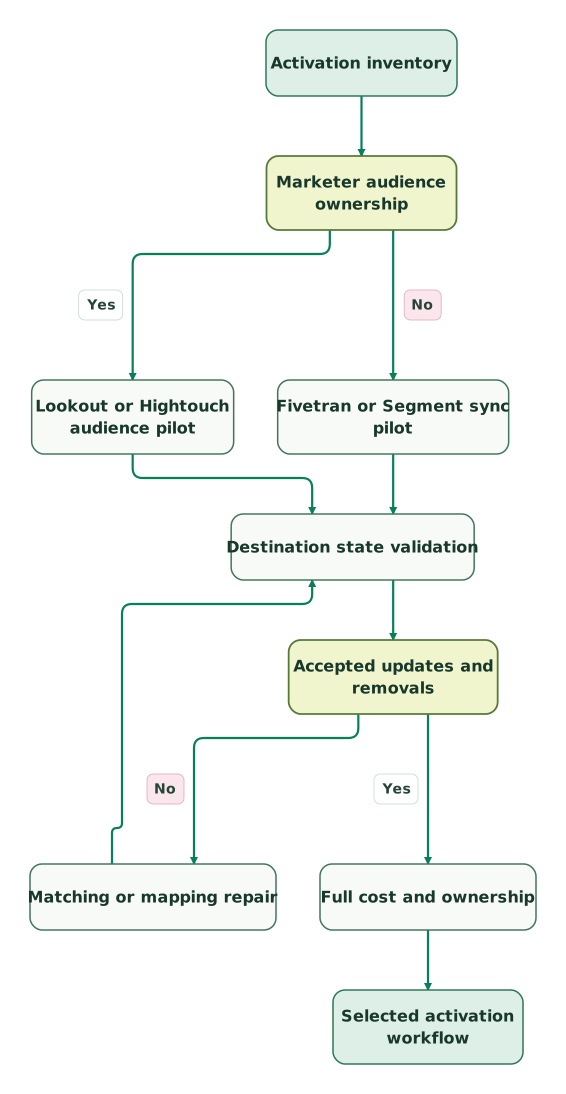
Read diagram as text
- Activation inventory to Marketer audience ownership.
- Marketer audience ownership to Lookout or Hightouch audience pilot: Yes.
- Marketer audience ownership to Fivetran or Segment sync pilot: No.
- Lookout or Hightouch audience pilot to Destination state validation.
- Fivetran or Segment sync pilot to Destination state validation.
- Destination state validation to Accepted updates and removals.
- Accepted updates and removals to Matching or mapping repair: No.
- Matching or mapping repair to Destination state validation.
- Accepted updates and removals to Full cost and ownership: Yes.
- Full cost and ownership to Selected activation workflow
Hightouch replacement checklist
- A complete inventory of models, destinations and activation owners.
- A stable matching key and source-population reconciliation.
- Field ownership and explicit null-value behavior.
- A known removed-record or audience-exit test.
- An unchanged rerun and a retry-safe destination operation.
- A quote using the correct sync, MAR or activated-record unit.
- Destination fan-out and warehouse-query costs in the budget.
- Rejected-row monitoring and a named repair owner.
- A bounded cutover with one accepted source of destination updates.
Use the marketing data audit skill to organize source and identity checks. Preserve the destination cases with the activation configuration so future changes can repeat them.
Keep reading
Browse all Data Warehouse guides
 Data Warehouse
Warehouse Audiences: Activate Customer Data in Google Ads, Meta and HubSpot
Build warehouse audiences for Google Ads, Meta and HubSpot with clear entry and exit rules, marketer self-serve guardrails and honest match-rate checks.
Jafrin Akter AloLast updated 18 min read
 Data Warehouse
Hightouch Pricing: Count Activation Work Before You Compare Quotes
Hightouch's free plan covers 2 active syncs, and its Composable CDP and Agentic plans are usage-based with no public price. Count syncs and test the claims.
Jafrin Akter AloLast updated 18 min read
 Data Warehouse
Reverse ETL to Salesforce: Match Accounts, Control Writes and Verify Results
Sync warehouse signals into Salesforce with unique external IDs, controlled writes and field access. Reconcile row results, retries, readback and automation.
Jafrin Akter AloLast updated 14 min read
Data warehouse & CDP
See the implementation scope, deliverables and acceptance checks.
Questions people ask
Is Census still the current product name for a Fivetran activation shortlist?
Fivetran's current documentation calls the product Activations and identifies Census as its former name. Use the current package, usage rules and account terms when evaluating it against Hightouch. A historical Census allowance should not be carried into a new purchase without confirmation. The Activations glossary provides the naming reference.
Do two Hightouch active syncs mean unlimited simultaneous model-to-destination routes?
Two active syncs do not mean unlimited simultaneous model-to-destination routes. Hightouch defines a sync as one model connected to one destination object, list or table. Its Basic offer permits two active syncs while allowing unlimited configured destinations. Count the actual active routes needed by the design using the sync definition and plan scope.
Can the same person consume several Lookout activated records?
The same person can consume several Lookout activated records when sent through different audience and destination combinations. Its public definition counts each person per audience and destination, with further rules for updates and rejoining. Model those combinations explicitly before comparing the allowance with unique customers. See RudderStack Lookout pricing.
Can a null warehouse field erase a destination value during Segment activation?
A null warehouse field can affect the destination value because Segment syncs mapped null values by default. The actual result also depends on the destination and mapping. Review the null setting and test a maintained field before broad activation, especially where another team owns the value. See Segment Reverse ETL setup.
Should an activation retry be treated like rerunning a read-only report?
An activation retry should be treated as another potential destination write. Depending on the operation, it can update state, create another record or trigger another event. Confirm the target's repeat behavior and test an unchanged rerun before relying on recovery controls. The acceptance check belongs in the receiving system, not only in the activation run status.
Sources
- Hightouch pricing
- Hightouch sync, matching and removal behavior
- Fivetran pricing
- Fivetran Activations overview
- Fivetran Activations glossary
- Fivetran activation migration and trial FAQ
- RudderStack Core and Lookout pricing
- Segment Connections pricing
- Segment Reverse ETL system and usage
- Segment Reverse ETL setup and null mapping

Written by
Jafrin Akter AloData Engineer and Co-founder at Martechdevs and Growth and Analytics Partners
Jafrin writes practical guides to marketing technology, customer data, analytics and AI workflows. Martechdevs is a Growth and Analytics Partners company.