
Segment vs Hightouch: Choose the CDP Around Your Customer Model
Segment and Hightouch overlap more than their usual labels suggest: both can collect events and activate warehouse data. The useful choice is where customer definitions live, who maintains them, and which paid capabilities a campaign needs. Compare the complete operating setup, then make both products deliver the same eligible audience before choosing either one.
On this page
When should you choose Segment, Hightouch or both?
Choose Segment when a packaged profile and audience workflow fits your team; choose Hightouch when warehouse models should drive activation. Keep both when Segment already collects reliable events and replacing collection would add work without improving the audience. Our default is to preserve a functioning collection layer and pilot the missing activation capability first.
Martechdevs earns implementation fees for helping teams design and operate these systems.
| Your situation | Starting shortlist | What must be proven |
|---|---|---|
| You need collection, profiles and marketer-operated audiences together | Segment's complete CDP package | The quoted package includes the identity, audience and governance capabilities you need |
| Accounts, subscriptions and eligibility already have maintained warehouse models | Hightouch, alongside Segment's warehouse features | Both reproduce those definitions without competing business logic |
| Segment collection works, but sales needs warehouse-computed account signals | Keep Segment; compare activation options | A second contract buys a measurable operational improvement |
| Nobody owns identity, consent or source freshness | Assign those responsibilities before buying either | A named person can resolve a wrong customer match or stale audience |
| You mainly need an event pipeline into analytics tools | Compare collection products separately | The pipeline works without buying an unnecessary audience platform |
This is not a binary choice between a tool that collects and one that cannot. Hightouch Events collects browser, mobile and backend events, with warehouse delivery, downstream streaming or both. Segment Reverse ETL sends warehouse records to destinations. Decide which responsibilities you want to consolidate, then compare those packages.
Our warehouse and CDP implementation service starts with that ownership map and a bounded audience pilot. If the immediate question is the collection layer, use Segment vs RudderStack; it covers a different purchasing decision.
What are the practical pros and cons of each product?
Segment's advantage is an integrated customer-data workflow; Hightouch's is activation built around your warehouse. Neither advantage eliminates modeling work or guarantees that a destination receives the correct record. Treat the following as operating trade-offs, then validate the specific plan and connector.
Segment
Best for: a team that wants collection and packaged profile workflows under a coordinated product setup.
Pros
- Collection and routing can remain useful even if another tool handles warehouse activation.
- Reverse ETL is available without making the full CDP package the starting purchase.
- Unify provides profile exploration and identity capabilities for teams buying the appropriate package.
- Data Graph connects profiles with warehouse entities, including accounts and subscriptions.
Cons
- Growth in billable identities can change collection costs even when destination count stays stable.
- The Connections subscription alone does not include the full identity and audience stack.
- Warehouse-linked features still require warehouse permissions, schema work and maintenance.
- Rebuilding warehouse business rules inside audience definitions creates another place to keep them consistent.
Free and startup use: Connections Free is suitable for a bounded technical evaluation; larger workloads or full profile workflows need the relevant paid package. Do not include an unconfirmed startup discount in a budget.
Choose it when: the team can demonstrate a simpler operating workflow using the complete quoted package.
Skip it when: the purchase mainly duplicates maintained warehouse definitions and existing activation, without removing enough work to justify the change. The product boundaries above follow Segment's CDP packaging, Unify availability and Data Graph requirements.
Hightouch
Best for: a team with owned warehouse models that wants marketers and operations teams to activate those models.
Pros
- Existing warehouse definitions can become the basis for operational audiences.
- Basic Reverse ETL offers a small free pilot before a larger paid scope.
- Collection is available through Events if replacing that layer is actually required.
- The product catalogue allows activation capabilities to be evaluated alongside additional CDP and AI products.
Cons
- Warehouse-centered activation still depends on someone maintaining usable source models.
- A paid proposal is necessary to price the required product combination accurately.
- Audience queries, syncs and other warehouse work contribute to a separate compute bill.
- Storage and processing details differ across capabilities; the warehouse architecture does not mean no customer data is ever cached elsewhere.
Free and startup use: use the limited Basic plan for a narrow sync test; obtain a quote for the real workload rather than extrapolating a free pilot to production.
Choose it when: owned warehouse definitions and a working activation workflow reduce duplicated logic and operational effort.
Skip it when: the team expects a connector purchase to repair missing identity, consent or source-quality ownership. The capability and operating boundaries come from Hightouch's product pricing, warehouse compute guidance and security architecture.
Where do profiles, customer definitions and sync state live?
Separate the business definition from the product's execution state. A warehouse can own “an account with an overdue invoice and an active subscription” while another system maintains a profile, audience membership or delivery checkpoint. Document all four; calling one product composable does not tell you where every copy lives.
| Layer | Segment consideration | Hightouch consideration | Question for your pilot |
|---|---|---|---|
| Collection | Retain or configure the event pipeline | Retain another collector or evaluate Events | Are identifiers, timestamps and required properties preserved? |
| Customer model | Profiles can link to warehouse entities through Data Graph | Warehouse models feed activation | Where is account eligibility defined and reviewed? |
| Execution state | Reverse ETL creates warehouse state and checkpoint tables | Change tracking, logs and caches depend on configuration | What persists, where, and for how long? |
| Operational destination | Connector and destination rules still apply | Connector and destination rules still apply | Which exact object, key and operation are supported? |
Segment Data Graph is a semantic layer linking profiles to warehouse entities. For Linked Audiences, setup requires Profiles Sync and appropriate warehouse and workspace permissions; Linked Audiences enablement is another setup consideration. It is inaccurate to assume Segment only handles isolated users and events. Segment Data Graph
Hightouch distinguishes its standard activation approach from a separate primary customer-data store. However, change tracking, debugging, real-time and AI capabilities can involve configuration-dependent state, buckets or caches. The Lightning engine also needs an isolated writable warehouse location. Ask for the actual data-flow and retention configuration for the capabilities you will buy. Hightouch security architecture
Segment Reverse ETL maintains records and checkpoints in a dedicated warehouse schema. Include those objects in access reviews and migration planning; they are not the authoritative definition of a customer. Segment Reverse ETL system requirements
For the broader architecture decision, read CDP vs data warehouse. For the modeling responsibilities behind the label, see what a composable CDP requires.
How do pricing units and free plans differ?
Segment's Connections entry pricing follows monthly tracked users, while Hightouch's Basic Reverse ETL limit follows active syncs. Neither unit describes the entire cost of a complete CDP. Request the exact product scope, usage definitions, included capacity, overage treatment and required add-ons in writing. Compare how other reverse ETL tools price the same syncs before treating either unit as the market standard.
| Published entry offer | Allowance | Important boundary |
|---|---|---|
| Segment Connections Free | 1,000 monthly visitors, two sources, one warehouse destination; 500,000 Reverse ETL records | A collection/activation trial, not the complete profile and audience package |
| Segment Connections Team | USD 120/month for 10,000 tracked users; 1 million Reverse ETL records | Additional tracked users and broader CDP capabilities need separate treatment |
| Hightouch Basic Reverse ETL | Two active syncs; unlimited destinations and seats listed | Two active jobs do not become six because the destination catalogue is unlimited |
| Hightouch paid products | Quote for the chosen activation and CDP capabilities | Confirm the billable unit for each selected product |
Entry allowances are published on Segment Connections pricing and Hightouch pricing. Segment Unify is an additional Business-tier capability rather than part of Free or Team; Engage requires Unify. Segment Unify
An MTU is not simply a paying customer. Segment counts distinct identified users plus anonymous identities that were not linked to an identified user during the billing period. That makes anonymous-identity fragmentation relevant to forecasting. Segment's MTU calculation
For Hightouch business-tier accounting, a sync that executed in the previous calendar month counts as active even if it was later disabled or deleted. The self-serve documentation also specifies hourly scheduling limits and an operations allowance. Confirm which terms apply to the proposed package; “unlimited destinations” is not a promise of unlimited execution at any frequency. Active-sync accounting, self-serve limits
Use Segment pricing and Hightouch pricing for the deeper contract checks. The decision here is whether the resulting workflows and full costs are comparable.
What does a 25,000-user, six-audience workload actually cost?
The published Connections bands produce a USD 300 monthly collection estimate at 25,000 MTUs: USD 120 plus 15 additional blocks of 1,000 at USD 12. That is not a complete Segment CDP quote. Hightouch needs a paid proposal for six active syncs; its free two-sync limit cannot price this workload.
The detailed Segment rate bands and its brief pricing FAQ use different additional-user wording. Confirm the contracted bands rather than using the FAQ's flat shorthand. The USD 300 illustration follows the detailed table. Segment Connections pricing
Make “six audiences” measurable. In this hypothetical workload, each audience is one model-to-destination job, initially delivering 2,000 rows. Each then delivers 100 changed rows daily for the remaining 29 days of a 30-day month. Assume every attempted row succeeds and no additional full refresh occurs.
| Workload component | Arithmetic | Result |
|---|---|---|
| Initial delivery to six destinations | 6 × 2,000 rows | 12,000 delivered records |
| Subsequent changed-record deliveries | 6 × 100 rows/day × 29 days | 17,400 delivered records |
| Total successful delivery volume | 12,000 + 17,400 | 29,400 records |
| Same delivery repeated to a second destination per audience | 29,400 × 2 | 58,800 records |
Segment counts Reverse ETL records successfully processed for a destination; delivering the same records to two destinations counts twice. Failed records do not contribute to that usage measure. Thus 29,400 deliveries are not necessarily 29,400 distinct people. Segment Reverse ETL accounting
Now compare complete scopes. Let S be the monthly Segment quote and H the monthly Hightouch quote for the capabilities that passed your pilot. Each must include any collection, identity and audience features the design requires. Do not substitute the USD 300 Connections estimate for S when the design needs more.
For a transparent planning example, suppose either candidate requires USD 120/month in incremental warehouse work, four operating hours/month valued at USD 75/hour, and 40 setup hours at the same internal planning rate. These are hypothetical team inputs, not vendor fees or Martechdevs prices.
| Cost line | First-year calculation | First-year cost |
|---|---|---|
| Warehouse work | USD 120 × 12 | USD 1,440 |
| Recurring operation | 4 hours × USD 75 × 12 | USD 3,600 |
| Initial setup | 40 hours × USD 75 | USD 3,000 |
| Non-subscription total | USD 1,440 + USD 3,600 + USD 3,000 | USD 8,040 |
| Complete comparison | Subscription plus the above assumptions | Segment: 12S + USD 8,040; Hightouch: 12H + USD 8,040 |
Equal operating assumptions deliberately isolate the subscription comparison. Replace them with measured differences: one extra operating hour each month adds USD 900/year at this rate; ten additional setup hours add USD 750 once. Include retained collector fees and contract overlap where applicable, without charging the same retained service twice.
Hightouch queries consume warehouse compute for audiences, traits, syncs and journeys. Query frequency, repeated joins and concurrent work can change that bill. Measure the pilot workload rather than applying a vendor's typical-cost percentage to your account. Warehouse compute drivers
How should you run a fair one-audience pilot?
Use one written eligibility definition, the same evaluation time and the same destination. Compare eligible record keys and resulting field values, not just dashboard counts. Put both candidates through a state change, an invalid record, a consent withdrawal and a controlled recovery before comparing usability.
For example, select account contacts whose account has an active subscription, whose required activation milestone is incomplete, and whose channel permission allows the proposed message. Specify the account-to-contact rule so a multi-contact account does not silently become several unrelated customers. Use the warehouse audience design guide for the eligibility model.
| Pilot case | Evidence to collect | Pass condition |
|---|---|---|
| Initial audience | Reference keys, candidate keys and destination results | Every unexplained missing or extra key is resolved |
| Trait changes while someone remains eligible | Source value, model result and destination readback | The correct field changes within the agreed time |
| Eligibility ends | Exit rule and resulting destination state | Removal, suppression or field reset follows the agreed operation |
| Permission is withdrawn before dispatch | Current permission and send eligibility | The record cannot initiate a newly prohibited action |
| Connector rejects one record | Row error, alert and corrected retry | Failure is visible and retry does not duplicate the action |
| Privacy deletion test | Authorized test identity and deletion evidence across systems | The approved deletion procedure covers every required copy |
A person leaving an audience is not automatically a privacy deletion. Likewise, a successful API response does not prove the destination has matched a usable marketing profile. Record transport acceptance, identity matching and usable audience membership separately.
Consider a reference audience of 200 keys and a candidate audience also containing 200. If ten reference keys are missing and ten unexpected keys have replaced them, the count comparison passes while both coverage and precision are only 95%. Compare the sets before arguing about campaign performance.
Use a fixed test identity to measure elapsed time from the source change to a usable destination value. Record source ingestion, model readiness, connector processing and destination availability separately. Set the acceptable delay from the business action; an overnight sales-priority list and an immediate cancellation suppression need different treatment. The freshness SLA guide explains that contract.
Hightouch's comparison page describes a sub-month Hightouch proof of concept and discusses a six-to-twelve-month Segment implementation. Those are vendor claims about different milestones, not a like-for-like deadline for your project. Ask both teams to deliver the same pilot exit criteria. Hightouch's comparison
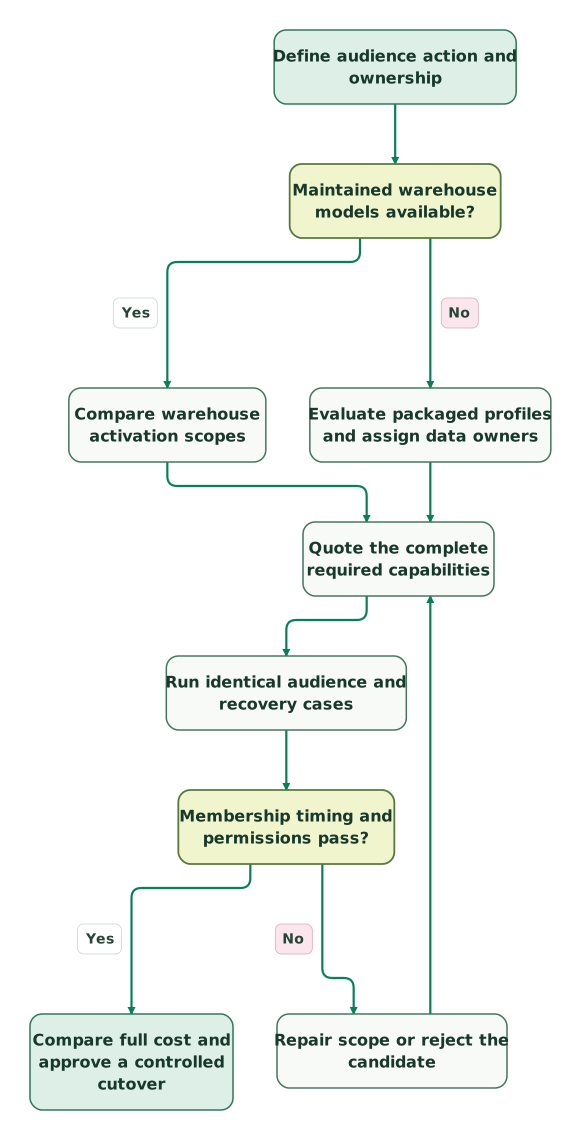
The diagram shows how to choose a pilot scope and reject a candidate that cannot meet it:
Read diagram as text
- Define audience action and ownership to Maintained warehouse models available?.
- Maintained warehouse models available? to Compare warehouse activation scopes: Yes.
- Maintained warehouse models available? to Evaluate packaged profiles and assign data owners: No.
- Compare warehouse activation scopes to Quote the complete required capabilities.
- Evaluate packaged profiles and assign data owners to Quote the complete required capabilities.
- Quote the complete required capabilities to Run identical audience and recovery cases.
- Run identical audience and recovery cases to Membership timing and permissions pass?.
- Membership timing and permissions pass? to Repair scope or reject the candidate: No.
- Repair scope or reject the candidate to Quote the complete required capabilities.
- Membership timing and permissions pass? to Compare full cost and approve a controlled cutover: Yes
Which integration and AI details belong in the contract?
Name the actual operation, not only the destination logo. A supported CRM integration can still lack your required object, matching method, deletion behavior or permission model. Get those details into the pilot and the order form before adding AI features to the evaluation.
For each required destination, record the object and fields, primary matching key, allowed write mode, null behavior, removal behavior, API capacity and alert ownership. For Salesforce specifically, use the Salesforce reverse ETL checks.
Hightouch lists AI Decisioning and related marketing products separately from its basic sync offering. Segment's broader CDP packaging also distinguishes capabilities and add-ons. A product appearing in a feature catalogue does not make it part of the entry subscription. Evaluate the additional workflow against an explicit holdout and outcome measure; AI decisioning compared covers that buying decision. Hightouch product packaging, Segment CDP packaging
Before signing, require clear answers on data region, retention, support coverage, service limits, renewal uplifts and export access. Identify what can be exported as reusable definitions versus what needs rebuilding. A lower year-one price can be outweighed by a costly exit if critical identity rules or audience logic cannot be reproduced.
What do customer reviews tell you to test?
Reviews are useful for choosing pilot tasks, not for predicting your implementation time. Read the reviewer's role and workflow: a marketer operating an approved audience and an engineer diagnosing a rejected write have different definitions of “easy.” The aggregate score does not resolve that difference.
| Review source | Displayed rating and count | Useful signal | Pilot task it suggests |
|---|---|---|---|
| Segment on G2 | 4.5/5 from 567 reviews | Individual reviewers praise connection breadth while others describe navigation, cost or taxonomy difficulties | Have the actual operator find and fix a bad mapping, then forecast the next workload band |
| Hightouch on G2 | 4.6/5 from 422 reviews | Reviews describe marketer autonomy alongside technical error messages and setup boundaries | Ask a marketer to edit an approved audience and an engineer to recover a rejected row |
G2 identifies some entries as incentivized or seller-invited. Ratings and counts change, and neither sample represents every implementation. The concrete failure-resolution task is more useful than ranking products by a tenth of a star.
A practitioner discussion also describes both CRM enrichment through Segment and product-usage activation through Hightouch. That is useful evidence of the jobs teams attempt, not a verified performance comparison. Reverse ETL use-case discussion
How do you migrate without changing customer meaning?
Move a defined responsibility, then verify its replacement before removing the old one. An audience migration does not require an immediate SDK migration. A collector migration does not automatically preserve historical identities, destination mappings or the meaning of an audience condition.
| Migration direction | Preserve first | Rebuild or validate | Cutover gate |
|---|---|---|---|
| Segment audiences to warehouse activation | Stable IDs, permissions and audience semantics | Warehouse joins, lookback windows, suppression and destination writes | Same expected members and current values, with no duplicate dispatch |
| Warehouse activation to Segment workflows | Business definitions and reproducible reference results | Profile linking, entity relationships, packaged audience logic and entitlements | Required account/contact cases pass under the new model |
| Keep Segment for collection; add Hightouch | Existing tracking contracts and event identity | Warehouse activation and its operational ownership | Additional product solves the identified gap |
| Replace collection as well | Event naming, IDs, timestamps and required properties | SDK behavior, delivery, history joins and downstream dependencies | Event and identity parity established before old collection is retired |
Use shadow evaluation before dual production writes. Calculate both candidate audiences against the same snapshot, but let one system own the live destination fields or dispatch path. Otherwise each system can overwrite the other's result, or both can trigger the same message.
Create a rollback point that preserves the last accepted definitions, mappings and destination state. If the new path produces incorrect members, stop its writes, restore the old owner and reconcile changes already made. Do not replay an outdated audience solely because it was correct when captured; re-evaluate current permission and eligibility.
A return path also needs an owner. Keep reusable business definitions outside presentation-only configuration where possible, and record any product-specific logic that must be rebuilt. Hightouch implementation mistakes covers common failures between a clean source model and the resulting action.
What should the final decision checklist contain?
Approve the workflow that meets the audience contract at a defensible total cost. Keep the evidence with the decision so a new operator can understand why the product was chosen and what would justify replacing it.
Checklist
- The owner of collection, identity, consent and audience logic is named.
- Each quote covers the same required capabilities and destinations.
- Tracked identities, active syncs and delivery volume are estimated separately.
- Warehouse work, operating time, retained services and migration overlap are included.
- Reference and candidate audience keys are compared, not only counts.
- Trait changes, exits, permission changes, failures and deletion procedures are tested.
- One system owns each production write and dispatch responsibility during cutover.
- Export, rollback, support and renewal conditions are recorded.
If the pilot exposes inconsistent account definitions or ownership gaps, the $99 martech audit can isolate the work. Once the required capabilities and acceptance checks are clear, request a detailed Hightouch implementation scope.
Keep reading
Browse all Data Warehouse guides
 Data Warehouse
Segment Pricing: Twilio Segment Plans, MTU Costs and How to Control Them
Segment pricing explained: the Free plan, Team from USD 120 a month for 10,000 MTUs, Business quotes, extra usage meters and how to cut avoidable MTU spend.
Jafrin Akter AloLast updated 13 min read
 Data Warehouse
Hightouch Pricing: Count Activation Work Before You Compare Quotes
Hightouch's free plan covers 2 active syncs, and its Composable CDP and Agentic plans are usage-based with no public price. Count syncs and test the claims.
Jafrin Akter AloLast updated 18 min read
 Data Warehouse
Segment Implementation Mistakes: Fix Identity, Duplicate Events and Delivery Gaps
Fix Segment identity errors, duplicate purchases, schema gaps, consent buffering and delayed events, with a tested SQL diagnostic and acceptance checklist.
Jafrin Akter AloLast updated 11 min read
Data warehouse & CDP
See the implementation scope, deliverables and acceptance checks.
Questions people ask
Does a high number of events automatically mean a high Segment MTU count?
No. MTUs concern distinct identified users and unlinked anonymous identities during the billing period, so repeated events from one consistently identified user do not each create another MTU. However, throughput and other usage measures can still matter. Estimate identities and event volume separately, then apply the limits in the proposed package. Segment usage definitions
Is a two-sync Hightouch pilot enough to validate six production audiences?
It can test a representative workflow, but it cannot demonstrate every production mapping or establish the paid price. Select one ordinary audience and one difficult case, such as account-based eligibility with a permission change. Record what remains untested across the other jobs. Confirm the production package and repeat any materially different destination or identity behavior before rollout.
What if both tools produce the same audience count but different people?
Treat that as an unresolved audience defect. Compare the actual keys, then inspect identity mapping, account-to-contact joins, evaluation time and eligibility rules for the missing and unexpected members. Do not average the two counts or choose whichever tool looks closer to a dashboard. The reference definition must explain each difference before either candidate can trigger a customer action.
Can a marketing team own Hightouch without a full-time data engineer?
A marketer can own approved audiences and campaign operations, but someone still needs to maintain the underlying definitions, access and failure recovery. That owner can be a shared engineer or an implementation partner rather than a full-time hire. Test the actual support arrangement: who responds when a source column changes, an account matches twice or a destination rejects a record?
Should an AI feature decide which CDP we buy?
Only when it addresses a defined use case better than the alternatives and the required data, controls and measurement are already feasible. First prove the customer model, permission handling and delivery workflow. Then compare the AI capability against a holdout or existing decision rule using an outcome you can measure. Include its separate entitlement and usage costs in the complete quote.
Sources
- Hightouch Events overview
- Segment Reverse ETL system and usage
- Segment CDP packaging
- Segment Unify
- Segment Data Graph
- Hightouch pricing
- Hightouch warehouse compute
- Hightouch security architecture
- Segment Connections pricing
- Segment MTUs and throughput
- Hightouch active-sync accounting
- Hightouch self-serve limits
- Hightouch's Segment comparison
- Segment customer reviews on G2
- Hightouch customer reviews on G2
- Practitioner reverse ETL use cases

Written by
Jafrin Akter AloData Engineer and Co-founder at Martechdevs and Growth and Analytics Partners
Jafrin writes practical guides to marketing technology, customer data, analytics and AI workflows. Martechdevs is a Growth and Analytics Partners company.