
GA4 pricing: what standard GA4 costs and how Analytics 360 is priced
Standard Google Analytics 4 (GA4) has no licence fee. Analytics 360 requires a quote from Google or a sales partner; Google publishes no universal list price. Compare the complete cost of the workflow: the contract, event volume, property structure, warehouse usage and ongoing maintenance. Pay for 360 when a specific limit or contractual requirement blocks work your team needs to do.
On this page
Is GA4 free?
Standard GA4 is free of licence charges, but running a reliable measurement system still uses money and staff time. Google’s Analytics product page identifies the standard product as free of charge.
Budget these operating costs separately:
- Collection and upkeep: defining events, implementing them, validating releases and reconciling purchases or leads with business records.
- Consent tooling: the consent platform and the work needed to make collection respect the visitor’s current choices.
- Server hosting: infrastructure used for server-side tagging, if your implementation needs that route.
- Warehouse usage: exported data creates storage and query costs. Estimate how BigQuery charges for the reporting workload.
- Streaming ingestion: Google lists an additional USD 0.05 per GB for streaming export, with about 600,000 GA4 events per GB depending on event size. Storage and processing are additional. Google’s export comparison
For an illustrative 30 million streamed events at that approximate event size, the ingestion calculation is 30,000,000 ÷ 600,000 × USD 0.05 = USD 2.50. This estimates the streaming ingestion line only. A dashboard scanning large tables repeatedly can create a very different warehouse bill.
A free licence therefore belongs in a budget with separate lines for the application, cloud usage and the people maintaining it. Our analytics tracking service covers the collection and validation work that an edition change cannot perform for you.
How much does Google Analytics 360 cost?
Google Analytics 360 has no public universal list price: request a quote for your properties and workload from Google or a Google Marketing Platform sales partner. The Analytics 360 product page directs enterprise buyers to sales, and the enterprise contact page includes Analytics 360 among the products available through that route.
Ask the seller to reconcile three forecasts: current event volumes, approved near-term changes and a credible peak case. Include every source property and every proposed copied-data route. A competitor’s historical contract cannot tell you your commitment, volume bands, service scope or renewal price.
The property-routing example below shows why the architecture matters even when website traffic stays unchanged. It converts a proposed structure into weighted event units for the seller to price; it does not invent a public per-event rate.
Tag Manager 360 also uses the enterprise sales route. Keep its commercial scope separate and compare Tag Manager 360 and server hosting costs before combining those items into one measurement budget.
Which GA4 and Analytics 360 limits change?
Analytics 360 raises collection, configuration and reporting allowances, but a higher allowance is valuable only when your team has a legitimate need for it. Audit unused definitions and redundant events before pricing additional capacity.
Per-property allowances unless stated otherwise. Google’s edition comparison supplies these feature limits.
| Configuration | Standard GA4 | Analytics 360 |
|---|---|---|
| Key events | 30 | 50 |
| Parameters per event | 25 | 100 |
| User properties | 25 | 100 |
| Event-scoped custom dimensions | 50 | 125 |
| Event-scoped custom metrics | 50 | 125 |
| Item-scoped custom dimensions | 10 | 25 |
| Audiences | 100 | 400 |
| Calculated metrics | 5 | 50 |
Use the key-event allowance for meaningful outcomes. More available slots do not make an event a valid business result.
Reporting and data-access units differ by row. “Tokens” are quota units, not a count of report requests.
| Reporting requirement | Standard GA4 | Analytics 360 |
|---|---|---|
| Explore sampling threshold, events per query | 10 million | 1 billion |
| Unsampled exploration tokens | Unavailable | 20,000 daily; 5,000 per query |
| Daily BigQuery export, events | 1 million | Billions |
| Eligible event-data retention, months | Up to 14 | Up to 50 |
| Core Data API tokens per property per day | 200,000 | 2 million |
The application programming interface (API) quotas also include hourly and concurrency limits. A request consumes tokens according to its work, so two million tokens do not imply two million calls. Use the Data API quota reference to identify the bucket your reporting process exhausts. Diagnose Data Studio quota errors on standard properties before buying an upgrade to solve an unidentified error.
Retention needs a separate qualification. User-level options remain 2 or 14 months; other event data on eligible 360 properties can have longer settings. Standard Large or XL properties, and 360 XL properties, are restricted to two months for the applicable event setting. These controls affect explorations and funnel reports rather than setting a universal expiry on standard aggregate reports. Google’s retention rules
Longer retention cannot recreate detail already deleted. Establish the export and storage policy before a future cohort analysis needs that history.
Sampling, an “other” row, privacy thresholding and retention can all make a report look incomplete for different reasons. The GA4 data-threshold guide separates those mechanisms. Match the restriction to the proposed solution instead of assuming 360 removes every reporting boundary.
What problem would paying for 360 solve?
Paying for 360 makes sense when a documented edition constraint or a needed contractual capability blocks a valuable workflow. “We need more accurate analytics” is too vague to establish that requirement. “Our required daily event export exceeds the standard ceiling on campaign days” is specific enough to investigate.
These scenarios lead to different next steps:
| Situation | First choice | Alternative to evaluate | Evidence needed |
|---|---|---|---|
| Duplicated purchases or inconsistent event names | Repair collection on standard GA4 | Redesign the event contract | One business action reconciles to one intended outcome |
| Required complete daily export exceeds the standard ceiling | Price 360 against the retained event scope | Remove unnecessary exported events where appropriate | Peak-day counts and analysis requirements |
| Required custom definitions exceed standard after cleanup | Evaluate 360 capacity | Remodel definitions or analyze detail in the warehouse | Named users and decisions for each definition |
| Reporting needs clearer product journeys more than higher Google limits | Test a product-analytics workflow | Keep GA4 for acquisition and use another tool for product analysis | A matched set of questions and acceptance results |
If the defect is a duplicate sender, missing consent context or an event firing before the business action succeeds, fix the setup before paying for 360. Raising limits preserves those defects until the implementation changes.
A useful buying requirement is concrete: “Finance needs yesterday’s approved acquisition dataset before its morning refresh, at the forecast volume, with a named escalation owner.” That statement makes freshness, completeness, scale and support independently assessable. Ask the seller which export mode and contractual terms meet it.
How should you budget for the BigQuery export?
Budget the export around its required completeness, timing and volume, then add storage and query usage. Standard GA4 already supports export, so an export requirement alone does not establish a need for 360.
The standard daily batch ceiling is one million events. Repeated exceedance can pause daily export; significant exceedance can cause an immediate pause, and missed days are not reprocessed. Filtering can reduce the streams or event types included. Google’s setup and export-limit guidance
Measure daily peaks as well as monthly averages. An illustrative property with 24 million events across a 30-day month averages 800,000 a day. If a launch day contains 1.4 million, that average hides a breach of the daily allowance. Use the property timezone consistently and include automatically collected events in the forecast.
Streaming has no event-volume limit, but delivery is best effort and lacks a completeness service-level objective. New-user and new-session traffic-source data is excluded from that feed. Those differences matter if a finance or acquisition report depends on complete attribution. Google’s export modes
Define the selected feed, expected readiness signal and behavior when it is late. The GA4 BigQuery export guide covers implementation. Price queries, transformations, retained history and monitoring beside the Analytics contract; upgrading the source does not eliminate downstream work.
How can property structure change the bill?
Subproperties and roll-up properties add processing even when source traffic stays unchanged. A subproperty filters a source; a roll-up combines eligible sources. Use them for a genuine access or reporting requirement and include every route in the forecast.
Google charges copied events in either type at half the initial event rate. Copies sent to multiple destinations contribute separately. Google Analytics Certified Partners can use Bill Preview to estimate the configured structure. Google’s account-structure guidance
This hypothetical monthly example uses millions of events and source-rate-equivalent units. It is a volume model, with no assumed currency rate or contract tier.
| Route | Events, millions/month | Weight | Weighted units, millions/month |
|---|---|---|---|
| Two source properties, 20 million each | 40 | 1.0 | 40 |
| Regional subproperty from the first source | 12 | 0.5 | 6 |
| Product subproperty from the first source | 8 | 0.5 | 4 |
| Roll-up combining both source properties | 40 | 0.5 | 20 |
| Total | 100 processed across routes | Mixed | 70 |
The two subproperties intentionally overlap. An event in both still contributes to both routes, so deduplicating copied events across destinations understates this architecture’s processing.
The weighted total is 70 million units, 75% above the 40 million source-only baseline: (70 − 40) ÷ 40 × 100. The quote still needs the actual contract’s tiers, commitment and adjustments. Multiplying 70 million by an invented flat rate would not produce a defensible invoice estimate.
Draw the structure before requesting a quote. For each extra property, write the audience, access requirement and report it serves. A copy created only to mirror the organization chart creates a cost without an established reporting need.
How should you prepare an event forecast?
Prepare current, planned and peak workloads with separate quantities for source events, copied events, exported events and warehouse bytes. A single “usage” column hides the different units each service bills or limits.
- Inventory daily events by property and event name. Separate production from test traffic and investigate duplicated senders.
- Record which events support a decision, audience or operational workflow. Agree which unnecessary events can stop or stay outside the export.
- Add approved product changes. An interaction firing 20 times per session changes volume differently from one subscription-success event per paying account.
- Add the proposed subproperty and roll-up routes, including overlaps.
- Model a credible launch or seasonal peak and its daily export effect.
- Give the seller all three scenarios and request the calculation behind each quote.
Verify new-event frequency during rollout. Keep the forecast owner and the event-plan version together so a later product release does not silently invalidate the purchase case.
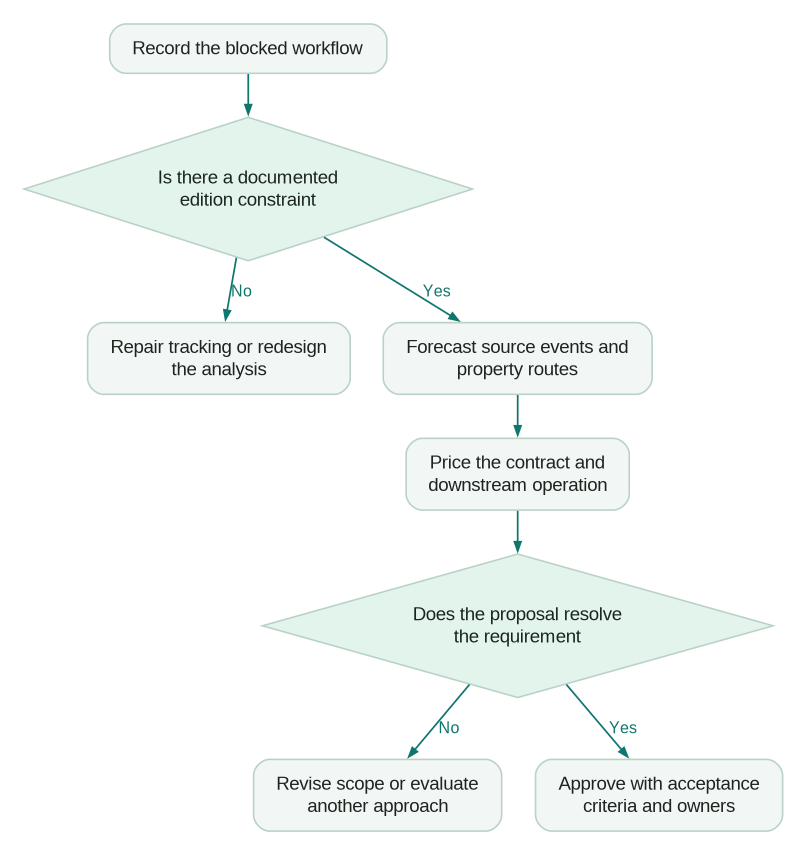
Read diagram as text
- Record the blocked workflow to Is there a documented edition constraint.
- Is there a documented edition constraint to Repair tracking or redesign the analysis: No.
- Is there a documented edition constraint to Forecast source events and property routes: Yes.
- Forecast source events and property routes to Price the contract and downstream operation.
- Price the contract and downstream operation to Does the proposal resolve the requirement.
- Does the proposal resolve the requirement to Revise scope or evaluate another approach: No.
- Does the proposal resolve the requirement to Approve with acceptance criteria and owners: Yes
What should the vendor return with a quote?
The quote should reconcile to your forecast and identify every cost and service boundary your workflow depends on. Request the covered account and properties, currency, billing period, commitment, event assumptions, copied-property treatment and rules for usage above the forecast.
Ask how changes in volume bands affect the bill. Establish whether the relevant change is incremental, applies to another volume base or follows a different contract mechanism. Do not infer that rule from another company’s price.
Separate licence, partner services and cloud charges. Migration, event cleanup, training, reporting development and support need their own deliverables. Record who investigates a collection failure, who handles a warehouse billing problem and who maintains transformations.
Review response and resolution commitments separately. A service-level agreement for one eligible export mode does not automatically cover the report built downstream. Include the actual property classification, feed, readiness requirement and escalation route in the acceptance criteria.
For renewal, price the second year at the expected workload with any introductory concession removed. Standard GA4’s licence remains free; its operating costs can still increase. For 360, the signed contract controls renewal and any concession. Neither a general startup status nor a first-year offer establishes a continuing discounted rate.
How do you build a defensible business case?
Compare the full incremental cost with one specific avoided cost or enabled decision, using the same acceptance criteria for alternatives. Keep released staff capacity separate from a cash saving and from any unproven revenue effect.
Consider a hypothetical reporting team with a workaround taking 10 analyst hours weekly, a loaded cost assumption of USD 70 per hour and 48 working weeks. Suppose an accepted workflow would remove six weekly hours and leave four for analysis and validation.
All amounts below are annual USD planning estimates. They value staff capacity; they are not a vendor price or a customer result.
| Workload | Hours/week | Weeks/year | Annual capacity cost, USD |
|---|---|---|---|
| Current workaround | 10 | 48 | 33,600 |
| Remaining work | 4 | 48 | 13,440 |
| Capacity released | 6 | 48 | 20,160 |
USD 20,160 becomes a cash saving only if staffing expense or purchased hours actually change. Add the quoted licence increase, warehouse usage, partner services and ongoing administration before comparing costs. Establish the six-hour reduction through acceptance work rather than assuming every enterprise feature saves time.
Count each benefit once. If the six hours include reconciliation, do not add another benefit line for removing that same reconciliation. A faster report might support a better campaign decision, but it needs separate evidence before it becomes a revenue forecast.
Compare improved exports and GA4 alternatives worth testing first when they can answer the same questions. The right choice is the maintained workflow that meets the requirement at a justified total cost.
What should be settled before signing?
Sign when the requirement, complete cost and acceptance evidence agree. Use these checks to prevent an enterprise licence becoming a substitute for an unfinished measurement plan.
Checklist
- The blocked workflow has a business owner and a reproduced constraint.
- Daily export peaks are separate from monthly source and copied-event volumes.
- Current, planned and peak scenarios have a reconciled quote.
- Licence, services, cloud usage and internal capacity have separate budget lines.
- The selected capabilities have measurable acceptance criteria and an escalation owner.
- Renewal, overage and downgrade consequences fit the operating plan.
If the constraint is still unclear, book a free call before committing to a licence change. For defined collection, export or reporting work, request an analytics implementation scope.
Keep reading
Browse all Tracking & Attribution guides
 Product Analytics
Amplitude vs Google Analytics for acquisition and product decisions
Choose Amplitude or Google Analytics by product and acquisition decisions. Compare current event pricing, identity, retention, exports and a shared setup.
Jafrin Akter AloLast updated 10 min read
 Product Analytics
Google Analytics vs Plausible for website reporting
Choose Plausible or Google Analytics by website reporting needs, visitor identity and advertising dependencies, with usage costs and migration checks.
Jafrin Akter AloLast updated 11 min read
 Product Analytics
PostHog vs Google Analytics: Product Decisions, Acquisition and Cost
Compare PostHog and GA4 for acquisition, product analysis and cost. See event pricing, identity checks, export limits and a practical selection checklist.
Jafrin Akter AloLast updated 11 min read
Analytics & tracking
See the implementation scope, deliverables and acceptance checks.
Questions people ask
What happens if we downgrade a property from Analytics 360?
Standard limits apply immediately, and configuration above them must be reduced before creating objects or changing settings that would exceed those limits. First trash the source property’s subproperties or disconnect it from its roll-up, as applicable; a roll-up itself cannot be downgraded. Include these dependencies in the exit plan. Google’s downgrade guidance
What happened to the Google Analytics 360 Suite?
Google brought the Google Analytics 360 Suite and DoubleClick Digital Marketing together under Google Marketing Platform on 27 June 2018. That historical name does not establish a current bundled price. Ask the seller to identify Analytics 360, Tag Manager 360 and services separately in the proposed commercial scope. Google’s launch announcement
Is Fresh Daily BigQuery export available on standard GA4?
No. Google lists Fresh Daily for Normal and Large Analytics 360 properties. Treat that eligibility separately from the near-real-time streaming option available on standard properties. Confirm the property classification and contractual delivery terms before promising a morning reporting deadline; the downstream transformation and dashboard also need their own readiness checks. Google’s export comparison
How should a shared Analytics contract allocate costs to business units?
Allocate costs using a written rule that separates source collection, copied-property processing and shared services. Charge a copied route to the team requesting it where that reflects ownership, and allocate genuinely shared work once. Reconcile the internal allocation to the actual invoice total; a business-unit model must not create extra vendor charges or conceal a central commitment.
What evidence explains an Analytics invoice above the forecast?
Reconcile the invoice period and covered properties to the version of the forecast used for approval. Compare source volumes, added copied-data routes and the contract’s volume treatment, then separate taxes, services, credits and currency effects where applicable. Preserve the seller’s explanation for any unresolved line. A traffic increase alone does not explain an invoice if the property structure or commercial terms also changed.
Sources
- Google, Google Analytics overview
- Google, Analytics 360
- Google, Contact enterprise sales
- Google, Analytics 360 limits and upgrade or downgrade rules
- Google, Data API quotas
- Google, Data retention
- Google, Set up BigQuery Export
- Google, BigQuery Export
- Google, Analytics account structure
- Google, Introducing Google Marketing Platform

Written by
Jafrin Akter AloData Engineer and Co-founder at Martechdevs and Growth and Analytics Partners
Jafrin writes practical guides to marketing technology, customer data, analytics and AI workflows. Martechdevs is a Growth and Analytics Partners company.