
GA4 Alternatives: Choose by the Questions You Need to Answer
Choose a Google Analytics 4 (GA4) alternative around the decision your team cannot make today. Plausible suits focused website reporting, Matomo offers cloud or self-hosted web analytics, and Mixpanel or PostHog support product investigation. A warehouse can reconcile outcomes across systems. Test the required journey, identity rules and downstream dependencies before replacing a tool that other teams still rely on.
On this page

What are you trying to replace?
Separate collection, reporting, identity, advertising connections and business-data reconciliation. A replacement can take over one responsibility while GA4 continues doing another.
A frustrating report may come from the interface, a missing event, an ambiguous metric or unavailable business data. Those failures need different remedies. If a form event fires on a button click instead of successful submission, changing its destination preserves the measurement error.
Collect a few decisions from the intended users before booking demos. “Which pages create qualified demos?” needs website and customer relationship management (CRM) evidence. “Where do accounts fail to activate?” needs product events and an account definition. “Do retained customers cover acquisition cost?” needs billing, cost and cohort data.
| Decision the team cannot make | Responsibility to improve | Candidate direction | Evidence needed in the pilot |
|---|---|---|---|
| Which content creates meaningful website actions? | Website collection and reporting | Plausible or Matomo | Correct goal event and an explainable traffic denominator |
| Where do users stop before reaching product value? | Event and identity analysis | Mixpanel or PostHog | Stable events, identity and a reproducible funnel |
| Which campaigns create profitable customers? | Cross-system reconciliation | Warehouse plus reporting | CRM qualification, billing and agreed cost definitions |
| Why do reports disagree after a release? | Measurement reliability | Repair the collection contract first | The first missing or duplicate business event |
Use what GA4 and Analytics 360 cost to separate software charges from implementation effort. Then fix GA4 before replacing it when the problem is a configuration or definition that would follow you into another tool.
An analytics and tracking assessment should identify the failed responsibility and the consumer of its output. For healthcare, review Google Analytics and HIPAA and analytics options for healthcare sites within the applicable data, agreement and configuration boundaries.
What are the pros and cons of the main GA4 alternatives?
Evaluate Plausible for a focused website workflow, Matomo for deployment control, and Mixpanel or PostHog for repeated product questions. Use the reporting question, deployment requirements and maintenance owner to decide which belongs in the pilot.
A startup benefit is conditional; use the ordinary plan and required features when forecasting costs after it expires.
Plausible: focused website decisions
- Best for: content and growth teams measuring traffic sources, pages and goal conversions.
- Pros: goals can use pageviews or custom events, with filters that connect conversions to sources and entry pages.
- Cons: its daily visitor identity does not provide a persistent cross-day or cross-device user history.
- Free tier and startup offer: the hosted product offers a 30-day trial without a credit card. Budget a paid service afterward unless another offer is confirmed.
- Choose it if: the intended user can answer the website question without an analyst preparing the result.
- Skip it if: the required output depends on a person's identified behavior across many days.
Plausible's documented goals support actions such as signup, download or purchase. Funnels and user journeys require the Business or Enterprise plan. Its data policy explains that the daily identifier is specific to a site and device and does not recognize the same visitor across days. Goal conversions, data policy, hosted plans and trial.
Ask the content owner to find the pages associated with an agreed conversion, filter a campaign and explain the denominator. Then verify that the event represents real success. A revisitable thank-you page may need more deliberate collection than a pageview goal.
Read how cookieless analytics counts visitors before comparing its visitor count with GA4. Assess the rest of the site's advertising, chat and embedded tools separately; an analytics product's privacy model does not define the behavior of every script on the page.
Matomo: deployment and operating control
- Best for: an organization with a concrete requirement for where and how web analytics runs.
- Pros: Cloud and On-Premise provide managed and self-operated deployment choices.
- Cons: self-hosting adds responsibility for updates, backups, availability and report performance.
- Free tier and startup offer: the On-Premise core is free to download and use; Cloud advertises a 21-day trial. Premium features and support may add costs, and no startup discount is assumed.
- Choose it if: a named owner can operate the required configuration and demonstrate recovery.
- Skip it if: the team wants self-hosting benefits without allocating the work to maintain the service.
Matomo's comparison distinguishes vendor-managed Cloud maintenance from ongoing On-Premise operation, including optional paid support. Compare the actual feature bundle rather than a core installation with a fully managed package. Hosting comparison, pricing and feature scope.
Name the constraint: required infrastructure location, an internal access model or a specific operating policy. Then run a nonproduction restore exercise and a representative report at peak expected volume. Installation success does not establish that the reports will be available when stakeholders need them.
Mixpanel: product funnels and return behavior
- Best for: product teams investigating progression through events and later return behavior.
- Pros: funnels and retention reports are available on free and paid plans, allowing a real analytical pilot.
- Cons: useful analysis still requires stable event meanings, identity and the correct user or account unit.
- Free tier and startup offer: the Free plan includes up to one million events monthly. An eligible startup can apply for the separate first-year offer; confirm its terms and the next year's configuration.
- Choose it if: product managers can reproduce the activation and retention questions on your data.
- Skip it if: the missing requirement is billing reconciliation or an advertising dependency outside the proposed configuration.
Mixpanel funnels measure event progression within a selected window. Retention starts from an initial behavior and measures a return behavior; the chosen timing criterion changes what counts. Funnels, retention, pricing, startup offer.
Ask a product manager to find newly created workspaces that stop before their first successful output. Then segment by a property defined at signup and inspect a later value event. Record which steps need analyst or engineering help.
A user-level funnel cannot automatically answer whether an account activated through work by several teammates. Group Analytics is an extra-cost add-on on paid plans under the ordinary pricing schedule; verify any approved startup entitlement separately. Define the analysis unit first. The Mixpanel versus GA4 guide explains the wider division of responsibility.
PostHog: connected website and product investigation
- Best for: a team that will use a shared event foundation for website and product questions.
- Pros: documented insight types include trends, funnels, retention, paths and custom queries; web analytics uses the same collected events.
- Cons: broader product scope brings more configuration and separate usage counters.
- Free tier and startup offer: PostHog has monthly per-product allowances, including one million analytics events. Startup credits have eligibility, expiry and exclusions; confirm the required products rather than assuming every feature is covered.
- Choose it if: engineering and growth can investigate the same event and customer journey together.
- Skip it if: the additional capabilities remain unowned or unused.
PostHog's insights guide and web analytics documentation describe the shared investigation workflow. Its pricing and startup terms define the commercial boundaries.
Test whether an engineer and a growth manager can explain the same event, exclude the same test environment and distinguish a real conversion from a synthetic one. Broad coverage creates value when the team uses the connections between features. Merely enabling more products adds collection and administration.
Once the requirement is product analysis, shortlist Mixpanel alternatives, then use the PostHog versus Mixpanel comparison for the focused choice.
When should product analytics enter the shortlist?
Add product analytics when the decision requires repeated investigation of event sequences, identity and cohorts. Start with product analytics tools for startups, then give each candidate the same difficult question.
Avoid a demo built only on the vendor's sample data. Use a small dataset with a known successful account, an account that stalls, a repeated event and a person who changes from anonymous to signed-in. The product manager should explain which records were included and why.
Keep qualitative investigation distinct from measurement. A recording or heatmap may show a confusing step, while a correctly defined event measures how often customers complete it. Neither replaces the other. Decide which missing evidence prevents action before adding another interface.
If the requirement is aggregate content performance, a focused website tool may remain sufficient. If the question is how teams repeatedly reach value, a richer identity and event model earns its maintenance cost.
When is a warehouse the missing piece?
Use a warehouse when the answer needs reconciled records from several business systems. It is an analytical architecture with a reporting layer, rather than a drop-in website dashboard.
Examples include joining accepted demos to CRM opportunities, incorporating refunds into customer revenue, or comparing acquisition cost with retained cohorts. Someone must maintain identifiers, source history and the definitions the business intends to own.
Standard GA4 can export raw event data to BigQuery. The export and Analytics interface have different processing and scope, and the standard daily export has its own limit. A warehouse total should not be forced to reproduce every interface metric. Google BigQuery Export.
Use the marketing data warehouse guide for the source and modeling work. Compare analytics tools that query your warehouse directly when the shared model already exists.
Keep a useful web or product interface alongside the warehouse if it makes daily investigation faster. A warehouse becomes valuable because it answers the cross-system question with maintained definitions; owning raw tables alone does not finish that job.
Which option fits your situation best?
Choose the smallest configuration that completes the decision and preserves required dependencies. A first candidate earns a pilot; it does not win automatically because it appears in this table.
| Situation | First candidate | Runner-up | Deciding test |
|---|---|---|---|
| Small content team measuring pages and meaningful goals | Plausible | Matomo Cloud | Can the editor explain the traffic-to-goal result independently? |
| Organization with a required self-operated analytics deployment | Matomo On-Premise | Managed option meeting the requirement | Can the owner restore and maintain the complete feature scope? |
| Product team diagnosing activation and return behavior | Mixpanel | PostHog | Can a product manager answer the account-level question on real definitions? |
| Engineering and growth sharing website and application events | PostHog | Mixpanel | Does shared investigation remove useful work without uncontrolled collection? |
| Marketing and finance reconciling CRM, billing and acquisition | Warehouse plus reporting | Existing tools with a bounded reconciliation | Can the agreed cohort result be reproduced from source records? |
Do not buy an entire replacement to solve an unowned definition. If a vendor passes the interface test but cannot produce the required output under your identity rules, keep looking or narrow its role.
How do you run a pilot that produces a decision?
Test a complete business journey with a known reference sample. Keep the acceptance rule and the analysis unit fixed so the evaluation does not turn into a contest between dashboard totals.
Consider a hypothetical business-to-business software company deciding whether to keep funding a demo campaign. The required journey is landing-page visit, successful submission, CRM qualification and opportunity creation within thirty days. A distinct accepted submission measures the first conversion; a distinct account measures the pipeline outcome.
Hypothetical reconciliation counts. These are invented inputs, not vendor results.
| Stage | Count | Unit | Meaning |
|---|---|---|---|
| Successful submissions | 100 | Form occurrences | Starting reference sample |
| Internal tests | 5 | Form occurrences | Excluded |
| Spam | 10 | Form occurrences | Excluded |
| Eligible submissions | 85 | Form occurrences | After mutually exclusive exclusions |
| Matched accounts | 72 | Accounts | Several submissions can belong to one account |
| Qualified accounts | 18 | Accounts | Business-approved qualification |
| Accounts with an opportunity | 9 | Accounts | Within the thirty-day window |
The opportunity rate among the matched accounts is 9 ÷ 72 = 12.5%. Qualification is 18 ÷ 72 = 25%, and half of qualified accounts create an opportunity. A valid submission rate cannot be calculated without the appropriate eligible traffic denominator.
Dividing nine opportunities by one hundred raw submissions mixes an account numerator with a form-occurrence denominator. The arithmetic produces a number, but it does not answer the account conversion question.
Give each candidate the same assignment:
- Collect or receive the agreed success event with its required fields.
- Apply the identity and exclusion rules for the responsibility it will own.
- Ask the intended user to produce and explain the output.
- Confirm that the result reaches the report or downstream process that needs it.
- Record missing capabilities, manual work and unresolved differences.
A focused website tool might handle the landing-page portion, while the CRM and warehouse handle qualification. That division can be a successful result. A seven-day pilot cannot validate a thirty-day opportunity outcome; use immediate fixtures for collection and mature cohorts for delayed results.
Why will user and session numbers differ during a parallel run?
Tools can define identity, sessions and eligible collection differently. Start with stable business events, then separate expected modeling differences from missing or duplicated data.
Reconcile a confirmed order, accepted form or completed product action by route, browser, permission state and event source. Locate the first point where the known action disappears or repeats. A dashboard-to-dashboard percentage alone cannot identify that stage.
Document differences that follow from the intended model. Plausible's daily identity and a persistent product identity answer different questions about returning people. Forcing equal totals may hide that distinction or reproduce an old collection error.
The tracking-plan guide helps preserve event meaning. Freeze the core definitions during the comparison, and record changes that would otherwise make the result uninterpretable.
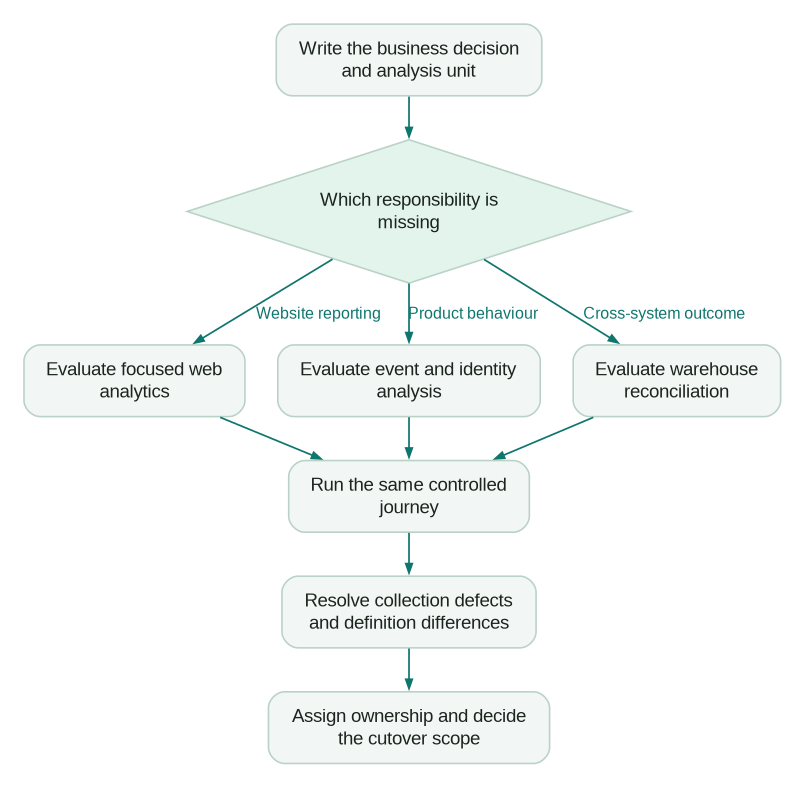
Read diagram as text
- Write the decision and analysis unit to Which responsibility is missing.
- Which responsibility is missing to Test focused web analytics: Website reporting.
- Which responsibility is missing to Test event and identity analysis: Product behavior.
- Which responsibility is missing to Test warehouse reconciliation: Cross-system outcome.
- Test focused web analytics to Run the same controlled journey.
- Test event and identity analysis to Run the same controlled journey.
- Test warehouse reconciliation to Run the same controlled journey.
- Run the same controlled journey to Explain defects and model differences.
- Explain defects and model differences to Assign ownership and cutover scope
What should a migration preserve?
Preserve historical definitions and every process that consumes the current data. A new product does not automatically recreate the previous identity graph, attribution or event history.
List scheduled reports, Google Ads conversion imports, audience uses, stakeholder access and warehouse jobs. Name the owner and replacement for each dependency before removing collection. Confirm historical import granularity and limitations rather than promising continuity from a matching chart label.
A replacement can also coexist with GA4 in a narrower role. Define which system owns each output and remove duplicate work only when that consumer has accepted the new path.
Checklist
- The decisions and analysis units are written down.
- The pilot reconciles stable business events and expected definition differences.
- Advertising, reporting and warehouse dependencies have named cutover owners.
- The chosen configuration's identity, permission, retention and access behavior is reviewed.
- Costs include required features, implementation and ongoing operation.
- Intended users can answer the target question on your data.
- Historical comparisons show any changed metric or migration boundary.
- A rollback can restore the required collection without duplicating business events.
Want a second pair of eyes on your stack? Get the $99 martech audit. For an agreed measurement design, request a detailed analytics implementation scope covering collection, identity, reconciliation and the cutover.
Keep reading
Browse all Product Analytics guides
 Tracking & Attribution
GA4 pricing: what standard GA4 costs and how Analytics 360 is priced
Standard GA4 has no licence fee and Analytics 360 has no public price. See how 360 is quoted and billed, which limits change and what the exports cost.
Jafrin Akter AloLast updated 12 min read
 Tracking & Attribution
GA4 setup for SaaS and apps: the events and settings that matter
Set up GA4 for a SaaS acquisition journey. Define events, test consent and cross-domain tracking, choose Ads goals and verify revenue, identity and export.
Jafrin Akter AloLast updated 14 min read
 Tracking & Attribution
GA4 Bounce Rate Looks Wrong? 5 Checks Before You Change the Page
Diagnose unexpected GA4 bounce rates. Check duplicate views, key events, engagement timers, session scope and weighted averages before changing your page.
Jafrin Akter AloLast updated 10 min read
Analytics & tracking
See the implementation scope, deliverables and acceptance checks.
Questions people ask
How should an agency choose analytics when clients need different reports?
Define a minimum reporting contract, then allow client-specific tools where the requirements differ. A publisher, subscription product and lead-generation business may need different identities and outcomes. Keep access, ownership and offboarding consistent across those choices. A single agency dashboard is convenient only if it preserves the client's actual decision and does not force incompatible metrics into one template.
How should we test data export access before signing?
Request a small export through the intended account role and inspect its fields, timestamps and level of detail. Reconcile it with a known reference sample, then check the permitted volume, retrieval process and required plan. A screenshot of an export button is insufficient. Record how the team would retrieve its data during an outage investigation or eventual change of provider.
What should a board report show during an analytics migration?
Keep the stable business measures visible and annotate the date when collection or definitions changed. Where a metric cannot be compared directly, present the two periods with a short explanation rather than joining them into an apparently continuous trend. Retain the old calculation and source period so a later reviewer can reproduce the reported result without relying on memory.
How do we evaluate analytics for several brands with shared customers?
Decide whether the question concerns each brand independently or the customer's combined relationship. Then test the identifiers and permissions needed for that specific view. A shared login does not automatically make every cross-brand analysis appropriate, and separate website visitors cannot automatically be treated as separate customers. Use a small set of known relationships to expose those assumptions before rollout.
Should we choose a tool because a missing feature is on its roadmap?
Evaluate the product that is available for your intended plan today. Treat an unshipped capability as an unresolved dependency, with a fallback and an owner, rather than as a passed requirement. If the purchase depends on that feature, delay the commitment or agree an appropriate contractual condition. A promised release date does not demonstrate that the eventual implementation will meet your acceptance test.
Sources
- Plausible: Goal conversions
- Plausible: Data policy
- Plausible: Hosted product and trial
- Matomo: Cloud and On-Premise comparison
- Matomo: Pricing and features
- Mixpanel: Funnels overview
- Mixpanel: Retention
- Mixpanel: Pricing
- Mixpanel: Startup offer
- PostHog: Creating insights
- PostHog: Web analytics
- PostHog: Pricing
- PostHog: Startup terms
- Google: BigQuery Export

Written by
Jafrin Akter AloData Engineer and Co-founder at Martechdevs and Growth and Analytics Partners
Jafrin writes practical guides to marketing technology, customer data, analytics and AI workflows. Martechdevs is a Growth and Analytics Partners company.