Braze alternatives: choose by the job Braze does for you today
Data Engineer and Co-founder at Martechdevs and Growth and Analytics Partners
Last updated 14 min read
The right Braze alternative depends on the job you need to replace: mobile engagement, account-aware SaaS journeys, ecommerce automation or a focused push programme. Start with that requirement, then compare billing units, operating effort and migration work. A smaller quote is useful only if the replacement preserves the customer behavior you rely on, including the messages that should never be sent.
Which Braze alternative fits your situation?
Shortlist two realistic candidates, including a repaired or differently packaged Braze setup when appropriate. These recommendations are implementation judgments, not a ranking of overall product quality.
| Job Braze performs | First trial | Runner-up | What decides the fit? |
|---|---|---|---|
| Account-aware SaaS journeys | Customer.io | Iterable | Separate account context and stop conditions |
| Warehouse-fed cross-channel programmes | Iterable | Customer.io | Data freshness and operator diagnosis |
| Consumer mobile engagement | MoEngage | CleverTap | Device lifecycle and coordinated interventions |
| Retail plus web personalization | Insider One | Klaviyo | Site and messaging decisions share current state |
| Store-led automation | Klaviyo | Customer.io | Orders, returns and repeat-purchase exceptions |
| Focused push-led programme | OneSignal | Reteno | Required controls fit the selected tier |
| Subscription-app messaging | Reteno | OneSignal | Trial, payment and cancellation behavior |
| Configuration or packaging problem | Repaired Braze | Job-matched alternative | Complete repair cost versus migration cost |
Lifecycle platform implementation and migration starts by defining that job and its acceptance tests. If Customer.io is the main contender, the Customer.io versus Braze comparison goes deeper into the data and journey behavior.
Before requesting demos, ask the operator who uses Braze weekly to identify one painful task and one valuable capability that must survive. A renewal spreadsheet can miss the work that makes the current programme useful.
Why are you considering leaving Braze?
Separate a commercial problem from a product limitation and an implementation problem. Each produces a different shortlist.
Braze currently lists Go, Select, Pro and Enterprise. Its contract combines an edition, monthly active users with a profile allowance, Action Credits and applicable services or additions. It advertises a trial but no permanent free plan. Braze pricing
| Reason for change | Evidence to collect | First action |
|---|---|---|
| Renewal cost | Current usage, commitments and unused capacity | Request a quote matching the real workload |
| Too much operating effort | Time spent maintaining and diagnosing journeys | Identify which complexity can be removed |
| Missing capability | A reproducible failed requirement | Trial candidates that demonstrate it |
| Unreliable messaging | Broken identities, stale state or overlapping sends | Trace the data and configuration first |
For cost, review how a Braze quote is built. Ask whether a different edition, commitment or channel mix changes the renewal. Do not assume a downgrade is immediately available under an existing contract.
For operating effort, name the work. “Braze is complicated” might mean a small team is maintaining too many Canvases, or that only one engineer understands a fragile event feed. A new platform can inherit both problems if the scope stays unchanged.
For a missing capability, define the consequence. An inaccessible audit trail, an unsupported app behavior or an unmet data-residency requirement is more precise than a feature checklist with unchecked boxes.
How do the main alternatives compare?
Use each vendor's published unit and the package needed for the actual requirement. Public starting prices below were checked on 17 October 2026; they are not quotes for a large migrated audience.
Customer.io for behavior-based SaaS and B2B journeys
- Best for: Account relationships and committed product events drive the messages.
- Pros: People, objects and events give the trial an explicit data model.
- Cons: Stored objects and profiles affect cost, and the entry tier may omit required features.
- Free tier and startup offer: Eligible startups can investigate a free year. Checked on 17 October 2026, Essentials starts at USD 100/month for 5,000 profiles, with USD 0.009 per additional profile and one million included emails. Pricing.
- Choose it if: The two-account reminder works and profile billing fits the real audience.
- Skip it if: The apparent saving depends on an entry price that disappears at your volume or feature needs.
Iterable for cross-channel programmes with a warehouse
- Best for: A programme with marketing operations capacity and a contract-led buying process.
- Pros: Smart Ingest supports warehouse activation on schedules as frequent as fifteen minutes.
- Cons: The quote, identity model and operating workload need a complete trial.
- Free tier and startup offer: Five configured production syncs are included in the standard Smart Ingest allowance, checked on 17 October 2026; each can run repeatedly. This is not a free messaging platform. Sync limits.
- Choose it if: The Customer.io–Iterable trial proves the data and journey behavior you need.
- Skip it if: An urgent customer promise depends only on a slower warehouse schedule.
Iterable's former pricing URL currently redirects to its main site. Obtain an itemized proposal through the current buying route instead of treating a third-party estimate as an official price.
MoEngage for consumer mobile engagement
- Best for: An app programme evaluating coordinated interventions around customer activity.
- Pros: Its MTU model makes the measured audience definition explicit.
- Cons: MTU is not interchangeable with a session-only MAU count.
- Free tier and startup offer: No universal free production allowance is established here. Checked on 17 October 2026, Growth and Enterprise use quote-based pricing with a minimum one-year commitment. Plans.
- Choose it if: The device and journey tests pass and finance can reproduce the proposed MTU count.
- Skip it if: A quote uses your existing MAU number without reconciling the vendor's activity definition.
MoEngage counts a unique profile with a session or defined event in the month and excludes specified platform-generated interactions and attribute updates. Calculate that population from representative source data before pricing it.
CleverTap for mobile programmes with a defined commercial model
- Best for: A mobile team comparing engagement and experimentation within a broader platform.
- Pros: Core provides a published entry route for a scoped evaluation.
- Cons: MAU and data-point commercial models can produce different bills.
- Free tier and startup offer: Checked on 17 October 2026, Core displays USD 85/month after a thirty-day trial, excluding taxes and additions. Larger requirements need a matched proposal. Pricing.
- Choose it if: Identity, device transitions, deep links and competing campaigns behave correctly in the app.
- Skip it if: The proposal prices a small audience tier but leaves your actual channels or controls unspecified.
Run the same mobile fixture in MoEngage and CleverTap: logout, shared-device switching, token refresh, expired subscription and overlapping campaigns. The label “mobile platform” does not establish those outcomes.
Insider One for retail plus web personalization
- Best for: Retail teams whose site personalization and messaging need shared customer context.
- Pros: Its migration offer includes evaluation, inventory and implementation assistance.
- Cons: Automated migration claims need an asset-by-asset demonstration.
- Free tier and startup offer: Request written evaluation terms and a scoped quote; no universal free messaging plan is established here.
- Choose it if: A journey from product view through stock change, purchase and partial return stays coherent across channels.
- Skip it if: Promised migration speed excludes preferences, active journeys or app adoption.
Insider One's platform positioning includes retail, web personalization and messaging. Its migration capabilities describe the vendor's migration offer, not independently measured outcomes. Ask what its tools import, rebuild and exclude before approving the schedule.
Klaviyo for ecommerce stores
- Best for: Store events, repeat buying and merchandising drive the lifecycle programme.
- Pros: The evaluation can focus on concrete commerce exceptions.
- Cons: Workspace membership or product entitlements may need separate modeling and ownership.
- Free tier and startup offer: Checked on 17 October 2026, Free allows 250 active profiles and 500 monthly email sends. It is not a large-audience migration quote. Pricing.
- Choose it if: The actual store integration handles orders, returns and preferences correctly.
- Skip it if: Most essential journeys become unowned custom work outside the commerce model.
Compare Klaviyo with Customer.io, then Klaviyo's own alternatives. Keep active email eligibility separate from recent engagement or mobile activity when estimating cost.
OneSignal for a focused push-led programme
- Best for: A bounded push-led programme with a small number of important journeys.
- Pros: Published channel rates make an initial usage model possible.
- Cons: Required orchestration and access controls may force a different package.
- Free tier and startup offer: Checked on 17 October 2026, Free mobile usage covers organizations up to 1,000 MAU. Growth starts at USD 19/month plus USD 0.012 per mobile MAU, with 20,000 monthly emails included and USD 1.50 per thousand extra. Pricing.
- Choose it if: The customer-value journeys fit the selected tier, including Growth's five-active-journey limit.
- Skip it if: Essential remaining work reappears as scripts, another tool or an unbudgeted annual package.
Reteno for subscription-app messaging with a free start
- Best for: Subscription apps testing lifecycle messages around trial and payment state.
- Pros: The free entry route can support a controlled production evaluation.
- Cons: Currency and large-audience scaling need confirmation in the actual offer.
- Free tier and startup offer: Checked on 17 October 2026, Startup lists unlimited mobile push, 1,000 sends per channel monthly and 20,000 workflow launches. SMS delivery costs extra. Growth's headline is EUR 30/month for up to 10,000 profiles. Pricing.
- Choose it if: Trial, first payment, renewal, cancellation intent and effective expiry produce distinct appropriate messages.
- Skip it if: The free allowance does not cover the first real production month.
The inspected page also contains dollar-denominated summary text. Do not extrapolate the EUR headline into a universal USD rate; obtain a currency-specific proposal for the intended audience.
Why does the same app receive very different bills?
The same customer base can generate several valid vendor counts. Reconcile the units before comparing money.
| Billing unit | Counting basis | Input to verify against the quote |
|---|---|---|
| Braze MAU | Unique people with a recorded app or site session during the calendar month | Session activity and the anonymous-user collection policy |
| MoEngage MTU | Its defined session/event activity, with documented exclusions | Activity records after applying those exclusions |
| Customer.io profiles | Stored people and objects within the billing model | People, objects and duplicate records across workspaces |
| Klaviyo active email profiles | Email eligibility rather than mobile activity | The eligible email population and its suppression rules |
| OneSignal mobile and web push units | Mobile activity and web-push subscribers are separate meters | Separate mobile-user and web-subscriber counts |
| Reteno profiles | Stored user-profile population under the selected plan | The profile inventory and cross-channel identity mapping |
| Iterable contract capacity | The units and commitments in the actual proposal | The order form's unit definitions and matching usage export |
Braze's MAU definition and profile allowance come from its pricing FAQ. OneSignal separately prices mobile activity and web-push subscribers. Customer.io counts people and objects across workspaces. These differences are not accounting errors; they reflect different commercial models. Braze, OneSignal, Customer.io billing
Anonymous visitors, dormant records, shared accounts and duplicated identities can widen the gaps. Export a representative population and calculate each proposed meter using the vendor's definition. Keep the assumptions with the quote.
A worked cost check for a 200,000-MAU app
Assume a fictional application has 200,000 mobile monthly active users, 900,000 billable stored profiles and 400,000 monthly emails. It needs no paid SMS or web push in this illustration. Assume the public rates apply without volume discounts and the named packages meet its functional requirements. The following calculation uses prices checked on 17 October 2026 and reports monthly costs in USD.
| Platform and component | Calculation | Monthly USD |
|---|---|---|
| OneSignal Growth base | Published base | 19 |
| OneSignal mobile push | 200,000 MAU × USD 0.012 | 2,400 |
| OneSignal email | 380,000 excess sends ÷ 1,000 × USD 1.50 | 570 |
| Illustrative OneSignal total | 19 + 2,400 + 570 | 2,989 |
| Customer.io base | Published base | 100 |
| Customer.io profiles | 895,000 excess profiles × USD 0.009 | 8,055 |
| Customer.io email | 400,000 sends remain within one million allowance | 0 |
| Illustrative Customer.io total | 100 + 8,055 | 8,155 |
These calculations do not establish equivalent products or a guaranteed quote. At this audience size, ask Customer.io about negotiated packaging and OneSignal about required annual-plan features. If the app needs more than five active journeys, the Growth scenario already fails an important assumption.
Send the same workload to Braze, Iterable, MoEngage, CleverTap and Insider One. Ask each to show its own billable audience calculation, not merely return a total. Reteno's large-audience proposal needs the same discipline and an explicit currency basis.
What does switching from Braze involve?
A migration moves customer decisions and sending responsibility, not just profile rows. Its workstreams include identity mapping, preferences and delivery exclusions, templates and Liquid logic, integrations, reporting, journeys in flight, sender preparation and mobile app adoption.
One system must own each logical message during overlap. A customer who opts out after the initial export must remain protected in the destination. A person halfway through a sequence needs a deliberate drain, resume or restart policy rather than an automatic return to step one.
Push work may depend on a new SDK release and device registration, so profile import completion is not the whole schedule. The step-by-step migration playbook explains these workstreams and how to assess a vendor's migration tool.
Insider One advertises four-to-six-week go-live timing. That is its own migration claim, not a universal forecast for your app, preference model and journey inventory. Ask what assumptions and exclusions sit behind the proposed date. Vendor migration timeline
When is staying on Braze the better decision?
Stay when a scoped repair or commercial change resolves the actual problem more efficiently than migration. Compare that option using the same acceptance tests and cost horizon.
Start by retiring unused journeys, clarifying field ownership and fixing identity and suppression problems. Ask for a quote on the edition and usage you need. Review Braze's AI features by the decision they support; removing an unused feature matters only if it changes the commercial or operating scope.
Use a complete payback model. In this fictional planning example, the current platform costs USD 8,000 monthly, the proposed replacement quote is USD 4,500, and the replacement adds USD 500 monthly maintenance. One-time migration is USD 24,000 and incremental overlap costs USD 4,000. These are scenario inputs, not vendor prices or Martechdevs project quotes.
| Measure | Calculation | Result |
|---|---|---|
| Net monthly saving | 8,000 − 4,500 − 500 | USD 3,000 |
| Upfront change cost | 24,000 + 4,000 | USD 28,000 |
| Simple payback | 28,000 ÷ 3,000 | About 9.3 months |
| Twelve-month net saving | 3,000 × 12 − 28,000 | USD 8,000 |
The twelve-month result assumes savings start immediately and persist. A three-month delay leaves only nine months of savings within that first year: USD 27,000 against USD 28,000 upfront, a USD 1,000 shortfall. A renewal commitment, lost capability or deliverability setback can change the result further.
This is why an apparently cheaper platform can be the wrong immediate decision. Compare migration with a practical repair quote and a realistic start date, not with doing nothing forever.
How do you run a fair two-platform trial?
Use one event contract and synthetic records in both finalists. Choose the journey that represents the reason you might leave Braze, then include the exceptions that would damage a real customer relationship.
| Test case | Required observation | Evidence to retain |
|---|---|---|
| Normal eligible entry | Correct recipient, context and message | Entry record and resulting message |
| Duplicate event | No unintended second business journey | Repeated occurrence ID and journey count |
| Goal completes during delay | Stale reminder stops | Goal timestamp and suppression decision |
| Opt-out before sending | Actual delivery respects the new preference | Preference change and delivery decision times |
| Two devices or accounts | Identity and context remain correct | Person/account mapping and rendered context |
| Missing or delayed state | Explained fallback or exclusion | Missing field or stale timestamp and chosen path |
| Failed destination or export | Operator can identify and recover the failure | Error, retry decision and reconciled outcome |
Ask the future operator to diagnose a deliberately missing message. Record the time, evidence and engineering help required. A vendor demonstration built by a specialist does not establish what your team can sustain every week.
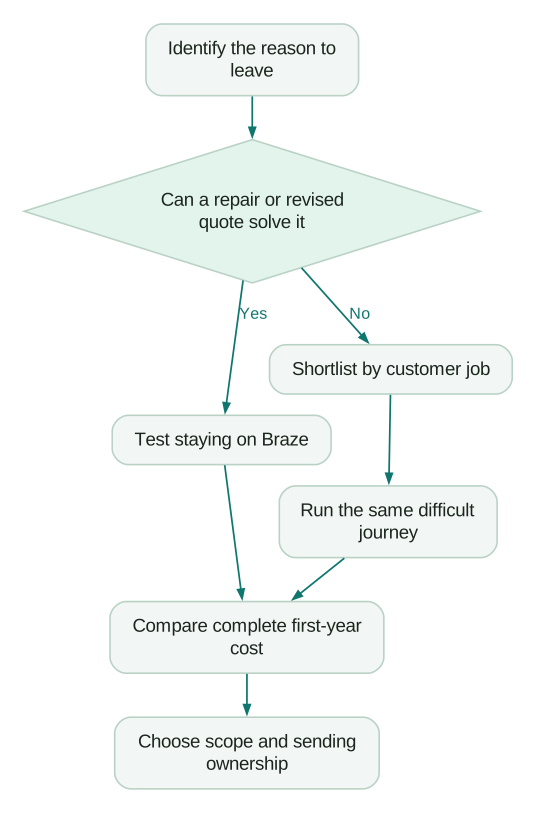
What must the final platform choice prove?
Choose a platform only after the matched workload, difficult journey and first-year cost model support the decision. The checklist records what must be true before sending ownership moves.
Checklist
- State the single main reason for considering a move.
- Evaluate a scoped Braze repair or revised quote where relevant.
- Give every vendor the same audience, object, channel and peak-month workload.
- Reproduce each billable unit from source data.
- Confirm package limits and the features required to pass the trial.
- Test goal completion, duplicates, opt-outs and identity transitions.
- List what the migration tool moves and what the team must rebuild.
- Plan mobile release adoption, sender preparation and journeys in flight.
- Assign one sending owner per logical message during overlap.
- Compare first-year cost, delayed savings and ongoing maintenance.
A free Martech AI audit can separate a platform-fit problem from a broken implementation. For a defined change, request a lifecycle migration quote with your current journey inventory, proposed destination and renewal deadline.
Questions people ask
Is there a free alternative to Braze?
Several candidates have free entry routes, including OneSignal, Reteno and Klaviyo, while Customer.io offers an eligible-startup programme. Their audience, channel and workflow limits differ. Check a realistic production month and the post-offer price; a free test account is not evidence that your existing Braze programme fits the free allowance.
Is Iterable more expensive than Braze?
You need matched quotes to answer that. Compare the same audience, channels, integration requirements, support and contract term, then include implementation and operation. A quoted annual commitment cannot be compared fairly with a small self-service starting price or a third-party estimate for an unknown workload.
Which Braze alternative suits B2B SaaS?
Customer.io is a strong first evaluation when account relationships and product events drive the journeys. Iterable can be relevant for a larger programme, while a narrower tool may suffice for a few simple interventions. Test a person belonging to two accounts before treating any profile model as adequate.
Can I keep Braze for push and move email elsewhere?
Yes, with explicit ownership and coordination. Both systems need current preferences, relevant customer state and a shared pressure policy. Define which platform owns each message purpose and how queued work behaves during changes. Include that continuing integration effort when calculating the saving from splitting channels.
How long does it take to move off Braze?
Estimate from identity quality, preference migration, journey rebuilding, sender preparation and mobile release adoption. A vendor's advertised timeline describes its own assumptions. Build the schedule around release gates and existing contractual deadlines; importing contacts can finish well before customer messaging is ready to transfer.
Sources
- Braze: Pricing and editions
- Customer.io: Pricing
- Iterable: Current buying route
- Iterable: Smart Ingest overview and limits
- MoEngage: Plans and MTU definition
- CleverTap: Pricing
- Insider One: Braze migration offer
- Klaviyo: Pricing
- OneSignal: Pricing
- Reteno: Pricing
- Customer.io: Billing mechanics
- Insider One: Platform and industry positioning

Written by
Jafrin Akter AloData Engineer and Co-founder at Martechdevs and Growth and Analytics Partners
Jafrin writes practical guides to marketing technology, customer data, analytics and AI workflows. Martechdevs is a Growth and Analytics Partners company.