
Responsys to Braze Migration: Move Data, Rebuild Journeys and Cut Over Safely
A Responsys to Braze migration succeeds when the new platform preserves customer identity, current preferences and the intended next message. Export profiles and event history, map them deliberately, rebuild the journeys, prepare delivery and transfer send ownership in verified cohorts. A successful file import proves only that one part of that work finished.
On this page
What does a Responsys to Braze migration involve?
Treat the migration as six workstreams: inventory, export, identity and permission mapping, destination loading, journey rebuilding, and delivery with cutover. Mobile SDK work becomes another dependency when push or in-app messaging is in scope. Each workstream needs an owner, acceptance evidence and a decision about what happens if it fails.
Start with the reason for moving. A renewal deadline, faster lifecycle changes and a new channel strategy create different priorities. Retire obsolete programs; preserve essential low-volume messages such as account verification and service notifications. Moving more campaigns is not a useful success metric if the team cannot explain why customers should receive them.
Use this inventory before committing the release calendar:
| Inventory item | Record explicitly | Release evidence |
|---|---|---|
| Message purpose | Trigger, customer benefit, owner and channel | Named owner approves its continued use |
| Audience and data | List, profile extension table, joins and event dependencies | Representative customers resolve to the right identity |
| Preferences | Channel, topic, consent evidence and delivery exclusions | Negative cases remain excluded |
| Active participants | Current episode, completed actions and next due message | Drain, resume or restart policy passes |
| Content and delivery | Templates, dynamic fields, sender, links and replies | Rendering and channel tests pass |
| Reporting | Source events, definitions and comparison period | Reconciled records support an external outcome measure |
Our lifecycle messaging implementation starts with those decisions because they determine both implementation effort and the overlap period. Check Braze pricing and quote terms alongside the technical plan: paying for two systems longer than expected can change the migration economics.
How do you export data from Oracle Responsys?
Use separate exports for profile data, event history and content assets. A profile list alone does not preserve preferences that change later, reporting history or the behavior of a Program.
Responsys Connect must be enabled for the account, and its operator needs the Data Director role. Connect supports list, profile extension table, supplemental-table, audience and event-feed workflows. Confirm access before scheduling the extraction. Oracle Connect overview
Export the current population and its related tables
The current Export Data wizard supports lists, list filters, app channel lists, audiences, profile extension tables and supplemental tables. It can select records inserted or updated since the previous job run. Configure the headers, delimiters, quoting, compression and encryption explicitly; the wizard supports Responsys file-server or external SFTP destinations. Its optional ready file can indicate completion and include a record count. Responsys Export Data
Create a small manifest for each extraction: account, source object, job and execution IDs, filter, extraction boundary, filename, checksum, row count and distinct-key count. Download and verify the file before marking it received. A ready file confirms the producer finished its operation; it does not prove that your downstream download contains every expected record.
Treat related tables as a joined dataset. If a PET contains loyalty tier and a supplemental table contains bookings, decide which values become profile attributes, which represent repeatable objects or events, and which should stay in the warehouse. Flattening every booking into a single profile field destroys the distinction between two concurrent trips.
Export events that preserve permission and reporting history
Event-feed exports produce a CSV for each selected event type. Oracle recommends at least Launch State, Opted In, Opted Out, Complained and Bounced. Other feeds cover sends, failures, clicks, conversions and program activity. Retain event timestamps and the applicable recipient, campaign and launch identifiers; a campaign name alone is a weak reconciliation key. Responsys event-feed exports
Responsys keeps exported CED files on its server for 14 days. After the first export, subsequent files cover activity since the last successful export. Archive the files promptly and establish what history the initial export actually contains. Oracle also distinguishes fixed CED snapshots from historical reports whose displayed metadata can change after campaign renaming. Exporting Contact Event Data
Do not treat a profile snapshot taken on Monday as permission to send on Friday. Keep incremental preference, complaint and delivery-exclusion changes flowing through the overlap period. Record the last successfully applied boundary in the destination, not just the last export attempted in the source.
Retrieve content without confusing it with working journeys
Oracle's API data model includes retrieval of Content Library documents and media, plus campaign-related resources. Templates are therefore not necessarily a manual copy-and-paste exercise simply because Connect's data export list omits them. Responsys API data model
Keep the exported assets and an inventory of their dependencies. Then rebuild and test the intended journey behavior in Braze. Retrieved HTML does not establish equivalent personalization, preference links, scheduling, business rules or participant state. For difficult source joins and extraction dependencies, scope the integration and data mapping separately from campaign production.
How should Responsys identity and permissions map into Braze?
Use a stable customer identifier for the destination and preserve the source identifiers for reconciliation. Map permission, deliverability and topic preferences as separate facts; never make an unresolved record marketable merely to complete an import.
Responsys RIID_ identifies a recipient and is unique across lists within an account. CUSTOMER_ID_ represents an external customer identifier. EMAIL_PERMISSION_STATUS_ uses I for opt-in and O for opt-out; EMAIL_DELIVERABILITY_STATUS_ uses D for deliverable and U for undeliverable. Those two status fields answer different questions. Responsys system fields
Build a crosswalk containing source account, RIID, canonical customer ID and destination external_id. Preserve the account namespace when consolidating several Responsys accounts. Resolve missing IDs, duplicate email addresses, shared inboxes and changed emails before messaging. Our identity resolution guide explains why a contact method is not automatically the correct identity key.
Braze's email states distinguish explicit opt-in, subscribed and unsubscribed. New profiles default to subscribed, which does not establish explicit permission. Global state and subscription-group state work together; a saved group subscription cannot be assessed in isolation. Braze subscription status
The following is a conservative migration policy for one ordinary marketing purpose. It is a release rule for this example, not a claim that every source opt-in meets every legal or business requirement.
| Source evidence | Preserve in the destination | Pilot decision |
|---|---|---|
| Current opt-out | Corresponding restrictive channel state and evidence | Block the marketing purpose |
| Opt-in, deliverable, sufficient purpose evidence | Appropriate global and topic state | Consider only after all other checks pass |
| Undeliverable or complaint | Delivery exclusion with its reason | Block while the exclusion applies |
| Unknown permission or conflicting identity | Explicit exception record and sending hold | Resolve before eligibility |
| Preference changed after the snapshot | Latest authoritative state and event evidence | Apply the change before the next send decision |
Braze does not automatically change global email subscription state to unsubscribed after a hard bounce. Preserve delivery exclusions separately from consent. Also inspect shared-email profiles: Braze documents propagation of email subscription changes across matching addresses, with limits. Test your duplicate-email cases instead of assuming every profile is independent. Braze email subscriptions
Email groups add topic choices to email's global state. SMS, MMS and RCS use subscription groups without the same global SMS layer. Do not copy an email opt-in into a text-message permission. Configure the actual channel and purpose combinations before importing them. Braze subscription groups
If a valid later re-consent replaces an earlier opt-out, resolve that chronology through the approved preference process. “Most restrictive forever” and “last row in the CSV wins” are both poor substitutes for authoritative, purpose-specific evidence. A customer preference center needs to keep that evidence current after migration too.
Which records are ready for an email pilot?
Only records with verified identity, current source changes, matching destination state and sufficient purpose evidence should reach the pilot cohort. Keep blocked and unresolved records visible in reconciliation rather than dropping them from the denominator.
This original Python helper implements that conservative preflight policy. It does not call either platform or validate the evidence behind a flag. An operator must establish those facts from the migration checks before setting a flag to true.
def email_pilot_gate(*, permission, deliverability, complaint,
                     identity_verified, delta_complete,
                     destination_verified, purpose_verified):
    if permission not in ("I", "O", "unknown"):
        raise ValueError("permission must be I, O or unknown")
    if deliverability not in ("D", "U", "unknown"):
        raise ValueError("deliverability must be D, U or unknown")
    flags = {
        "complaint": complaint,
        "identity_verified": identity_verified,
        "delta_complete": delta_complete,
        "destination_verified": destination_verified,
        "purpose_verified": purpose_verified,
    }
    for name, value in flags.items():
        if type(value) is not bool:
            raise ValueError(f"{name} must be a boolean")

    blocked, held = [], []
    if permission == "O":
        blocked.append("opt_out")
    if deliverability == "U":
        blocked.append("undeliverable")
    if complaint:
        blocked.append("complaint")
    if permission == "unknown":
        held.append("permission_unknown")
    if deliverability == "unknown":
        held.append("deliverability_unknown")
    for name in ("identity_verified", "delta_complete",
                 "destination_verified", "purpose_verified"):
        if not flags[name]:
            held.append(name)
    decision = "blocked" if blocked else "hold" if held else "pilot"
    return {"decision": decision, "reasons": blocked + held}
A useful acceptance fixture includes the cases most likely to disappear behind a reassuring import total:
| Fixture | Expected decision | Evidence to inspect |
|---|---|---|
| Valid identity, opt-in, deliverable, all evidence verified | Pilot | Destination profile and purpose-specific audience |
| Opt-out arrives after the initial export | Blocked | Applied delta and destination exclusion |
| Email is deliverable but permission is unknown | Hold | Exception queue; no default eligibility |
| Opt-in is present but address is undeliverable | Blocked | Delivery exclusion survives the move |
| Source state is correct but destination is still queued | Hold | Read-back shows the intended state before release |
| Duplicate identity remains unresolved | Hold | Crosswalk exception remains counted |
Pilot eligibility is not a complete send authorization. The journey must also own the episode, remain relevant, pass delivery checks and avoid a logical message already completed by Responsys.
How do you load data without creating new messaging mistakes?
Load a controlled fixture first, with real sends disabled. Apply restrictive preference and delivery decisions as part of creating or updating profiles, then add the attributes and selected history that the rebuilt journeys actually need.
Braze supports CSV imports, its user API and warehouse ingestion routes. Attribute CSV files can be up to 500 MB; custom-event files up to 50 MB. Imported HTML is not sanitized or reformatted for you. Treat customer-provided strings as untrusted when they reach web personalization; removing one tag is not a complete rendering-security policy. Braze import options
For CSV, an existing external ID updates its profile; a new one can create an identified profile. Dependent imports should run sequentially because concurrent imports are not guaranteed to process in order. Errors can skip an entire row, while warnings can import a row with affected values omitted. Reconcile both classes rather than accepting a completed job as a clean result. Braze CSV imports
For /users/track, the current standard limit is 75 objects combined across attributes, events and purchases; some older accounts have a separately documented legacy limit. A success response indicates receipt and queuing, not completed profile updates. Braze offers processing-status tracking in beta, with availability and its own conditions; even a completed group requires inspection of object-level errors. Use confirmed account capabilities and read-back checks. Braze users/track
Use separate controls for historical backfill and live activity. A three-year-old purchase imported today must not start a “thanks for your first order” sequence merely because an event arrived now. Disable affected entry paths, distinguish historical records and test the actual destination behavior before replay. Preserve detailed reporting history in the warehouse when profiles only need a current summary.
How do you rebuild Responsys Programs as Braze Canvases?
Rebuild the customer decision, then test timing, identity and exits. Copying the visible sequence can preserve a stale list dependency while losing the reason a customer was eligible.
Consider a hypothetical welcome program that selects yesterday's new accounts overnight. The new design receives an account-created event, waits for the relevant product milestone and sends a useful setup reminder only if the account still needs it. A first purchase or changed preference should alter subsequent messaging.
| Decision | Rebuild requirement | Negative test |
|---|---|---|
| Entry | One intended account-creation episode | Historical import does not start a new welcome |
| Eligibility | Correct person, account and purpose | A second account does not inherit the first account's state |
| Delay | Defined timezone and due time | A late event does not silently reset the entire wait |
| Exit | Purchase, completion and preference changes | A purchase during the delay prevents the unwanted next message |
| Re-entry | Deliberate episode-level policy | Replayed events do not repeat the same message |
Braze Canvas exit behavior depends on the step. A user marked for exit during a Delay step remains until that delay ends; event-triggered steps have additional queued-send and repeat-trigger behavior. Test the actual path with purchase and preference changes during its wait, rather than equating “exit condition configured” with “all pending sends canceled.” Canvas exit criteria
For existing participants, choose whether the source journey drains, the destination resumes from verified business state, or a redesigned journey intentionally restarts. Record completed messages and the next eligible action by episode. The Braze implementation mistakes guide covers identity and event choices that can undermine the rebuild before campaign copy enters the picture.
How should email warming affect the cutover plan?
Prepare the actual sending infrastructure and move volume according to observed delivery health. A familiar brand name does not give a new dedicated IP the same history as the old sending path.
Braze's manual warming guidance provides different schedules. Its conservative example starts at 50 messages daily for the first three days, reaches 8,000 on days 19–21 and then increases on a three-day cadence. The moderate example reaches one million by day 21. These are different planning paths, not interchangeable promises that every account should hit those volumes. Braze IP warming
Choose cohorts with current permission and recent meaningful engagement. Review provider-level deferrals, bounces and complaints before increasing volume. Braze's manual guide calls for investigation of campaign bounce rates above 3–5% and spam reports above 0.08%; being below those review thresholds does not prove healthy inbox placement. Separate marketing from transactional sending as appropriate, and verify major mailbox-provider requirements before launch.
Automated warming also needs cutover controls. Braze can hold the next day's volume when delivery benchmarks are crossed. A stopped plan cannot resume; starting another plan with the same segment requires excluding recipients already served by the earlier plan. Template deduplication within one plan is not a cross-plan or cross-platform duplicate-send guarantee. Automated warming FAQ
If push or in-app messaging is included, plan SDK integration, app release, device identity, permission and delivery tests early. Braze's integration model covers SDK and server-side work, but a database import alone does not update installed mobile apps. Validate the supported token and SDK route for your actual app; do not infer that Responsys tokens are automatically portable. Braze integration overview
How do you cut over without duplicate or missed messages?
Give each message purpose, channel and journey episode one active sending owner. Both systems may receive validation data, but they should not independently decide to send the same logical message.
Include work already queued in Responsys. Stopping new program entry does not establish that every existing scheduled message has stopped. Choose an explicit drain, cancel or transfer policy and prove it on representative cases before releasing the equivalent destination journey.
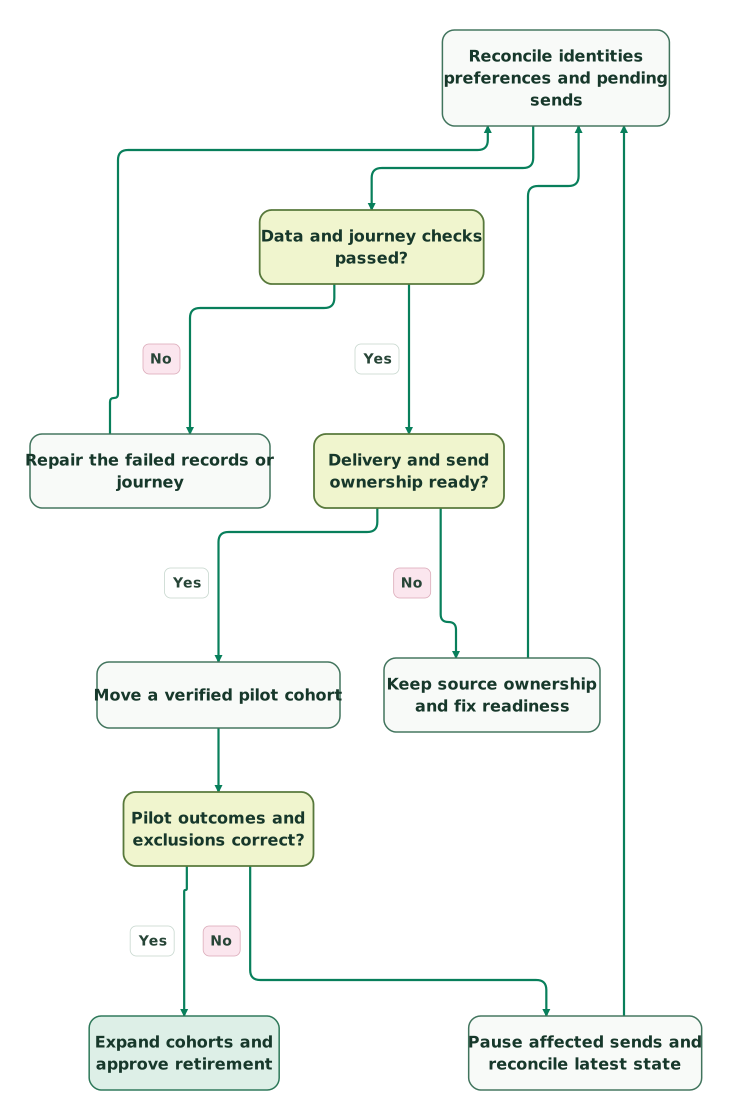
Read diagram as text
- Reconcile identities preferences and pending sends to Data and journey checks passed?.
- Data and journey checks passed? to Repair the failed records or journey: No.
- Repair the failed records or journey to Reconcile identities preferences and pending sends.
- Data and journey checks passed? to Delivery and send ownership ready?: Yes.
- Delivery and send ownership ready? to Keep source ownership and fix readiness: No.
- Keep source ownership and fix readiness to Reconcile identities preferences and pending sends.
- Delivery and send ownership ready? to Move a verified pilot cohort: Yes.
- Move a verified pilot cohort to Pilot outcomes and exclusions correct?.
- Pilot outcomes and exclusions correct? to Expand cohorts and approve retirement: Yes.
- Pilot outcomes and exclusions correct? to Pause affected sends and reconcile latest state: No.
- Pause affected sends and reconcile latest state to Reconcile identities preferences and pending sends
Rollback starts by identifying completed messages and new preference changes. Restore current eligibility and ownership, not the original snapshot. A routing change can affect the next send; it cannot retract a message already delivered. The Braze to Customer.io migration guide applies the same ownership principle to a different destination.
What evidence should approve Responsys retirement?
Approve retirement when the scoped population, customer behavior and reporting reconcile, with named owners for any exceptions. A sample of good profiles cannot justify silently excluding the unresolved remainder.
For an illustrative cohort of 20,000 source identities, 19,500 reconciled destination profiles and 500 held exceptions mean 97.5% verified coverage. The pilot may use the verified population if its exclusions are intentional. It is still inaccurate to report the migration as 100% complete by removing those 500 from the denominator.
Reconcile counts by permission, delivery state, account and journey episode. Compare expected entries with actual entries, then compare business outcomes in your product or warehouse. Changing vendor attribution windows can move a reported conversion count without changing customer behavior. Keep the definitions with the exported evidence.
Checklist
- Every message purpose has a rebuild, retire or temporary-source decision.
- Export files, related tables and event feeds reconcile with their manifests.
- Identity exceptions remain visible and excluded from inappropriate sends.
- Current opt-outs, complaints and delivery exclusions survive the transfer.
- Import errors, warnings and queued updates have been resolved or held.
- Historical events and repeat events cannot create unwanted entries.
- In-flight episodes and pending sends have an enforced ownership policy.
- Email and any mobile delivery paths pass their actual release checks.
- Rollback retains completed messages and the latest preferences.
- Reporting archives, access removal and source shutdown have owners.
Get the $99 martech audit to identify gaps in identity, ownership and activation. Request a detailed lifecycle migration scope with your program inventory, data model, channel mix and source renewal deadline. Those inputs make the overlap and acceptance work concrete.
Keep reading
Browse all CRM & Lifecycle guides
 CRM & Lifecycle
6 Braze Implementation Mistakes and How to Fix Them
Fix six Braze failure points: split profiles, hidden API errors, duplicate triggers, Canvas re-entry, stale eligibility and incorrect suppression.
Jafrin Akter AloLast updated 14 min read
 Martech AI
Braze Remote MCP Server: Claude, ChatGPT and Cursor Setup
Braze's local MCP server is deprecated. Connect the remote one to Claude, ChatGPT or Cursor via OAuth, see which tools write, plus 8 prompts.
Jafrin Akter AloLast updated 13 min read
 Martech AI
Braze AI: what Decisioning Studio, Predictive Churn and Operator each decide
What each BrazeAI feature decides, from Decisioning Studio Go and Pro to Predictive Churn and Operator, and how to test it against manual A/B tests.
Jafrin Akter AloLast updated 15 min read
Lifecycle marketing
See the implementation scope, deliverables and acceptance checks.
Questions people ask
Can Responsys stay live while Braze warms up?
Yes. Controlled overlap lets Responsys retain ownership of work that Braze is not yet ready to deliver. Define ownership by purpose, channel and episode, keep preference changes current, and account for queued messages before moving a cohort. Two active contracts are manageable; two independent senders acting on the same customer action are the problem to prevent.
Should we import years of opens and clicks into Braze?
Import history only when a defined audience or journey decision needs it. Keep the detailed archive and its definitions in the warehouse for reporting. Responsys distinguishes ordinary Opened from privacy-related Auto Opened events, so combining them can create a misleading engagement signal. Test historical replay with real sends disabled before allowing those events near live entry rules. Oracle event types
Who should own the migration, marketing or data engineering?
Assign one accountable migration lead with named owners across both teams. Lifecycle owners define purpose, content and acceptance; data engineers own extraction, identity and reconciliation; application engineers own SDK and event delivery where needed. The release decision needs all of that evidence. Neither a completed data transfer nor an approved template can independently establish a successful migration.
How long does the migration take, and do we need a Braze partner?
Estimate the data, journey, delivery and app-release dependencies separately. Braze says a first campaign can launch in as little as six weeks through its onboarding approach; that is a vendor claim about an initial campaign, not a guaranteed full migration. Braze offers its own onboarding and certified partner-led options. Choose based on your team's capacity and the actual rebuild scope. Braze onboarding
What should we keep after shutting Responsys down?
Retain the permitted profile crosswalk, preference evidence, event archive, campaign and launch identifiers, reporting definitions and cutover decisions for the agreed retention period. Also preserve the reconciliation exceptions and their resolution. Export before access ends and verify retrieval independently. An inaccessible old account is a poor place to discover that the only copy of an important report remained there.
Sources
- Oracle Connect overview.
- Responsys Export Data.
- Responsys event-feed exports.
- Exporting Contact Event Data.
- Responsys API data model.
- Responsys system fields.
- Braze subscription status.
- Braze email subscriptions.
- Braze subscription groups.
- Braze import options.
- Braze CSV imports.
- Braze users/track.
- Canvas exit criteria.
- Braze IP warming.
- Automated warming FAQ.
- Braze integration overview.
- Braze onboarding and partner-led options.

Written by
Jafrin Akter AloData Engineer and Co-founder at Martechdevs and Growth and Analytics Partners
Jafrin writes practical guides to marketing technology, customer data, analytics and AI workflows. Martechdevs is a Growth and Analytics Partners company.