
AI agents for marketing: what to automate, what to review and where to start
AI agents can investigate marketing performance, prepare campaign and content work, and assemble sales or lifecycle briefs. Choose jobs with reliable inputs, a clear acceptance test and manageable consequences when something is wrong. Start with outputs a person can verify; expand authority only after the workflow handles the exceptions your team actually encounters.
On this page
A weekly pipeline report is a useful place to see the difference. Producing a paragraph about pipeline is easy. Explaining the change from last week requires snapshots, consistent stages, currency rules and a way to distinguish new opportunities from edited ones.
An agent can perform that investigation. It cannot recover a historical snapshot you never stored, or decide what qualified pipeline means without a definition.
What makes a marketing workflow agentic?
For this guide, an agent is a system that can choose steps and tools while pursuing a task. It might inspect a report, notice a discrepancy, retrieve more detail and revise its explanation.
A fixed automation follows predetermined steps. Many useful marketing systems combine the two: deterministic rules control eligibility and execution, while an AI component interprets evidence or drafts a recommendation. Anthropic's engineering guide makes a similar distinction between predefined workflows and agents that dynamically direct their work. Building effective agents.
The buying decision should follow the work. A reliable routing rule does not need an agent to rediscover it on every lead. An ambiguous request to investigate a revenue change may benefit from adaptive analysis.
Martechdevs develops marketing agents around specific operational jobs, including the data definitions and acceptance checks that make the result usable.
What do adoption surveys tell a small team?
LeanData's enterprise survey is useful for identifying control failures to investigate, rather than estimating a small team's likely return. Its July 2026 article reports a survey of 157 enterprise B2B revenue professionals. Among respondents, 93% had deployed at least one agent, while 30% had encountered actions on records without a clear audit trail. The survey also reports duplicate outreach and ownership conflicts. LeanData's customer survey.
This is vendor-published research from a specific enterprise sample. It does not establish an adoption rate for every startup or prove that a particular agent improves revenue.
It does identify a useful implementation question: when something changes, can you explain which workflow changed it, which records it used and why the action was allowed?
Which marketing jobs are easiest to verify?
Start with work whose evidence and completion can be checked without allowing a consequential action. Our order uses input quality, acceptance clarity, consequences and reversibility:
| Candidate workflow | Initial output | What proves it is useful | Authority to withhold initially |
|---|---|---|---|
| Reporting investigation | Reconciled answer with contributing records | Totals and definitions match an independent result | Budget or CRM changes |
| Data hygiene | Proposed corrections with old/new values | The business rule and record identity are correct | Bulk updates and merges |
| Campaign preparation | Brief, draft or QA findings | Claims, audience and implementation requirements pass review | Publishing and sending |
| Sales or lifecycle preparation | Account brief and proposed next step | Current ownership and suppression conditions are respected | Enrollment and customer contact |
| Stack upkeep | Evidence-backed issue or draft change | A retained failure case explains the affected system | Production repair without approval |
Use AI workflows for RevOps teams when account ownership and revenue definitions shape the job. The comparison above is a starting recommendation; move a workflow down the list when its inputs or acceptance test are weak.
Reporting investigations are a strong first candidate
Ask the agent to run reporting investigations in ChatGPT on connected data. Give it curated data, approved dimensions and access to the records behind the total.
A useful output contains the answer, the calculation, the material contributors and the limitations. “Pipeline fell because demand weakened” is inadequate if the actual change came from a seller correcting an opportunity amount.
Begin with questions such as:
- Which campaigns account for the change in spend?
- Which opportunities explain the movement in qualified pipeline?
- Which mature trial cohorts have lower activation?
- Which reports are affected by a late data load?
The workflow should stop short of a causal claim unless the evidence supports one. A correlation between a campaign launch and revenue does not establish incremental impact.
Data hygiene works best as an exception queue
Agents can inspect inconsistent names, missing fields and likely duplicate records. The safest useful output is often a proposed correction with evidence.
For example, a skill can identify companies whose billing country conflicts with the CRM country. That does not mean the billing country should overwrite the CRM value. One may represent a legal entity and the other an operating location.
Require the agent to show original values, the proposed change, the rule and the affected record ID. Approve deterministic corrections separately from judgement calls.
Content and campaign preparation need an evidence layer
Useful tasks include drafting a brief from research, checking claims against product documentation, preparing creative variants and reviewing a sequence against journey rules.
The acceptance test should include factual accuracy, audience fit and implementation constraints. More variants are not inherently better. Ten versions of an unsupported claim create ten review problems.
Keep approved claims, voice examples and product limitations in maintained context files. A writing agent should be able to identify when the source material cannot support the requested promise.
Sales and lifecycle preparation need shared ownership rules
An agent can prepare a call brief, summarise account history or draft the next message. It becomes more consequential when it enrolls contacts, changes stages or sends outreach.
Before those actions, define who owns the account, which existing journeys take precedence and which states suppress contact. A support escalation or an active sales conversation can change what should happen next.
Use stable account and contact IDs. A name match is not enough to update the correct record when several companies or people share similar names. For ongoing customers, define a post-sales agent for renewal and churn signals that coordinates the account owner, billing recovery and support incidents.
Budget and campaign changes require tighter controls
A tool may technically support campaign creation or budget updates. That says little about whether your workflow should execute them without review.
Marketing decisions depend on delayed conversions, learning periods, margin, seasonality and business commitments. A system optimising yesterday's reported cost per lead can damage a campaign whose qualified outcomes arrive later.
Start with recommendations that include current state, proposed state, evidence, expected effect and a review deadline. If you later automate a narrow action, enforce monetary limits, eligible campaigns and rollback conditions outside the model's prose instructions.
Which agents keep the stack itself working?
Tracking checks, pipeline monitoring, CRM hygiene and routing reviews are upkeep jobs with different inputs and authority from campaign preparation. The guide to agents that keep the martech stack itself working covers those jobs, their runtimes and the evidence needed before expanding access.
This work can begin with read-only investigation and end in a written finding or draft change for review. To triage a tracking or pipeline alert, start with the metric definition, independent source and change history. Keep an observable record of the investigation so the proposed repair can be explained before approval, then verify the result separately.
What architecture does a small marketing team need?
A small marketing team needs one owned path from a business question to a checked result, with clear data access, validation and action boundaries.
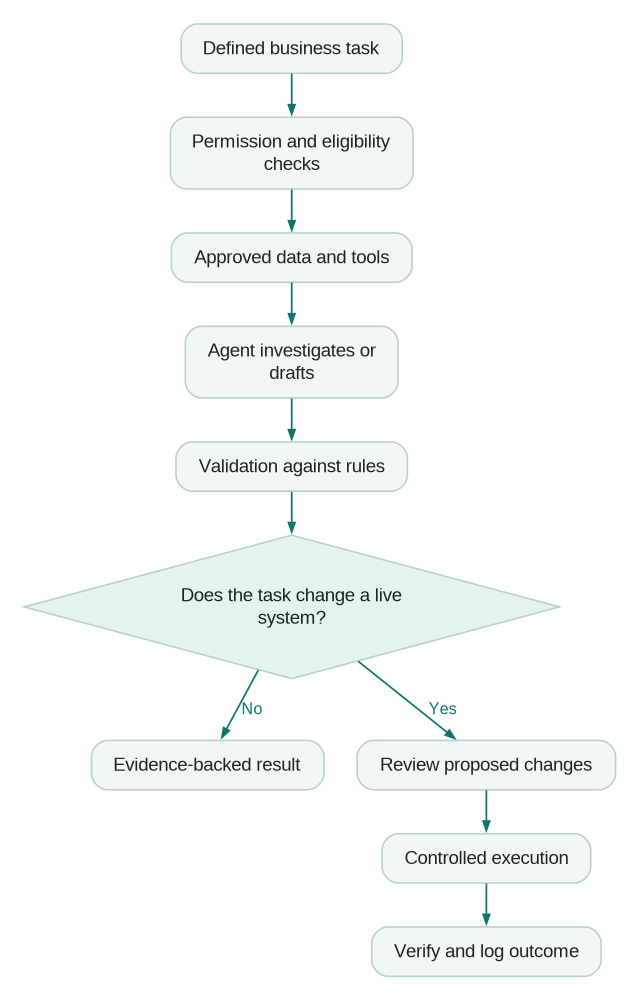
Read diagram as text
- Defined business task to Permission and eligibility checks.
- Permission and eligibility checks to Approved data and tools.
- Approved data and tools to Agent investigates or drafts.
- Agent investigates or drafts to Validation passes.
- Validation passes to Stop and report failed checks: No.
- Validation passes to Does the task change a live system?: Yes.
- Does the task change a live system? to Evidence-backed result: No.
- Does the task change a live system? to Review exact proposed changes: Yes.
- Review exact proposed changes to Approval and current state remain valid.
- Approval and current state remain valid to Stop or return for revised review: No.
- Approval and current state remain valid to Controlled execution: Yes.
- Controlled execution to Verify and log outcome
The key components are practical:
A task definition. Specify the question, output, deadline and conditions under which the workflow should stop. See a first Claude Code workflow for a concrete implementation.
A source contract. Define record grain, IDs, timezones, freshness and metric logic. The business and data owners approve definition changes, version their effective period and update the reference cases. The AI-ready data guide explains this foundation in more detail.
Scoped tools. Give access to the records and operations the job requires. Read access can still expose sensitive data, so scope both rows and fields.
Validation. Recalculate totals, check record counts and confirm required evidence. Use deterministic checks for deterministic rules. Package repeated steps as marketing slash commands, with those checks still enforced.
An execution boundary. Separate a proposed action from its authorised execution. A review must describe the actual changed values, not merely ask whether the user trusts the agent. Before execution, verify that the approval has not expired or been withdrawn and that the relevant record state still matches what was reviewed.
An audit record. Store the input version, tool calls, decisions, approvals and verified outcome with appropriate retention and access controls.
How should an agent explain weekly pipeline movement?
Consider a fictional SaaS business with 12 employees. Its qualified pipeline falls from $420,000 to $365,000 between two weekly snapshots.
The initial request is: “Explain the $55,000 reduction and identify anything marketing should investigate.”
The agent has read access to opportunity snapshots and campaign associations. It does not have permission to edit opportunities. These fictional USD inputs express each opportunity's contribution to the same open-pipeline definition:
opportunity_id,prior_open_usd,current_open_usd,reason
a,200000,200000,unchanged
b,110000,110000,unchanged
c,40000,0,closed_lost
d,30000,0,closed_won
e,40000,30000,amount_correction
f,0,25000,newly_qualified
Zero means the opportunity is outside this defined open-pipeline measure in that snapshot. It does not mean the underlying closed deal has no value. Match snapshots by stable opportunity ID before joining campaign associations.
Its reconciliation produces this bridge. All figures are USD for the same two snapshots:
| Movement | Change in open pipeline | What it means |
|---|---|---|
| Closed lost | −40,000 | Lost opportunities leave the measure |
| Closed won | −30,000 | Won business also leaves open pipeline |
| Newly qualified | 25,000 | New eligible opportunities enter |
| Amount corrections | −10,000 | Existing recorded value changes |
| Total movement | −55,000 | 420,000 becomes 365,000 |
The bridge is -40,000 - 30,000 + 25,000 - 10,000 = -55,000.
That result changes the conversation. Closed-won movement is positive business activity, even though it reduces open pipeline. Amount corrections change measurement. Only some of the movement calls for acquisition investigation.
The accepted output should identify the relevant opportunity IDs, state the snapshot dates and explain whether stage definitions changed. It should also separate observed facts from follow-up hypotheses.
If one source failed to load, the workflow should label the result incomplete. It should not compensate by writing a more confident narrative.
How do you evaluate the agent before giving it more authority?
Evaluate a marketing AI agent before release using ordinary cases and the exceptions that cause expensive mistakes. Define expected evidence and permitted actions before measuring whether its explanation sounds convincing.
For the pipeline example, test:
- A deal with a changed amount and stage in the same week.
- A deleted opportunity.
- Multiple currencies.
- A late snapshot.
- A renamed stage.
- A duplicated campaign association.
- A request for data outside the user's access.
- A note containing instructions that conflict with the task.
Score correctness at the level that matters. A fluent explanation with the wrong total fails. A correct total with invented causal reasoning also fails. A refusal to answer an answerable question is a usability problem worth recording.
Track accepted output rate, correction time, missed exceptions, unauthorised action attempts and total cost. Keep a record of the model, workflow and tool versions used for each evaluation.
Do not promote a workflow because it performed well once. Repeat representative cases after changes to prompts, schemas, permissions or models.
How much value remains after review and maintenance?
Value remains only after preparation, review, maintenance and usage costs are included. Use this fictional monthly reporting model to separate recovered capacity from cash spending.
The manual process takes 16 hours. The agent reduces preparation to three hours, but reviewers spend four hours checking results and an operator spends two hours maintaining definitions and fixing exceptions.
The net time saving is seven hours. At an assumed internal capacity value of USD 60 per hour, that is USD 420 of recovered capacity. Model, tooling and infrastructure cost an assumed USD 120 per month, leaving USD 300 of modeled resource benefit before initial implementation.
| Monthly input | Fictional value | Treatment |
|---|---|---|
| Manual process | 16 hours | Baseline work to replace |
| Assisted preparation | 3 hours | Remaining operator work |
| Review | 4 hours | Human verification and correction |
| Maintenance | 2 hours | Definitions and exceptions |
| Tooling and infrastructure | USD 120 | Incremental cash spending |
If existing payroll stays unchanged, the seven hours are capacity and the USD 120 is additional cash cost. With the other assumptions fixed, review can rise to nine hours before the modeled resource benefit reaches zero: (16 − 3 − 9 − 2) × 60 − 120 = 0. At ten review hours, it is negative USD 60. Measure correction time instead of assuming the first plausible answer finishes the job.
This is an illustrative calculation, not a vendor quote or a promised saving. Replace every assumption with your own measurements. Use traces of agent answers, actions and failures to capture the operating evidence.
Also record the value of better decisions separately. It may be substantial, but attributing every subsequent revenue improvement to the agent would overstate the evidence.
Should you buy, configure or build the workflow?
Use the build or buy comparison for marketing agents to choose the smallest maintained option. A native agent is a useful first candidate when the workflow mostly lives inside one platform and its permissions, data model and interface fit the job. HubSpot's AI tools are one example of this category.
Use a reusable skill when you already have a capable agent and need a consistent procedure. The marketing skills guide includes concrete recipes.
Build a custom workflow when the work crosses systems, needs business-specific logic or requires controls that the native product does not provide. Keep the first scope narrow enough to evaluate.
Open-source frameworks such as LangGraph and CrewAI can support custom implementations. They provide development building blocks; they do not arrive with your account identity rules, suppression logic or definition of qualified revenue.
For a small team, operational ownership is often the deciding factor. Someone must respond when a connector expires, a source column changes or an evaluation starts failing.
What must be true before the first rollout?
The first rollout needs one owned task, a reliable evidence path and clear limits on action. Confirm these conditions before making the workflow a dependency:
Checklist
- One business task and one accountable owner are named.
- Inputs, definitions and freshness expectations are documented.
- The first version has a limited, reviewable scope.
- Permissions match the permitted operations and data.
- Outputs include evidence and unresolved uncertainty.
- Representative exceptions have been tested.
- Live changes have enforceable limits and approval rules.
- Failed or partial runs remain visible.
- Logs identify what changed and how it was verified.
- Net value includes review, maintenance and usage costs.
When these checks expose missing identity or reporting foundations, fix those dependencies first. The AI-ready data service covers the integration and modelling work that agent workflows rely on.
At Martechdevs, we build the data access, definitions and working instructions behind repeatable AI workflows. Start with the free AI readiness checklist, or explore an AI assistant built around your approved workflows.
Keep reading
 Martech AI
AI for RevOps: Useful Workflows, Reliable Data and a Pilot That Proves Value
Choose useful AI workflows for RevOps, compare native tools with custom agents, and test evidence quality, missed issues, forecast accuracy and real effort.
Jafrin Akter AloLast updated 13 min read
 Martech AI
Claude Code Memory for Marketing Teams: What Goes in CLAUDE.md
Put marketing rules in the right Claude Code memory files. Use project, user and folder instructions, imports, shared rules and checks that prove what loaded.
Jafrin Akter AloLast updated 13 min read
 Martech AI
Is Claude Code Safe? Permissions and a Read/Write Test
Review Claude Code permissions, sandbox limits and marketing MCP access. Use a synthetic file exercise to check blocked reads and approval before writes.
Jafrin Akter AloLast updated 12 min read
AI readiness score
Check your tracking, data, context and access before connecting an agent.
Questions people ask
What should happen when two agents propose changes to the same customer record?
Route both proposals through the same ownership and conflict rules before either writes. Compare the intended record, current value, proposed value and source evidence, then decide whether one change supersedes the other. Recheck the record when executing the approved operation. Two individually reasonable recommendations can conflict when they describe different moments or business meanings, so the shared execution boundary must make that conflict visible.
How should we measure a scheduled agent that finds no work to do?
Record a successful no-work result separately from a failed or incomplete run. The workflow should show that its source was available, its eligibility query completed and no records qualified. Count the usage and maintenance cost even when there is no action. This distinguishes a quiet operating period from a broken connection, and prevents an empty output from being reported as either a failure or an invented saving.
How should an agent compare a forecast with the eventual result?
Keep the forecast version, assumptions, population and issue time fixed before comparing it with the later outcome. Record missing or changed inputs separately from genuine forecasting error, and use the same outcome definition for both. Do not let a revised explanation overwrite what the team actually knew when it made the decision. The comparison should help improve the next forecast without rewriting the earlier one.
Do agent logs need to contain every raw customer record?
Keep the evidence needed to explain the result and reproduce an authorized investigation, with access and retention suited to the data. Record identifiers, input versions, relevant calculations and approved changes where possible instead of duplicating entire customer histories into another system. If troubleshooting needs additional detail, collect it under an explicit scope. More copied data can make an audit harder while expanding who can see sensitive information.
How do we retire a marketing agent without leaving unfinished work?
Stop its schedules and new intake, then account for pending runs, proposed changes and already-triggered actions. Assign a person or replacement workflow to any continuing obligation before removing credentials. Preserve the definitions, useful outputs and decision records the business still needs. Verify that no old integration can resume the work unexpectedly, and record the remaining operating owner rather than treating deletion of the prompt as completion.
Sources

Written by
Jafrin Akter AloData Engineer and Co-founder at Martechdevs and Growth and Analytics Partners
Jafrin writes practical guides to marketing technology, customer data, analytics and AI workflows. Martechdevs is a Growth and Analytics Partners company.