Post-Sales AI Agent: Which Customer Signals to Monitor and What It May Do
Data Engineer and Co-founder at Martechdevs and Growth and Analytics Partners
Last updated 15 min read
A post-sales AI agent should monitor product adoption, payments, support problems, account contacts, renewal obligations and expansion headroom. Give each signal a trusted source, a freshness limit, an owner and an allowed action. Start with evidence-backed alerts and reviewed drafts. Expand its authority only after you can explain its decisions and stop inappropriate actions before they reach customers.
What should a post-sales AI agent monitor?
Monitor changes that give your team time to make a useful intervention. A lower usage count matters when it indicates lost value; a failed payment matters when someone can resolve it. Collecting more account facts without deciding who should act produces a busier queue, not better customer management.
For a customer success or revenue operations team, the following six families cover the first useful account view. These are proposed operating rules; tune the lookback windows and urgency to your product and contracts.
| Signal family | Source of truth | Change worth investigating | Decision it supports |
|---|---|---|---|
| Adoption | Product events and account database | Core workflow usage falls against the account’s own baseline; active seats decline | Offer help with the lost use case |
| Billing | Invoice and subscription records | Unpaid invoice, failed attempt, payment method requiring attention | Coordinate recovery with the billing owner |
| Support | Support organisation and ticket records | Severe unresolved incident, repeated reopening, blocked integration | Escalate the blocker before a commercial conversation |
| Contacts | Verified customer relationship management (CRM) records and account administration | Billing contact changes, champion becomes unreachable, administrator departs | Verify who now owns the relationship |
| Renewal | Contract and commercial records | Notice deadline approaches, price changes, decision owner missing | Start the correct renewal process |
| Expansion | Entitlement and usage records | Sustained capacity pressure alongside successful adoption | Evaluate an upgrade after service and payment issues are resolved |
A custom post-sales agent built on your stack should bring those facts together around the account your team actually manages. It should not require the account manager to open five systems just to check whether the recommendation is sensible.
Product adoption needs a meaningful baseline
Compare equivalent observation windows. Four complete weeks of successful exports are comparable; a partial Monday morning and a full working week are not. Exclude internal testing and agree whether activity belongs to a person, a workspace or the commercial account.
Track both absolute usage and its denominator. Nineteen active users out of forty purchased seats means something different from nineteen out of twenty. Separate a seat reduction from reduced adoption among an unchanged entitlement. For teams using HubSpot, publish the relevant product usage data in HubSpot with its observation cutoff and explanation.
Billing state must stay with the recovery owner
Stripe’s invoice.payment_failed event exposes attempt_count, but a scheduled retry after a hard decline can advance that counter without executing another charge until a new payment method is supplied. Read the invoice’s current state and recovery configuration before deciding what happened. Stripe recommends eight Smart Retry attempts within two weeks as its default configuration; that is a configurable recommendation, not every customer’s schedule. Stripe Smart Retries.
The agent’s first job is to explain the situation to the owner. It should not start a second retry schedule, invent a payment deadline or contact a person whose billing role has changed. Keep operational recovery in the established billing workflow. Our CRM and lifecycle implementation connects renewal, dunning and account communication around that ownership.
Support and contact changes need verification
A severe incident near renewal should suppress an expansion message. Count customer impact and unresolved severity, not ticket volume alone: five questions during a successful rollout can be healthier than one unreported outage.
A bounced email is a reason to verify a contact, not evidence that the champion left. Confirm through account administration, the named account owner or an appropriate customer contact. The US Bureau of Labor Statistics reported that 20.6% of wage and salary workers had tenure of one year or less in January 2026. That describes a broad workforce population, not the probability that your champion will leave. Use observed account changes for individual decisions. BLS employee tenure release.
Renewal and expansion need the commercial context
Store the notice deadline separately from the renewal date. A conversation sixty days before renewal can already be late if notice was due ninety days before it. Link each obligation to the contract version and the person responsible for resolving it; the renewal workflow should own the commercial decision.
Capacity pressure becomes an expansion opportunity only when the customer receives value. A team near its quota because failed jobs keep retrying needs a technical fix. An unresolved support incident can also make an otherwise reasonable upgrade recommendation badly timed.
Which signals should you automate first?
Start with failed payment, a sustained adoption drop and an unresolved severe ticket near renewal. They have identifiable sources and owners, and a timely response can change the customer’s experience. Add other signals when you can specify an equally clear intervention.
Evaluate each candidate on four questions: can the team do something useful, is the observation reliable, does it arrive early enough, and what does a false alarm cost? A signal with a dramatic name but no reliable source should stay out of the first release.
For example, a usage drop rule might require two consecutive complete weekly observations below the account’s established baseline. The account’s normal working pattern matters: a seasonal customer and a daily operations customer need different baselines. Keep the baseline window and the comparison window in the evidence so the owner can challenge the result.
Leave single-message sentiment, generic third-party intent and an annual satisfaction score out of the initial automatic action path. They can prompt a person to investigate, but they do not establish what changed inside the account. Avoid stacking weak observations until a numerical score looks convincing.
A deterministic workflow can handle threshold checks and routing. Use the model where interpretation adds value: summarising a long incident, connecting evidence across systems or drafting a relevant check-in. Anthropic distinguishes predefined workflows from agents that choose their steps and recommends starting with the simplest effective approach. Building effective agents. Our guide to choosing work an agent can finish reliably applies that decision to marketing and customer operations.
How do you turn a signal into an allowed action?
Write a signal-to-action contract before connecting a write-capable tool. The contract identifies the evidence, its owner, its expiry and the maximum action the agent may request. A signal may support several proposals, but each proposal needs its own explicit authority.
The following tiers are a practical starting policy for a customer success team.
| Tier | Permitted behaviour | Required control | Example |
|---|---|---|---|
| Log | Record a relevant observation | Account key, source reference and timestamp | A change in weekly seat usage |
| Alert | Add a bounded item to an internal owner queue | Deduplication, urgency and an accountable recipient | Severe incident approaching a notice deadline |
| Draft | Prepare text or a proposed record change | No customer send or authoritative field update | A check-in for the account manager to edit |
| Act with approval | Execute the exact approved change | Named approver, payload version, expiry and current-state recheck | Update the verified billing contact |
| Never | Reject an action outside this agent’s mandate | Enforcement in tools and downstream permissions | Change contract price or retry a charge independently |
An internal task is still a write. If the agent may create one automatically, give it a narrowly scoped action that checks for an existing episode and limits queue volume. Do not grant broad CRM editing rights because the policy says “alert only.”
OWASP identifies excessive functionality, permissions and autonomy as causes of excessive agency. It recommends enforcing authorisation outside the model and using human approval for high-impact actions. OWASP excessive agency guidance. Use a restricted service identity and separate tools for reading evidence, writing a draft and executing an approved change.
What belongs in the approval record?
Bind approval to the customer, destination, exact proposed values or message, recipient, action type and expiry. Store the evidence version and the approver’s identity. Editing the recipient or changing a material paragraph after approval should create a new review, not silently reuse the old decision.
Before execution, re-read current payment, incident, contact and communication state. An approval from this morning should not send a reminder after the invoice was paid at lunchtime. A failed recheck stops the action and returns it to the owner. The approval workflow explains how to bind permission to the exact change.
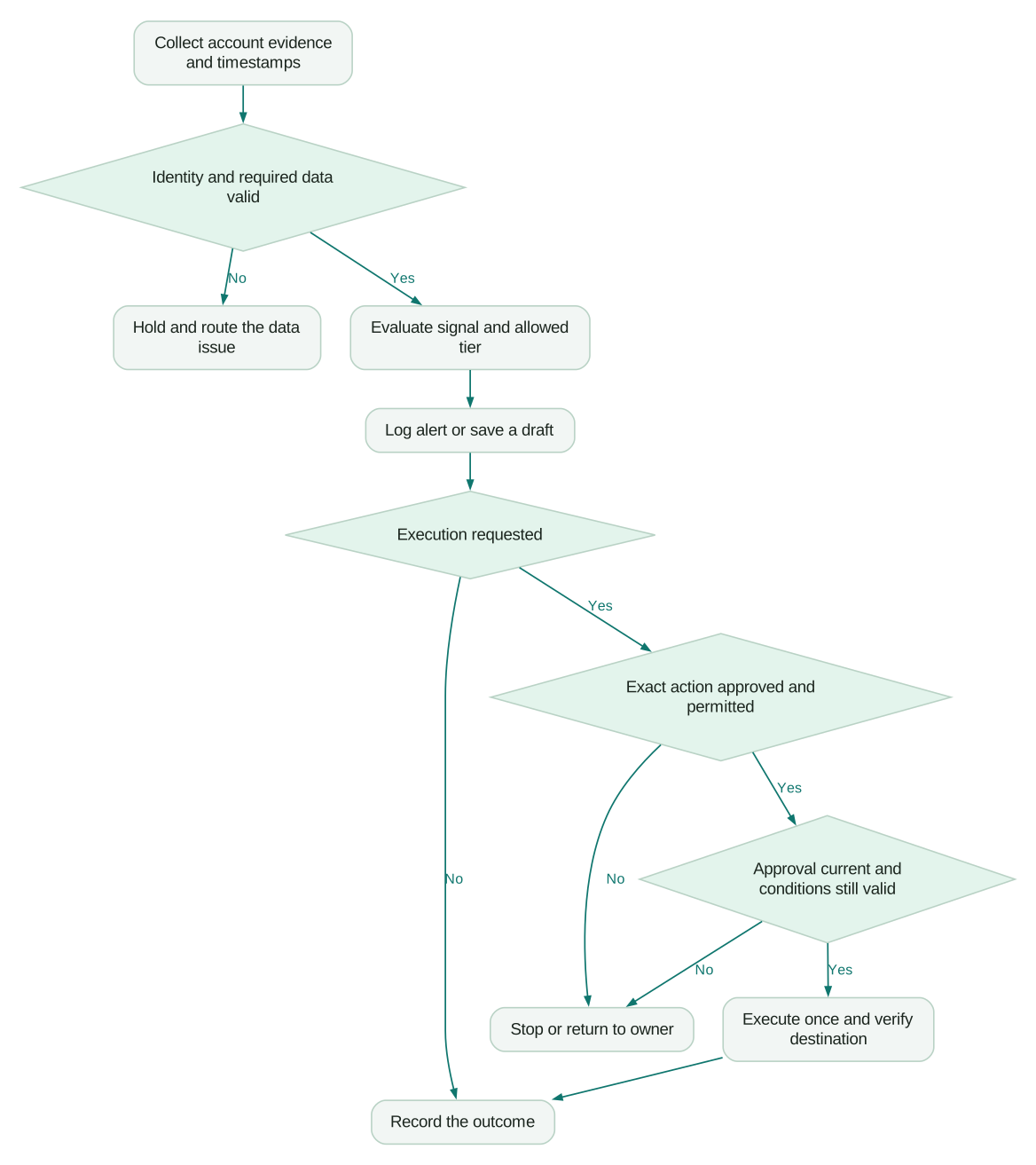
What do the assistant’s approval controls cover?
ChatGPT’s custom Model Context Protocol (MCP) connections ask for confirmation on write actions by default; tools without a read-only annotation are treated as writes. A user can remember an approve or deny decision for that conversation. Treat that convenience setting separately from your account-specific approval record. OpenAI custom MCP guide.
Claude connector tools can be set to Always allow, Needs approval or Blocked. Source permissions still matter, particularly when a custom connector uses a shared credential: that credential’s access can be broader than the individual’s usual access. Claude connector controls.
n8n can pause before a selected agent tool runs and present its parameters to a reviewer. Approval executes the proposed input; denial cancels that action. Put the current-state validation inside the approved execution path so a long wait cannot bypass it. n8n human review for tools.
What should the agent recommend for a struggling forty-seat account?
It should prioritise the unresolved service problem, coordinate with billing and hold the expansion offer. The following fictional account demonstrates how several observations produce one coherent owner brief rather than several competing automations.
All figures are illustrative. Weekly activity windows have equal length, the entitlement remains forty seats, and the usage source is complete through yesterday.
| Observation | Evidence | Interpretation | Next step |
|---|---|---|---|
| Adoption fell | Active seats declined from 32 to 19 over four weeks | 13 fewer active seats; a 40.625% decline | Ask whether the support incident explains the lost use |
| Service is blocked | A priority-one (P1) ticket has remained open for nine days | The customer has an unresolved severe problem | Alert the account and support owners together |
| Renewal approaches | Renewal is in sixty days | Commercial follow-up depends on notice terms | Check the contractual deadline and current renewal episode |
| Payment needs attention | Invoice remains unpaid after a recorded second attempt with a soft decline | Recovery may already be running | Leave retry and reminder ownership with billing |
| Contact changed | Billing administrator changed last week | Old recipient information may be unsafe | Verify the new contact before proposing a CRM update |
Seat utilisation fell from 32/40, or 80%, to 19/40, or 47.5%. That is a fall of 32.5 percentage points. Keep it separate from the 40.625% relative drop in active seats; either number without its denominator can mislead the account manager.
The owner brief could read:
Hold the expansion offer. The account has a nine-day P1 incident and thirteen fewer active seats than four weeks ago. Ask support for the recovery plan, then review a check-in focused on that blocker. Billing already owns the unpaid invoice. Verify the changed billing contact before any payment-related message or CRM update.
Attach the ticket, invoice and account references plus their observation times. Avoid placing sensitive payment details in a broadly visible task. The customer-facing draft should discuss the relevant support issue and agreed next step, without exposing an internal risk score or guessing that the customer intends to cancel.
Now change one input: usage data is three days old, beyond this fictional workflow’s twenty-four-hour freshness limit. The agent should remove the adoption conclusion from the recommendation, flag the stale feed and retain the independently current incident and billing evidence. It can still alert on those facts. It must not turn missing recent activity into a fresh usage collapse.
Where should the agent read the account context?
Use a governed account model for repeatable calculations, then read volatile source records again at action time. A warehouse, a customer context service or an existing customer success platform can supply the model; its suitability depends on identity, evidence access and ownership.
Start with daily usage aggregation for account trends when a daily cutoff gives the owner enough time to act. Choose a shorter interval only when the workflow needs it and the source can sustain it. Payment and support status need a fresh lookup before the proposed action; a nightly account snapshot cannot establish that an invoice is still unpaid or an incident remains open.
Do not force a one-to-one relationship across every system. One company can have several workspaces, subscriptions or support organisations. Define the commercial account key and retain those relationships explicitly. Aggregate usage at the intended level and quarantine ambiguous matches instead of attaching one customer’s unpaid invoice to another customer’s record.
Each signal needs an observation window, a completeness cutoff, a retrieval time and a source reference. A warehouse load finishing at 10:00 does not prove that yesterday’s product events all arrived. Distinguish a trustworthy zero, missing data and an expired observation in both the model and the owner interface.
Give each writable field one authoritative producer. The post-sales agent may propose a contact correction, but it should not compete with a product sync, an enrichment workflow and a human owner for the same field. Resolve the ownership first and let the agent call the approved change path.
Choose a platform agent or a custom implementation around that operating model. A native platform is attractive when the relevant records and owners already live there. A cross-system agent is useful when the decision depends on product, billing and support evidence that the native workflow cannot reliably join. Keep the output in the queue the team already works.
How do you measure whether the agent is helping?
Measure useful decisions and prevented mistakes before attributing retained revenue. Replay historical accounts using only evidence that would have been available at each decision time, then run a bounded live review period with clear denominators.
A backtest of churned or contracted accounts from the last two quarters can estimate how often a signal appeared and how much lead time it provided. Include accounts that remained healthy as well. Testing only losses cannot tell you how many healthy accounts the same rule would incorrectly flag.
The following fictional audit has 200 eligible accounts, including twenty later losses. Its event dates, eligibility and outcome window are fixed before evaluation.
| Measure | Calculation | Example result | What it tells you |
|---|---|---|---|
| Loss detection coverage | Loss accounts flagged in time / all loss accounts | 12 / 20 = 60% | How many observed losses the rule could have surfaced |
| Loss precision | Flagged accounts with a later loss / all flagged accounts | 12 / 40 = 30% | How often a flag precedes the defined loss outcome |
| Healthy-account flag rate | Flagged healthy accounts / all healthy accounts | 28 / 180 = 15.6% | The investigation burden among accounts without that outcome |
| Owner acceptance | Alerts accepted as actionable / alerts raised | 30 / 40 = 75% | Operational usefulness, not prediction accuracy |
| Review workload | Alerts multiplied by average review time | 40 × 6 minutes = 240 minutes | Four hours of review for the observation period |
Those measures answer different questions. An owner may accept a support alert on an account that never churns because resolving the problem is useful. A subsequent renewal also does not prove that the alert caused it. If the team needs a predictive risk model, predicting and preventing churn with AI covers the labels, evaluation and intervention design behind that separate decision.
Report abstentions separately: how many eligible accounts could not be evaluated because identity or required data failed? Calculate lead time from the first valid, actionable signal to the relevant deadline, and show its distribution. A warning one day after the notice deadline has no preventive lead time even if it precedes the renewal date.
During rollout, set a weekly alert ceiling per customer success manager and a response owner for urgent overflow. Record dismissals with specific reasons: incorrect join, stale source, duplicate episode, already handled or insufficient value. Use these cases to evaluate the agent before release and maintain regression tests as policies change.
For retained revenue or expansion lift, compare equivalent eligible groups with a suitable holdout and an agreed outcome window. Do not count an account’s full renewal value as incremental revenue because the agent created a task. Trace every alert and action so the commercial analysis can distinguish recommendations, approvals, executions and verified outcomes.
What should be ready before the first customer-facing action?
Launch when the evidence can support a decision, the owner can reject it and the execution path can stop safely. A useful pilot starts with a small account population and a complete operating loop.
Checklist
- Each signal has a source owner, a decision owner, a freshness limit and an expiry rule.
- Account relationships have a declared grain, and ambiguous identity matches are held.
- Zero, missing and stale observations produce different outcomes.
- Internal alerts have episode deduplication, urgency and a manageable volume limit.
- Customer-facing changes bind approval to an exact payload and named recipient.
- Payment, incident, contact and recent communication state are rechecked before execution.
- Historical tests include healthy accounts and point-in-time evidence, not only churn cases.
- A person can pause writes while preserving the evidence needed to investigate.
- Execution records include destination verification and a clear owner for uncertain outcomes.
At Martechdevs, we build post-sales agents on the CRM, billing and product data you already have, with approvals and a handover your team owns. Start with a free martech AI audit to identify the first useful account workflow and the data or ownership gaps that would prevent it from working.
Questions people ask
How should the agent handle a newly launched account with no usage baseline?
Place it in a new-account cohort rather than comparing it with mature customers. Use agreed onboarding milestones and the expected time to first value until enough complete observations exist. Record the baseline as unavailable, not zero. The owner should decide when the account graduates to trend monitoring, especially when procurement or implementation delays make the first weeks unrepresentative.
What if two teams disagree about the severity of the same incident?
Keep the original severity and source visible, then route the disagreement to the person authorised to resolve it. Do not let the model average incompatible labels into a new priority. The commercial brief can explain the differing evidence and customer impact. Until ownership resolves the conflict, hold actions whose appropriateness depends on the disputed severity, such as an expansion message.
Should a parent company’s healthy usage offset a subsidiary’s warning?
Only when the commercial agreement and operating model make that aggregation meaningful. Keep subsidiary observations available even if the parent receives one summary. A healthy subsidiary can hide another unit’s unresolved blocker in a combined average. Route local issues to their owners and reserve the parent view for decisions made across the group, such as a consolidated renewal.
How should the agent track a recovery commitment that support postpones?
Keep the original promised date, the revised date, the reason and the person authorised to communicate the change. Alert the account owner when the customer’s expectation is no longer achievable. The agent can draft an update grounded in the approved recovery plan, but it must not invent a replacement deadline or treat an internal estimate as a customer commitment.
Can feedback from account managers train the agent automatically?
Capture feedback immediately, but promote changes through a reviewed policy or evaluation process. An accepted alert may reflect a manager’s workload or relationship knowledge rather than a universally better rule. Keep the original evidence, dismissal reason and policy version. Test proposed changes against previous failures and healthy accounts before expanding authority or changing which customers receive outreach.
Sources
- Stripe, Smart Retries
- US Bureau of Labor Statistics, Employee tenure in January 2026, released 24 September 2026.
- Anthropic, Building effective agents
- OWASP, Excessive agency
- OpenAI, Custom MCP server connections
- Anthropic, Claude connector controls
- n8n, Human review for tools

Written by
Jafrin Akter AloData Engineer and Co-founder at Martechdevs and Growth and Analytics Partners
Jafrin writes practical guides to marketing technology, customer data, analytics and AI workflows. Martechdevs is a Growth and Analytics Partners company.