
Segment Implementation Mistakes: Fix Identity, Duplicate Events and Delivery Gaps
A reliable Segment implementation needs more than events appearing in the debugger. Define stable identities, assign each business event an authoritative producer, validate schemas on every delivery path and verify the final destination result. Most expensive mistakes happen between those steps: the payload arrives, but it describes the wrong person, repeats a transaction or never becomes usable downstream.
On this page
For a growth team, the symptom might be an inflated activation rate. For lifecycle marketing, it might be an onboarding message sent to an existing customer. For finance, it might be revenue that disagrees with the order system. These problems need an event-level investigation, not another dashboard filter.
Start with one journey that matters commercially, such as signup to first paid order. Document the expected identity and event at each stage. The tracking plan guide helps define that contract; this article focuses on the implementation failures that survive a superficially successful installation.
Why should the permanent user identifier survive an email change?
An email address can change. Shared addresses, account transfers and normalization differences also make it a weak permanent identifier. Segment recommends a stable identifier from your own system, with email stored as a trait rather than the primary identity. The identification guidance explains the relationship between userId, anonymousId and traits.
Use the application's durable user identifier (ID) for the person. Keep account or workspace identity separate. A user who belongs to two workspaces remains one person participating in two account contexts; changing their user ID to the active workspace ID destroys that distinction.
For a business-to-business (B2B) event, a useful contract might include userId for the actor and an account_id property for the workspace in which the action happened. Decide separately whether a destination needs a Group call or a mapped account relationship. Do not assume that adding a property automatically creates the destination's account model.
Our analytics implementation work treats identity and event ownership as design decisions before enabling destinations. That order prevents teams from building campaigns on identifiers they later need to replace.
Test the lifecycle of the identifier
Use a test user who changes their email, switches workspaces, logs out and returns on another device. Record the expected IDs after each action. The email change should not create a new application user; the workspace switch should change the account context without replacing the person.
For anonymous-to-known transitions, inspect the emitted payloads and the destination's resulting profile. Passing the right IDs to Segment is necessary, but each destination's identity behavior still needs verification. See the identity resolution guide for the wider model.
What should analytics reset when a user logs out?
Reset the relevant analytics identity as part of logout, then verify each downstream tool separately. If the application clears its session while analytics retains the previous identity, the next visitor on the same browser can inherit that identity in subsequent events. Include analytics state in the logout design.
Analytics.js reset clears Segment's stored IDs and traits, including anonymous identity. It does not clear every integrated vendor's cookies or state. Segment also documents the need to reset separately across subdomains because its local storage is not shared between them. The Analytics.js reference describes these boundaries.
Test a shared-browser sequence: user A logs in, completes an action, logs out, then user B logs in. Inspect both Segment payloads and downstream profiles. Include any customer-support widget, replay tool or advertising library that maintains its own state.
Do not “reset” by assigning all logged-out visitors a common user ID such as guest. That creates a shared identity for unrelated activity. If your product supports deliberate account switching without logout, write a separate test for that path rather than assuming the ordinary logout test covers it.
How do you stop browser and server events counting the same order twice?
Choose one authoritative producer for the completed business outcome, and distinguish it from a browser observation. A browser can observe a confirmation page. A server can confirm that an order was accepted. If both emit Order Completed without a coordinated design, two technically valid messages can describe one purchase.
The browser may still emit a separate confirmation-view event for user-experience analysis. Make that distinction visible in the event names and downstream mappings.
Consider a fictional USD 120 order reported by two producers. Values are in USD major currency units; these are local diagnostic inputs, not events sent to Segment.
| Transport message | Producer | Source order | Reported value, USD |
|---|---|---|---|
| browser_1 | Browser confirmation page | order_42 | 120 |
| server_1 | Server order acceptance | order_42 | 120 |
Distinct message IDs do not establish distinct orders. Counting both would report USD 240 for one USD 120 purchase.
Keep transport identity and business identity separate. Segment's common fields include messageId for a message; your order_id represents the commercial object. The event specification documents the envelope. Define which fields identify a purchase, refund, payment attempt or subscription change in your own contract.
A small diagnostic can reveal the problem
The following illustrative Structured Query Language (SQL) query assumes an events table with event_name, message_id, order_id and revenue. Adapt the query to your warehouse dialect and schema, then check the synthetic two-message fixture before investigating real orders. It identifies repeated order-completion records; it does not prove that every repeat is safe to delete. The fixture uses one currency. For mixed-currency data, restrict the query to one currency or add currency to the grouping before interpreting the summed amount.
SELECT
  order_id,
  COUNT(*) AS event_rows,
  COUNT(DISTINCT message_id) AS message_ids,
  SUM(revenue) AS reported_revenue
FROM events
WHERE event_name = 'Order Completed'
GROUP BY order_id
HAVING COUNT(*) > 1;
For the two-message fixture, the query returns one grouped row for order_42: event_rows is 2, message_ids is 2, and reported_revenue is USD 240. Investigate producer, retry and mapping behavior before deciding whether the repeated records represent a duplicate or a legitimate revision. Multiple missing order IDs also group together, so inspect those as missing identity rather than declaring them one duplicated purchase.
A simplistic DISTINCT on revenue is unsafe. Two different orders can have the same amount. A simplistic order_id-only rule is also wrong for payment-attempt events because one order may have several genuine attempts. Deduplication belongs to the event's business meaning.
Which schema controls apply to each delivery route?
Match the control to the actual delivery route, and confirm your workspace's Protocols access and connected tracking plan before relying on enforcement. The schema-control reference documents different scopes.
| Control | Documented supported route | Boundary to test |
|---|---|---|
| Block unplanned Track events | Analytics.js device and cloud mode; mobile libraries in cloud mode | Mobile device delivery is outside this stated scope |
| Omit unplanned properties or traits | Cloud-mode and storage destinations | Device-mode payloads are not cleaned by this control |
| Block common JavaScript Object Notation (JSON) schema violations | Cloud-mode and storage destinations | Invalid device-mode events are not blocked by this rule |
That means a cloud-side rule is not a universal guarantee that a browser destination never receives an unwanted property. Validate what leaves each actual route. Where a field must never be sent, prevent its collection or remove it before the relevant delivery path, rather than relying on an unsupported downstream control.
Define and map event names for each destination before enforcing the shared contract. A destination mapping is a separate boundary to verify.
Introduce enforcement deliberately. First observe violations against representative traffic. Classify them as instrumentation defects, legitimate new events or an outdated plan. Fix the contract, then test blocking with known valid and invalid specimens.
For example, send Order Completed with numeric revenue and a currency, then send a specimen with revenue as a string. Record what Segment accepts, what each mapping sends and what the destination stores. A green schema status is useful only when you understand which events and routes it covers.
Keep test traffic clearly separated from production decisions. A validation exercise should not trigger a real welcome campaign, conversion bid signal or account update.
Why is buffering an event different from consent-aware collection?
Buffering changes when data is transmitted; it does not decide whether collecting or later sending that data is permitted. The AnalyticsBrowser implementation can buffer calls before load and flush them when loaded. This can help control initialization, but delaying the network request does not by itself establish that earlier events should later be sent. The load behavior needs to be considered alongside your actual consent design.
Define the desired behavior for unknown, denied, granted and withdrawn states. Decide which event producers may run in each state and what happens to queued data when the state changes. The implementation should follow the organization's approved policy; this is an engineering test specification, not a legal conclusion.
Use browser network inspection and destination inspection together. Test a fresh visitor who declines, a returning visitor with a stored choice and a visitor who changes their choice during a session. Repeat for both device-mode libraries and server-routed events.
Avoid interpreting a missing marketing event as a tracking defect until you know whether it was intentionally excluded. A report that separates policy exclusions from technical failures is more useful than a single delivery percentage.
Which timestamp should represent the customer action?
Use the timestamp whose authority matches the business measure, and retain receipt time for delivery diagnostics. A queued mobile action, delayed network request or replay can arrive long after the action occurred. Segment distinguishes originalTimestamp, sentAt, receivedAt and its calculated timestamp. The current specification also notes software development kit (SDK) behavior for offline queues in Swift, Kotlin and C# libraries, where the calculated timestamp can be closer to receipt than the original action. The timestamp documentation explains the limits.
Preserve an authoritative business timestamp where you have one, such as the server's order-acceptance time. Do not replace every timestamp with that field indiscriminately: a screen view and an accepted payment have different authorities.
An illustrative action at 23:58 on Monday, delivered at 00:07 Tuesday, belongs to different daily buckets depending on the chosen field. Write down the intended report timezone and the field used for the business measure. Retain receipt time separately to measure pipeline delay.
This distinction also affects activation windows and lifecycle eligibility. A user who completed onboarding before the cutoff should not enter a reminder merely because the event arrived late. The late-arriving data guide explains how to handle those corrections downstream.
What does the debugger prove about destination delivery?
The source debugger is a sampled diagnostic view of incoming events. It is not a complete event ledger or proof that every destination processed the data. Segment's debugger documentation describes its role.
For cloud-mode connections, use Delivery Overview to distinguish ingestion failures, source filtering, destination filtering, pending retries and delivery failures. Its visibility does not extend to device-mode traffic sent directly from the client. The delivery guide explains that boundary.
Then verify the business result in the destination: the correct profile, field, event, audience or conversion. A successful Hypertext Transfer Protocol (HTTP) response is not the same as the desired campaign eligibility or report value.
For cloud-mode integrations, Segment's Event Tester requires workspace write access and can inspect requests and responses across enabled mappings. The Mappings Tester focuses on one mapping. These tests send real events to the destination, so use an appropriate test environment or clearly isolated test records. The testing guide documents the behavior.
What does an end-to-end acceptance test look like?
Choose a single synthetic customer and an unmistakable order ID. Exercise signup, identification, account selection, purchase, email change and logout. Capture the expected event count, amount, identity, destination field and timestamp at every stage. Confirm whether you need a customer data platform (CDP), a warehouse or both so each tested stage has an explicit owner.
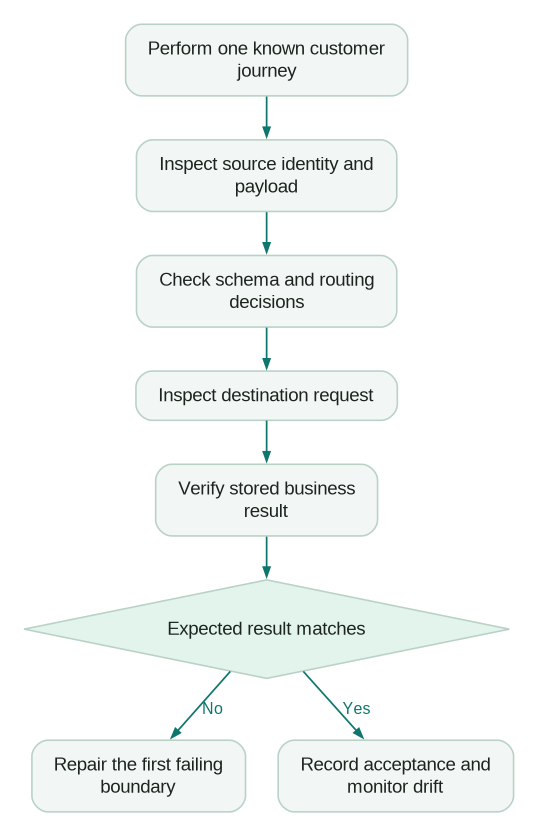
Read diagram as text
- Perform one known customer journey to Inspect source identity and payload.
- Inspect source identity and payload to Check schema and routing decisions.
- Check schema and routing decisions to Inspect destination request.
- Inspect destination request to Verify stored business result.
- Verify stored business result to Expected result matches.
- Expected result matches to Repair the first failing boundary: No.
- Expected result matches to Record acceptance and monitor drift: Yes
For a purchase journey, reconcile three counts: accepted orders in the application, authoritative purchase events and destination purchase records. Explain exclusions and timing differences before comparing totals. A daily grand total can conceal a missing order offset by a duplicate.
Checklist
- Stable user and account identifiers survive email changes and account switching.
- Shared-browser logout tests keep the next user's activity separate.
- One authoritative producer owns each commercial outcome.
- Duplicate and retry specimens produce the intended business count.
- Valid and invalid schema specimens have been checked on each delivery mode.
- Consent-state transitions follow the approved collection and routing rules.
- Late events use the intended business time and reporting timezone.
- The final destination record matches the source business transaction.
Keep these specimens with the tracking plan. Reuse them when testing a Segment replacement, so the new collection path must demonstrate the same destination results. Re-run the relevant ones when a library, mapping, consent flow or identity rule changes. That gives the team a concrete way to detect regressions without relying on someone noticing a strange dashboard weeks later. Keep monitoring drift after the acceptance test, including ownership of alerts and evidence that repairs reached the downstream result.
Want a second pair of eyes on your stack? Get the $99 martech audit. For a defined repair, request a detailed Segment implementation scope with the failing journey, producer, delivery routes and expected destination evidence.
Keep reading
Browse all Data Warehouse guides
 Data Warehouse
Segment Pricing: Twilio Segment Plans, MTU Costs and How to Control Them
Segment pricing explained: the Free plan, Team from USD 120 a month for 10,000 MTUs, Business quotes, extra usage meters and how to cut avoidable MTU spend.
Jafrin Akter AloLast updated 13 min read
 Data Warehouse
mParticle vs Segment: Identity, Event Routing and CDP Cost
Compare mParticle vs Segment by identity strategy, consent-aware outputs, event routing and CDP scope, with practical tests and clearly scoped cost examples.
Jafrin Akter AloLast updated 12 min read
 Data Warehouse
Segment vs Hightouch: Choose the CDP Around Your Customer Model
Compare Segment and Hightouch on customer models, complete CDP costs and activation. Use a 25,000-user budget, one-audience pilot and controlled migration plan.
Jafrin Akter AloLast updated 16 min read
Twilio Segment implementation
See the setup scope, acceptance checks and handover.
Questions people ask
How should an event name change be rolled out across producers?
Version the contract and list every producer, mapping, report and journey that depends on the old name. Decide whether to translate the old event, migrate consumers or run a clearly labelled compatibility period. Test both versions without counting the same business occurrence twice. Keep a retirement date and an owner for older producers so a renamed event does not silently disappear from one destination.
What should happen if an unintended personal-data field reached a destination?
Contain the relevant producer or route, preserve the minimum diagnostic evidence needed to identify the affected field and records, and involve the responsible data owner. Check each destination separately under the organization's approved remediation process. Blocking future delivery does not establish that earlier copies were removed. Re-test the corrected collection path before resuming it, without reproducing the exposure in ordinary test traffic.
How should order-level revenue be checked when line items are also sent?
Keep the order total at one order-level grain and treat line items as a related detail dataset. Document whether item values include discounts, tax and shipping before attempting a reconciliation. Joining the full order amount to every item can multiply revenue even when each event was delivered once. Test a multi-item order and an adjusted item, then reconcile the intended totals without summing repeated order values.
How should older mobile-app versions be handled after a schema change?
Identify which supported versions still emit the older contract before enabling enforcement. Keep compatible interpretation where necessary, or route those versions through a documented transition while the product team manages adoption. Test actual old payload specimens against current mappings. A valid event under yesterday's app contract should not become an unexplained delivery failure because the tracking plan changed ahead of the installed user base.
What if the event evidence has expired before an incident is investigated?
State which records are unavailable and avoid treating the missing logs as proof that delivery succeeded or failed. Reconcile retained source and destination records, then reproduce the relevant condition with an isolated current specimen where appropriate. Preserve the distinction between that reproduction and the historical incident. Adjust future evidence retention around the business investigation window and permitted data handling, rather than promising a reconstruction you cannot substantiate.
Sources

Written by
Jafrin Akter AloData Engineer and Co-founder at Martechdevs and Growth and Analytics Partners
Jafrin writes practical guides to marketing technology, customer data, analytics and AI workflows. Martechdevs is a Growth and Analytics Partners company.