
LinkedIn Conversions API for B2B SaaS: connect campaigns to qualified outcomes
LinkedIn Conversions API sends verified business outcomes to LinkedIn for matching and advertising attribution. For business-to-business software-as-a-service (B2B SaaS) teams, connect campaigns to genuine qualification, opportunity or customer milestones. Define the customer relationship management (CRM) outcome, retain its original time and make delivery traceable. Then distinguish a successful upload from an attributed conversion and a commercially useful result.
On this page
Which business outcome should you send to LinkedIn?
Send a verified milestone that the campaign team can use to evaluate lead quality. The CRM system should identify who qualified, why and when.
A form submission tells you someone submitted a form. It does not establish that they fit your product, have a buying problem or entered a sales process. Feeding only form submissions back to an advertising platform can leave the marketing team judging campaigns on a different outcome from the one sales cares about.
Choose a milestone your team can verify. For example: a sales rep accepts a qualified opportunity after confirming the account fits your service and the buyer has a relevant project. Define the required evidence, who records it and when that decision becomes final enough to send.
Our analytics and tracking implementation starts with that outcome and follows it through identity, delivery and reporting.
Keep the earlier lead event if it remains useful, but give each stage its own meaning. Do not rename all leads “qualified” to increase the number of conversion signals.
Before building, answer four questions:
- Which business change should produce one event?
- Which entity reaches that milestone: a person, account or opportunity?
- Where is the original occurrence time recorded?
- What action will the campaign team take differently with this information?
If the CRM cannot distinguish a genuine qualification from a bulk cleanup, fix that first. The lead-scoring guide helps separate fit, intent and demonstrated qualification. A score crossing a threshold is only a useful conversion definition when the threshold represents an outcome the business trusts.
Which integration route fits the outcome?
Use the native route for a matching contact-lifecycle workflow, a supported partner for an appropriate maintained connector, or a direct API for business logic your team must control. Compare their handling of data and failures, not just the number of setup steps. Compare server-side and server-to-server routes by the data controls and operating work each requires.
A connector subscription does not by itself establish the required fields or sharing eligibility.
| Route | Good starting fit | Control to verify | Work your team still owns |
|---|---|---|---|
| HubSpot native | Contact lifecycle-stage transitions | Marketing Hub entitlement, mapped stage and data-sharing settings | Correct stage history and one intended counting unit |
| Supported partner | A maintained connector covers the required source | Actual objects, occurrence time and replay support | Outcome definition and reconciliation |
| Direct API | Opportunity-specific logic or a governed delivery ledger | Advertiser token or approved partner access | Authentication, mapping, recovery and version updates |
HubSpot's native conversion events
HubSpot's native guide lists Marketing Hub Starter, Professional and Enterprise, with up to 5, 50 and 100 ad conversion events respectively. Only lifecycle updates after the conversion event is created count through this configuration. Review the mapped LinkedIn type, shared fields and consent-property setting. An optional consent-mapping field does not remove the underlying sharing obligation, and an old qualified-contact list is not automatically a backfill.
This route is useful when your agreed outcome really is a contact lifecycle transition. It becomes less straightforward when your commercial truth lives on opportunities, several contacts belong to one deal, or the same person can participate in different purchases.
For example, changing three contacts at one company to “Customer” does not necessarily mean three new customer accounts. Decide the counting unit before mapping the event.
A supported partner connection
A connector can reduce the infrastructure you maintain. Inspect which objects and changes it supports, whether it preserves occurrence time, how it records failed deliveries and whether you can replay one event safely. Ask to see the actual field mapping before assuming that “CRM integration” includes your opportunity-stage logic.
LinkedIn distinguishes advertiser and partner access routes in its Conversions API overview. Use the route appropriate to the integration. An advertiser implementing its own connection should not assume it needs to complete the same onboarding as a vendor building a product for many advertisers.
A direct connection from your application or warehouse
Choose a direct integration when you need explicit opportunity logic, controlled identity mappings or a delivery ledger your team owns. Budget for authentication, monitoring, API changes and failed-event recovery as part of the implementation.
An advertiser can generate a Direct API access token in Campaign Manager under Measure, Signals manager and Direct API. Store it in the server's secret-management system. LinkedIn's Direct API instructions explain token creation and conversion setup. Never put the token into a website tag, client bundle or shared spreadsheet.
For Salesforce or another CRM, treat the following as a design pattern: consume the relevant recorded stage change, resolve the associated person under your chosen rule, construct the event and send it through the selected connection. Confirm the available change-history mechanism in your own CRM setup. Polling today's stage without retaining previous state can turn every daily sync into another supposed qualification.
Treat eligibility, delivery and attribution as separate checks. Preserve the original business-event identity and occurrence time through recovery, then inspect the completed reporting period before explaining a conversion gap.
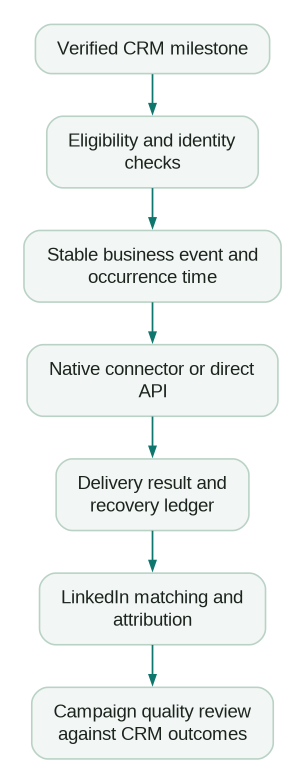
Read diagram as text
- Verify the CRM milestone entity and original occurrence to Identity and current sharing eligibility are valid?.
- Identity and current sharing eligibility are valid? to Hold delivery and record the eligibility reason: No.
- Identity and current sharing eligibility are valid? to Send the stable event through the verified route: Yes.
- Send the stable event through the verified route to The recorded delivery response confirms acceptance?.
- The recorded delivery response confirms acceptance? to Inspect failure or uncertainty and recover with the same identity: No.
- Inspect failure or uncertainty and recover with the same identity to Identity and current sharing eligibility are valid?.
- The recorded delivery response confirms acceptance? to Check matching campaign association timing and deduplication: Yes.
- Check matching campaign association timing and deduplication to The completed reporting difference is explained?.
- The completed reporting difference is explained? to Investigate the affected checkpoint and retain the gap: No.
- Investigate the affected checkpoint and retain the gap to Check matching campaign association timing and deduplication.
- The completed reporting difference is explained? to Review campaign quality against comparable CRM outcomes: Yes
What should the CRM conversion contract contain?
Specify the outcome, counting entity, occurrence and allowed delivery state before mapping fields. A useful conversion contract contains:
- Outcome: the exact stage transition and evidence required.
- Entity: the opportunity or contact that qualifies under your counting rule.
- Episode: the particular occurrence when repeated qualification is legitimately possible.
- Occurred at: the recorded time of the milestone, with a known timezone.
- Identity: the eligible person's identifiers and their relationship to the entity.
- Delivery state: pending, accepted or failed, with a reason and attempt history.
Suppose opportunity opp_1042 first becomes sales-qualified on Monday. A Tuesday retry must carry the same business-event identity and Monday's occurrence time. Updating the opportunity amount on Wednesday should not create another qualification unless your written definition deliberately says it should.
If the opportunity moves backwards and later qualifies again, decide whether that is a correction or a new episode. Make the rule consistent across the warehouse and CRM. A platform cannot infer your intended business semantics from a stage label.
Resolve the person deliberately, too. The opportunity owner is your employee, not the buyer. A generic billing address is not necessarily the contact who interacted with an ad. Do not send an event for every associated person just because the CRM provides a list of contacts.
For an account-level outcome, retain the account and opportunity relationships in your own analysis even when the delivery payload represents a person. Our single-customer-view guide covers the identity relationships needed to avoid confusing people with customer accounts.
What must the direct API setup contain?
A direct setup needs an authorised caller, a conversion rule, campaign associations and a correctly formed event. LinkedIn's API implementation guide requires a conversion rule, campaign associations and streamed events. These are separate checks. An accepted event cannot receive campaign credit through an association that does not exist.
For the documented partner OAuth route, confirm rw_conversions, r_ads and an eligible ad-account role. Keep that distinct from an advertiser-generated Direct API token.
Create the rule with the correct account, outcome type and CONVERSIONS_API method. Review the actual associated campaigns after creation, including any automatic association. Do not assume that selecting an automatic mode covers every campaign you might want to evaluate.
Direct requests also require the documented authentication and version headers, including Linkedin-Version and X-Restli-Protocol-Version. Use a currently supported API version and assign responsibility for upgrading it. Copying an old tutorial's version indefinitely is a maintenance failure waiting to happen.
This illustrative payload represents one fictional opportunity milestone. The rule ID and event identity are examples. The hash represents the reserved example address ada.example@example.com; replace all example values through your validated mapping.
{
  "conversion": "urn:lla:llaPartnerConversion:123",
  "conversionHappenedAt": 1791799200000,
  "eventId": "opp_1042:sql:episode_1",
  "user": {
    "userIds": [
      {
        "idType": "SHA256_EMAIL",
        "idValue": "c9a113580a216ed5b18c6a941ff6735df99a072d83c0ec780487e7bbad894d5f"
      }
    ]
  }
}
The timestamp represents 12 October 2026 at 10:00 UTC. LinkedIn expects milliseconds since the Unix epoch. Email identifiers use lowercase, whitespace-free input followed by SHA-256 hashing to hexadecimal. Follow the current event schema for your chosen identifiers.
Do not apply another platform's email transformations automatically. Preserve the original CRM record and create destination-specific representations at the delivery boundary. Hashing the already-hashed value again produces a different identifier, even though the result still looks like a valid hash.
Keep personal data out of event IDs, job names and routine error logs. Record enough information to trace an internal outcome without making every operational surface a copy of the customer's details.
When should browser and server events share an event ID?
Two events require deduplication when they represent the same business occurrence. A website submission and a qualification three weeks later are different outcomes. They should not share an event ID merely because they concern the same person.
For an outcome sent through both Insight Tag and Conversions API (CAPI), LinkedIn documents separate conversion rules for the browser and server sources. Send the same eventId for the corresponding occurrence in the same ad account. When LinkedIn identifies that pair, it counts the Insight Tag event and removes the redundant CAPI event from campaign reporting. Follow the LinkedIn deduplication implementation.
CAPI therefore may show lower reported counts when browser and server coverage overlap correctly. A target of equal browser and server attributed totals would be the wrong acceptance criterion.
Your own sender still needs retry controls. Store whether an outcome was queued and its previous delivery result. A timeout is not proof the remote system received nothing. Preserve the event identity when retrying, use the documented response semantics, and investigate recurring failures instead of generating fresh IDs until one appears successful.
Use these controlled acceptance cases. Each row describes the intended business counting rule, not a guarantee that the member will match an eligible ad interaction.
| Case | Event identity | Expected interpretation | What to inspect |
|---|---|---|---|
| Browser only | One occurrence ID | One represented outcome | Browser rule and associated campaigns |
| Server only | One occurrence ID | One represented outcome | Accepted server event and match diagnostics |
| Browser and server, same outcome | Shared ID for the corresponding pair | Browser event retained in campaign reporting | Same ad account and both source rules |
| Submission followed by qualification | Different IDs for different milestones | Two distinct business facts | Correct stage, type and original occurrence time |
Compare how Meta CAPI handles the same deduplication problem when maintaining both platforms. Reuse the business definition while implementing each destination's own matching fields and rules.
How do event age, attribution windows and reporting delay differ?
Treat event age, the ad-interaction lookback and reporting delay as three separate checks. A long sales cycle does not justify replacing an old milestone time with today’s upload time.
Days and hours below describe different clocks; they cannot be substituted for one another.
| Clock | What it measures | Implementation decision |
|---|---|---|
| Event age | Time since the business milestone | Send a genuine recent outcome, not a rewritten timestamp |
| Attribution window | Time from eligible ad interaction to outcome | Inspect the saved click and view windows |
| Processing delay | Time from receipt to completed reporting | Reconcile a completed period before declaring events missing |
LinkedIn’s event schema requires an occurrence timestamp within the past 90 days. Attribution windows answer a different question: how far an eligible outcome can sit after an ad interaction. LinkedIn's conversion-window guidance allows 180- and 365-day windows for specified CAPI conversion types.
A five-month sales cycle does not mean you should hold an outcome in a queue for five months. Send the newly reached milestone promptly with its real occurrence time. Its potential relationship to an older ad interaction depends on the configured attribution window and other matching conditions.
Inspect the saved rule rather than relying on a general statement about defaults. LinkedIn's API schema lists 30-day click and seven-day view defaults, while HubSpot's integration guide describes a 90-day default for its configuration. HubSpot also directs users to Campaign Manager to adjust eligible longer windows. Those are route-specific instructions, not interchangeable settings. LinkedIn schema, HubSpot integration guide.
Keep window choices visible in the campaign review. A report using a longer view-through window answers a broader attribution question than a narrowly timed click-only analysis. Neither should quietly replace the company's customer and revenue records.
How do you reconcile delivery with campaign reporting?
Reconcile the CRM milestone, transport, platform processing and commercial report separately. Use four checkpoints:
- Business eligibility: the CRM contains a genuine milestone with the required identity and data-sharing eligibility.
- Delivery: the sender attempted the event and recorded the response correctly.
- Platform processing: matching, association, timing and deduplication determine whether the received event becomes attributable.
- Commercial analysis: the outcome joins to the correct account, opportunity and reporting cohort.
If CRM outcomes exceed reported conversions, identify which checkpoint explains the gap. Inspect individual examples across successful, failed and absent cases. “The API is working” is too vague to distinguish an unauthorised request from a valid event with no eligible ad interaction. Allow for processing: LinkedIn's Conversions API FAQ describes up to 24 hours for ingestion and another 48 hours for reporting. Check completed periods before declaring recent events missing.
Useful failure questions include:
- Did the sender read a real transition or repeatedly export the current state?
- Was the person eligible for this destination under the configured sharing rules?
- Did an identifier change or disappear during the CRM-to-warehouse join?
- Does the payload reference the intended account's conversion rule?
- Are the relevant campaigns associated with that rule?
- Is the original time in milliseconds, and does it fall within the accepted range?
- Is the event already represented by a deduplicated browser event?
The rule's attribution model also affects totals. LinkedIn supports crediting each eligible ad set or the last eligible ad set. Inspect that setting before summing reports into a company-wide customer total. For most conversion types, repeated conversions by one member within the window are also counted differently from Purchase and Add to Cart events. These platform counting rules can differ from your CRM's distinct opportunity count. Attribution models, conversion-window counting rules.
How should qualified outcomes change the campaign decision?
Compare cost per consistently qualified outcome before choosing the campaign with the cheapest lead. In this fictional example, both cohorts have had equal time to mature and use the same qualification rule. The HockeyStack versus Dreamdata comparison separates company-level LinkedIn exposure, attributed credit and the conversion records sent back to the platform.
Hypothetical USD spend for the same completed cohort period. These are example inputs, not LinkedIn benchmarks.
| Campaign | Spend, USD | Leads / qualified opportunities | Cost per lead, USD | Cost per qualified opportunity, USD |
|---|---|---|---|---|
| A | 6,000 | 200 / 10 | 30 | 600 |
| B | 6,000 | 100 / 25 | 60 | 240 |
Campaign A's calculation is 6,000 ÷ 200 = USD 30 per lead and 6,000 ÷ 10 = USD 600 per qualified opportunity. B is 6,000 ÷ 100 = USD 60 and 6,000 ÷ 25 = USD 240. The lead-volume view makes A look cheaper; the qualification definition changes the decision.
Before reallocating budget, check that qualification is applied consistently, the cohorts have had comparable time to mature, follow-up quality is similar and the opportunities are commercially comparable. A campaign targeting larger enterprises may progress more slowly while creating greater value.
Do not attach full opportunity value to every stage and add the results as revenue. Qualification, pipeline creation and a won customer describe different milestones in the same possible purchase. If you assign an estimated value to a qualified lead, label the estimation method and keep it separate from contracted or collected revenue. Apply the same discipline to offline outcome imports for Google Ads and Meta, while keeping each destination’s payload and diagnostics separate.
CAPI gives you another measurement input. It does not prove the advertising caused every attributed opportunity. Use the attribution and incrementality guide when the decision is whether extra advertising spend creates extra business.
What should pass before the integration is complete?
Approve the integration when known outcomes, duplicates, exclusions and failures produce the expected evidence, with an owner for continuing operation.
Checklist
- Sales and marketing agree on the outcome, counting unit and requalification rule.
- The selected integration preserves the original occurrence time.
- Identity and sharing eligibility are checked before delivery.
- Conversion rules and campaign associations are verified in the intended account.
- Duplicate-source events share the correct occurrence ID; different milestones do not.
- Failed deliveries have an owner, a reason and a safe recovery path.
- Reporting shows the actual attribution settings and cohort maturity.
- API versions, credentials and connector changes have an operating owner.
An analytics and tracking implementation should leave a traceable path from the CRM milestone to the campaign report. That makes the integration useful for a budget decision and maintainable when your sales process changes. Get the $99 martech audit or request a detailed tracking scope with the CRM milestone and the campaigns it should inform.
Keep reading
Browse all Tracking & Attribution guides
 Product Analytics
AppsFlyer Implementation Mistakes: SDK Start, ATT, Postbacks and Revenue
Fix the AppsFlyer setup errors that distort ROAS: SDK start order, ATT waits, missing SKAN and AdAttributionKit postbacks, duplicate revenue and deep links.
Jafrin Akter AloLast updated 16 min read
 Tracking & Attribution
Google Ads conversion diagnostics: "setup is incomplete" and "needs attention" explained
Diagnose incomplete setup, inactive tags and enhanced-conversion alerts. Verify campaign goals, event delivery, offline uploads and the 2026 API changes.
Jafrin Akter AloLast updated 15 min read
 Tracking & Attribution
Meta Conversions API setup, with deduplication done correctly
Implement Meta Conversions API with reliable purchase events, matching and deduplication. Compare setup routes and validate browser and server records.
Jafrin Akter AloLast updated 10 min read
Analytics & tracking
See the implementation scope, deliverables and acceptance checks.
Questions people ask
What should happen to queued conversions when sharing permission changes?
Recheck the current eligibility rule before sending the queued event. Preserve the original outcome and permission evidence in the appropriate internal records, but do not treat earlier queue acceptance as continuing permission to share. If the event was already sent, follow the applicable destination and privacy process separately. Deleting a local queue item cannot retract data already delivered elsewhere.
How should a CRM opportunity merge affect conversion identities?
Keep the original sent-event identity and a crosswalk to the surviving opportunity. A CRM merge should not manufacture another qualification simply because the record ID changed. Review separate commercial episodes before consolidating their history, and retain the mapping needed to explain each delivered event. Correct internal reporting deliberately rather than replaying the full merged record as a new outcome.
What should be checked when a Direct API credential is replaced?
Verify the new credential against the intended advertiser account, update the controlled secret reference and test one permitted delivery before retiring the previous credential. Keep the event ledger independent of the token so a deployment does not reset completed work. Confirm that failed requests reach the responsible operator and that rollback restores access without creating new IDs for previously attempted outcomes.
Can two partners send the same CRM milestone to LinkedIn?
Choose one accountable delivery route unless both have a defined purpose and an explicit overlap design. Inventory each partner's conversion rule, source identity and replay behavior before enabling both. The same CRM record appearing in two integrations does not prove that their outputs represent one countable event. Reconcile the overlap with controlled examples and retain one internal ledger of the business milestone.
Should the campaign currency replace the original opportunity currency?
Preserve the original amount and currency in the CRM and reporting model. If the approved conversion-value policy requires another currency, record the rate, effective date and calculation used for that destination. Do not relabel an unchanged number with a different currency code. The multi-currency reporting guide explains how to keep native and converted values traceable without treating estimated pipeline as collected revenue.
Sources
- HubSpot: LinkedIn ad conversion events.
- LinkedIn: Conversions API overview.
- LinkedIn: Set up Direct API conversions.
- LinkedIn: Conversions API implementation.
- LinkedIn: Conversion rule and event schema.
- LinkedIn: Browser and server deduplication.
- LinkedIn: Conversion windows and counting.
- LinkedIn: Attribution models.
- LinkedIn: Conversions API FAQ.

Written by
Jafrin Akter AloData Engineer and Co-founder at Martechdevs and Growth and Analytics Partners
Jafrin writes practical guides to marketing technology, customer data, analytics and AI workflows. Martechdevs is a Growth and Analytics Partners company.