
HockeyStack vs Dreamdata: 7 Checks Before You Buy
Shortlist HockeyStack when configurable attribution, CRM reporting and sales workflows belong in the same evaluation. Shortlist Dreamdata when account journeys, attribution and audience activation are the immediate priority, with a limited free entry point. Choose the paid scope only after both candidates explain the same CRM deals, reporting window and source coverage.
On this page
At Martechdevs, we implement B2B tracking and attribution as paid project work. We start with the CRM outcome and the evidence a team needs to act, then decide which software can maintain that view.
1. Which platform fits the work your team needs to do?
Choose the platform whose specific reporting and activation workflow your team can operate and verify. Company size alone cannot settle this comparison: a small team with several sales motions can have more complex attribution requirements than a larger company with one straightforward funnel.
HockeyStack presents configurable buyer journeys, attribution, reporting and data syncs; its Revenue Agents cover sales tasks and account intelligence. Dreamdata connects stage-based customer journeys to reporting and activation, with distinct AI and data-access capabilities. Confirm the bundle in the proposal because a product-family capability is not necessarily included in the attribution subscription. HockeyStack platform, Revenue Agents, Dreamdata plans
HockeyStack decision block
- Best for: A RevOps and marketing team evaluating custom revenue reporting alongside a concrete sales workflow.
- Pros: Configurable reports and model comparisons; supported CRM and warehouse connections; sales-agent workflows that can be evaluated against an actual rep task.
- Cons: The main pricing page does not give a purchase-ready amount; source freshness varies; specialist setup and ongoing ownership still need to be demonstrated.
- Free tier and startup offer: The main pricing page describes a sales-led evaluation, without a self-serve free tier or a named startup discount. Agree trial scope and any concessions in writing.
- Choose it if: The quoted configuration reconciles your opportunity data and the intended operators can maintain the reports and workflow.
- Skip it if: You need a small, self-serve source-capture report and cannot justify the operating responsibility of the wider platform.
Dreamdata decision block
- Best for: A B2B marketing team connecting account journeys and CRM stages to paid-channel analysis and activation.
- Pros: An entry-level free plan; explicit contact, company and opportunity journey scopes; a hosted MCP connection and warehouse export options.
- Cons: Free user history and activity coverage are bounded; advanced functionality needs a scoped quote; changing identity and configuration can revise earlier attribution results.
- Free tier and startup offer: Free and a guided advanced trial are published. The pricing page does not list a separate startup discount; confirm the expiry and renewal terms of any negotiated offer.
- Choose it if: Its journey scope, required historical coverage and activation destinations match the decisions you need to make.
- Skip it if: You expect the free tier to prove a long sales cycle with every paid integration feature enabled.
Our default for a small team is to prove a narrow reporting contract before expanding the subscription. Use the attribution ROI guide to identify the decision worth improving first.
| Team situation | First option to evaluate | Runner-up | What decides the choice |
|---|---|---|---|
| Small team needing form-to-deal source visibility | Existing CRM report with repaired source capture | Dreamdata Free | Whether the simpler view already answers the question |
| Demand generation team needing account journeys and ad activation | Dreamdata paid pilot | HockeyStack with the corresponding activation scope | Required history, destinations and payload acceptance |
| RevOps team also needing rep tasks and custom reporting | HockeyStack with named workflow scope | Dreamdata plus an existing sales workflow | Who owns each action and how its result is checked |
| Team with a warehouse and unusual revenue definitions | A bounded warehouse model | Managed platform with an export entitlement | Maintenance cost, coverage and control over definitions |
A warehouse option is strongest when a data owner already exists and the necessary inputs can be maintained.
2. What will you actually pay and test before committing?
Obtain a quote for the exact data volume, history, destinations and operating support required. Neither main pricing page gives a public fixed price for the full paid comparison scope.
| Published entry point | What is specified | What to resolve before the pilot |
|---|---|---|
| Dreamdata Free | USD 0/month; five seats, two months of user history, three stage models, two notifications and one sync | The monthly tracked-user cap is referenced but not quantified on the page |
| Dreamdata Advanced | Custom attribution scope; Activation and Data Warehouse add-ons; guided trial | History, source coverage, export, activation and post-trial entitlements |
| HockeyStack main pricing page | Integrations, support, custom setup and reporting are described; no amount is shown | Quote currency, billing unit, included modules and evaluation conditions |
Sources: Dreamdata pricing, HockeyStack pricing.
HockeyStack's Academy pricing page and another official comparison article still describe different package prices and inclusions. Those pages do not establish which package is being offered to you. Request a proposal naming the product, usage allowance and contracted features rather than copying an isolated search-result price into the budget. Academy packages, official comparison package example
Compare year one and renewal separately:
| Cost component | First year | Renewal year |
|---|---|---|
| Subscription and add-ons | Contracted base fee plus required modules | Renewal rate and retained modules |
| Usage | Agreed included volume and excess-use calculation | Expected volume after more sources or traffic |
| Implementation | Data cleanup, mappings, historical imports and training | Maintenance and further changes |
| Data access | Export entitlement and your own query/storage costs | Continued export, retention and infrastructure |
| Commercial terms | Trial conversion, commitment and cancellation notice | Auto-renewal, price changes and discount expiry |
Use quoted amounts and your own staffing assumptions. A free software evaluation can still require CRM administration and analyst time. Headcount is a poor substitute for the number of sources, records and reporting definitions the team must support.
3. Will the CRM and identity model tell the right deal story?
Require both tools to preserve the opportunity population, account relationships, stage timestamp and amount definition used by your CRM baseline. More recorded touches are useful only when they attach to the appropriate deal and outcome.
| Input | Check on actual records | Failure it catches |
|---|---|---|
| Account and contact relationships | Trace contacts with several affiliations and duplicate company domains | Unrelated activity appearing on the same opportunity |
| Stage entry | Reproduce which event makes a deal enter the selected stage | Current status being mistaken for historic stage entry |
| Deal value | Agree currency, amount field, new business versus expansion and reporting basis | Pipeline value being compared with recognized revenue or cash |
| Forms and source fields | Follow the original submission through contact, company and opportunity | Overwritten UTMs or a contact disconnected from the deal |
| Exclusions | Check internal activity, test records, reopened deals and missing identifiers | A polished total built from the wrong population |
Start by connecting form submissions to pipeline and assigning CRM field ownership. Preserve the source and its capture time so a later campaign does not silently replace the acquisition record. If both systems are involved, align GA4 and HubSpot around the same qualifying outcome.
Dreamdata's stage model chooses the CRM object, entry rule, timestamp, value and journey scope. Contact-level journeys exclude anonymous activity; company-level journeys can include associated contacts and anonymous company activity; opportunity-level journeys restrict activity to directly connected contacts. Select the scope that matches the question rather than treating the broadest journey as automatically more accurate. Dreamdata stage models
Dreamdata also links anonymous activity through company domains. If several CRM companies share a domain, the activity can link to several companies. Test parent/subsidiary structures and shared domains directly; a familiar company logo is insufficient evidence of a unique buyer. Anonymous company mapping
HockeyStack can use configured enrichment sources for company and contact context. Its Vector integration explicitly distinguishes provider-supplied contact intelligence from HockeyStack identifying a previously anonymous individual itself. Inspect the provider, identifying action and relationship behind a resolved visitor, including the permissions and commercial scope for any additional source. HockeyStack Vector integration
Keep cookieless collection, company identification and identified-person activity as separate concepts in the acceptance test. Review what the implementation collects and how its consent configuration behaves; a tracking label cannot establish the completeness or permitted use of every signal.
4. Is the data fresh enough, with enough history, for your decision?
Measure freshness from the source change to the final report, not only from a website event to a debugger. CRM extraction, modelling and export can each add a separate delay.
HockeyStack's Salesforce integration describes daily ingestion after the historical load, with newly created fields appearing within 24 hours when permissions allow. Its Snowflake workers are scheduled, typically daily, and outbound Snowflake syncs are also described as daily. Confirm the actual cadence for your configured sources before promising an immediate pipeline report. HockeyStack Salesforce, HockeyStack Snowflake
Dreamdata distinguishes near-live tracking visibility from modelled reports. Its schedule includes source extraction, CRM runs, modelling and downstream syncs, with reports potentially taking up to 24 hours to populate. The schedule page uses some older plan names, so have the proposal identify the cadence available in the package being sold. Dreamdata modelling schedule
Dreamdata's Salesforce connection also has pilot-specific boundaries: Task and Campaign Member data are paid features, and its sandbox connection starts from a static snapshot. Support is required to retrieve later sandbox additions or remove sandbox data before production. API quota consumption can defer a sync. Build these cases into the test rather than interpreting absent meetings or unchanged sandbox records as an attribution-model failure. Dreamdata Salesforce connection
For a sales cycle spanning several months, verify how much web, campaign and CRM history is actually available under the evaluation entitlement. A retained CRM opportunity does not prove that its earlier anonymous journey was captured. Record the earliest available occurrence for each source and preserve explicit unknowns where the history does not exist.
Run one controlled change through the entire chain: modify a test opportunity's agreed amount or stage, record its source time, and observe ingestion, modelling, report and export times. Repeat after a failed source refresh. The result should be a measurable freshness expectation and an owner for missed updates.
5. Can the attribution survive a 20-deal reconciliation?
Trace a varied sample of twenty closed-won opportunities to find coverage, mapping and accounting errors before trusting channel totals. Twenty is a practical diagnostic sample, not a statistical threshold for choosing a model or proving marketing impact.
- Freeze the CRM baseline: opportunity IDs, selected stage, close or stage-entry window, currency basis and amount field.
- Select varied cases: a large deal, multiple contacts, an offline event, several opportunities at one account, a long journey and an incomplete identity trail.
- List known evidence from source records and sales notes, keeping self-reported discovery separate from observed events.
- Reproduce each journey in both candidates with the same scope and lookback. Label missing evidence, unsupported links and legitimate differences.
- Reconcile counts and value before comparing model credit. Preserve unattributed deals so unexplained revenue cannot disappear.
- Ask the eventual operator to explain a result, repair a mapping and rerun it without a vendor presenter driving the screen.
In a hypothetical sample, nineteen opportunities are worth USD 5,000 each and one is worth USD 100,000. The total is USD 195,000. If the large deal is missing, the tool contains 95% of the deal count but only 48.72% of the CRM value. Those two coverage measures expose very different levels of completeness.
This Python helper compares normalized, one-row-per-deal exports. First select the same stage, period and currency basis in each system. Amounts are non-negative integer cents for the chosen deal-value definition. Raw touchpoint rows must be aggregated to the agreed deal grain before use.
from fractions import Fraction


def reconcile_deals(crm_rows, platform_rows):
    def index(rows):
        result = {}
        for row in rows:
            deal_id, amount = row["deal_id"], row["amount_cents"]
            if not isinstance(deal_id, str) or not deal_id.strip():
                raise ValueError("A non-empty deal ID is required")
            if type(amount) is not int or amount < 0:
                raise ValueError("Use non-negative integer cents")
            if deal_id in result:
                raise ValueError("Duplicate deal ID: " + deal_id)
            result[deal_id] = amount
        return result

    expected, actual = index(crm_rows), index(platform_rows)
    shared = expected.keys() & actual.keys()
    total = sum(expected.values())
    covered = sum(expected[key] for key in shared)
    return {
        "missing_ids": sorted(expected.keys() - actual.keys()),
        "extra_ids": sorted(actual.keys() - expected.keys()),
        "amount_mismatches": {
            key: (expected[key], actual[key])
            for key in sorted(shared) if expected[key] != actual[key]
        },
        "count_coverage": Fraction(len(shared), len(expected)) if expected else None,
        "value_coverage": Fraction(covered, total) if total else None,
    }
Coverage uses the CRM value of the IDs found; amount agreement is a separate check. An inflated platform amount cannot improve value coverage. An empty or zero-value baseline returns None for the undefined ratio, and duplicate deal rows raise an error instead of being silently summed. For the example, multiply the returned fractions by 100 and round only for display.
Then distinguish attribution from influence. A USD 10,000 opportunity touched by two channels can appear as USD 10,000 influenced value for each. Those overlapping influence figures do not add to USD 20,000 of revenue. A fractional model allocating all credit for the same opportunity should instead reconcile to its agreed USD 10,000 basis, including any unknown bucket.
Dreamdata's data-driven model uses Markov modelling and tends toward linear allocation with fewer than fifty journeys. Its own explanation is explicit: “They look for correlations.” Modelled removal of a touchpoint is not a randomized removal of a campaign from the real market. Dreamdata data-driven model
Use attribution models to describe recorded paths and credit rules. Use incrementality or marketing mix modelling when the decision requires a different form of evidence. Neither a high match rate nor a persuasive AI explanation resolves a causal question on its own.
6. What can LinkedIn, activation and AI actually do?
Evaluate the underlying signal and the downstream action separately. A company-level ad exposure, an attributed share of a deal and a conversion sent to an ad platform are different records with different rules.
HockeyStack's LinkedIn integration describes daily company-and-campaign impression and engagement data. Its caveats include a greater-than-two reporting threshold and approximate aggregates that can differ by time range or reporting level. That is account exposure evidence, not the identity of the particular employee who saw an impression. HockeyStack LinkedIn integration
Dreamdata's impression attribution also works at account level. It applies to multi-touch models and has configurable importance levels with maximum impression credit of 0%, 2.5%, 5% or 10%. Disabling attributed impression credit does not remove those impressions from the journey or influenced metrics. Changing that setting changes the model; it does not demonstrate a change in advertising performance. Dreamdata impression attribution
Keep a neutral self-reported source question in the handoff process, with the original answer intact. A peer recommendation, private message or podcast mention can add context that tracking does not observe. Treat the response as testimony rather than forcing it into a precise event timestamp or redistributing all credit around it.
For activation, agree the destination, event definition, identifiers, value, timing and duplicate-prevention rule. Dreamdata's LinkedIn conversion sync sends eligible contact stage events and takes value from the stage-model settings. It is a separate workflow from dividing attribution credit across channels. Validate the destination's received record using the LinkedIn Conversions API guide and its provider-specific eligibility. Dreamdata LinkedIn conversion sync
Before enabling automatic syncs, apply the offline conversion import rules to event identity, conversion time and destination ownership. Parallel CRM and server uploads should not create two conversions for one business outcome.
HockeyStack's Salesforce connection does not write back by default. Its separate Salesforce Sync documentation marks new activations of the HS_Touchpoint__c feature as disabled. Confirm the current objects, fields, permissions and module entitlement for the exact writeback you need. A broad “bidirectional” label does not establish that a particular touchpoint object can be created for a new customer. Salesforce Sync scope
For AI, separate report assistance from workflow execution:
| Capability | Current boundary | Acceptance task |
|---|---|---|
| Dreamdata Analytics Hub Agent | Historical reporting; it does not forecast or create audiences, signals or syncs | Inspect the chosen metrics, filters and attribution model, then drill to records |
| Dreamdata hosted MCP | Available on all plans, with account-access limits; supports reporting, journey and saved-object operations | Review the exposed tools and permissions before allowing saves or other changes |
| HockeyStack Revenue Agents | Sales-task and account-intelligence capabilities alongside the wider platform | Show the cited evidence, proposed action and operator responsibility on one real workflow |
Sources: Dreamdata Analytics Hub Agent, Dreamdata MCP, HockeyStack Revenue Agents.
Ask every AI demonstration the same question against the frozen baseline. Inspect which population, window and definition it used, then test a correction. A report assistant and a sales execution agent should not receive the same permissions merely because both accept natural language. For any proposed HockeyStack MCP scope, request the actual tool inventory and repeat this verification rather than inferring capabilities from a reviewer's experience.
7. Can you operate, change and leave the chosen setup?
Make reporting ownership, historical restatement and export a condition of the purchase. The team must be able to explain a changed number and retain enough evidence to rebuild a critical report after switching tools.
What do users' experiences add to the pilot?
G2 shows HockeyStack at 4.4/5 from 84 reviews and Dreamdata at 4.7/5 from 278. The populations and deployments differ, so treat those aggregates as a route to relevant individual accounts of using the products.
HockeyStack reviewer Jim T. describes useful model switching and established dashboards, alongside a difficult initial setup. Jay M. reports a much more difficult implementation and ongoing maintenance experience. These accounts make an operator-led pilot and a named implementation owner important. HockeyStack user reviews
Dreamdata reviewer Melisa H. values connecting changing systems to customer journeys but finds navigation across reporting perspectives difficult. Ashley T. values the marketing-to-revenue view while raising the need to retain a fixed reporting snapshot. G2 labels Melisa's review as incentivized through a seller invitation and Ashley's as organic. Dreamdata user reviews
A B2B marketing discussion on Reddit raises the practical problem of long, multi-contact journeys with limited specialist capacity. It also contains vendor recommendations. Use those questions to test workload and coverage; verify product limits in the contracted configuration rather than treating forum endorsements as a feature specification.
What must survive a migration?
Retain source IDs, event times, permitted identity mappings, CRM associations, stage definitions, channel rules, exclusions, report settings and an agreed history window. Raw rows alone will not recreate a report if the meaning of the relationships and filters is lost.
Dreamdata describes importing HockeyStack history through exported CSV data and assistance from customer success. Before canceling the source subscription, prove that the export contains the required occurrence times, identities and event fields. Import a representative slice and reconcile it before moving the remaining history. Dreamdata historical import
For a move in the other direction, agree the source export entitlement and HockeyStack's destination schema and ingestion route. Its Snowflake connection supports raw-action or stage exports, but that does not imply a one-click transfer of Dreamdata's identity graph, models or saved dashboards. Rebuild those explicitly and compare the common reporting contract.
Dreamdata's BigQuery V2 migration is a concrete example of why schema versions matter. Its guide sets 1 January 2027 as the Legacy switch-off date. V2 stores attribution models in an array; aggregating all models can multiply totals. Events associated with several companies also require the activity identifiers for distinct event or session counts. Select the actual schema, model and stage before adapting an old query. Dreamdata BigQuery migration
Dreamdata also explains that historical attribution can change as identities or configured events change. Save approved reporting snapshots outside the live model when you need to reproduce an earlier decision, with the configuration and extraction context that produced them. Historical attribution changes
When should the warehouse remain the primary attribution layer?
Keep the warehouse primary when your required relationships, revenue definition or audit trail need custom control and a team can maintain them. That responsibility includes collection, consent-aware identity, history, late corrections, channel rules, source failures and reporting support.
Start with explicit identity resolution and a small reproducible model. Compare its ongoing staffing cost with the complete vendor quote. A warehouse can be the reporting foundation while a managed product handles exploration or activation; the decision does not require moving every responsibility into one system.
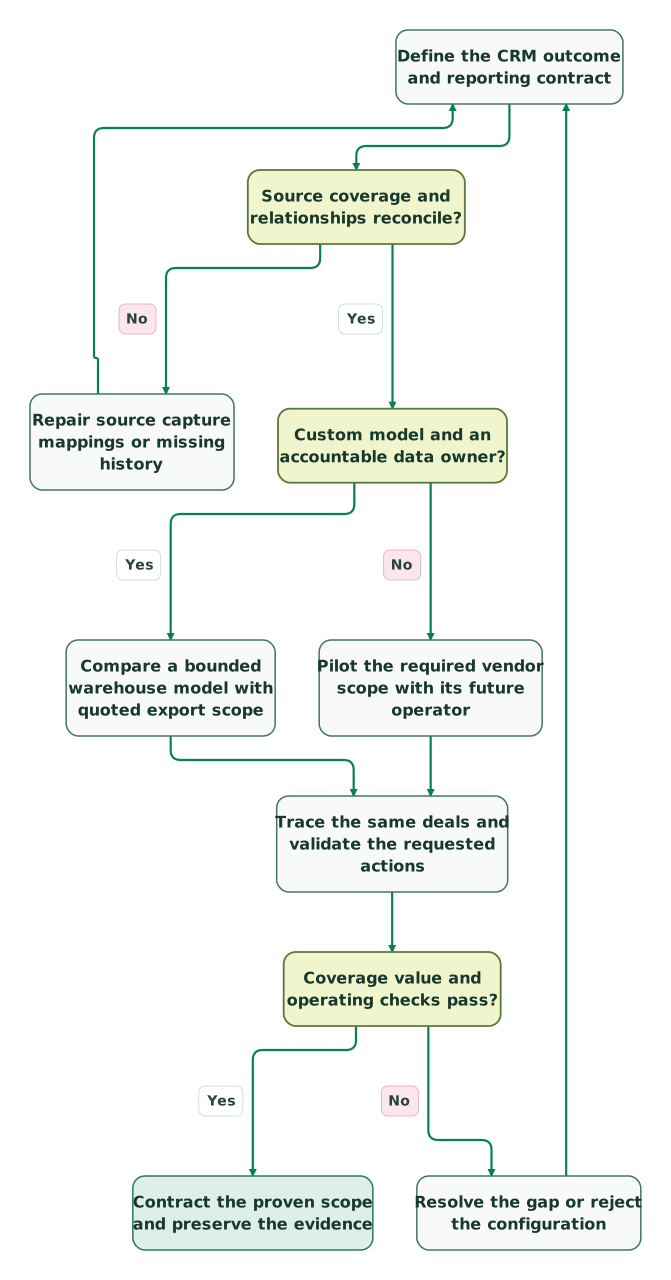
Read diagram as text
- Define the CRM outcome and reporting contract to Source coverage and relationships reconcile?.
- Source coverage and relationships reconcile? to Repair source capture mappings or missing history: No.
- Repair source capture mappings or missing history to Define the CRM outcome and reporting contract.
- Source coverage and relationships reconcile? to Custom model and an accountable data owner?: Yes.
- Custom model and an accountable data owner? to Compare a bounded warehouse model with quoted export scope: Yes.
- Custom model and an accountable data owner? to Pilot the required vendor scope with its future operator: No.
- Compare a bounded warehouse model with quoted export scope to Trace the same deals and validate the requested actions.
- Pilot the required vendor scope with its future operator to Trace the same deals and validate the requested actions.
- Trace the same deals and validate the requested actions to Coverage value and operating checks pass?.
- Coverage value and operating checks pass? to Resolve the gap or reject the configuration: No.
- Resolve the gap or reject the configuration to Define the CRM outcome and reporting contract.
- Coverage value and operating checks pass? to Contract the proven scope and preserve the evidence: Yes
Checklist
- The primary operator can explain the required reporting question.
- Trial features and retained paid features are distinguished.
- First-year and renewal costs include every required module.
- CRM population, journey scope, history and freshness are explicit.
- The deal sample reconciles by count and value, with unresolved cases visible.
- Influence, fractional attribution and causal evidence have separate meanings.
- Activation passes destination checks without duplicate conversions.
- AI answers expose the population and configuration used.
- Exports, ownership and historical snapshots survive an operator change.
Use our tool-selection method to turn the results into a purchase decision. If the uncertainty sits in the joins, source capture or CRM definitions, bring the sample and its exceptions to the $99 martech audit before expanding the software contract.
Keep reading
Browse all Tracking & Attribution guides
 Tracking & Attribution
Your attribution may be flattering your ads: check before changing the budget
Check whether ads create additional business or claim existing demand. Use research, credible holdouts and break-even contribution to guide the budget.
Jafrin Akter AloLast updated 14 min read
 Tracking & Attribution
Triple Whale vs Northbeam: Compare Costs, Attribution and the Order Data
Compare Triple Whale and Northbeam pricing, contracts, models and exports. Use an order-revenue bridge and a reporting pilot to choose the right scope.
Jafrin Akter AloLast updated 18 min read
 Tracking & Attribution
Marketing attribution models explained for small teams
Compare first touch, last touch, linear, time decay and data-driven attribution, using one worked path, current platform rules and a reporting contract.
Jafrin Akter AloLast updated 14 min read
Analytics & tracking
See the implementation scope, deliverables and acceptance checks.
Questions people ask
Can a free Dreamdata pilot be compared fairly with a full HockeyStack demonstration?
Compare the common capabilities first, then identify which required features need an expanded trial. A free plan's history or source limits can prevent a fair test of the complete use case. Record the scope behind each result and ask both vendors to demonstrate the retained configuration with the same records, including the features and limits that apply after the evaluation ends.
What should a pilot do with opportunities that reopen after being marked won?
Keep reopening as a separate lifecycle event and decide whether the report counts unique opportunities or stage entries. Compare the same rule in both candidates. A live-status filter can remove an earlier win, while repeated-entry models can count another occurrence. Normalize to the agreed deal grain before using the reconciliation helper, and preserve the original snapshot for any earlier decision.
Why can two channels each claim an opportunity's full value?
An influenced-value report can count the full opportunity for every qualifying channel, creating overlapping views. A fractional attribution report distributes credit under a selected model. Check the metric label and underlying deal list before adding channel rows. If the report is intended to allocate a fixed total, reconcile its selected model, stage, exclusions and unattributed bucket to that total.
Can we keep quarter-end reporting fixed while the customer journey evolves?
Yes, by retaining a reporting snapshot and its definitions separately from the live view. Save the included deal IDs, values, reporting window, attribution settings and extraction context, with access appropriate to the data. Later identity resolution or corrections can improve the current view while a bridge explains the difference from the snapshot used for the original decision.
Does passing a twenty-deal trace mean a channel is ready for more budget?
No. The trace checks whether the configuration can explain selected records and reconcile their value. It does not establish statistical stability across every channel or prove that changing spend will create additional sales. Examine broader coverage, deal concentration, sales-cycle maturity and the relevant causal evidence before making a budget change, and preserve the distinction between observed records and modeled credit.
Sources
- HockeyStack: platform capabilities
- HockeyStack: main pricing page
- HockeyStack: Academy package page
- HockeyStack: official comparison package example
- Dreamdata: plans and add-ons
- Dreamdata: stage models and journey scope
- Dreamdata: anonymous traffic and company mapping
- HockeyStack: Vector integration and identity boundaries
- HockeyStack: Salesforce integration
- HockeyStack: Snowflake integration
- Dreamdata: modelling schedule
- Dreamdata: Salesforce source
- Dreamdata: data-driven attribution
- HockeyStack: LinkedIn impressions and engagement
- Dreamdata: LinkedIn impression attribution
- Dreamdata: LinkedIn conversion sync
- HockeyStack: Salesforce Sync scope
- Dreamdata: Analytics Hub Agent
- Dreamdata: MCP Server
- HockeyStack: Revenue Agents
- G2: HockeyStack user reviews
- G2: Dreamdata user reviews
- Reddit: B2B attribution evaluation discussion
- Dreamdata: historical web tracking imports
- Dreamdata: BigQuery Legacy to V2 migration
- Dreamdata: historical attribution changes

Written by
Jafrin Akter AloData Engineer and Co-founder at Martechdevs and Growth and Analytics Partners
Jafrin writes practical guides to marketing technology, customer data, analytics and AI workflows. Martechdevs is a Growth and Analytics Partners company.