
Your attribution may be flattering your ads: check before changing the budget
Data Engineer and Co-founder, martechdevs
Last updated 12 min read
A campaign can claim a sale without causing it. Someone already planning to buy can click your brand ad, see a retargeting ad and receive an email before checking out. Each reporting system may find a reason to claim credit. Before you increase the budget, ask what would have happened without the spend and how much additional contribution the campaign needs to pay for itself.
Last updated: 15 September 2026.
Start with the decision the ROAS number cannot make
Attributed return on ad spend divides credited revenue by advertising spend. It is useful for monitoring performance under a consistent measurement definition. It does not, by itself, establish how much revenue would disappear if the campaign stopped.
That distinction matters when the next decision is “Should we put another $10,000 here?” A campaign receiving credit for existing demand can look more productive than a campaign introducing people to a product they had never considered. The first campaign may still be useful. The report has not settled the question.
Write the proposed decision before opening another dashboard. For example: keep, reduce or expand a particular retargeting campaign next quarter. Then identify the outcome that makes that decision worthwhile: additional paid customers, retained contribution, qualified opportunities or another outcome with a defensible connection to the business.
Avoid treating every conversion as equally valuable. A duplicated form submission, a low-quality lead and a completed sale should not become interchangeable units because they appear in the same advertising column. Fix those definitions first using the Google Ads conversion diagnostic process.
The question is not whether attribution is useless. The question is whether you are asking a credit-allocation report to justify a causal budget decision.
Look for places where demand and ad exposure travel together
Several situations deserve investigation. None is proof that a campaign has no value.
Brand search: the person typed your company or product name before clicking. Some of that intent existed before the ad. Your organic visibility, competitors and the search results they would otherwise see matter.
Retargeting: someone enters the audience because they visited a product page, started checkout or engaged with the product. Their prior interest helps explain both their eligibility for an ad and their likelihood of buying. Comparing exposed visitors with everyone else mixes those differences into the result.
Existing customers: repeat orders can be valuable, but they should not be presented as new customer acquisition. Decide whether the campaign is intended to create a new relationship, accelerate a repeat purchase or prevent a lapse. Evaluate that outcome.
Overlapping channels: one customer can interact with several platforms before one order. Adding the independently credited orders across those reports does not create a count of unique orders or incremental orders.
For an original example, imagine a customer already deciding to renew an annual subscription. They click a paid brand result to find the login page and renew. The observed path contains an ad click and a renewal. You still need evidence about what that customer, or a comparable group, would have done without the ad.
Use these patterns to select questions worth testing. Do not turn them into an arbitrary discount such as “only half of retargeting revenue is real.” The size and even direction of the bias need evidence.
Read the advertising research with its boundaries intact
Three research findings are useful here, provided you do not turn them into universal rules.
eBay showed why existing intent matters
Blake, Nosko and Tadelis ran field experiments at eBay and found no measurable short-term benefit from its brand-keyword advertising in the studied setting. Much of the traffic moved to unpaid search when brand ads stopped. For non-brand terms, new and infrequent users responded more than frequent users, who accounted for much of the expense. Read the authors' paper.
That result makes audience familiarity worth investigating. It does not establish that an unfamiliar business with weak organic visibility should stop buying brand search. It also does not answer every long-term brand or competitive question.
Rich observational data did not reliably reproduce experiments
Gordon and colleagues compared observational approaches with 15 large Facebook advertising experiments. For seven of the 14 studies with checkout outcomes, the observational point estimates were consistently more than a factor of three away from the experimental estimates. The methods mostly overstated lift, but sometimes substantially understated it. Read the study.
This is evidence against assuming that more observed variables automatically remove selection bias. It is not a correction factor for today's Meta dashboard, nor a finding that every platform overstates every campaign by three times.
Competitive search results change the brand-search question
Simonov, Nosko and Rao studied brand-keyword search advertising on Bing. They found substantial substitution between paid and unpaid clicks and showed why competing ads can change the traffic consequences of brand advertising. The paper also distinguishes its randomized comparisons from a brand-position comparison with selection limitations. Its click findings are not a profit estimate for your account. Read the research.
For a founder, the practical implication is to inspect the actual competitive setting before copying someone else's brand-search policy. A famous marketplace, a new software company and a retailer sharing a brand term with resellers do not face the same decision.
Audit the reporting definition before paying for a test
An experiment cannot rescue an outcome definition that changes halfway through it. Record what each report means before comparing the numbers.
Confirm the conversion action, attribution window, click or view eligibility, currency, timezone and the treatment of refunds or cancellations. Identify whether the report is assigning results to the interaction date or the outcome date. Use the documented settings of the actual platform and report; do not assume they match because both columns are called revenue.
Then inspect the operational outcome. For ecommerce, that may be completed orders with a clear refund policy. For a sales-led business, it may be accepted opportunities or eventual closed revenue. A request for a demo can be an early diagnostic, but it cannot establish profitability if sales quality changes between audiences.
Check whether the campaign is being evaluated on gross revenue while the business decision depends on contribution after fulfilment, payment fees, discounts and other variable costs. Agree those cost definitions with the person responsible for the commercial numbers.
Use the attribution-model guide to align credit definitions. Keep the reconciled operational total beside the channel views. The operational total is a baseline for knowing what happened; a credible comparison is still needed to estimate what the advertising caused.
Choose a test that changes the advertising opportunity
A useful incrementality test creates a credible comparison between a defined advertising policy and an alternative. That alternative might be withholding a campaign or reducing its spend in selected units. The result applies to the contrast you actually tested.
Do not compare people who clicked with people who did not click and call it a holdout. Clicking is a behaviour influenced by interest and exposure. Similarly, switching ads off on Monday and comparing sales with Sunday leaves day-of-week patterns, promotions and other changes mixed into the result.
Google's Conversion Lift documentation describes controlled user or geography studies and reports incremental outcomes. Availability is restricted; its help page directs advertisers to their account representative. Check eligibility before planning around a feature your account may not have.
For a geographic test, use enough suitable geographic units and historical outcome data to assess feasibility. Google's Meridian GeoX design method uses pre-test behaviour to construct comparable groups, randomizes within those groups and evaluates design quality and detectable lift. Drawing a line between two convenient cities is not the same process.
An ad-creative A/B test usually answers which creative performs better under that experiment. It does not automatically estimate the value of advertising versus withholding it. Read the treatment definition before calling a result incremental.
The attribution, MMM and incrementality guide covers method selection. For this budget decision, choose the smallest credible experiment that could change your action. A small experiment with no realistic chance of resolving the question is not cheap once you include the resulting decision risk.
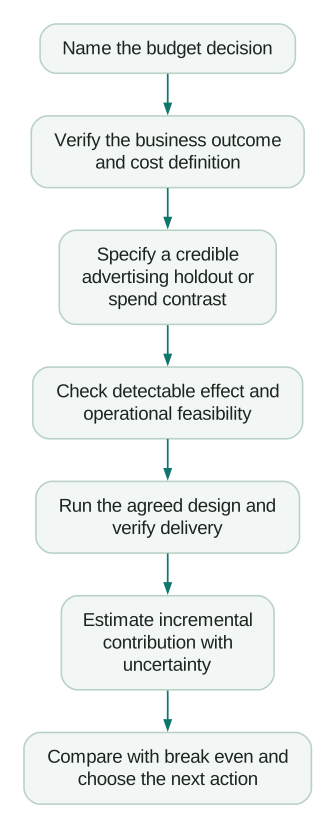
Write the test agreement before changing delivery
Keep the agreement short enough that marketing, finance and the analyst will actually read it. It should settle these questions before anyone sees a result:
- Decision: which budget, audience and future action could change?
- Assignment unit: are you assigning people, accounts or geographic areas, and can that assignment remain stable?
- Treatment: which advertising continues, changes or stops, and what remains running in both groups?
- Outcome: what business record counts, when does it count, and how will it be measured in both groups?
- Timing: how long will delivery run, and how much additional time is required for conversions and refunds to mature?
- Analysis: how will group size, assignment, clustering, uncertainty and the agreed decision threshold be handled?
- Operating checks: who watches delivery, spend, broken measurement and customer-impact limits?
Analyse according to the design's assignment rule. Removing assigned people because they never received an impression can destroy the comparison you created. In a sales-led business, several people from one buying account may influence the same purchase; treating them as independent customers can also misrepresent the evidence.
During the test, monitor whether the intended contrast exists. A holdout that is reached through a duplicate campaign, overlapping audience or another device may reduce the difference between groups. A paused brand campaign may also shift spend into another campaign if the surrounding budget system allows it. Document these possibilities before interpreting the outcome.
Use the business outcome across relevant acquisition paths. If brand ads stop and a customer buys through an organic result, the business still has that sale. Looking only at paid-attributed conversions would bake the removal of paid credit into your definition of failure.
These are design checks, not a promise that every business can create a clean experiment in every channel. If a key condition cannot be maintained, record the limitation and reconsider the design before calling the result causal.
Put a break-even threshold beside the estimate
An experiment can detect a positive effect that is still too small to pay for the advertising. A business decision needs the effect and its economics.
Consider this fictional, simplified case. You are evaluating $3,000 of incremental campaign spend against a holdout. Each additional completed order contributes $70 after the agreed variable costs and before advertising. Assume that contribution is constant over the tested range and that other incremental costs are already accounted for.
Break-even additional orders equal incremental spend divided by contribution per additional order: $3,000 divided by $70, or about 42.86. In whole orders, the campaign needs at least 43 additional orders to clear that threshold under these assumptions.
Now suppose the experiment's point estimate is 40 additional orders. Estimated contribution after media is 40 × $70 − $3,000 = −$200. A positive effect on orders has not produced a positive estimated contribution after media.
For illustration, suppose a correctly calculated uncertainty interval spans 20 to 60 additional orders. That corresponds to −$1,600 to +$1,200 of contribution after media. These interval endpoints are hypothetical inputs, not the output of a study conducted for this article. Their purpose is to show why an estimate can be commercially unresolved even when its central value looks simple.
The range crosses break-even. It supports neither “this definitely pays” nor “advertising does nothing.” The next decision depends on the cost of more information, the business's tolerance for a possible loss and the alternatives available for that money.
Use actual incremental spend for the tested contrast. If the control group still receives some advertising, using all campaign spend as if it were newly introduced can misstate the comparison. Include differences in discounts, service costs or customer quality when the intervention changes them.
For subscriptions or long sales cycles, do not fill the gap with an optimistic lifetime value. State the observed horizon, show any forecast separately and test how the decision changes under more conservative retention or margin assumptions.
Decide what evidence would change the budget
Agree this before the results arrive so a favourite channel does not receive a different standard after the fact.
If the plausible incremental contribution is comfortably above the commercial threshold, consider a measured expansion with monitoring. The effect of the tested spend level does not establish the return on unlimited additional spend. More expensive inventory or a less responsive audience can change the next dollar's economics.
If the plausible contribution is below the threshold, reducing or reallocating the tested spend may be reasonable. Preserve the distinction between that specific campaign policy and the whole channel. A poor retargeting treatment does not prove prospecting cannot work.
If the range crosses the threshold, label the decision uncertain. Consider whether a longer or better-designed test can meaningfully narrow it. Do not extend a test repeatedly until a preferred result appears; use a prespecified extension or sequential-analysis rule where appropriate.
A small team may lack the volume to resolve a modest effect. It can still remove known duplicates, exclude inappropriate audiences, improve outcome quality and make bounded budget changes with explicit uncertainty. Those are useful operational decisions. They should not be sold internally as experimental proof.
Keep a decision record: tested policy, population, period, estimate, uncertainty, economic assumptions, chosen action and the condition for revisiting it. That record makes the result usable when someone asks three months later why the budget changed.
Use attribution to operate and experiments to challenge the assumptions
You still need routine campaign reporting between studies. Watch delivery, spend, lead quality, funnel progression and operational revenue. Keep the definitions stable enough to notice a real change.
Then use experimental evidence to challenge large spending assumptions, especially where credited performance looks excellent and existing intent is strong. A study can inform a broader measurement model, but do not spread one result across different audiences, creatives and seasons without qualification.
Checklist
- The report's outcome and credit rules are written down.
- Unique business outcomes are reconciled independently of platform totals.
- The suspected bias is a testable hypothesis, not an assumed correction factor.
- The comparison changes a defined advertising policy and has a credible control.
- Delivery, contamination and conversion maturity are checked.
- Incremental contribution is compared with a commercial threshold and uncertainty.
- The decision record says where the result applies and when to revisit it.
If your team cannot agree whether a report counts customers, claims credit or estimates additional business, an analytics and tracking review should resolve those definitions before recommending more spend. A useful measurement system lets you defend a decision with evidence and recognise when the evidence is still incomplete.
Questions people ask
Does a high ROAS mean the campaign is profitable?
It means the report credited substantial revenue relative to spend under its rules. Profitability also depends on incremental outcomes, margins, other costs and the appropriate time horizon. A high attributed ROAS alone does not establish those conditions.
Should I stop buying brand search?
Do not make that decision from another company's study. Inspect your organic visibility, competitors, customer familiarity and the outcome you need to protect. Use a feasible controlled test where the business importance and uncertainty justify it.
Can I add conversions from different ad platforms?
Not as a count of unique business outcomes unless you have reconciled overlap. Multiple platforms can credit the same order or lead under their own rules. Maintain a deduplicated operational total and separate it from each attribution view.
Can a small-budget company test incrementality?
Sometimes, but feasibility depends on outcome volume, variation, the effect worth detecting and the available comparison. There is no useful universal minimum spend. Check the design first; an inconclusive test is not evidence of zero effect.
How often should we repeat an incrementality test?
Repeat when a material budget decision or a change in audience, offer, delivery, competition or business economics makes the previous result less applicable. The cadence should follow decision value and feasibility, rather than a calendar rule that ignores those changes.
Sources
- Blake, Nosko and Tadelis: Consumer Heterogeneity and Paid Search Effectiveness
- Gordon and colleagues: A Comparison of Approaches to Advertising Measurement
- Simonov, Nosko and Rao: Competition and Crowd-Out for Brand Keywords in Sponsored Search
- Google Ads: About Conversion Lift
- Google: Meridian GeoX design methodology
Written by
Jafrin Akter AloData Engineer and Co-founder, martechdevs
Jafrin Akter Alo is a data engineer and co-founder of martechdevs, where the team has delivered 74+ martech, data and growth stack implementations.