
Triple Whale vs Northbeam: Compare Costs, Attribution and the Order Data
Choose Triple Whale when your ecommerce team wants attribution alongside business reporting and governed AI workflows. Evaluate Northbeam when the main job is understanding media performance across its attribution models, accounting modes and supported channels. Base the decision on the configuration you can verify, the cost at your actual volume and the person who will operate it. Higher reported ROAS is not proof of a better tool.
On this page
At Martechdevs, we provide paid attribution and tracking implementation. The first job is to establish which orders, amounts and interactions a report represents. That gives the team a reliable basis for comparing software and deciding whether the extra operating cost is worthwhile.
Which product fits the work your team needs to do?
Compare the workflow you need to maintain, including its data requirements and downstream actions. A brand spending heavily on one established channel can have a simpler reporting problem than a smaller brand operating several storefronts and sales channels.
Triple Whale decision block
- Best for: Ecommerce operators who want connected reporting, attribution, creative analysis and AI-assisted work in one operating environment.
- Pros: A free starting point; paid multi-touch models and business intelligence tools; Moby workflows that extend into supported actions on higher packages.
- Cons: Paid cost depends on GMV and package; monthly billing can still mean a twelve-month commitment; several models and add-ons require careful interpretation and entitlement checks.
- Free tier and startup offer: Free includes first- and last-click attribution. The pricing page does not publish a separate startup discount; confirm any negotiated concession and its expiry.
- Choose it if: Your team can reproduce the required reports and the broader operating tools replace work it actually performs.
- Skip it if: You only need an explained order total, or you expect every channel row from Triple Attribution to add up to store revenue.
Northbeam decision block
- Best for: A team with an accountable measurement owner evaluating media performance across channels, dates and customer groups.
- Pros: Several attribution models; explicit transaction-date and interaction-date views; export routes and optional measurement services for deeper analysis.
- Cons: Pageview volume affects the quote; some exports and services depend on plan; granular view-through reporting can have coverage or privacy limits.
- Free tier and startup offer: The pricing page does not list a free plan or named startup discount. Growth is an agency-supported commercial route, rather than a generally available free startup offer.
- Choose it if: Its supported channels, order feed and reporting controls resolve a material media-buying question your team will revisit.
- Skip it if: Nobody owns the model and settings, or the decision value cannot justify software and operating costs together.
Best fit by scenario
The product names alone do not settle the choice. Triple Whale's package guide separates Foundation, Automate and Enterprise, while Northbeam's model guide describes the distinct credit rules available inside its platform. Use attribution models explained to establish the question before selecting a vendor's default.
| Situation | First route to evaluate | Runner-up | Deciding evidence |
|---|---|---|---|
| Shopify team consolidating daily business and marketing reports | Triple Whale Free or the required paid scope | Current store and reporting setup | Whether consolidation saves useful work and preserves definitions |
| Media team with several view-heavy channels and a measurement owner | Northbeam with the required channel coverage | Triple Whale's corresponding models | Partner coverage, reporting semantics and usable evidence |
| Brand needing governed creative and paid-media actions | Triple Whale Automate | Existing reporting plus an owned action workflow | Actual permissions, approval controls and operating value |
| Non-Shopify store or custom order feed | Northbeam Professional or Enterprise evaluation | Existing warehouse and reporting model | Supported order ingestion and full ownership cost |
| Brand with unexplained missing or duplicated purchases | Repair the existing collection and order model | Reconsider either platform after the repair | Reconciled outcomes before a larger software commitment |
These routes can overlap. Test the smallest configuration that answers the required question and confirm what remains available after the trial or pilot.
How do Triple Whale and Northbeam pricing differ?
Triple Whale prices paid scope by annual GMV and package; Northbeam uses commercial tiers associated with ad spend and adjusts its monthly quote for pageview volume. A price comparison without those inputs is incomplete.
Triple Whale: listed entry prices and a GMV-based quote
The Shopify listing displays the following USD prices. Treat them as published entry references, then confirm the amount for your business's GMV and required add-ons.
| Plan | Shopify-listed amount | Boundary to confirm |
|---|---|---|
| Free | USD 0 | Ten users; first- and last-click models; twelve-month lookback listed |
| Foundation | USD 219/month or USD 2,190/year | Actual GMV tier and required capabilities |
| Automate | USD 749/month or USD 7,490/year | Moby usage and the actions included in your configuration |
| Enterprise | Custom quote on the vendor site | Measurement, integrations and separately entitled exports |
Sources: Triple Whale's Shopify listing, Triple Whale pricing.
The vendor's main pricing page states that paid plans are twelve-month subscriptions, billed monthly or annually; annual prepayment includes two months free and locks the revenue tier for that year. Monthly billing therefore should not be read as a right to leave after one month. Confirm the order form and renewal terms.
Triple Whale's billing guide uses Order Revenue over the last 365 days for pricing and distinguishes it from a return-adjusted sales figure. The same guide describes a thirty-day cancellation notice and restrictions on pausing twelve-month contracts. Resolve the remaining commitment and effective cancellation date in writing rather than assuming the notice period cancels the contractual obligation. Billing and invoice rules
Northbeam: plan scope, usage and commitment
Northbeam's starting amounts vary with pageviews. Confirm the quote for your required scope.
| Plan | Displayed amount | Published scope | Partner ad credits advertised |
|---|---|---|---|
| Growth | Custom | Agency-supported seven-figure brands below $200,000/month ad spend | Up to $50,000 |
| Starter | $1,500 shown | Shopify; below $1.5 million annual ad spend; monthly usage pricing | Up to $100,000 |
| Professional | $3,500/month | Any ecommerce platform; up to $500,000/month ad spend; annual term | Up to $150,000 |
| Enterprise | Custom | Above $500,000/month ad spend; annual term | Up to $200,000 |
Starter's card omits a period; the FAQ describes monthly usage pricing. Confirm its base, currency and allowance. Professional and Enterprise use annual or semi-annual billing. Northbeam pricing and contract FAQ
Value credits only after confirming eligibility, spending requirements and usable destinations. They do not reduce the software invoice.
For both vendors, write down next year's likely usage and the undiscounted renewal price. Budget any warehouse feed, additional AI usage, testing service or agency engagement as a separate line when it is not explicitly included.
If single sign-on or comprehensive audit logs are required, Triple Whale's package guide marks those capabilities as coming soon. Obtain account-specific confirmation before depending on them. Enterprise capability boundaries
How much improvement must the tool produce to justify its cost?
Compare the complete monthly operating cost with the contribution the decision could realistically improve. Software cost as a share of ad spend is a useful screen, but it is not a return estimate.
The following is a hypothetical budget exercise in USD. Monthly software bills of USD 219, USD 1,500 and USD 3,500 are scenario inputs; they do not establish package eligibility or the quote for a particular brand.
| Monthly software bill | Share of USD 20,000 ad spend | Share of USD 60,000 ad spend | Share of USD 250,000 ad spend |
|---|---|---|---|
| 219 | 1.10% | 0.37% | 0.09% |
| 1,500 | 7.50% | 2.50% | 0.60% |
| 3,500 | 17.50% | 5.83% | 1.40% |
Now add eight hours of monthly operating work at an assumed USD 75 per hour to the USD 3,500 scenario. Total monthly cost becomes USD 4,100. At a 40% contribution margin before these new costs, covering that bill through additional revenue alone requires USD 10,250 of incremental revenue: 4,100 / 0.40.
That is a break-even requirement under the example's assumptions, not a forecast that either platform will deliver it. Avoided media waste, reduced reporting work and additional contribution can all matter, but do not count the same benefit twice. A model that reallocates more existing revenue to a channel has not, by that action, generated extra revenue.
Compare first-year implementation with recurring maintenance separately. For an annual prepaid quote, compare annual cash outlay and commitment as well as a monthly equivalent. A lower equivalent price can still require more cash upfront and less freedom to change direction.
Why can the two tools produce different attribution results?
The tools can use different eligible interactions, credit rules, windows and date assignments for the same purchase. Align those settings before deciding that a discrepancy is a tracking failure.
Triple Attribution is not a store-revenue total
Triple Attribution can award each platform's last eligible interaction full credit. Triple Whale's guidance says: “Do not use Triple Attribution for financial reporting”. Adding these platform-level credits can exceed the underlying order value. For a reconciled view, evaluate a model designed to distribute credit across the common outcome population, then still check its filters and revenue basis. Triple Whale model definitions
For an illustrative USD 100 order with eligible Meta and Google clicks, a full-credit-per-platform view can show USD 100 for each platform. The USD 200 sum is analytical credit across overlapping views. A chosen 50/50 allocation of that same order instead totals USD 100. Neither rule establishes how many additional sales the ads caused.
Similar model names do not mean identical calculations
Triple Whale's Clicks & Deterministic Views combines first-party clicks with eligible partner view data. Its built-in decay halves click credit every seven days and view credit every day. The model does not use a configurable attribution window, even if a window label carries over in the interface. Views refresh daily and may take up to 48 hours to begin processing. Triple Whale C&DV
Northbeam's Clicks + Deterministic Views combines its click evidence with verified view matches from participating partners, using its own allocation rules. Paid clicks and views can take precedence over categories such as direct, branded search and email. Inspect the eligible categories and partner coverage instead of assuming this is the same model as Triple Whale's similarly named option. Northbeam C+DV
Triple Whale's Total Impact adds post-purchase survey evidence to tracked clicks. Its dedicated guide specifies a fixed seven-day attribution window and sufficient survey data; seven elapsed days alone do not prove readiness. It also states that the model does not retain an order-by-order explanation of the modeled allocation. Preserve survey answers as evidence without treating one response as proof of a particular campaign's contribution. Total Impact
Northbeam separates transaction dates, interaction dates and eligibility
Northbeam's Cash Snapshot places credit on the transaction date. Accrual Performance places credit on the contributing interaction dates. A purchase after month-end can therefore add credit to an earlier month's interactions. These are platform reporting modes; their names do not make either view a bank-settlement or statutory accounting report. Northbeam accounting modes
Northbeam also distinguishes its lookback window, which determines eligible interactions, from an attribution-window filter on allocated credit. Its attribution-window controls apply in Accrual mode. Changing the account lookback can restate historical reports. Record both settings so a seven-day label in one view is not mistaken for a directly comparable seven-day calculation elsewhere. Lookback windows, attribution windows
What must the tracking foundation establish first?
Establish a complete, deduplicated order population and a traceable interaction stream before asking either tool to optimize spend. The necessary work depends on the missing evidence; a new server-side project is not automatically the first purchase.
| Foundation check | Evidence to inspect | Consequence if it fails |
|---|---|---|
| Order feed | Unique order IDs, amounts, currency and the included sales channels | No stable outcome total to reconcile |
| Campaign identification | Destination URL, redirects and consistent source parameters | Paid activity can lose its intended channel or campaign |
| Event delivery | Browser/server events and their deduplication relationship | Missing or repeated purchase observations |
| Customer history | Durable customer IDs and available prior orders | Returning buyers can look newly acquired |
| Collection controls | Consent states, permitted fields and source coverage | Different populations can be compared without being recognized |
Use UTM naming rules and test the actual landing route, including redirects. For Meta, inspect Conversions API deduplication. Decide when server-side tracking is worth it from the collection gap, then compare Stape and Elevar's implementation responsibilities if that is the appropriate repair.
Northbeam's Meta C+DV requirements include the standard Purchase event with an order_id matching Northbeam's order identifier. Its guide also describes privacy withholding for low-volume Meta reporting slices, typically below 1,000 impressions at that reporting level. A withheld granular row is not automatically evidence that the aggregate has no associated value. Check the actual integration and level of reporting before treating the difference as lost conversions. Northbeam C+DV requirements
New visitors, first-time customers and first subscription orders are different populations. Northbeam uses different evidence for these classifications: pixel history, customer IDs with order history, and subscription tags. Verify the historic feed and identifier format, particularly with a custom order integration. Northbeam first-time and returning data
Keep orders with missing customer evidence visible as unresolved cases in your acceptance test rather than automatically treating them as new acquisitions.
How should you run a thirty-day reporting pilot?
Use a defined order cohort, reconcile its money first, and compare attribution only after explaining the baseline. Thirty days is an initial evaluation period, not a promise that a newly installed pixel has captured every earlier interaction or that a long conversion window has matured.
- Agree the decision, operator, order population, currency, timezone, amount definition and exclusions before comparing reports.
- Verify collection with known purchases, a repeat buyer, a partial refund, a cancellation and a purchase crossing a local-day boundary.
- Preserve raw source exports and report settings for the same cohort. Resolve missing or duplicated order IDs before comparing percentages.
- Reconcile a common revenue basis, then compare each selected attribution view with its own documented credit behavior.
- Repeat after the expected ingestion delay and late adjustments. Keep the earlier snapshot so changes have an explanation.
- Ask the intended operator to reproduce the report, explain one discrepancy and complete the required export. Record the ongoing time this needs.
This copyable contract uses illustrative choices. Replace them with the agreed business definition and actual settings:
comparison: ecommerce_attribution_pilot_v1
population: eligible online orders created in one complete 30-day window
order_unit: one canonical order ID per store
currency: USD
reporting_timezone: UTC
value_basis: merchandise after discounts and item refunds, excluding tax and shipping
refund_cutoff: common source-complete cutoff recorded with each run
exclusions: test orders and explicitly excluded sales channels
customer_split: first-time and returning from stable customer IDs and history
source_record: order export plus refund and adjustment records
baseline_date_basis: order creation date
attribution_settings: record each model, window, lookback and accounting mode
unattributed_orders: retained and explained
missing_order_ids: investigate individually
rounding_tolerance: agreed in currency units before comparison
snapshot: retain source export and report settings for every accepted run
Northbeam recommends comparing its order view with a Shopify Orders export under matched filters and revenue settings. Its default revenue treatment includes tax and shipping and does not deduct refunds; configuration can change that. When refunds are deducted, they can restate the original order date, while Shopify reports can recognize refunds on their processing date. A calendar-month difference can therefore be a definition or timing difference rather than a missing order. Northbeam's Shopify reconciliation guide
Do not apply a generic formula blindly to every export field. Shopify's subtotalPriceSet, for example, is already after discounts and can include tax when taxesIncluded is true. Subtracting discounts again or adding tax again would corrupt the bridge. Its Orders CSV can also place additional line items on separate rows. Normalize the records and verify field meaning on a known order before summing. Shopify Order monetary fields, Shopify order exports
A worked revenue bridge
These hypothetical USD amounts describe one fixed order cohort at one common refund cutoff. Taxes and shipping below are already net of their respective refunds. They are explicitly defined example components, not raw Shopify column mappings.
| Component | Calculation | USD |
|---|---|---|
| Merchandise before discounts | Sum for eligible orders | 120,000 |
| Discounts | Deduct once | 12,000 |
| Merchandise before item refunds | 120,000 − 12,000 | 108,000 |
| Item refunds for this order cohort | Deduct through the common cutoff | 6,000 |
| Merchandise after discounts and item refunds | 108,000 − 6,000 | 102,000 |
| Tax after tax refunds | Separately included only if the metric requires it | 8,160 |
| Shipping after shipping refunds | Separately included only if the metric requires it | 3,800 |
| Amount including net tax and shipping | 102,000 + 8,160 + 3,800 | 113,960 |
Against the merchandise-only USD 102,000 baseline, USD 108,000 has an explained USD 6,000 refund difference. USD 113,960 has an explained USD 11,960 tax-and-shipping difference. Neither discrepancy should be “fixed” by adjusting channel weights.
Use the Shopify and GA4 reconciliation guide for the broader collection checks. Keep platform-reported conversions as another view with its own identity, windows and overlap. Meta and Google can both claim the same order; their combined claims are not a required store-revenue total.
How do AI, attribution passback and measurement tests differ?
Separate reading data, changing campaigns and testing causal impact. Both platforms have AI access, but the permissions and measurement questions are different.
Triple Whale's paid packages include read-only MCP access, distinct from native API or headless access. Moby Actions can prepare or execute supported changes under the account's approval settings, and monthly Moby usage depends on package and account configuration. A read-only connector does not authorize the action layer. Triple Whale plan and action scope
Northbeam has its own in-product AI on every plan, as well as a read-only MCP connection. Northbeam AI can answer account questions and change the requesting user's default attribution settings, but it does not edit orders, spend or platform connections. Its usage resets weekly. Do not rely on comparisons that describe Northbeam as having no native AI assistant. Northbeam AI, Northbeam MCP
Attribution passback is another layer. Northbeam Apex sends attributed signals to an advertising partner and is additive to the existing pixel/CAPI connection. Enabling the data connection is separate from running a campaign that uses Custom Attribution. Triple Whale's passback configuration likewise has a specific eligible-model list; Total Impact is not supported by that integration. Northbeam Apex, Triple Whale Attribution Passback
Check rollout and readiness in the actual account. Triple Whale's guide describes Meta Custom Attribution as generally available, while Northbeam's campaign guide retains beta-access language and a planned rollout that may not describe every account's current state. Northbeam's FAQ also excludes C+DV from the Custom Attribution test configuration it describes. Get the supported model, live campaign option and readiness criteria demonstrated before buying for this use case. Northbeam campaign setup, Apex FAQ
Neither changing a model nor successfully delivering its signal proves incremental sales. Triple Whale offers Compass measurement scope and Northbeam lists optional incrementality and MMM services on particular plans. Evaluate data suitability, test design and the intended decision rather than treating an ad-spend threshold as universal proof that MMM will work. The attribution, MMM and incrementality guide explains which evidence each method can provide.
What do user experiences suggest you should test?
Use relevant user accounts to identify operational questions, then test those questions in your intended configuration. Review ratings do not reconcile your store or establish which model is causally accurate.
G2 displays Triple Whale at 4.5/5 from 482 reviews and Northbeam at 4.5/5 from 16. Northbeam's much smaller sample makes a simple rating comparison especially limited. Triple Whale reviewer Naisargi S. values centralized cross-channel reporting but describes a learning curve, pricing concerns and the need to validate differences between tools; G2 marks the review as incentivized. Triple Whale G2 reviews
Northbeam reviewer Ankush J. describes useful day-to-day reporting after initial setup, while Harel L. reports an unsuccessful onboarding experience. Both are labelled organic on G2. Bring a real integration and report-maintenance task to the pilot so ownership and support are observable. Northbeam G2 reviews
Shopify's Triple Whale listing contains merchant feedback on reporting, support and AI usage expectations. Fitbiomics praises the reporting workflow; another merchant's positive review still asks for clearer usage-limit communication. These are useful prompts to inspect the retained usage allowance and support path. Merchant reviews
The Reddit alternatives discussion mixes integration, support and price concerns with comments from competing vendors. Separate the buyer's problem from the recommended brand. A price complaint, missing order feed and causal-measurement question call for different remedies.
What must be checked before switching or signing?
Prove the export, preserve the reporting contract and agree the overlap and exit conditions before removing the previous collector. An attribution history, an order history and a CSV of aggregated campaign results are different assets.
| Required output | Triple Whale check | Northbeam check |
|---|---|---|
| A reproducible report snapshot | Export the selected attribution model, dates and columns | Export the selected Sales view and preserve its settings |
| Automated warehouse delivery | Confirm Data Warehouse Sync entitlement, including on Enterprise | Confirm Data Export API entitlement and destination |
| Individual journey evidence | Identify which model retains usable order-level explanations | Confirm access to the Touchpoints Export, which is limited to selected service plans |
Triple Whale's attribution CSV guide describes a manual selected-view export. Its warehouse sync is a separate entitlement and is not automatically included with Enterprise. Northbeam distinguishes Sales exports, row-level Touchpoints Export, Data Export API and MCP; MCP query access is not a bulk export pipeline. Triple Whale CSV export, Triple Whale export entitlement, Northbeam export choices
If a parallel reporting period is useful, keep each collector and downstream destination documented. Do not let both implementations independently send the same standard purchase events into an ad platform without a deliberate deduplication and ownership design. Extend the observation period when delayed conversions, refunds or model readiness require it.
Agree how much history can actually be imported and reprocessed. A newly installed pixel cannot reconstruct interactions that no source retained. Obtain sample export files and test their identities, timestamps, currency and model context before assuming that the destination can reproduce an old dashboard.
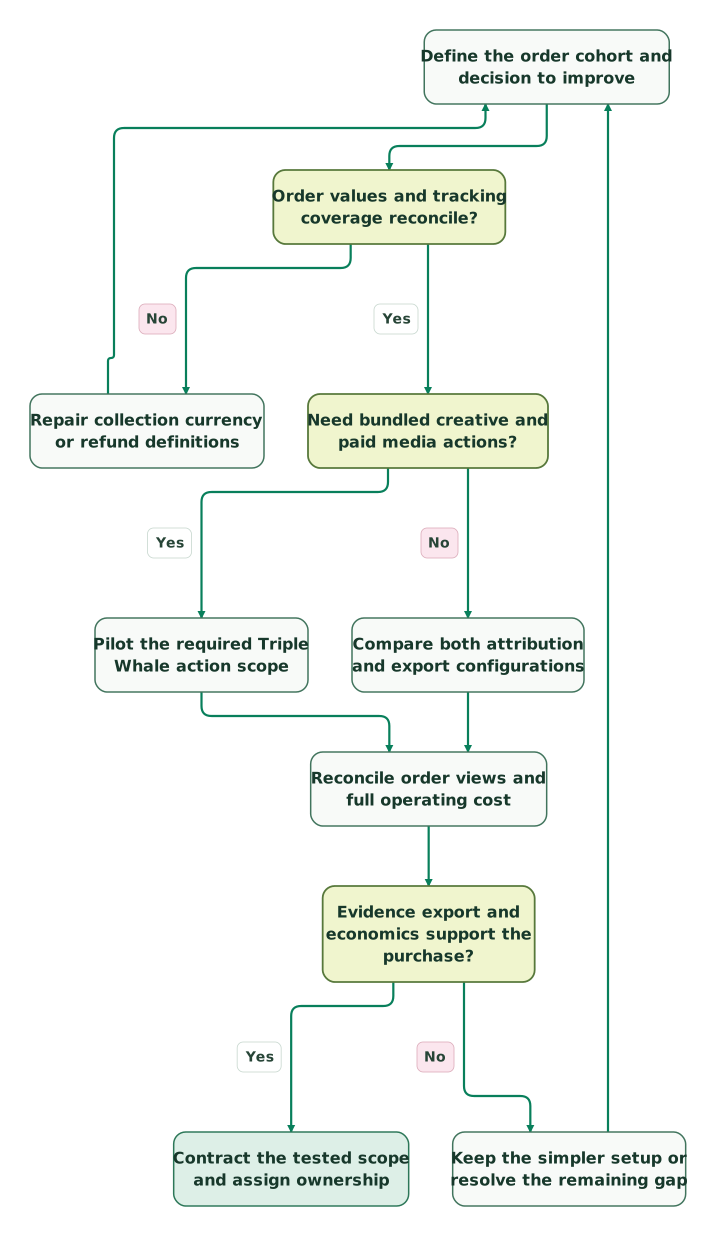
Read diagram as text
- Define the order cohort and decision to improve to Order values and tracking coverage reconcile?.
- Order values and tracking coverage reconcile? to Repair collection currency or refund definitions: No.
- Repair collection currency or refund definitions to Define the order cohort and decision to improve.
- Order values and tracking coverage reconcile? to Need bundled creative and paid media actions?: Yes.
- Need bundled creative and paid media actions? to Pilot the required Triple Whale action scope: Yes.
- Need bundled creative and paid media actions? to Compare both attribution and export configurations: No.
- Pilot the required Triple Whale action scope to Reconcile order views and full operating cost.
- Compare both attribution and export configurations to Reconcile order views and full operating cost.
- Reconcile order views and full operating cost to Evidence export and economics support the purchase?.
- Evidence export and economics support the purchase? to Keep the simpler setup or resolve the remaining gap: No.
- Keep the simpler setup or resolve the remaining gap to Define the order cohort and decision to improve.
- Evidence export and economics support the purchase? to Contract the tested scope and assign ownership: Yes
Checklist
- The quote uses the actual GMV, ad spend, pageviews and required modules.
- Billing cadence, commitment, notice and renewal are separately understood.
- Credits and trial features are not counted as guaranteed recurring value.
- Orders, customer identity and adjustments reconcile before attribution weights are compared.
- Every report records its model, date basis, window, lookback and filters.
- The operator understands overlapping platform credit and fractional allocation.
- View-data eligibility, lag and any withheld rows are explained.
- AI permissions and passback model support match the intended workflow.
- A usable export and the operating owner survive the initial implementation.
- The proposed budget change has appropriate causal and commercial evidence.
Use our tool-comparison method to evaluate the configuration you can maintain. If the current report is over-crediting advertising, diagnose the definition or collection problem first. Bring the order bridge and unresolved differences to the $99 martech audit when you need implementation help.
Keep reading
Browse all Tracking & Attribution guides
 Tracking & Attribution
Your attribution may be flattering your ads: check before changing the budget
Check whether ads create additional business or claim existing demand. Use research, credible holdouts and break-even contribution to guide the budget.
Jafrin Akter AloLast updated 14 min read
 Tracking & Attribution
HockeyStack vs Dreamdata: 7 Checks Before You Buy
Compare HockeyStack and Dreamdata on pricing, CRM coverage, history, attribution and exports. Includes a 20-deal test before committing to a paid plan.
Jafrin Akter AloLast updated 17 min read
 Tracking & Attribution
Marketing attribution models explained for small teams
Compare first touch, last touch, linear, time decay and data-driven attribution, using one worked path, current platform rules and a reporting contract.
Jafrin Akter AloLast updated 14 min read
Analytics & tracking
See the implementation scope, deliverables and acceptance checks.
Questions people ask
Does paying Triple Whale monthly mean we can cancel after one month?
Monthly billing and subscription commitment are separate. Triple Whale's public pricing describes paid plans as twelve-month subscriptions, while its billing guidance also specifies cancellation notice. Read the order form for the remaining commitment, effective cancellation date and renewal conditions. A monthly invoice or a notice-period instruction alone does not establish a right to leave a fixed-term contract immediately.
Why does a seven-day setting fail to change Triple Whale C&DV results?
Clicks & Deterministic Views uses its built-in decay rules rather than a configurable attribution window. A setting left visible from another model can therefore be a cosmetic carryover. Confirm the active model before interpreting the label, and compare reporting dates and filters separately. Use a model with a configurable window when the purpose is to test how that window changes eligible credit.
Can a first-time visitor still be a returning customer in Northbeam?
Yes. Visitor classification uses pixel and device-history evidence, while customer classification uses customer IDs and historical orders. A previously purchasing customer can arrive through a device the pixel has not recognized before. Check both fields and the available history before treating a new visit as a new acquisition, particularly after a migration or an identity-format change.
Should a partially refunded order count as a fraction of an order?
Define order count separately from the retained monetary value. A partial refund can reduce an order's revenue while the original purchase remains one order under an order-count definition. Fractional attributed transactions instead arise from distributing credit between interactions. Keep the refund record and allocation rule separate so the team can explain whether a fractional number represents money returned or analytical credit.
Is a higher ROAS after changing attribution models evidence that the tool paid for itself?
No. A different model can assign more of the same revenue to a channel without creating another sale. Compare the business outcomes, costs and contribution under a stable definition, then evaluate any intervention with suitable evidence. The commercial case can include saved operating time, but that benefit also needs a realistic baseline and should not be counted again as additional sales.
Sources
- Triple Whale: pricing and commitment
- Triple Whale on Shopify: published prices and merchant reviews
- Triple Whale: paid packages, AI and export entitlements
- Triple Whale: billing and cancellation guidance
- Northbeam: pricing, audience bands and terms
- Northbeam: attribution models
- Triple Whale: attribution models
- Triple Whale: Clicks & Deterministic Views
- Northbeam: Clicks + Deterministic Views
- Triple Whale: Total Impact
- Northbeam: accounting modes
- Northbeam: lookback windows
- Northbeam: attribution windows
- Northbeam: first-time and returning data
- Northbeam: Shopify order reconciliation
- Shopify: Order monetary fields
- Shopify: exporting orders
- Northbeam: in-product AI
- Northbeam: MCP access
- Northbeam: Apex
- Triple Whale: Meta Attribution Passback
- Northbeam: Custom Attribution campaign setup
- Northbeam: Apex FAQ
- G2: Triple Whale reviews
- G2: Northbeam reviews
- Reddit: attribution alternatives discussion
- Triple Whale: attribution CSV export
- Northbeam: export choices

Written by
Jafrin Akter AloData Engineer and Co-founder at Martechdevs and Growth and Analytics Partners
Jafrin writes practical guides to marketing technology, customer data, analytics and AI workflows. Martechdevs is a Growth and Analytics Partners company.