
Tracking Governance: Stop Releases From Silently Breaking Your Data
Tracking governance defines who can change measurement, what evidence they need before release and how the team recovers when the change causes a problem. Apply it to website code, tag-manager configuration, CRM fields and warehouse models. All four can change the meaning or availability of the same commercial metric.
On this page
Keep the process proportional. A wording correction outside a tracked component should move quickly. A change to purchase value, consent, identity or lead qualification needs an accountable owner, a controlled test and a recovery plan.
The deliverable is a working release rule that people can follow. A long policy document with unrestricted publishing access will not protect the data.
Which changes need a tracking-governance review?
Review any change that can alter an event, identity, permission state, field mapping or metric used by another team or system.
A website redesign can remove the CSS selector behind a conversion tag. A CRM option change can stop a qualification workflow. A warehouse refactor can retain every column while changing one row per order into one row per order item.
Start by listing the dependencies:
| Change surface | Typical failure | Evidence the reviewer needs |
|---|---|---|
| Application or website | Missing, early or repeated event | Trigger and non-trigger test results |
| Tag manager | Wrong destination or consent behavior | Container diff, request evidence and version |
| CRM configuration | Broken mapping or overwritten value | Field consumers, permitted writer and sample records |
| Warehouse or model | Changed grain, types or business calculation | Contract, tests and reconciled output |
Use the tracking plan to identify event meaning and the martech RACI to name decision owners. This guide covers the change process around those records.
Tracking implementation and release checks should include the configuration that consumes the event. An application test can pass while a separately published GTM container still maps the old property.
How should you classify a tracking change by risk?
Classify the change by its downstream consequences and reversibility, not by the number of lines edited.
Use this starting policy and adapt it to the business:
| Risk | Example | Minimum control |
|---|---|---|
| Low | Copy change outside measured components, with no data dependency | Record the change and use the normal release check |
| Medium | New event or optional field with understood consumers | Peer review, contract update and targeted tests |
| High | Identity, consent, revenue, conversion trigger, field ownership or breaking schema change | Accountable-owner approval, impact review, test evidence and recovery plan |
An optional field can still be high risk if it exposes personal information or activates a customer workflow. A one-line consent change can affect every visitor. Escalate based on what the change does.
For a medium or high-risk change, answer five questions before implementation:
- What behavior or definition changes?
- Which consumers read the affected data?
- What would a harmful result look like?
- Which test demonstrates the intended behavior and catches that harm?
- What can the operator restore or stop if the result is wrong?
Assign the release checker and backup before publishing. “Analytics will look tomorrow” is incomplete until a person, evidence source and decision deadline are recorded.
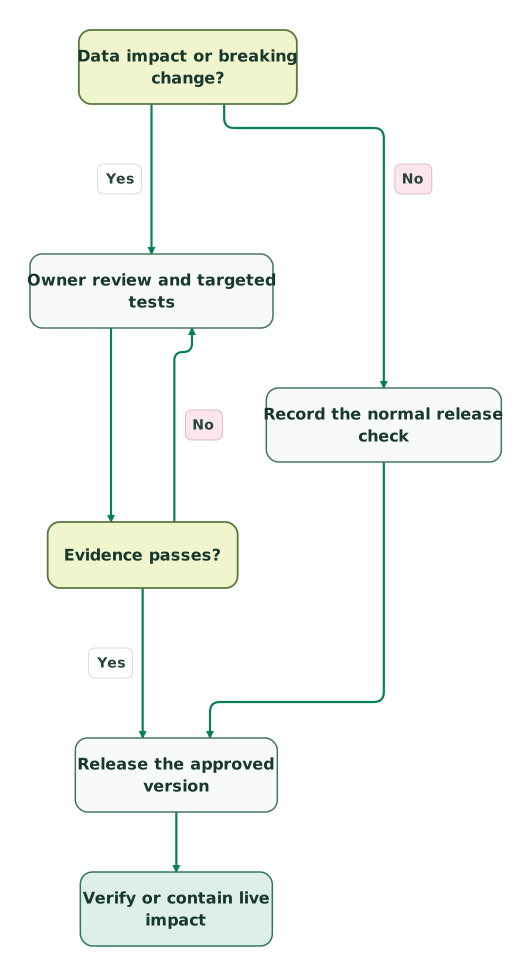
Read diagram as text
- Data impact or breaking change? to Owner review and targeted tests: Yes.
- Data impact or breaking change? to Record the normal release check: No.
- Owner review and targeted tests to Evidence passes?.
- Evidence passes? to Owner review and targeted tests: No.
- Evidence passes? to Release the approved version: Yes.
- Record the normal release check to Release the approved version.
- Release the approved version to Verify or contain live impact
The low-risk path still produces a release record. It does not grant permission to classify an unknown dependency as harmless.
How do you make application changes respect the tracking contract?
Put the relevant event requirements in the feature ticket and require review when the implementation or contract changes.
A ticket for a new checkout step should specify what counts as completion, which event occurs, which fields matter and which failed actions must not produce success. Link the existing contract rather than copying it into several documents that will diverge.
Prefer explicit application events or stable test attributes over selectors chosen for visual styling. Keep the single-page application tracking rules attached to router changes, because a route can change without a full page load.
GitHub CODEOWNERS can request the relevant review when a pull request changes owned files. Requiring code-owner approval is a separate repository setting, and owners need the appropriate repository access. GitHub code-owner behavior.
Include the tracking wrapper, contract file and critical UI components in that ownership map. Also protect the ownership file itself. A path rule that only covers an analytics folder will miss a pricing-page change that removes the element a tag depends on.
Use automated tracking QA for the executable tests. The release record should identify the tested application and tag configuration together. A pass against last week's container does not approve today's combined release.
Who should be able to publish Google Tag Manager changes?
Give publishing access to the named tracking operators and their backup, while allowing builders to prepare changes with narrower access.
GTM distinguishes container permissions clearly: Edit can change workspaces but cannot create versions or publish; Approve can create versions but cannot publish; Publish can do both. Google recommends at least two active account administrators and organizational ownership rather than sole agency control. GTM permissions.
Keep account administration, change review and routine publishing as explicit responsibilities. The permission name “Approve” does not, by itself, prove a second person reviewed a release.
Use a workspace for a coherent change, inspect its diff and give each published version a useful name and description. GTM records versions and publishing history. Its built-in approval-request workflow is available in Tag Manager 360; teams using standard GTM can retain the approval record in their existing ticket or pull request. GTM publishing and approvals.
For staging, GTM environments let you assign a container version to the intended environment. Install the correct environment snippet or use the supported preview path; the default Live environment follows the published container. GTM environments.
Before publishing, inspect inherited and direct access, the destination IDs and the selected environment. After publishing, verify the public version. The GTM implementation-mistakes guide provides the tag-level checks behind that sign-off.
How should CRM fields and workflows be changed safely?
Identify the field's writers and consumers, test the new behavior and preserve enough history to repair unintended writes.
For each CRM property or picklist change, inspect forms, workflows, lists, reports, integrations and any warehouse model that reads it. The CRM property-ownership guide defines who may write a value; the change record should show whether that authority changes.
A label change and an internal-value change are different operations. A workflow may use the internal option while a report displays the label. Test both the customer-facing form and the integration mapping rather than assuming a visible rename is cosmetic.
HubSpot's standard sandboxes are available on eligible Enterprise subscriptions. Supported assets can be copied and deployed, but integrations do not automatically connect to the sandbox. Use appropriate test integrations and verify the supported asset scope. HubSpot sandbox requirements.
When a sandbox is unavailable, define a smaller test scope with dedicated records, restricted automation and an explicit rollout plan. A duplicated workflow that still sends real customer messages is not an isolated test.
Use the correct history source during review:
- HubSpot's centralized audit log records user actions and has subscription-dependent categories. Its main views show the last 30 days; it does not capture every automated property update. Super Admins can configure the documented audit notifications, such as admin-permission removal. HubSpot audit logs.
- Record property history shows the changed value, time and source. Its Restore action is available only for supported sources, including CRM UI edits, imports and workflows. Inspect the proposed restore scope, especially when it offers all changes from a source. HubSpot property history.
For an integration-driven overwrite, fix the authoritative source or mapping before resyncing. Otherwise, the next run can overwrite the repaired value again. The HubSpot and Salesforce sync guide covers the validation and mapping side.
Which controls should protect warehouse and model changes?
Require review of the output contract, business grain and dependent uses before a model change reaches reporting or activation.
dbt platform CI builds and tests modified assets and their downstream dependencies in a staging schema, then reports the result to the Git provider. Teams using dbt Core need an equivalent CI execution path. dbt continuous integration.
Model contracts check output names and data types for supported model types. They do not apply to every resource or materialization, and constraint enforcement depends on the data platform. dbt model contracts.
Pair shape checks with business assertions. A model can retain an integer order_count column while double-counting orders after a join. A changed currency conversion can pass a type check while producing the wrong value.
Before approval, compare:
- Entity and uniqueness at the model's intended grain.
- Null, accepted-value and relationship behavior.
- A controlled set of known records.
- Aggregate amounts under the same business definition.
- Downstream reports, audiences and sync destinations.
The dbt implementation guide covers deployment mistakes, while metric contracts protect the definition consumers use. Keep ingestion schema changes inside the review boundary too; a source column can change without a pull request in the transformation repository.
A failed build should also stop the relevant downstream publication or sync. A previously built table can still exist, so “the table is there” is not evidence that the candidate run passed.
Do Amplitude, Mixpanel or Segment replace a change process?
Their native controls can enforce specific parts of the process, but the controls operate at different points in the data path.
| Tool control | What it governs | Important boundary |
|---|---|---|
| Amplitude Data branches and reviews | Proposed tracking-plan changes | Plan access varies; required reviews depend on configuration |
| Mixpanel Event Approval | Visibility of newly received events | Hiding an event does not mean it was never ingested |
| Segment Protocols | Validation and controls on supported source data | Coverage depends on the source and delivery path |
Amplitude Data supports branching and merge requests. Where team review is required, Manager or Admin permissions approve changes; an approved request can then be merged by a team member. Its current guide states that branch availability varies by plan. Verify the specific entitlement before designing your approval process around it. Amplitude branches.
Mixpanel's Enterprise Event Approval setting hides new events by default and notifies administrators, who can make them visible. That is a discovery and visibility control. Mixpanel Event Approval.
Segment Protocols is a premium Business-tier add-on for supported event-stream and Engage sources. It validates against plans and can block nonconforming events, with separate handling for quarantined data. Segment Protocols.
Test a legitimate new event and an invalid event before enabling a blocking policy. A stale plan can reject valid production behavior. Retain a recovery path and a person who can decide whether the contract or the emitter needs correction.
If these features are unavailable, use a versioned contract and required review in the repository. Compare tracking QA and monitoring tools when the missing capability is live coverage or automated enforcement.
How should event renames and release notes be handled?
Treat a rename as a consumer migration, and record the exact release boundary where the new definition takes effect.
List the old and new definitions, the emitters, destinations, reports and customer workflows involved. During overlap, ensure that a metric does not count both names as separate occurrences of the same action. The event naming guide covers the migration steps.
Keep a short change record next to the contract. This original template describes the evidence to retain:
change: Replace pricing CTA selector with explicit trial-start event
risk: high
owner: Growth operations owner
implementation: Web application and GTM container
release_reference: Link to the exact application and container versions
expected_effect: One event after successful trial creation
evidence: Link to allowed, failed and repeated-action cases
consumers: Acquisition report and advertising conversion mapping
recovery: Restore a compatible application and container pair
post_release_check: Named operator verifies the known journey
Use links to the real version and evidence rather than pasting large logs into the note. Keep the record with the operational documentation used during handover.
Record the intended effect even when counts should remain stable. “No change to purchase count or value” gives the operator something concrete to verify.
What would this process catch in a pricing-page redesign?
The process should catch the broken trigger before release and provide a bounded recovery path if it still reaches production.
Consider a hypothetical redesign that removes the CSS ID used by a trial-start tag. Before the release, 2,000 eligible pricing-page views produce 120 recorded trial starts, a 6% ratio. Afterward, another 2,000 comparable views produce six recorded starts, a 0.3% ratio.
The ratio falls by 5.7 percentage points, or 95% relative to its previous level. Those numbers are an investigation signal. The evidence establishing the tracking defect is the missing event during a known successful trial creation and the removed selector in the release diff.
Three controls address the failure:
- The feature ticket identifies trial creation as a tracked outcome.
- Review covers the pricing component and its dependent GTM trigger.
- The release test creates a controlled successful trial and checks the emitted event and destination mapping.
A page-view smoke test alone would pass. A click-only test could also pass while the wrong downstream trigger remained.
The recovery must restore a compatible application and container pair, or deploy a targeted compatible fix. Republishing an old GTM version that still expects the removed CSS ID will not repair the redesigned page.
Annotate the affected reporting interval internally and identify any advertising or lifecycle action that used the incomplete signal. Do not reconstruct missing events from an assumed historical conversion rate.
What should the rollback plan include?
The rollback plan should identify the component to restore, compatible dependencies, irreversible effects and evidence required before resuming automation.
For GTM, a saved version can be published again. For application and model code, restore the appropriate revision and execute the required deployment or rebuild. For CRM data, use supported restoration or a controlled correction from the authoritative source. The operator needs the exact versions and record population, not an instruction to “undo the last change.”
Separate configuration recovery from data recovery. Returning a workflow to its previous definition does not unsend messages, remove every downstream export or restore deleted source history.
Use the data incident runbook when impact has escaped the release boundary. The governance record should supply its owner, change scope and rollback evidence without recreating a separate incident process.
Agree in advance which failures need a postmortem. Google's SRE guidance includes data loss and monitoring failure among possible triggers and recommends setting those criteria before an incident. Google's postmortem guidance.
Keep follow-up actions specific: add the missing negative test, fix the ownership path or restrict the unsupported publishing route. “Be more careful” does not change the conditions that allowed the failure.
What belongs in a practical tracking-governance checklist?
A practical checklist should establish authority, evidence and recovery for the actual change.
Checklist
- Risk classified from affected data and consumers.
- Event, field or metric meaning linked to its current contract.
- Reviewer, publisher, release checker and backup named.
- Required permissions limited to those responsibilities.
- Application, tag, CRM and model dependencies reviewed.
- Positive, negative and repeated-action evidence retained.
- Approved versions identified together.
- Live verification checks the consequential outcome.
- Recovery distinguishes configuration from existing data.
- Affected reports and customer actions have a correction owner.
Keep ongoing marketing data-quality monitoring active after the release check. Governance reduces avoidable change failures; monitoring supplies evidence when the real environment behaves differently.
Keep reading
Browse all Martech Strategy guides
 Martech Strategy
Marketing Ops Documentation: Seven Records That Survive Turnover
Maintain seven martech operating records with owners, metadata exports and review triggers. Includes a runbook, decision log and practical handover test.
Jafrin Akter AloLast updated 15 min read
 Martech Strategy
Martech Handover Checklist: Transfer Control Without Breaking the Work
Hand over tracking, CRM, warehouse and automation safely. Map runtime identities, transfer control and prove workflows still run after old access is removed.
Jafrin Akter AloLast updated 16 min read
 Martech Strategy
Martech QA Checklist: 12 Tests Before a Launch
Test a martech launch across tracking, CRM, warehouse and messaging. Use twelve cases, real-user UAT, record-level reconciliation and versioned sign-off.
Jafrin Akter AloLast updated 14 min read
Analytics & tracking
See the implementation scope, deliverables and acceptance checks.
Questions people ask
How can a small team review changes without creating a queue?
Use a short change record and review only the dependencies relevant to the risk. One person can hold several roles, but record where independent review is unavailable and narrow the rollout accordingly. Reserve deeper review for consequential changes. Keep a backup reviewer and an escalation deadline so routine work does not wait indefinitely for one person.
Does an emergency fix need the same approval sequence?
Use an agreed emergency path when waiting would prolong material harm. Name who may contain the issue, what they may change and who must review afterward. Preserve the previous configuration and the evidence that justified the action. An emergency path should shorten the sequence while keeping accountability, rather than removing the record of what changed.
Should an AI agent receive GTM Publish access?
Give an agent only the access needed for its authorized job. An agent preparing a diff or test report does not need routine publishing authority. If a workflow permits publishing, bind that permission to the approved version, test evidence and operating controls. The responsible owner still needs a clear way to pause, inspect and recover the change.
How do we govern a SaaS integration that changes outside our repository?
Record its owner, configuration, change notifications and the customer journeys it affects. Include a small acceptance check after relevant vendor or configuration changes, and retain exports where the product supports them. Repository review alone cannot observe every external change. Combine the operating record with monitoring and a defined escalation path for vendor-controlled behavior.
Can a rollback make an affected historical report trustworthy again?
Only if the underlying records can be recovered and the corrected report reconciles. Restoring configuration stops or changes future behavior; it does not automatically repair the past. Identify the affected population, available source evidence and supported replay path. Preserve an explicit gap when reliable reconstruction is impossible, and communicate any changed totals to report consumers.
Sources
- Google Tag Manager permissions
- Google Tag Manager publishing and approvals
- Google Tag Manager environments
- GitHub code owners
- HubSpot sandbox requirements
- HubSpot audit logs
- HubSpot property history
- dbt continuous integration
- dbt model contracts
- Amplitude Data branches
- Mixpanel Event Approval
- Segment Protocols
- Google SRE postmortems

Written by
Jafrin Akter AloData Engineer and Co-founder at Martechdevs and Growth and Analytics Partners
Jafrin writes practical guides to marketing technology, customer data, analytics and AI workflows. Martechdevs is a Growth and Analytics Partners company.