
mParticle vs Segment: Identity, Event Routing and CDP Cost
Pick mParticle when the program needs an explicit identity strategy across application and customer-data workflows; pick Segment when standardized event routing and a staged path from Connections to broader CDP capabilities fit the team. mParticle vs Segment should be decided on the resulting profiles and destination behavior. Compare equivalent identity, audience and delivery scope before treating a pipeline entry price as a complete CDP quote.
On this page
mParticle vs Segment comparison
Segment's published USD entry terms cover Connections; mParticle and broader Segment CDP requirements need a qualified commercial offer.
| Decision | Rokt mParticle | Twilio Segment |
|---|---|---|
| Public commercial route | Sales-assisted platform scope and contractual usage rates | Connections Free; Team from $120/month for 10,000 visitors |
| Free evaluation basis | Agree the evaluation scope with the vendor | Free: 1,000 visitors/month, two sources and one warehouse destination; Team trial fourteen days |
| Identity design | IDSync strategies and identifier priority | Identify event specification; broader profile resolution through Unify scope |
| Activation boundary | Event outputs and audience outputs are distinct | Connections routing, Reverse ETL and separately packaged CDP capabilities |
| Main selection risk | Incorrect identity strategy or output consent behavior | Assuming Connections includes every identity and audience capability |
See the Rokt mParticle platform, mParticle usage model, Segment Connections pricing and Segment CDP scope. The mParticle name remains in its product and documentation; its current public platform is presented as Rokt mParticle.
We would evaluate both against the same customer cases: anonymous activity followed by login, a changed email, a shared device and a customer whose permission changes. A successful event request is only the first step. The accepted result is the intended profile, permitted output and correct record in the receiving tool.
At Martechdevs, we implement those contracts through our customer data platform and warehouse service. The pilot starts with identity and event meaning so the later audience and messaging work has a dependable foundation.
mParticle and Segment decision blocks
mParticle
- Best for: A team whose customer-data design needs deliberate choices about anonymous history, known users and identifier precedence.
- Pros: IDSync provides identity strategies and a priority order for matching identifiers. The team can evaluate those choices against the application's real login and profile behavior. See IDSync components.
- Cons: Strategy and priority choices need a data owner. The platform cannot determine the correct business identity merely from several plausible identifiers.
- Free plan and startup offer: The current platform page offers an expert-led discussion. Agree sandbox, SDK, destination and trial terms in the proposal; no permanent production free allowance or universal startup concession is assumed.
- Choose it if: Its identity and output model passes the hard customer cases and the team can maintain the selected strategy and commercial scope.
- Skip it if: The requirement is only a narrow event-routing task and the proposed identity, audience and platform arrangement adds work without a defined use.
Segment
- Best for: Developers standardizing event collection and routing, with an explicit decision about any additional profile and audience products.
- Pros: The Identify specification provides a consistent user-and-traits contract. Unify offers broader identity-resolution scope when included in the selected arrangement.
- Cons: Connections and the full CDP have different commercial boundaries. An Identify call does not prove that every downstream tool merges the customer exactly as intended.
- Free plan and startup offer: Connections Free covers 1,000 monthly visitors, two sources and one warehouse destination. Team has a fourteen-day trial and a published $120/month entry basis. No startup credit is included in the regular budget. See Connections plans.
- Choose it if: The required sources and destinations fit its event contract and the complete selected scope passes identity and output validation.
- Skip it if: The buying case prices only Connections while relying on separately packaged identity resolution, audiences or orchestration.
Event routing and the complete CDP boundary
Collecting and forwarding an event is different from maintaining an identity-resolved customer profile and operating audiences from it. A small implementation may need only the first job. A lifecycle program with several applications and destinations may require both, plus a reliable permission and deletion process.
Twilio separates Connections from the broader Customer Data Platform, which combines Connections, Unify and Engage. Its pricing page describes unified profiles, audiences and orchestration in that larger scope. Use those boundaries when requesting a quote. See Segment customer-data products.
mParticle also distinguishes event outputs from audience outputs. An event integration accepts user-triggered activity; an audience integration receives a collection of users. A vendor logo in the integration catalog therefore does not prove that both delivery modes support the required operation. See mParticle output types.
Write an inventory for each destination. Include the event or profile fields required, the expected identifier, the allowed delivery route and the business owner. Test the particular operation rather than checking only that the destination is listed.
If the requirement is bulk data ingestion into a warehouse, Airbyte alternatives covers that adjacent problem. For activation of already prepared warehouse models, Hightouch alternatives compares a narrower route that may avoid buying unnecessary CDP scope.
Identity strategies and customer transitions
mParticle IDSync resolves a request using the identifiers supplied and the selected identity strategy. Its documented components include profile conversion, linking and isolation approaches, with identifier priority influencing which profile is selected. The business should decide the intended treatment of anonymous activity before implementation. See IDSync strategy and priority.
A product with shared devices may need different treatment from an application used by one person on several devices. An anonymous browsing history should not automatically become the next person's history merely because the device is the same. Build those cases into the acceptance plan rather than assuming the default strategy matches the business.
Segment's Identify call requires a user identifier or an anonymous identifier and can carry user traits. Its Unify identity graph provides a broader profile-resolution capability across touchpoints. The collection contract and the identity graph are related but distinct parts of the design. See Identify and Unify identity resolution.
| Customer case | Required business decision | Evidence to inspect |
|---|---|---|
| Anonymous visitor signs in | Intended anonymous history association | Profile timeline and destination identity |
| Person changes email | Stable customer with updated contact information | Old and new identifier behavior |
| Another person uses the same device | Appropriate separation of customer histories | Logout and next-login result |
| Customer belongs to several accounts | Correct account context for each action | Account relationship and event properties |
| Conflicting identifiers arrive together | Approved identifier precedence | Selected profile and subsequent output |
The identity merge guide helps define the expected result. Keep those expected results with the implementation so a later SDK or identifier change can repeat the same cases.
Permission state and audience delivery
Audience membership and permission to forward that audience are separate concepts. mParticle's consent filters apply when audience data is forwarded to an output, and the documentation says they do not change the audience membership or size displayed inside mParticle. A smaller destination population can therefore be an intended result. See mParticle consent filters.
Consider a hypothetical reconciliation with 1,000 members in a source audience. Suppose 200 are excluded from a particular output by the agreed permission rule. The expected eligible output is 800. If a hypothetical destination accepts 795 and rejects five, the source-to-output difference has two separate causes.
| Hypothetical measure | Calculation | Result | Interpretation |
|---|---|---|---|
| Source audience | Given population | 1,000 | Membership before output filtering |
| Permitted output | 1,000 minus 200 | 800 | Intended forwarding population |
| Accepted destination records | 800 minus 5 | 795 | Hypothetical accepted writes |
| Delivery acceptance | 795 ÷ 800 | 99.375% | Acceptance among eligible output |
The 200 excluded records are not delivery failures. The five rejected records need investigation. Reporting only that 795 of 1,000 members arrived would conceal the distinction and could encourage someone to remove a valid exclusion.
Apply the same expected-population discipline in Segment. Define the permission authority, the destination filter and the behavior after a change. Inspect the destination with a customer who becomes ineligible during the test. A profile flag visible in the CDP is insufficient evidence that every output respects it.
Segment vs mParticle cost models
Segment Connections prices its entry offer around monthly tracked users, including the identified and anonymous population described by its billing definition. Throughput and other usage can also matter. Use the actual account usage report and documented identity handling when estimating volume. See Segment usage and billing.
Assume a hypothetical month contains 6,000 identified MTUs and 3,000 anonymous MTUs that are disjoint under the applicable billing rules. The total is 9,000 MTUs, within the stated 10,000-user Team entry scope. At a $120 monthly base, twelve unchanged monthly payments would total $1,440 before other charges. These are scoped planning assumptions, not a quote for a complete CDP. See Connections pricing.
Twilio's current pricing page shows differing additional-MTU figures in its detailed table and FAQ. Use the approved usage schedule for overages. The example above stays within the consistent published entry allowance, rather than presenting one conflicting overage figure as universal.
mParticle's value-based pricing documentation describes prepaid credits consumed by contracted billing items. Event tiers, retention, real-time products, rule invocations and other activities can affect usage. The contract supplies unit prices, so a public event count cannot be turned into a universal dollar amount. See mParticle usage metering.
Give both vendors the same workload sheet: source applications, measured users, events by purpose, required history, audience count, destinations, support and implementation. Preserve each vendor's own units. A pipeline entry plan and a larger identity-and-audience package are different scopes.
For a separate hypothetical migration calculation, assume a complete steady-state saving of $700/month and $12,600 of one-time transition work. Simple payback is eighteen months after savings begin. If two months of additional parallel service cost $500/month, transition cost becomes $13,600 and payback becomes approximately 19.43 months. These inputs are illustrative and exclude any unlisted costs.
The Segment pricing guide and software pricing tool help structure the commercial comparison. Keep required engineering work and ordinary renewal terms beside the subscription.
Debugging evidence and destination acceptance
mParticle's identity-resolution log describes the lookup mutations made during identity resolution. It is a debugging tool rather than a complete audit log, and read operations are not displayed as mutation entries. Use it to investigate a profile result without treating an absent entry as proof that no identity lookup occurred. See identity-resolution logs.
For either platform, retain a known event with its source timestamp, business identifier and intended destination result. Inspect ingestion, transformation, routing and receipt as separate stages. A request accepted by the CDP can still be rejected or mapped incorrectly downstream.
Use a second destination in the pilot if the business relies on more than one consumer. An analytics tool and a messaging platform may expect different identifiers or event structures. The same upstream event can therefore need different approved mappings while preserving its business meaning.
The marketing data quality guide provides a useful reconciliation framework. Assign ownership of schema changes before a new field or renamed event breaks a downstream journey.
Migration and historical continuity
Do not assume SDK method names are interchangeable. mParticle publishes a Segment-to-mParticle migration reference that maps identity and event concepts, including differences in event structures. Use it as a starting point for the actual SDK and destination configuration, then validate the business cases. See the migration reference.
Decide how historical data is retained and whether it needs replay. Replayed activity can alter audiences or trigger downstream actions. Define the eligible period and destination behavior before enabling a backfill, with live action-producing outputs controlled for the evaluation scope.
Keep one authoritative production route per business event during cutover. Parallel collection can help compare payloads, but duplicate delivery to the same messaging or advertising destination can create unintended actions or inflate reporting. A destination-level ownership register makes the transition easier to inspect.
Retire the old setup only after identity, permission, event and destination checks pass for a bounded cohort. A successful import count is insufficient if the receiving system has the wrong customer relationships or missing exclusions.
Best fit by customer-data program
| Company or operating model | Best fit | Runner-up | Decision reason |
|---|---|---|---|
| Application team needing deliberate IDSync strategy choices | mParticle pilot | Segment Unify scope | Identity transitions and precedence lead the requirement |
| Developer team standardizing collection and routing | Segment Connections | mParticle | Event contracts and destination delivery are the first job |
| Lifecycle team needing resolved profiles and audiences | Complete CDP pilot | The other qualified package | Pipeline-only prices do not cover the whole requirement |
| Existing customer of either platform with one bad mapping | Current-platform repair | Qualified replacement | A bounded correction can avoid SDK migration |
| Warehouse-first team mainly syncing approved audiences | Activation-focused shortlist | Broader CDP only if required | The actual job may be narrower than full event collection |
Customer-data platform decision
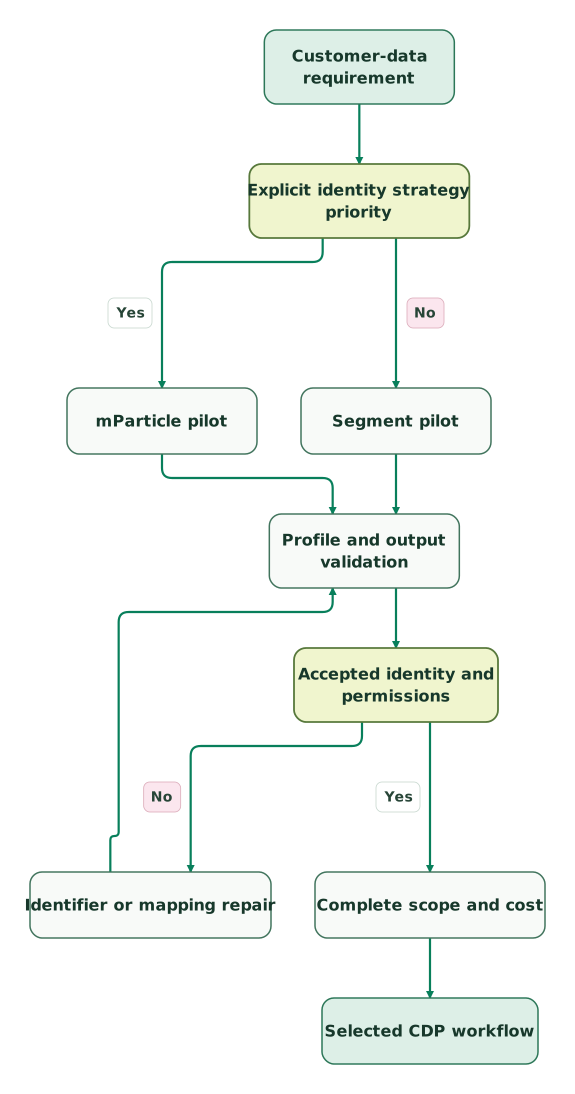
The graph routes the first pilot by identity-strategy requirements, then requires both paths to pass profile and output checks. Repairs repeat validation before the full commercial and operating scope is accepted.
Read diagram as text
- Customer-data requirement to Explicit identity strategy priority.
- Explicit identity strategy priority to mParticle pilot: Yes.
- Explicit identity strategy priority to Segment pilot: No.
- mParticle pilot to Profile and output validation.
- Segment pilot to Profile and output validation.
- Profile and output validation to Accepted identity and permissions.
- Accepted identity and permissions to Identifier or mapping repair: No.
- Identifier or mapping repair to Profile and output validation.
- Accepted identity and permissions to Complete scope and cost: Yes.
- Complete scope and cost to Selected CDP workflow
mParticle and Segment checklist
- A distinct requirement for routing, identity, audience and activation work.
- Stable user identifiers and approved anonymous-history treatment.
- Shared-device, email-change and conflicting-identifier test cases.
- A separate account relationship where the business needs it.
- Permission-aware expected populations for each output.
- Source-to-destination event and profile reconciliation.
- Contract units and required product packages stated explicitly.
- A historical replay plan with action-producing outputs controlled.
- One authoritative production delivery route during migration.
- A second owner able to investigate an incorrect profile or rejected output.
Use the marketing data audit skill to retain the identity and source evidence. The decision should leave the team with a customer-data process it can explain and repair after the initial implementation.
Keep reading
Browse all Data Warehouse guides
 Product Analytics
Identity merge in Mixpanel, Amplitude and PostHog explained
Mixpanel identity merge compared with Amplitude and PostHog: identify and reset behaviour, client and server IDs, shared devices and historical repair limits.
Jafrin Akter AloLast updated 15 min read
 Data Warehouse
Segment Pricing: Twilio Segment Plans, MTU Costs and How to Control Them
Segment pricing explained: the Free plan, Team from USD 120 a month for 10,000 MTUs, Business quotes, extra usage meters and how to cut avoidable MTU spend.
Jafrin Akter AloLast updated 13 min read
 Data Warehouse
Marketing Data Quality: How to Monitor, Alert and Fix What Breaks Over Time
Marketing data quality slips after launch. See what breaks, which checks catch it, how to route alerts to owners and repair data safely, with a checklist.
Jafrin Akter AloLast updated 16 min read
Data warehouse & CDP
See the implementation scope, deliverables and acceptance checks.
Questions people ask
Does Segment Connections Team include every feature needed for a full CDP replacement?
Segment Connections Team should not be assumed to include every full-CDP feature. Twilio separately describes identity-resolved profiles, audiences and orchestration in its broader CDP scope. Start with the required workflow and obtain the corresponding package, rather than comparing its complete cost with the Connections entry price. See Segment product pricing.
Can a smaller mParticle destination audience reflect correct consent handling?
A smaller mParticle destination audience can reflect correct consent handling. Its consent filters apply when audience data is forwarded and do not change the audience size displayed inside the platform. Reconcile source membership, permitted output and rejected delivery separately before treating the difference as missing data. See mParticle consent filters.
Are mParticle identity-resolution logs a complete audit of every lookup?
mParticle identity-resolution logs are a debugging tool rather than a complete audit of every lookup. The documentation says they show lookup mutations, while read operations are not displayed as mutation entries and rare events may be missing. Use the logs alongside known customer cases and destination evidence. See identity-resolution log guidance.
Should an email address always be the highest-priority CDP identity?
An email address should not automatically be the highest-priority CDP identity. Addresses can change, be shared or represent different business relationships. Define a stable business-controlled identifier and the intended precedence among other identifiers, then test conflicts and shared devices. The correct choice depends on the customer model and the identity behavior the organization has approved.
Can historical CDP event replay be treated as a harmless data copy?
Historical CDP event replay should be treated as potential downstream activity. Replayed events can change audiences, update profiles or trigger actions in receiving tools. Define the intended historical range and destination behavior, control action-producing outputs during validation and reconcile a small sample before expansion. A complete replay plan includes both data accuracy and the effects of delivery.
Sources
- Rokt mParticle platform
- mParticle IDSync components
- mParticle event and audience outputs
- mParticle consent filters
- mParticle value-based usage metering
- mParticle identity-resolution logs
- Segment-to-mParticle migration reference
- Segment Connections pricing
- Segment CDP pricing and scope
- Segment Identify specification
- Segment Unify identity resolution
- Segment usage and billing definitions

Written by
Jafrin Akter AloData Engineer and Co-founder at Martechdevs and Growth and Analytics Partners
Jafrin writes practical guides to marketing technology, customer data, analytics and AI workflows. Martechdevs is a Growth and Analytics Partners company.