
Segment Alternatives for Small Teams: Pick the Right Replacement
Data Engineer and Co-founder, martechdevs
Last updated 11 min read
The right Segment alternative depends on what would break if you removed Segment tomorrow. A warehouse feed, an advertising conversion, a product analytics event and a customer audience are different jobs. Replace the jobs you use, then compare the cost of keeping them working.
Last updated: 2 October 2026.
Define the replacement before choosing a vendor
Write down one required outcome for each part of your current implementation:
- Collection: which browser, app and server events must arrive?
- Delivery: which destinations need them, with which fields and timing?
- Identity: which anonymous, user and account relationships must survive?
- Activation: which audiences, traits or journeys depend on those relationships?
Add recovery to every outcome. “The purchase reaches the warehouse” is incomplete if an outage can erase a day's purchases with no way to recover them.
A small SaaS team might need activation reporting, a CRM account signal and one onboarding trigger. A retailer might need purchase deduplication, paid-media delivery and audience suppression within minutes. Those requirements produce different shortlists even at the same traffic volume.
Use this diagram to identify a starting point. It is a selection framework, not a claim that each product serves only one purpose.
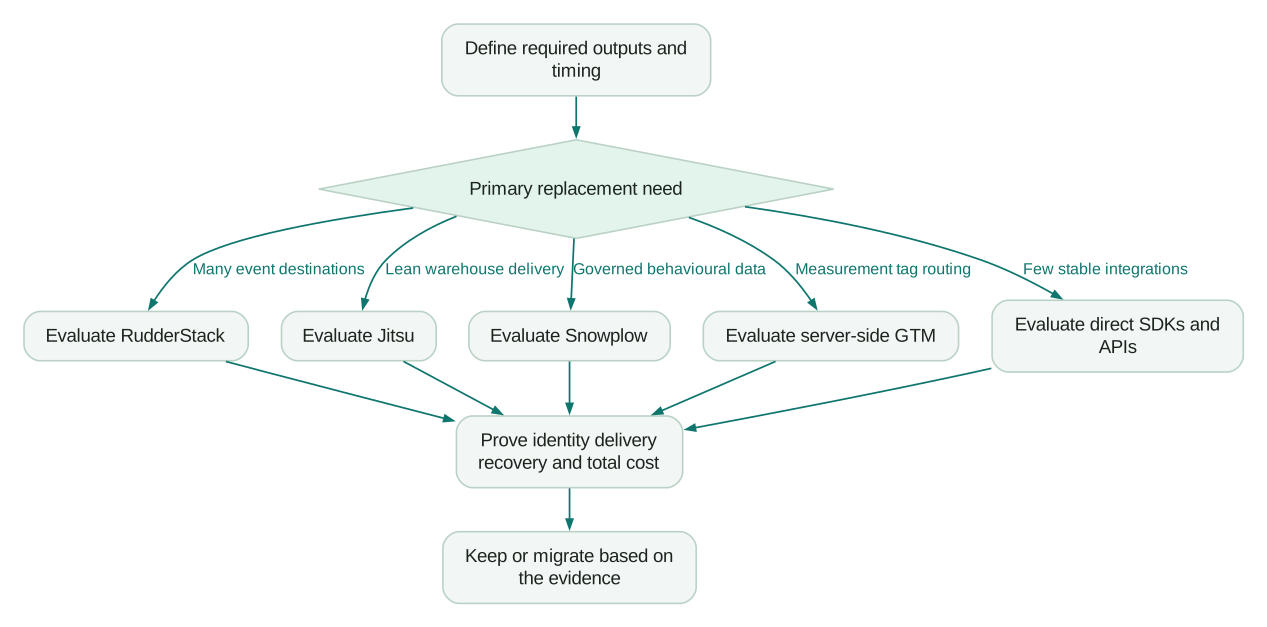
If the real requirement is a broader customer-data system, use the composable CDP guide to map collection, modelling and activation before comparing individual tools.
1. RudderStack for a maintained event-routing layer
Shortlist RudderStack when you need multiple SDK sources, packaged destinations, transformations and warehouse delivery, with a technical team owning the implementation.
Its current public plans are Free, Growth and Enterprise. Free includes 250,000 events monthly; Growth starts at $265 monthly for one million events. The pricing page lists warehouse sync intervals of three hours, 30 minutes and five minutes respectively. Profiles and Data Apps are available through Enterprise. RudderStack pricing.
The practical advantage is having a shared layer for event delivery instead of maintaining a separate integration for every destination. The practical question is whether your required transformations and destination actions are supported in the plan you can afford.
Request a demonstration using your payload. A destination logo does not establish support for the specific object, method, custom field, consent signal or delivery mode you need. Include one awkward case, such as changing an account's plan after a refund.
RudderStack's current billing documentation distinguishes Growth's event-based overages from legacy Starter's tier-based model. Collected and activated events contribute to Growth overage volume. Do not price a new account from an older Starter comparison. Plan and billing rules.
RudderStack is worth testing when destination maintenance is consuming engineering time. It is less compelling when you would buy a broad routing layer to support one stable integration. Do not assume that changing vendors removes the need for a tracking plan or identity design.
2. Jitsu for a focused warehouse pipeline
Shortlist Jitsu when the first job is getting usable event data into your own warehouse and you can verify a relatively small set of downstream routes.
The public Cloud plan includes 200,000 active events free. Business lists $99 monthly for two million active events, then $40 per additional million. An event delivered to several destinations still counts once; function multiplexing creates separately counted outputs, and an outgoing function HTTP request can make a dropped event billable. Connector sync charges are separate. Jitsu pricing.
That pricing can suit a large anonymous audience generating relatively few useful events. It can also encourage a good design question: which events need to leave collection and serve an actual consumer?
Do not equate a low pipeline price with a complete replacement for every profile or audience feature. There is an entitlement conflict to resolve: the pricing page lists Identity Stitching across plans, while its dedicated documentation says Enterprise Cloud only. Confirm access before including automatic stitching in a $99 comparison. Jitsu Identity Stitching.
Recovery also needs explicit attention. Jitsu documents Cloud event backups, with restoration performed by its team. Self-hosted Jitsu does not provide that archive automatically; configure a warehouse or file-storage destination when you need a raw copy. Backups and retention.
The pilot should therefore cover both ordinary delivery and a missing-data incident. Verify what can be restored, who requests the replay and whether the destination receives duplicate business actions. A functioning debugger alone does not prove recoverability.
3. Snowplow for governed behavioural data
Shortlist Snowplow when reliable behavioural datasets are a product capability: activation models, detailed journeys, experimentation inputs or customer context used across teams.
Its pipeline distinguishes failed events from the main atomic events table. Schema mismatches, missing schemas and enrichment failures can create failed events; common failures can be loaded into a separate warehouse table for inspection and repair when configured. Snowplow failed-event handling.
That separation is useful when “we received an event” is insufficient. You want to know whether the data conforms to the contract that downstream analysis expects, and what happened to records that failed.
There is still work to own. Someone must define schemas, coordinate releases, inspect failures and maintain models. A strict pipeline can reveal a broken product release quickly, but only if a person receives and acts on the signal.
Snowplow's current pricing is quote-based and includes a managed platform plus a self-hosted production option. The managed scope now includes profile and real-time customer-intelligence capabilities; treating it as only a raw event collector would be outdated. Ask for the exact deployment, modules and usage basis in the quote. Snowplow pricing.
For a small team with one reporting dashboard and no data owner, the operating model may be heavier than the problem requires. For a team already investing in governed behavioural data, evaluate it against the cost of building and maintaining that capability yourself.
4. Server-side GTM for measurement and advertising delivery
Shortlist server-side Google Tag Manager when the job is receiving measurement requests, applying routing and transformation rules, and sending data to analytics or advertising endpoints.
Google's server container uses clients to interpret incoming requests and tags to process and forward events. It runs on infrastructure you control. Server-side tagging architecture.
This is a strong candidate for a focused measurement project. A server container alone is not a persistent customer database, a maintained identity graph or a complete journey engine. If those outputs are required, specify the additional storage, modelling and activation components.
Hosting has a real cost. Google's Cloud Run setup guide estimates approximately $45 monthly per instance for its stated configuration and recommends two instances to reduce outage risk. That makes roughly $90 a starting compute illustration, before scaling, networking and other costs, not a universal production quote. Cloud Run setup and cost assumptions.
Evaluate it with the server-side GTM setup guide. Check destination acceptance and conversion deduplication, not just whether the preview screen shows a tag firing. Preserve consent choices throughout the route.
5. Direct SDKs and APIs for a deliberately small stack
Direct integration is a reasonable architecture when a few stable destinations cover the actual need and engineering can own their behaviour.
A small product could send interaction events to its analytics provider, trusted billing events from the backend to the warehouse, and a small number of lifecycle signals to its messaging platform. You avoid paying for a general routing layer, but take responsibility for the connections.
Create one application-level event contract even if delivery uses several APIs. Otherwise each team can independently define what “activated” means, leaving three working integrations and three incompatible reports.
Budget for retries, failed deliveries, identity mapping, consent handling, API changes and historical recovery. For business-critical backend events, assess whether a durable outbox or queue is needed so a temporary destination failure does not lose the event or block the customer transaction.
A warehouse does not automatically solve collection. If your plan is to export from the analytics provider later, verify the export's history, fields, freshness and entitlement. Data that never reached that provider cannot be recovered from its export.
Choose this route because the required scope is small and understood. Reconsider when every new destination causes a product release, mappings diverge or nobody can trace a failed event end to end.
Compare the billing units on the same workload
“Events are cheaper than users” is not a reliable rule. User count, events per user, activation traffic and required product features all matter.
Consider two fictional workloads, each with one million collected events monthly. Assume those events are billable under the relevant event plan and all become active in Jitsu; exclude extra activation volume, connector sync fees, taxes and downstream services.
- Workload A: 50,000 Segment MTUs averaging 20 events each. Segment's documented monthly Team bands give $575; RudderStack's one-million Growth tier is $265; Jitsu Business is $99.
- Workload B: 10,000 Segment MTUs averaging 100 events each. Segment's Team base is $120, while the same RudderStack and Jitsu event tiers remain $265 and $99.
The Segment amounts follow its monthly Team billing rules. The RudderStack and Jitsu amounts use the linked current pricing above. These are collection-price illustrations with deliberately limited scope, not equivalent full-CDP quotes or measured customer bills.
RudderStack is cheaper than Segment in A and more expensive in B. A feature needed only on a higher plan could reverse either purchasing decision. The Jitsu estimate also does not resolve the Identity Stitching entitlement conflict.
Select the intended tier before comparing. Exceeding a small tier's allowance can produce a different bill from buying the appropriate larger tier in advance. Price the launch month as well as the current average.
Use the Segment pricing guide to reconcile the current bill first. Migrating an implementation that creates accidental IDs or excessive events can carry the defect into a different billing model.
Self-hosting changes who does the work
Check the actual repository and version before grouping products under “open-source Segment alternatives.” Jitsu's repository uses MIT. RudderStack's server uses Elastic License 2.0, which includes a restriction on offering substantial functionality to third parties as a hosted or managed service. They are not interchangeable licences. Jitsu licence, RudderStack server licence.
Snowplow's SLULA-covered software permits non-production or non-commercial use under its defined terms; its pricing page offers a separate production route. Do not budget a current commercial deployment as unrestricted free software based on an old open-source article. Snowplow SLULA 1.1.
Operating effort matters even where the software licence is free. Jitsu's current documentation requires Kubernetes for a feature-complete deployment; the deprecated Docker Compose setup cannot run functions, profile builders or connector syncs. Jitsu self-hosting.
Use a cost model with internal capacity shown separately from cash. For example, assume self-hosting costs $180 monthly in infrastructure plus eight support hours valued at $100 each. That is $980 of monthly economic cost. A hypothetical managed option at $400 plus two support hours is $600.
The self-hosted option has a smaller external bill but consumes $380 more total capacity-adjusted cost each month. Ignoring setup, it would need support below 4.2 hours monthly to beat the managed case under those assumptions. These are planning inputs, not claims about any vendor's actual support burden.
Run a pilot that can disqualify a candidate
Choose one customer journey and a small event set covering its business outcome. Keep the original business definitions stable. If you rename events, rebuild identity and change the funnel during the migration, you will struggle to explain any reporting difference.
Create a test agreement before sending traffic. The following is an original example; its thresholds are requirements to adapt, not product guarantees:
pilot: activation_pipeline_replacement
event_types: [signup_completed, workspace_created, first_report_saved]
warehouse_deadline_minutes: 60
activation_destination_deadline_minutes: 5
cases:
  - anonymous_then_login
  - logout_then_different_user
  - same_event_retried
  - destination_unavailable_then_restored
  - consent_denied
  - invalid_required_property
compare: [event_id, occurred_at, user_id, workspace_id, destination_result]
traffic: synthetic_first_then_approved_production_sample
outbound_campaign_actions: disabled_during_shadow_test
A warehouse path can meet the first deadline and still fail the activation deadline. Measure each at its final consumer. Compare timestamp meaning and identity values, not just event totals.
Use stable event IDs for reconciliation. If the expected set has 1,000 IDs and the new path has 990 matching IDs plus ten duplicates, a 1,000-row total hides 1% missing coverage. A recovery test should restore the ten missing IDs without treating the ten duplicates as new customer actions.
Jitsu documents a Segment Webhooks route for sending a copy into Jitsu. Such a sidecar can help inspect output, but events still pass through Segment, so it is not itself a migration or a way to eliminate the Segment bill. Segment Proxy setup.
Keep mirrored data isolated from live campaign triggers and conversion uploads. Decide which route owns each destination during cutover. Leaving both paths active can produce duplicate sends even when the warehouse deduplicates correctly.
Before switching, require evidence for these checks:
Checklist
- Required fields and identities match for every test case.
- Each consumer meets its agreed delivery deadline.
- Consent-denied and account-switching cases behave correctly.
- Missing and duplicate events are measured separately.
- A destination outage has a tested recovery procedure.
- Historical data remains available in an agreed schema.
- Feature entitlements and the intended billing tier are confirmed.
- One person owns rollback, support and the post-cutover review.
Keep Segment if the alternative cannot pass the necessary cases at a better total cost or with a capability you actually need. A renewal is a valid outcome of a careful comparison.
For help with the decision and implementation, our data warehouse and CDP service can scope the required routes, identity model and migration work. Start with the event-to-destination map and the business decisions it supports.
Questions people ask
What is the best Segment alternative for a small team?
For broad event routing, evaluate RudderStack. For a focused warehouse pipeline, evaluate Jitsu. For governed behavioural data, consider Snowplow. For measurement routing, consider server-side GTM. Direct integrations can fit a small, stable stack. Choose by the required outcomes and the team that will operate them.
Is RudderStack cheaper than Segment?
It depends on event density and product scope. The worked examples show the comparison changing when the same one million events come from 50,000 rather than 10,000 tracked users. Include activated events, the selected tier and any higher-plan features before deciding.
Which alternatives are open source?
Jitsu's cited repository is MIT-licensed. RudderStack's server is source-available under Elastic License 2.0. Snowplow components and versions have differing licensing, including the cited limited-use terms. Check the software you would deploy rather than relying on a broad “open source” label.
Can server-side GTM replace a CDP?
It can replace some event collection and forwarding work. Persistent profiles, identity relationships, audiences and journey orchestration require additional components if your implementation depends on them. Compare the complete proposed architecture against the current CDP scope.
Does Segment-compatible mean a migration is automatic?
No. Compatible event methods reduce instrumentation work, but destinations, warehouse schemas, consent behaviour, identity history and recovery still need verification. A successful request is only the first check. The migration is ready when the required downstream outcomes and rollback procedure have been demonstrated.
Sources
- RudderStack pricing
- RudderStack plans and billing
- Jitsu pricing
- Jitsu Identity Stitching
- Jitsu backups and retention
- Snowplow failed-event handling
- Snowplow pricing
- Google server-side tagging architecture
- Google Cloud Run tagging setup
- Segment monthly Team billing
- Jitsu repository licence
- RudderStack server licence
- Snowplow SLULA 1.1
- Jitsu self-hosting
- Jitsu Segment Proxy
Written by
Jafrin Akter AloData Engineer and Co-founder, martechdevs
Jafrin Akter Alo is a data engineer and co-founder of martechdevs, where the team has delivered 74+ martech, data and growth stack implementations.