
GTM Engineer Skills: What to Learn and How to Prove You Can Build
A GTM engineer needs to turn a commercial rule into a reliable workflow: identify the right record, obtain useful evidence, make a reviewable decision and perform a controlled action. Learn one CRM deeply, understand APIs and tables, and practice failure recovery. The strongest portfolio proves what happens with missing data, duplicate deliveries and changing permissions, not just a successful run on clean records.
On this page
Which eight skills should a GTM engineer develop first?
Develop six technical capabilities and two commercial capabilities around one complete workflow. The point is to make a useful system operate correctly, not to accumulate disconnected tool badges. The GTM engineering role guide explains the broader mandate; this guide turns it into a learning and assessment plan.
| Skill | What good looks like | Evidence you can show |
|---|---|---|
| CRM data modeling | Correct objects, associations, identities and field ownership | A mapped account/contact workflow with duplicate and missing-match cases |
| APIs and webhooks | Authenticated, paginated and safely retried integration | A run log showing partial failure and controlled recovery |
| SQL and tabular reasoning | Correct grain, joins, nulls and reconciliation | Expected results that still match after a difficult input is added |
| Enrichment and identity | Only useful missing data is purchased and accepted | Provenance, rejection reasons and cost per accepted record |
| AI with evidence | Structured, reviewable output with an unknown path | Unsupported claims are rejected before action |
| Deliverability and preferences | Appropriate sending path with working suppression | Received-message and preference-propagation checks |
| Commercial decision design | Explicit ideal customer, exclusions, scoring and ownership | Written rules that sales can approve and challenge |
| Operating judgment and measurement | Safe action, monitoring, handover and useful outcomes | Another operator can pause, repair and rerun the system |
Onfire's analysis of 209 postings reports that 95% mention AI, LLMs or agents and 56% request SQL, Python or JavaScript. Only three named Clay alone. That supports learning systems rather than one interface, but it does not make every listed tool mandatory for every role. Onfire's posting analysis
If your team needs the workflow running before it has the specialist, GTM engineering implementation and handover can establish the system and acceptance criteria. The same criteria should guide the future hire.
Which background gives you the best starting point?
Use your existing strength, then close the gaps the workflow exposes. Commercial operators often understand where a sales handoff fails; engineers may already understand state and testing. Neither background automatically supplies the other half of the job.
RevGuild's separate sample of 44 practitioner profiles reports a median 7.4 years of prior experience before the GTM engineer title. That describes a bounded sample, not a minimum experience requirement or a promise that a course can replace it. RevGuild practitioner analysis
| Starting background | Likely strength to retain | Gap to demonstrate next |
|---|---|---|
| SDR or account executive | Prospect relevance, objections and sales context | CRM data models, integration behavior and measurement |
| RevOps or marketing operations | Process, CRM state and stakeholder coordination | Custom logic, testing, versioning and failure recovery |
| Analyst or analytics engineer | Data quality, SQL and metric definitions | Controlled operational writes and sales-user adoption |
| Software engineer | Code, deployment and reliability | Commercial rules, customer relevance and prioritization |
| Founder or generalist | Business context and rapid decision making | Repeatable operating controls and handover beyond yourself |
Treat these as questions to investigate, not judgments about an individual. Ask what the person has built, how it failed and what evidence shows it improved the intended workflow.
What should you learn in each technical area?
Learn a concept, build a small example and deliberately break it. The failure case reveals whether you understand the system or only remember which button to click.
1. CRM objects, associations and record IDs
Know the difference between a person, account, opportunity and activity. Write the entity grain and stable key before mapping fields. Decide which system owns each field and what happens when a record is merged, deleted or missing.
Clay's HubSpot integration provides a useful concrete test. Its object lookup defaults to ten results and allows a maximum of 200. Updating an object requires its HubSpot object ID, and adding a record to a static list requires HubSpot's numeric record ID rather than an email or domain. A limited lookup result is not proof that the entire CRM was inspected. Clay HubSpot integration
Practice: use controlled CRM records for one company with two contacts, a duplicate company and a contact with no valid association. Map each permitted update to the intended record ID. Preserve a salesperson-owned field.
Interview test: ask what happens when the lookup returns two plausible accounts or hits its result limit. A strong answer stops an ambiguous write and explains how to establish complete, correctly scoped evidence. The Clay-to-HubSpot guide covers the implementation path.
2. APIs, webhooks and retry behavior
Understand request methods, authentication, pagination, response status and the difference between receiving a request and completing its business action. A successful HTTP acknowledgement cannot substitute for durable processing and destination verification.
HubSpot's developer guidance recommends asynchronous processing and idempotent handling for webhook integrations. Idempotent here means a repeated delivery does not create another unintended business action. HubSpot webhook implementation guidance
The workflow webhook action is a distinct product surface: HubSpot lists it for Data Hub Professional and Enterprise, with request-signature or API-key authentication and configurable rate limiting. Verify the actual entitlement and action before borrowing retry assumptions from a different webhook API. HubSpot workflow webhook action
Practice: receive a controlled event, validate it, record a stable work key and process it. Inject a rate limit, a timeout after a successful destination write and a duplicate delivery. Preserve the outcome history.
Interview test: ask how the candidate distinguishes “the write failed” from “the response was lost after the write succeeded.” The answer should include destination reconciliation and a retry policy suited to the actual operation, not an unconditional loop.
3. SQL, joins and complete populations
Learn to state what one row represents and prove that a join preserves the intended meaning. Practice grouping, filtering, null handling, deduplication and simple window functions where the task requires them.
Practice: combine an account table, a contact table and a product-usage table. Show why joining two detail tables can multiply usage or revenue. Include an account with no activity and an activity record with no recognized account.
Interview test: give the candidate a correct total and a query that doubles it. Ask for the cause, a repaired query and tests that distinguish missing data from zero. The Snowflake Query Profile example demonstrates a join that turns USD 230 into USD 380; the underlying grain problem matters beyond Snowflake.
A pipeline that produces valid SQL can still answer the wrong business question. Keep the population, time window and unit beside the calculation. Use data quality tests to preserve the contract after the original builder leaves.
4. Enrichment, identity and purchase decisions
Treat enrichment as evidence acquisition with a budget. Define the missing field, acceptable provenance, freshness and match rule before calling another provider. A returned email address is not automatically permission to contact someone or proof that the person fits the target account.
Apollo's People API Search finds prospects but does not return email addresses or phone numbers; its enrichment endpoints serve a different operation. This distinction changes both workflow design and cost accounting. Apollo People API Search
Practice: build a three-provider waterfall for a controlled sample. Stop once the record meets the acceptance rule. Keep uncertain identity, stale evidence and unacceptable contact data separate from a successful match.
Interview test: compare a cheap provider with many unusable results against a more expensive provider with fewer but better matches. Ask which denominator is appropriate and when further enrichment should stop. The waterfall enrichment guide covers that operating design.
5. AI output, evidence and review
Use AI where unstructured information needs interpretation, and keep the source evidence available to review. Require a clear output shape and an explicit unknown result. Use deterministic logic for exact keys, amounts and release conditions.
Claude's structured outputs constrain responses to a schema and provide parseable results. That validates structure; it does not establish that a quoted fact is true or that the evidence belongs to the intended company. Validate those conditions separately before writing to the CRM. Claude structured outputs
A useful original decision record for a synthetic portfolio case might be:
{
  "record_id": "sample-021",
  "decision": "review",
  "reason_code": "company_size_unknown",
  "evidence_ids": ["source-record-021"],
  "permitted_action": "none",
  "rule_version": "portfolio-v1"
}
The evidence identifier must resolve to material in the project. It is not a decorative reference. If the source contradicts the proposed decision, the workflow should expose that conflict rather than generating a more confident explanation.
Practice: give the classifier incomplete and contradictory source material. Include a page containing instructions that try to redirect the workflow. Treat that page as data, not as authority to change the system's rules or permissions.
Interview test: ask the candidate to show one unsupported claim the workflow rejected and explain what prevents an unapproved write or send. MCP for GTM workflows connects that boundary to tool access.
6. Deliverability and preference handling
Know how the actual sending identity authenticates, where replies go and how recipient preferences stop future messages. Sending more is not a substitute for a relevant, permitted programme.
Google's sender guidance requires attention to wanted mail and recipient control as well as authentication. Use the bulk sender requirements for the detailed provider checks. Google sender guidelines
Practice: send only controlled test messages through the intended tool, inspect received authentication results, then change the test recipient's preference and verify that future dispatch respects it. Confirm that imports and retries do not restore an old permission.
Interview test: ask why a green warmup score cannot prove production inbox placement, and how the candidate would separate rejection, deferral and unwanted mail. The email warmup guide explains those distinctions.
Which commercial skills make the technical work useful?
Make the customer definition, action and acceptance rule explicit. A technically reliable workflow can still automate the wrong decision, so commercial reasoning belongs in the design rather than appearing only after launch.
Define the customer and the action
Specify the ideal customer profile, account scope and exclusions in terms another person can test. Separate an observed signal from an inference about intent. A company hiring engineers is an observation; a claim that it urgently needs your product requires more evidence.
Choose the action appropriate to the relationship. An open opportunity may need a note to its owner, while an existing customer may belong with customer success. An opted-out contact should not be routed into a new promotional sequence because a fresh enrichment result appeared.
Practice: write the rule before building the automation. Include a supported outcome, an out-of-scope outcome and an unknown outcome. Use signal-based selling, lead scoring and routing rules to separate evidence, priority and ownership.
Measure useful output and operating cost
Count accepted outputs at a defined stage. Contact-data acceptance, sales acceptance and revenue are different measures. Keep them separate so a better enrichment yield is not presented as a better acquisition outcome.
For an illustrative waterfall, 40 eligible records enter the process after exclusions. Each provider sees only records that still lack an acceptable match:
| Provider | Lookups attempted | Accepted contact-data matches | Still unresolved | Assumed lookup cost |
|---|---|---|---|---|
| A | 40 | 24 | 16 | USD 8 |
| B | 16 | 8 | 8 | USD 8 |
| C | 8 | 3 | 5 | USD 6 |
The result is 35 accepted matches from 40 records, or 87.5%, after 64 provider lookups. Lookup spend is USD 22, or about USD 0.63 per accepted match. If review takes 1.5 hours valued at USD 40/hour, the resource cost becomes USD 82, or about USD 2.34 per accepted match. All rates and outcomes here are hypothetical.
Those 35 matches are not automatically qualified leads. If a later approved rule produces 20 tasks and sales accepts 12, the same USD 82 is about USD 6.83 per sales-accepted task, before any additional downstream cost. The denominator must name the result it represents.
Interview test: ask where cost is recorded for a rejected record, a retry and a third-provider lookup. A useful answer preserves failed work in the cost total and does not quietly remove it from the reported economics. The ZoomInfo cost guide applies the same discipline to a contract quote.
How should expectations change as someone becomes more senior?
Increase the scope of ownership, judgment and recovery the person can handle. Do not define seniority only as faster clicking or a larger list of tools.
| Level of responsibility | Expected ownership | Demonstration |
|---|---|---|
| Defined-task builder | Implement a specified mapping or workflow with review | Correct normal and exception cases, clear escalation |
| End-to-end operator | Own a complete workflow and its failures | Reconciliation, cost visibility, safe retries and a runbook |
| Cross-system designer | Resolve identity, ownership and deployment boundaries | A migration or change that preserves consumers and operating controls |
| Function lead | Choose valuable work and develop the operating team | Prioritization, coverage, accepted outcomes and systems others can maintain |
These are suggested assessment levels, not a claim that every employer uses the same titles. For hiring budgets, use the GTM engineer salary guide to compare scope and pay evidence separately.
Which learning resources and courses are worth using?
Choose a learning path that ends in a reviewable system. Public documentation and focused lessons can teach concepts; a course or service should be judged by the work you can perform afterward and the feedback it provides.
Clay University lists courses in automation, enrichment, inbound workflows and signals. Start with the material needed for your project, then use the product's current documentation when implementing its actions. Product access and usage credits are separate from reading a lesson. Clay University course catalogue
Clay has paused general certification submissions while rebuilding the programme; existing certifications remain valid. Its page identifies an exception for people pursuing certification through the Solutions Partner process. Do not confuse that partner route with general reopening or promise a certificate after finishing a lesson. Clay certification status and exception
Apollo's page describes a twelve-week, done-with-you GTME engagement in which a dedicated engineer builds with the customer's team. That is a service-led implementation and training arrangement, not a self-paced personal course. Confirm current scope, eligibility and commercial terms rather than interpreting a promotional “free” label as a complete offer. Apollo GTME programme description
For any paid course, ask for the project specification, review process, required subscriptions, access duration and evidence of assessment. A syllabus listing popular products is insufficient if nobody reviews a failed write, incorrect match or unsupported AI claim.
Use progress gates rather than a guaranteed learning timeline:
| Gate | Build | Evidence needed to move on |
|---|---|---|
| Understand the model | One CRM object map and field contract | Correct identities and associations for difficult cases |
| Move data reliably | One API or webhook path | Pagination, authentication and retry cases pass |
| Make useful decisions | Eligibility and enrichment rules | Unknown and excluded records remain visible |
| Operate the system | Controlled action, measurement and handover | Another operator can rerun and recover it |
What portfolio project proves the skills together?
Build one controlled account-signal workflow on 50 synthetic records, with a written acceptance contract and no real outreach. The project should show correct no-action decisions as clearly as successful updates.
Use a fictional dataset with stable record IDs and controlled source evidence. Include five suppressed contacts, four records attached to open opportunities and one existing customer; these ten leave 40 candidates for the illustrative enrichment waterfall. Inject five repeated delivery events separately so deduplication can be tested without pretending they are five new people.
The project must produce:
- An object and field map showing identity, ownership and allowed writes.
- An exclusion stage before paid enrichment, with reasons retained.
- A three-provider waterfall that stops on an accepted match.
- A qualification rule that can return unknown or review.
- A sandbox CRM update by the verified record ID, with no real send action.
- A retry design that reconciles an ambiguous destination outcome.
- A second eligibility check before action if preferences or opportunity state changed.
- A run ledger with versions, attempts, decisions, destination results and costs.
- A one-page result explaining accepted yield, unresolved cases and the next useful change.
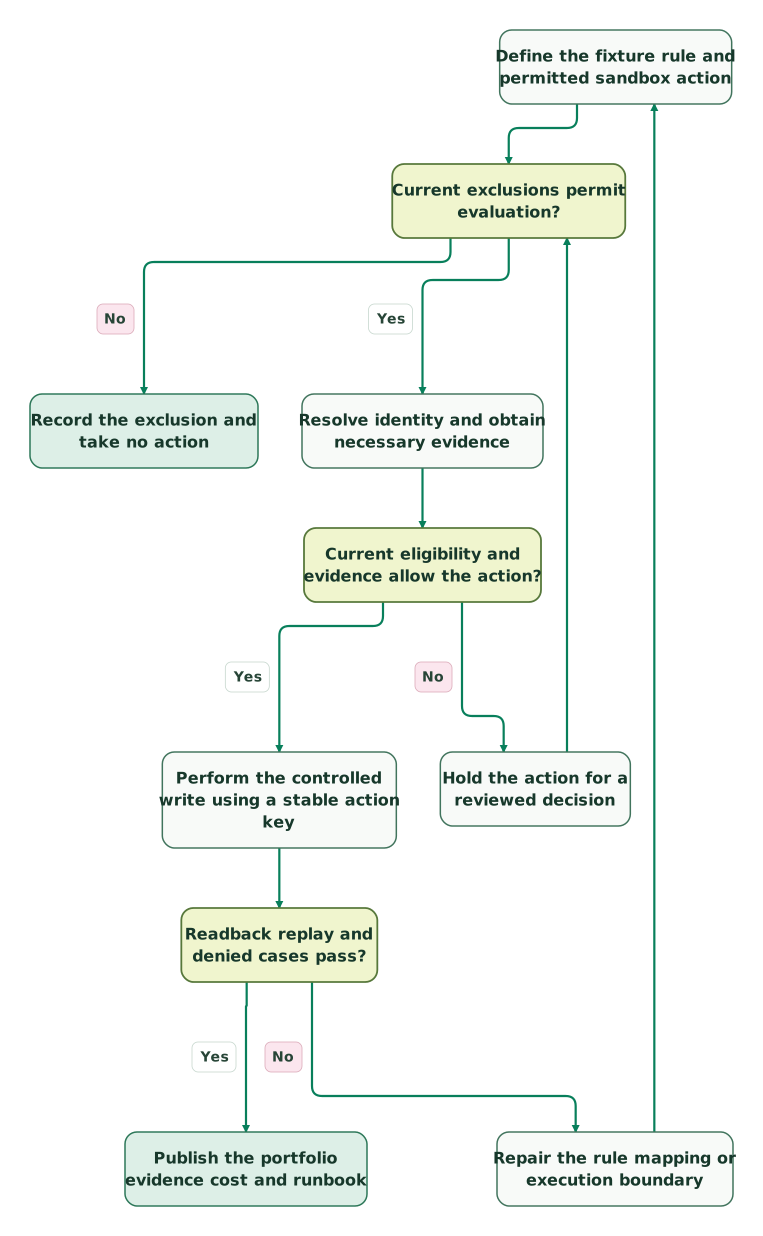
The diagram shows the required decision boundaries:
Read diagram as text
- Define the fixture rule and permitted sandbox action to Current exclusions permit evaluation?.
- Current exclusions permit evaluation? to Record the exclusion and take no action: No.
- Current exclusions permit evaluation? to Resolve identity and obtain necessary evidence: Yes.
- Resolve identity and obtain necessary evidence to Current eligibility and evidence allow the action?.
- Current eligibility and evidence allow the action? to Hold the action for a reviewed decision: No.
- Hold the action for a reviewed decision to Current exclusions permit evaluation?.
- Current eligibility and evidence allow the action? to Perform the controlled write using a stable action key: Yes.
- Perform the controlled write using a stable action key to Readback replay and denied cases pass?.
- Readback replay and denied cases pass? to Repair the rule mapping or execution boundary: No.
- Repair the rule mapping or execution boundary to Define the fixture rule and permitted sandbox action.
- Readback replay and denied cases pass? to Publish the portfolio evidence cost and runbook: Yes
A portfolio may use mocks for paid APIs, but identify the mock boundary and provide representative failure cases. Do not claim a native CRM integration was executed if you only tested a local representation. The portfolio's credibility depends on explaining exactly what the evidence covers.
How should a hiring manager score the exercise?
Score the reasoning and operating evidence, not just whether the happy path produces a screen. Let candidates explain constraints and ask clarifying questions before judging the result.
| Assessment area | Strong evidence | Reason to withhold acceptance |
|---|---|---|
| Identity and exclusions | Stable keys and correct no-action cases | Duplicate accounts or suppressed contacts reach the write path |
| Unknown handling | Missing facts remain explicitly unresolved | AI or defaults invent the required qualification |
| Execution and recovery | Repeated events do not duplicate actions | A lost response leads to blind replay |
| Cost and measurement | Every attempt contributes to the appropriate cost total | Rejected work disappears from the economics |
| Handover | Another person can diagnose and rerun the workflow | Only the original builder can explain or operate it |
Use a paid exercise when it approaches real delivery work, and keep access proportional to the assessment. A sandbox or synthetic fixture can reveal the important decisions without giving an applicant unrestricted access to production customers.
Ask the candidate what they would deliberately leave human. An ambiguous company match, an exception to a sales policy or a sensitive message may deserve review. The ability to define that boundary is part of engineering the workflow.
What should your learning or hiring checklist contain?
Require a complete, useful workflow with known limits. A smaller project that is correct and recoverable is stronger evidence than a broad demo with unexplained exceptions.
Checklist
- One commercial problem, expected result and owner are defined.
- CRM objects, stable IDs and field ownership are mapped.
- API pagination, authentication and failure behavior are tested.
- Enrichment has an acceptance rule, provenance and cost record.
- Unknown and excluded records remain visible and cannot trigger unapproved action.
- AI output is checked against evidence as well as its format.
- Current preferences and relationship state are rechecked before action.
- Retries, readback and duplicate deliveries behave correctly.
- Outcome and cost denominators are named and reconciled.
- Another operator can use the documentation to pause, repair and rerun the work.
If your team needs that system delivered and handed over, request a detailed GTM engineering scope. If the main uncertainty is which workflow deserves attention, the $99 martech audit can establish the backlog and acceptance criteria before you hire or buy another tool.
Keep reading
Browse all GTM Engineering guides
 Tracking & Attribution
Server-side GTM setup: a step-by-step implementation sequence
Set up server-side Google Tag Manager in a testable order: access, hosting, custom domain, clients, tags, consent and deduplication, then launch safely.
Jafrin Akter AloLast updated 16 min read
 Tracking & Attribution
Common Google Tag Manager mistakes and how to fix them
The Google Tag Manager mistakes behind duplicate events, missing sessions and wrong conversions, with the fix for each and a pre-publish checklist.
Jafrin Akter AloLast updated 16 min read
 Tracking & Attribution
Google Tag Manager pricing: is GTM free, what 360 costs and what you actually pay for
Google Tag Manager is free; 360 is quoted. Compare server-side hosting: about $45 per Cloud Run instance, with two recommended, or $20/month on Stape.
Jafrin Akter AloLast updated 14 min read
GTM engineering & outbound
See the implementation scope, deliverables and acceptance checks.
Questions people ask
What is the smallest useful portfolio if I cannot afford paid data tools?
Use synthetic records and clearly identified mock provider responses to demonstrate identity, exclusions, decisions, costs and retry behavior. Include successful, missing, conflicting and rate-limited responses. The mock should preserve the important contract rather than making every call succeed. Explain what remains to be tested against the real product. A transparent bounded project is more credible than claiming paid integrations you never executed.
How can an SDR demonstrate technical progress without changing career immediately?
Choose a repeated operational problem in an approved sandbox or controlled dataset, such as duplicate account research or an incomplete handoff. Map the data, build a small workflow and show how it handles exceptions. Keep the commercial reasoning that makes the research relevant. Use the resulting evidence to request more technical responsibility rather than relying on a new title before the work has changed.
Is a workflow that never sends email still a valid GTM portfolio?
Yes. Routing an eligible account to the right owner, enriching a controlled CRM field or preparing verified research can demonstrate valuable GTM engineering. The project needs a clear commercial purpose, reliable execution and measured acceptance. Sending real outreach is unnecessary to prove those skills, and a no-send sandbox often makes it easier to test exclusions, duplicate events and recovery without affecting customers.
Should a candidate use AI assistance during the assessment?
Set the rule before the exercise and judge the candidate's ownership of the result. AI assistance can be appropriate if the candidate can explain the code, identify unsupported assumptions and repair failures. Ask for the important decisions and test evidence, not a performance of typing unaided. A candidate who cannot diagnose the generated workflow has not demonstrated the ability to operate it.
What should I learn after the first complete workflow works?
Use its observed limits to choose the next skill. If identity failures dominate, improve modeling and matching. If retries or deployment are fragile, work on state and operating controls. If outputs are correct but sales rejects them, revisit the commercial rule and feedback loop. Add another tool only when it closes a demonstrated gap; otherwise deepen the reliability and usefulness of what you already built.
Sources
- Onfire GTM engineering posting analysis
- RevGuild practitioner analysis
- Clay HubSpot integration
- HubSpot webhook implementation practices
- HubSpot workflow webhook action and availability
- Apollo People API Search
- Claude structured outputs
- Google email sender guidelines
- Clay University courses
- Clay certification status
- Apollo GTME programme

Written by
Jafrin Akter AloData Engineer and Co-founder at Martechdevs and Growth and Analytics Partners
Jafrin writes practical guides to marketing technology, customer data, analytics and AI workflows. Martechdevs is a Growth and Analytics Partners company.