
Signal-Based Selling: Turn Intent Signals Into Useful Sales Actions
Data Engineer and Co-founder, martechdevs
Last updated 13 min read
An intent signal is useful when it changes a sales decision. It should tell someone which account deserves attention, what changed, how reliable the evidence is and what to do next. A stream of pricing-page alerts without those answers creates another inbox to ignore.
Last updated: 13 October 2026.
Signal-based selling uses recent evidence to decide when and how to engage an account. That evidence might be a direct request, meaningful product activity, research on your website, a new executive or a change in the company's technology. These observations carry different levels of certainty. None should become an automatic declaration that a company is ready to buy.
For a small sales team, start with a few signals you can interpret and act on. Prove that they improve the work queue before paying to monitor thousands of companies.
Separate the observation from the sales hypothesis
Every signal has two parts: something observed and a proposed explanation.
An authenticated trial account invited three colleagues. That is an observation. The account may be evaluating a team purchase. That is a hypothesis. It may also be running a training session, testing permissions or evaluating the product for someone else.
A company posted a data engineering vacancy mentioning Snowflake. That supports a claim about the job advertisement. It does not prove that the company has implemented Snowflake, controls a new consulting budget or wants to replace its existing partner.
Keep those distinctions visible in the CRM. Write “job advertisement mentions Snowflake; implementation status unconfirmed” rather than “Snowflake migration project confirmed.” The second version sends a rep into a conversation with a fact you do not have.
An effective signal record therefore needs evidence, identity scope, freshness, a reason it matters and an allowed next step. A score alone loses too much context.
Use different signals for different decisions
Direct requests create a response obligation
A demo request, a pricing question or a request for implementation help should enter an owned response process immediately. Do not wait for enrichment or a scoring model to declare the account interesting.
The task is to answer the request and qualify the need. An existing customer may need their account manager; a technical question may need support. High urgency does not imply that every request belongs to new-business sales.
Product signals reveal progress and friction
Prefer behavior connected to the customer's intended outcome: a successful production integration, a completed collaboration workflow or sustained usage by several real team members. A raw login count says less about value.
Interpret friction separately. Repeated integration errors might justify technical help. They should not trigger a congratulatory upgrade email. A feature limit reached by a healthy account can support a capacity conversation, but only after checking whether the limit actually blocked useful work.
Exclude employees, tests, automated service activity and duplicated events. Associate activity with the correct workspace or customer account; one consultant may belong to several companies. The customer-journey guide helps connect these observations to the task the customer is trying to complete.
Website activity supports account research
Repeated visits to relevant solution, integration or pricing pages can justify a closer look. The signal becomes stronger when the account fits your market and independent evidence supports a current need.
Company identification is still an inference when it comes from network data. HubSpot describes matching website visits to companies using its tracking code and collected visitor information. That does not identify the specific executive who opened a page. HubSpot buyer intent
Clay explicitly documents that bots, VPNs, cloud infrastructure and ISP-owned IPs can appear as companies in web-intent results. It also notes that a returned domain can belong to infrastructure rather than the company's primary website. Clay web intent
Use uncertain account matches for research, not personalized claims about an individual's behavior. Finding a VP's email at the inferred company does not establish that the VP visited your site.
Hiring, funding and technology changes supply context
These signals can reveal a plausible reason a problem is becoming urgent. A new revenue leader may review processes. Several analytics roles may indicate investment in measurement. A funding announcement may precede expansion.
They can also mean something else. A job post may be old or repeatedly renewed. Funding may be allocated to a different function. A technology fingerprint may reflect a small experiment rather than a company-wide standard.
Use the evidence to form a relevant question and choose a suitable offer. Do not turn “raised funding” into “has budget for us.” A useful next action could be checking an implementation requirement, reviewing an existing relationship or preparing a short diagnostic resource.
Build a small signal-to-action agreement
For each signal, document the qualifying event, evidence required, account-matching rule, maximum useful age, exclusions, owner and next action.
For a fictional reporting SaaS, a first product rule could be:
“A target-fit trial workspace produced a successful report from a live source and two distinct human members used the shared result within seven days. If the account has no open opportunity or existing follow-up task, ask its owner to review whether a collaboration or rollout conversation would help.”
The seven-day window is a starting business rule, not a proven universal threshold. Preserve the qualifying events so the rep can understand the recommendation.
A separate website rule could require multiple relevant sessions within a short period, a plausible company match and corroborating account context. Its output might be “research this account,” not “send an email.” A weak signal can justify a cheap investigation without justifying a costly or intrusive action.
For public news, choose an expiry that matches the play. A current leadership change and an old fundraising round do not have the same useful window. If the publication date is unavailable, mark the timing uncertain rather than treating collection time as the event date.
The lead-scoring guide covers ranking eligible accounts. Use the signal agreement to decide what evidence may enter that ranking in the first place.
Start with data you already control
An initial implementation can use your product database or event pipeline, form submissions, CRM records and a small monitored account list. You do not need a broad external-intent subscription to discover whether a known trial account is stuck or a prospect has asked for help.
Use product events for product behavior and the CRM for relationship state. Preserve the account ID and the identity mapping used at the time of the decision. Do not join a personal email domain to an arbitrary company and call the account resolved.
For public changes, monitor a defined list of company sources, job pages, announcements or feeds where access and use are permitted. Start with a few accounts a rep can inspect manually. A source that changes its page layout every week may cost more to maintain than the information is worth.
Clay's custom-signal documentation supports scheduled monitoring and comparing successive observations. It distinguishes formula-based comparison of structured values from AI-assisted interpretation of variable text. Clay custom signals
Prefer deterministic comparisons when possible. Normalize whitespace and known formatting differences before asking an AI system whether the business changed. Store the underlying evidence. An AI-generated summary without a source and observation history is difficult to audit when the rep disputes it.
Broader external data can help after you identify a coverage gap. Be explicit about the feed you are buying. For example, 6sense distinguishes keyword intent from website intent, with Data Pack delivery schedules that vary by pack. A periodic warehouse feed is not equivalent to an immediate website event. 6sense Data Packs
Preserve three clocks and a stable event key
Store when the event happened, when your system observed it and when a rep received an actionable task. These answer different questions.
If a job change occurred last month and arrived today, the routing system can be fast while the underlying signal is stale. If product activity arrived promptly but sat unassigned overnight, the problem is the queue.
Use a stable source-scoped event key so a delivery retry does not create a second signal. CloudEvents formalizes the combination of source and event ID as the identity of a distinct event; identical pairs can be treated as duplicates. CloudEvents specification
Here is an illustrative internal record. It is a proposed schema, not a HubSpot or Clay API payload:
{
  "source": "product-production",
  "event_id": "evt_demo_1042",
  "signal_type": "collaborative_report_used",
  "account_id": "acct_demo_27",
  "identity_basis": "authenticated_workspace",
  "occurred_at": "2026-10-13T08:00:00Z",
  "observed_at": "2026-10-13T08:02:00Z",
  "eligible_until": "2026-10-20T08:00:00Z",
  "evidence_ref": "internal-event:evt_demo_1042",
  "rule_version": "trial-collaboration-v1",
  "fit_status": "confirmed",
  "relationship_route": "trial_owner",
  "recommended_action": "review_rollout_need",
  "activation_state": "review_required"
}
A source event ID solves delivery duplication. It does not solve business duplication: three providers may describe the same funding announcement using different IDs. Group those observations into one account episode before creating tasks.
Keep the episode's evidence list and first-seen time. Adding another copy of the same news should improve traceability, not continually refresh its urgency. Where the true occurrence date is unknown, retain that uncertainty explicitly.
Route to one owner, with an expiry and a reason
Apply relationship rules before assigning a new prospecting task. Existing account ownership and active opportunities should take precedence over a generic round-robin queue. A customer signal should reach the appropriate customer team.
Apply communication restrictions and suppression before enrollment in any channel. Intent data does not change a person's permission status. Keep source collection settings, consent requirements and allowed uses aligned with the deployment; do not paste a tracking snippet into every page merely because a setup guide offers that default.
Then check whether an unresolved task already exists for the same account and play. Update that task with genuinely new evidence rather than generating competing alerts. Do not allow an older delayed event to overwrite a newer relationship state.
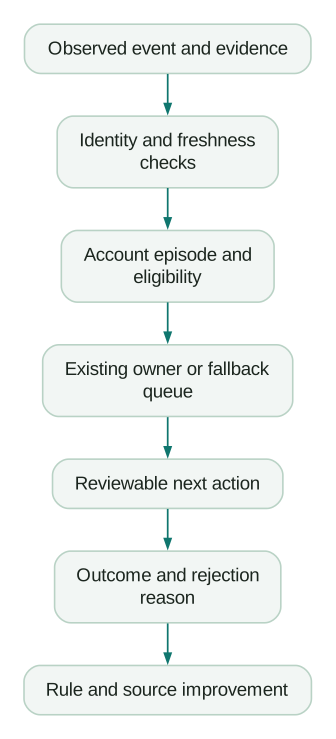
The rep should see the account, what changed, why the rule fired, evidence age, any uncertainty, the recommended action and the deadline. “Hot lead, score 92” leaves too much reconstruction work.
Set service targets by urgency. A direct request needs prompt response during the agreed coverage window. A product expansion signal may deserve same-day review. An ambiguous hiring signal may fit a weekly research queue. These are operating choices to agree with the team, not universal response-time benchmarks.
The lead-routing guide covers ownership, fallback and reassignment. Track overdue work explicitly so a silent assignment failure does not look like a low-converting signal.
Implement the same logic in HubSpot or Clay
In HubSpot, visitor-intent criteria can use page paths, minimum visits, minimum visitors, a time period and exclusions. The configuration can populate a company property that other tools use for segmentation or workflow enrollment. HubSpot buyer-intent configuration
Use that property as an input to your account rules, not as the entire routing system. Check customer status, open opportunities, ownership and existing work before creating a task. Keep a history outside a single current-state property if you need to explain which evidence triggered an earlier decision.
HubSpot also documents credit usage for adding and tracking companies. Its auto-add behavior applies to companies entering saved views after the automation is enabled, rather than automatically backfilling every existing result. Plan any initial review separately and budget the selected features. HubSpot buyer-intent operation
In Clay, distinguish a scheduled source check from the business event it discovers. The job-change monitor uses a contact's LinkedIn URL as its identifier and can perform an initial comparison against existing company information. An initial mismatch may be an old change your database missed, rather than a change that happened today. Clay job-change monitoring
For website signals, Clay groups results by company domain and documents delays of up to 30 minutes while sessions complete. Budget caps or exhausted credits can also interrupt collection. Monitor the feed's health before promising reps an immediate alert. Clay web-intent timing and limits
Whichever tool you use, keep raw observations, qualifying episodes and activated tasks distinct. That makes it possible to improve a rule without rewriting history or contacting the same account repeatedly. When the next action includes campaign enrollment, use the outbound automation guide to define message approval, duplicate handling and the destination controls that stop follow-ups.
Control costs by monitoring fewer things more deliberately
External monitoring costs are driven by checks as well as useful changes. Clay's job-change documentation lists one Action plus 0.2 Data Credits per check. That is a monitoring meter, not a charge only when someone changes jobs. Clay job-change cost
For an illustrative 28-day pilot monitoring 100 people:
- Four weekly checks per person produce 400 checks, using 400 Actions and 80 Data Credits.
- Twenty-eight daily checks produce 2,800 checks, using 2,800 Actions and 560 Data Credits.
Daily monitoring uses seven times the checking capacity in this example, before downstream enrichment or CRM work. It is justified only if discovering the change earlier improves an action you can actually take. Translate those meters through your current subscription and provider pricing; they are not dollar amounts.
Also budget rep attention. Two reps with two hours each available for signal review have 240 minutes. At an illustrative eight minutes per review, the team's capacity is 30 account reviews. Sending 100 alerts does not create another 70 review slots.
Deduplicate by account episode, rank within the available capacity and expire stale work. Route urgent direct requests separately so research alerts cannot crowd them out.
Measure whether signals improve decisions
Measure the full path: valid observations, correctly matched accounts, qualifying episodes, accepted tasks, actions completed and commercial outcomes. Break it down by signal type and source.
Require a rejection reason when a rep dismisses an alert: wrong company, stale evidence, irrelevant change, existing conversation, unavailable offer or insufficient information. Those reasons tell you whether to repair identity, freshness, the rule or the sales play.
High conversion among signaled accounts does not by itself prove that acting on the signal caused more deals. The accounts may already be larger, more engaged or closer to buying.
For proactive plays, consider a randomized account-level pilot among eligible accounts. Keep ordinary service and responses to direct requests available to both groups. Assign one group the additional signal-based action and the other the existing process, then use the same outcome definition and follow-up period.
In a fictional example, 12 of 200 treatment accounts and eight of 200 comparison accounts become accepted opportunities. Those observed rates are 6% and 4%, a two-percentage-point difference and four additional observed opportunities. With only 20 outcomes, do not declare a reliable lift from that arithmetic alone. Assess uncertainty, assignment quality and whether the effect survives a larger evaluation.
Record later wins and contribution where the sales cycle permits. A signal that creates more accepted opportunities but mostly poor-fit customers may still be a bad investment.
Launch checklist
- Define the business decision and next action for each signal.
- Separate source evidence from inferred purchase intent.
- Record account identity, event age, observation time and rule version.
- Deduplicate deliveries and repeated descriptions of the same change.
- Preserve account ownership and existing conversations.
- Apply collection, communication and suppression rules before activation.
- Limit the queue to real review capacity and monitor source failures.
- Collect rejection reasons and evaluate outcomes against a fair comparison.
Start with one product signal, one direct-request path and one carefully chosen external change. If you need help connecting those sources to accountable CRM work, GTM engineering and CRM lifecycle implementation address the collection and routing together.
Questions people ask
What are buyer intent signals?
They are observations used to infer that an account may have a relevant need or be evaluating a solution. Direct requests, product behavior, website activity and company changes provide different evidence. Preserve what was actually observed and avoid treating every signal as proof of purchase readiness.
Which intent signals should a small team use first?
Begin with direct requests and meaningful product activity from accounts you can identify reliably. Add external changes when there is a specific sales play and someone can review the evidence. The most valuable signal is the one that improves a decision you have capacity to act on.
Can a pricing-page visit identify the buyer?
An authenticated event may identify a known user under your collection rules. An inferred company match does not establish which person visited. Use company-level evidence at company level; do not claim that an enriched contact performed an anonymous action.
Do I need a dedicated intent platform?
Not to start. Product events, forms, CRM history and a focused monitoring list can support an initial workflow. Buy additional coverage when a measured gap warrants it, including the costs of matching, monitoring, routing and rep review. An unsupported universal monthly budget is not a useful buying rule.
How quickly should sales act on a signal?
Match the response to the event. Answer explicit requests promptly, review actionable product changes within the team's agreed coverage and put weaker research signals into an appropriate queue. Measure both source delay and assignment delay; faster routing cannot make an old event fresh.
Sources
Written by
Jafrin Akter AloData Engineer and Co-founder, martechdevs
Jafrin Akter Alo is a data engineer and co-founder of martechdevs, where the team has delivered 74+ martech, data and growth stack implementations.