
What is GTM engineering? The systems, skills and work behind the role
Data Engineer and Co-founder, martechdevs
Last updated 9 min read
GTM engineering is the work of building and maintaining the systems that turn market and customer data into useful sales and marketing actions. A GTM engineer connects sources, qualifies records, routes work, prepares outreach and measures the result. The role combines commercial judgment with implementation skills; its value comes from a reliable process that improves an outcome, not from the number of automations shipped.
Last updated: 1 September 2026.
A promising trial account reaches the usage threshold for sales assistance. Product analytics sees it. The CRM does not. By the time someone exports the data, the founder has already cancelled the trial. A GTM engineer works on the path between that signal and a timely, useful response.
What does a GTM engineer actually build?
The role commonly covers account research, enrichment, qualification, routing, outreach preparation and feedback from sales outcomes. Clay's own description of GTM engineering places automated revenue systems at the centre of the work. That is one vendor's framing; the discipline does not require Clay or any particular software. Clay's GTM engineering guide.
The practical deliverable should be easy to describe: “When an eligible account reaches this product milestone, the correct owner receives a task with verified context, and the outcome returns to the reporting model.” That is specific enough to build and test.
Martechdevs' GTM engineering service handles the data connections and workflows behind those systems. When the bottleneck is inconsistent account identity or reporting, martech integration and warehouse work may be the necessary first step.
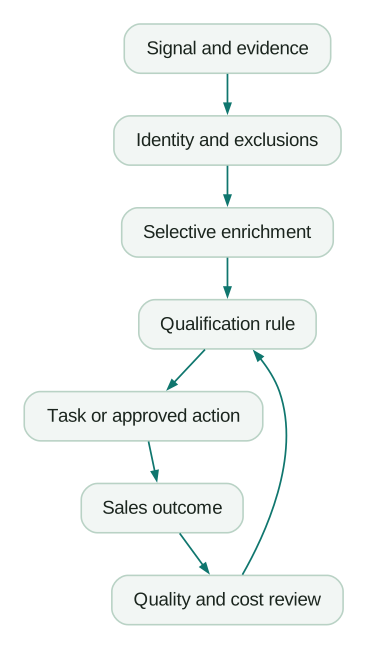
A complete workflow has six parts
1. A source worth acting on
The source might be a demo request, a product event, an account's hiring activity or an existing customer changing jobs. Record where the signal came from, when it happened and how confidently it maps to the account.
A company hiring a data engineer is a fact. “They urgently need our product” is an inference. Keep those separate. If the original evidence disappears or becomes stale, the downstream message should not continue treating it as current truth.
2. Identity and exclusions
Match the signal to the right account and person. Resolve subsidiaries, duplicate domains and people who work with multiple companies. Check existing customers, open opportunities, active sales conversations and suppression rules before spending money on enrichment.
A new signal does not automatically justify new outreach. The correct action for an open opportunity might be a note to its owner. For an opted-out contact, the appropriate result may be no action.
3. Enrichment with a purpose
Retrieve only the missing fields needed to make the decision. If routing requires region and company size, collecting a biography, personal phone number and ten AI summaries adds cost without improving routing.
Search and enrichment are often separate product operations. For example, Apollo's People API Search locates prospects but does not return email addresses or phone numbers; those require enrichment routes. Design the cost model around actual operations. Apollo People API Search.
4. An explicit decision rule
Write the rule in plain language before translating it into code or a workflow builder. “Route accounts with a supported use case, at least three active members and no existing owner” is reviewable. “Use AI to find the best leads” hides the criteria.
Allow an unknown result. Missing company size is not the same as a small company. An inconclusive research result should go to review or remain unqualified rather than receiving a confident invented value.
5. A controlled action
The action might update a property, create a task, draft a message or enrol an eligible contact in an approved sequence. Define the record key, permitted fields, duplicate prevention and the conditions that stop the action.
Start consequential workflows with a review step while you inspect output quality. The goal is to learn where human judgment matters and where a deterministic rule is sufficient. Automation scope should expand with evidence.
6. A feedback path
Return accepted, rejected, contacted, qualified and closed outcomes to the reporting layer. Capture rejection reasons with a small usable vocabulary. Otherwise, the system keeps producing the same bad recommendations while celebrating its activity count.
A worked example: product-qualified account routing
Consider a fictional SaaS company that wants sales to help accounts showing collaborative use. The rule requires three active members, two successful projects in seven days and a supported company profile. Existing opportunities stay with their current owner.
The workflow reads an account-level model each morning, detects accounts that newly qualify, checks the CRM and creates one task per account and qualification period. The task contains the observed usage, the reason for qualification and a link to the account view. It does not claim that the account intends to buy.
Suppose 500 accounts are evaluated. Eighty meet the usage rule, 30 are already in active opportunities and 10 have incomplete identity mapping. Forty reach the new-task stage. If sales accepts 24, the acceptance rate is 60% of generated tasks. The ten identity failures remain visible as operational failures rather than disappearing from the denominator.
If the process costs $120 in data and compute plus four hours of review valued internally at $50 an hour, its illustrative monthly cost is $320. That is $8 per generated task or $13.33 per accepted account. Neither measure establishes acquisition cost or return on investment; opportunity and revenue outcomes still need time to mature.
The product data in HubSpot guide explains how to build the account view that makes this workflow possible.
GTM engineering versus RevOps
RevOps commonly owns the operating model across revenue teams: lifecycle definitions, territory rules, CRM process, reporting and coordination. GTM engineering concentrates on building the data and automation systems that execute and improve parts of that model.
There is substantial overlap. In a small company, one person may do both. The useful boundary is ownership: who decides the qualification policy, who implements it, who approves changes and who responds when the workflow fails?
Do not hire a GTM engineer to solve an unresolved argument about what a qualified account means. They can help expose the tradeoff and test a definition, but software cannot make two contradictory commercial policies consistent.
GTM engineering versus a forward deployed engineer
A forward deployed engineer generally works close to customers to implement or adapt a technical product in their environment. A GTM engineer generally builds systems supporting acquisition, conversion, expansion and revenue operations. Job titles vary, so compare the actual responsibilities.
If the work is deploying your product into a customer's infrastructure, the role needs product and deployment depth. If it is connecting buying signals, CRM state and outreach operations, it needs GTM process and data depth. Some organisations combine those responsibilities, but a job description should make the balance explicit.
The tools follow the workflow
Useful categories include a CRM, an enrichment source, an orchestration layer, a messaging or task destination and a reporting store. Clay and Apollo cover overlapping parts of this landscape; the Clay versus Apollo comparison explains where each can fit.
A no-code workflow is appropriate when its connectors, state handling and observability meet the requirement. Custom code becomes useful when matching, batching, retries or business rules exceed the platform's practical limits. A warehouse is useful when several systems need the same account model.
AI can classify unstructured evidence, summarise research and prepare drafts. Deterministic code should handle exact comparisons, identifiers and arithmetic where possible. A model should not invent the company domain because an API lookup failed.
Keep credentials in managed connection settings or a secret store. Separate development and production access. Give each integration the permissions required for its job rather than sharing a founder's unrestricted login.
Reliability is part of the job
An automation that works once on ten rows is a prototype. Production work needs a plan for partial failure, duplicate inputs, changed schemas and unavailable vendors.
Persist work before acknowledging a webhook, process it asynchronously where appropriate, and make repeated deliveries safe. HubSpot's developer guidance specifically recommends asynchronous processing and idempotent handling for webhook integrations. HubSpot webhook implementation guidance.
Track source record, workflow version, attempt, decision, destination record and error category. Retry temporary failures with a limit. Send invalid data to a review queue. A rate limit and a malformed email require different responses.
Add a pause control and a clear owner. If a provider suddenly returns empty company names, the team should be able to stop downstream writes without dismantling the entire workflow.
Hire, borrow or outsource based on the workload
Use an existing operator with engineering support when the problem is narrow and the team can maintain the result. A well-defined routing fix does not always justify a new full-time role.
Use a specialist or agency when you need a bounded implementation, unusual integrations or an experienced review of a broken system. Require documentation, access handover and a maintenance plan in the scope. A working demo without ownership transfer leaves the company dependent on its builder.
Hire internally when there is a continuing backlog of valuable experiments, several connected systems and enough commercial ownership to prioritise the work. A full-time engineer needs an ongoing operating mandate, not a vague instruction to “do AI for sales.”
In interviews, ask candidates to design a workflow with duplicates, missing data and an existing opportunity. Have them explain cost, exclusions and the success metric. Their treatment of exceptions is often more informative than a list of tools on a résumé.
A practical first-month scope
In the first week, map one workflow and establish its baseline. Count manual effort, delayed records, error rates and downstream acceptance. In the second, build a limited prototype using representative records, including difficult cases.
Use the third week for a controlled pilot with a named reviewer. Record why outputs are accepted or rejected. In the fourth, decide whether to expand, revise or stop, using quality and outcome evidence rather than the amount of work already invested.
This is an example sequence, not a promised delivery timeline. Access delays, missing instrumentation and unresolved policy decisions can be the real critical path.
GTM engineering checklist
- One commercial problem has an agreed baseline and owner.
- The signal has a source, timestamp and confidence level.
- Identity, customers, open opportunities and suppressions are checked.
- Enrichment fields have a defined use.
- Qualification rules allow unknown and review outcomes.
- Writes and enrolments are safe to retry.
- Costs can be traced to useful outputs.
- Sales outcomes return to the measurement layer.
- Someone can pause, repair and maintain the workflow.
At Martechdevs, we build prospecting workflows with clear eligibility, controlled execution and documented handover. Start with the free martech AI audit, or explore an AI assistant built around your approved workflows.
Questions people ask
Does a GTM engineer need to code?
They need enough technical depth to understand APIs, data models, authentication, failures and testing. Many workflows can use visual tools, while custom code helps with more complex requirements. Tool familiarity alone is insufficient if the person cannot explain how the system behaves when something goes wrong.
Is GTM engineering just outbound automation?
No. It can support inbound routing, product-led sales, customer expansion, research, CRM quality and reporting. Outbound is one application. The appropriate first project is the highest-value operational bottleneck the team can define and measure.
Does every startup need a GTM engineer?
No. Early teams may need direct customer learning more than automation. The role becomes useful when a repeatable motion exists and manual coordination or fragmented data limits its execution. Automating an unproven offer can simply produce rejection faster.
How should we measure the role?
Use reliability, cycle time, accepted outputs and eventual commercial outcomes. Include data and maintenance costs. Avoid rewarding only leads generated, emails sent or workflows created; those counts can rise while customer relevance and sales productivity fall.
Can an AI agent do this work by itself?
An agent can help research, build and operate parts of a workflow. Someone still needs to define the commercial policy, approve access, validate outputs and own failures. The stronger the underlying definitions and controls, the more useful the agent can be.
Sources
- Clay's description of GTM engineering. Accessed 1 September 2026.
- Apollo People API Search. Accessed 1 September 2026.
- HubSpot webhook and workflow implementation guidance. Accessed 1 September 2026.
Written by
Jafrin Akter AloData Engineer and Co-founder, martechdevs
Jafrin Akter Alo is a data engineer and co-founder of martechdevs, where the team has delivered 74+ martech, data and growth stack implementations.