
Apollo Alternatives: Cognism, Clay, Outreach, Lemlist and HubSpot Compared
Choose an Apollo alternative around the part of your sales workflow that fails. Cognism addresses contact-data requirements, Clay supports custom account research, and Outreach or Lemlist can change how sellers execute outreach. HubSpot may simplify follow-up inside an existing customer relationship management (CRM) system. Compare the complete path to a useful sales conversation, including the subscriptions and operating work each replacement leaves behind.
On this page
Which part of Apollo needs replacing?
Replace the component that prevents useful sales work. A full platform change is justified when the combined replacement also handles the data, ownership and follow-up you rely on today.
“Replace Apollo” can involve a data source, prospecting workspace, sequencer, dialer and CRM handoffs. Buying a cheaper component can leave other subscriptions and more administration behind. Start with a failure the team can demonstrate.
| Current failure | Candidate to evaluate | Work that still needs an owner | Acceptance evidence |
|---|---|---|---|
| The intended buyer's phone details are unreliable | Cognism | Account eligibility and sales follow-up | Correct person and current role within your target countries |
| Standard fields cannot establish account fit | Clay | Research rules, uncertain answers and evidence review | Source-backed qualification that a second person can reproduce |
| Sellers miss actions across a structured sales process | Outreach | Process design, permissions and CRM authority | A rep completes the next action and the right account owner receives the result |
| Outreach and Salesforce updates disagree | Lemlist | Field direction, matching and activity attribution | Correct record, field value and destination user after an update |
| Reps duplicate work between HubSpot and a sequencer | HubSpot sequences | Prospect sourcing and eligible sales seats | Follow-up works from the existing CRM without a required external step |
These are evaluation patterns, not exclusive product categories. Each vendor has a broader offering; the table identifies the reason to put it on a shortlist.
Use the Apollo implementation guide to rule out repairable configuration issues. Compare the resulting baseline with Apollo's actual seat and usage costs. A replacement should beat the process you could operate, rather than an avoidable failure.
At Martechdevs, our go-to-market (GTM) engineering service maps the data, outreach and CRM handoffs as one workflow. That makes it possible to scope the component change and the acceptance test before choosing software.
What are the pros and cons of each Apollo alternative?
Cognism fits a contact-data trial, Clay a custom-research trial, Outreach a sales-execution trial, Lemlist an outreach-to-CRM trial, and HubSpot a consolidation trial. The choice depends on the failed step and the operator available to maintain the replacement.
Budget at the published or quoted terms; treat a startup discount as available only after the vendor confirms your eligibility in writing.
Cognism for a phone-led data requirement
- Best for: a sales team whose immediate bottleneck is reaching the correct person by phone.
- Pros: Cognism documents a process that calls numbers and confirms the intended person. This gives you a specific data attribute to test.
- Cons: a stronger contact source still needs eligibility checks, outreach ownership and a destination CRM.
- Free tier and startup offer: the public pricing page provides tailored Standard and Pro packages. Request sample access and any startup terms; a self-service free allowance is not established by that page.
- Choose it if: a matched sample improves the proportion of usable phone records in the regions you sell to.
- Skip it if: records are already usable and the lost work happens after a reply.
Cognism's phone-verification process is a product claim, not a guaranteed conversation rate. Its current pricing page also describes reveal credits and different prospecting packages, so ask which records and verification services your quote includes. Cognism phone-verified data, Cognism pricing.
Keep wrong numbers, correct voicemail, no answer and a conversation with the intended person separate in the test. “No answer” does not prove bad data. Calling outcomes also depend on time, message and seller, so a higher conversation rate alone cannot isolate the data vendor's effect.
Compare the same coverage and export requirements in Apollo versus ZoomInfo. The ZoomInfo pricing guide is useful when checking how another quoted data package handles seats, access and additional costs.
Clay for evidence-based account research
- Best for: qualification that needs evidence beyond a job title and company size.
- Pros: Claygent Builder supports reusable research and scoring agents, business context and test cases.
- Cons: someone must maintain the research instructions and decide what to do with ambiguous results.
- Free tier and startup offer: Clay's Free plan lists 100 Data Credits and 500 Actions per month, with up to 200 rows per table. Use the ordinary allowance for the pilot; confirm any separate startup offer before budgeting it.
- Choose it if: a source-backed custom attribute changes which accounts deserve sales attention.
- Skip it if: a standard verified contact field solves the entire problem.
Claygent Builder can help research accounts and classify people, but the useful output is your acceptance standard. Claygent Builder documentation, Clay pricing.
Suppose you sell integration work to subscription businesses operating several regional brands. A useful research record would contain the evidence for multiple storefronts, publicly named systems, the source date and why the account fits. A hiring page can support “recruiting a CRM manager.” It cannot, by itself, support “their lifecycle marketing is failing.”
Use separate fields for observed fact, inference and unknown. Reject an answer with an impressive explanation but no supporting source. Review a known negative account alongside an obvious positive so the workflow has to distinguish them.
Waterfall enrichment explains how to order data providers when coverage is the missing piece. The Clay versus Apollo comparison covers the wider architecture. List which existing Apollo functions remain elsewhere after moving research into Clay.
Outreach for a structured sales-engagement process
- Best for: teams with a defined rep workflow that spans sequences, tasks and calls.
- Pros: Outreach documents triggers, rulesets, schedules and engagement tools that give an administrator concrete controls to evaluate.
- Cons: process administration and data sourcing still need explicit scope.
- Free tier and startup offer: Outreach requests a quote and combines seat access with consumption for AI workflows. Request pilot and startup terms directly; do not substitute an unverified per-seat estimate.
- Choose it if: reps and managers can specify the required actions and exception handling before the demo.
- Skip it if: the team has not agreed who owns qualification or follow-up.
The current commercial page includes data enrichment within its packages. Ask what that means for your required coverage and usage rather than assuming all sourcing is included, or that it always requires another vendor. Outreach sales engagement overview, Outreach pricing.
Follow a rep's working day during the trial: select an account, understand its context, complete the next action and inspect the outcome. Have an administrator change ownership and inspect a failed CRM write. A completed task measures an action; a qualified conversation measures a different result. Keep both visible.
Lemlist for outreach alongside an existing CRM
- Best for: teams that want to evaluate outbound execution and Salesforce handoffs together.
- Pros: the documented Salesforce integration includes field direction, activity selection and user mapping.
- Cons: the team still has to decide which system owns a field after the initial record creation.
- Free tier and startup offer: Lemlist advertises a 14-day trial with Multichannel features except in-app calls, plus 200 data credits. That is a trial, not an ongoing free production plan; startup terms need separate confirmation.
- Choose it if: the integration can reproduce your Salesforce ownership and update rules.
- Skip it if: your only missing requirement is a contact attribute and the existing engagement process works.
Lemlist documents importing Salesforce records, configurable field synchronization and activity attribution through user mapping. Test those behaviors on your actual record types. Lemlist Salesforce integration, Lemlist pricing.
If Salesforce owns account status after creation, change that value in both systems and inspect the resulting record. If a reply belongs to a named rep, check the destination activity owner. An activity appearing somewhere in the CRM is insufficient when it attaches to the wrong person.
Follow one sequence through a positive reply, an absence and a disqualification. Decide which outcomes stop automation and which create seller work. Lemlist's pricing model separates the channel, volume and data requirements behind the commercial proposal.
HubSpot for reducing follow-up handoffs
- Best for: a team already working in HubSpot whose required follow-up can fit native sequences.
- Pros: timed sales emails and tasks can sit alongside the CRM record the seller already uses.
- Cons: native follow-up does not establish where qualified prospects and current contact details come from.
- Free tier and startup offer: sequences require an assigned Sales or Service seat on an eligible Professional or Enterprise subscription. Free CRM access does not include this requirement; confirm any startup package against the exact seats and renewal price.
- Choose it if: a complete named-account or inbound workflow passes inside the existing CRM.
- Skip it if: the trial reveals a specialized research or execution requirement the proposed setup cannot cover.
Sequence emails use a connected individual work email, and tasks are assigned to the enrolling user. Those details matter when a shared operations account builds the process for several reps. HubSpot sequence documentation.
Evaluate the benefit as reduced handoff work. Ask a rep to find the customer context, understand the next action and record the outcome without duplicating it elsewhere. Keep an external component where it resolves a demonstrated requirement; consolidation is useful only when the remaining process still works.
How do you compare the true cost of a replacement?
Compare accepted output, cash expense and operator capacity separately. A lower software bill can require more maintenance, while a higher unit yield may exceed the team's follow-up capacity.
Run the same scenario from input to destination in each candidate. Freeze a representative list with difficult segments, existing customers and uncertain matches. Store each candidate's results separately. Define “accepted” before the test: for example, correct company and current role, permitted contact route, evidence of fit, no suppression, and a matched CRM owner.
The following is a hypothetical monthly example in USD. These are invented setup prices and outputs, not vendor quotes. Existing operator time is valued at USD 50/hour; it becomes additional cash expenditure only if you actually pay for extra capacity.
| Monthly input or result | Setup A | Setup B | Interpretation |
|---|---|---|---|
| Software and data, USD | 900 | 700 | Recurring cash expense |
| Operating hours | 6 | 14 | Capacity required to run the workflow |
| Assumed value of time, USD | 300 | 700 | Hours multiplied by USD 50 |
| Combined economic cost, USD | 1,200 | 1,400 | Cash plus valued capacity |
| Accepted records | 400 | 500 | Same acceptance definition |
| Cash per accepted record, USD | 2.25 | 1.40 | Software and data divided by accepted records |
| Economic cost per accepted record, USD | 3.00 | 2.80 | Combined cost divided by accepted records |
B requires USD 200 more in combined economic cost and eight more operator hours. It produces 100 extra accepted records. If the team needs only 350 records, that unused output has no immediate value. If reps can properly follow up with only 300, buying greater enrichment output leaves the next bottleneck untouched.
The useful next calculation is the cost per accepted record the team actually uses. At 300 used records, A's economic cost is USD 4 each and B's is about USD 4.67. B can still win for another reason, such as evidence that speeds qualification, but measure that benefit instead of assuming every extra row becomes pipeline.
For revenue outcomes, separate a data-quality trial from a campaign test. If you change the audience, message, seller and sending tool together, the results describe the new combined process. They do not establish which component caused the difference.
Which alternative fits your team's situation?
Use the failed workflow step to select a first candidate and a credible runner-up.
| Team situation | First candidate | Runner-up | Decision that separates them |
|---|---|---|---|
| Five sellers with usable sequences but weak phone records | Cognism | Repair or extend Apollo | Does the matched phone sample justify a separate data contract? |
| Two operators researching unusual account criteria | Clay | Apollo plus manual research | Does reusable evidence reduce accepted-research effort enough to maintain the workflow? |
| Twenty sellers following a defined multistep process | Outreach | Lemlist | Which setup handles the required rep actions and exceptions with less administration? |
| Eight reps whose Salesforce updates cause rework | Lemlist | Outreach | Which trial preserves field authority and activity ownership under failure? |
| Three sellers already managing qualified leads in HubSpot | HubSpot sequences | Lemlist | Can native follow-up remove a handoff while retaining every required action? |
If the first candidate fails the mandatory task, remove it before comparing convenience features. Write the losing condition down as well: “No deployment if an existing customer can be enrolled” is more useful than a subjective score for ease of use.
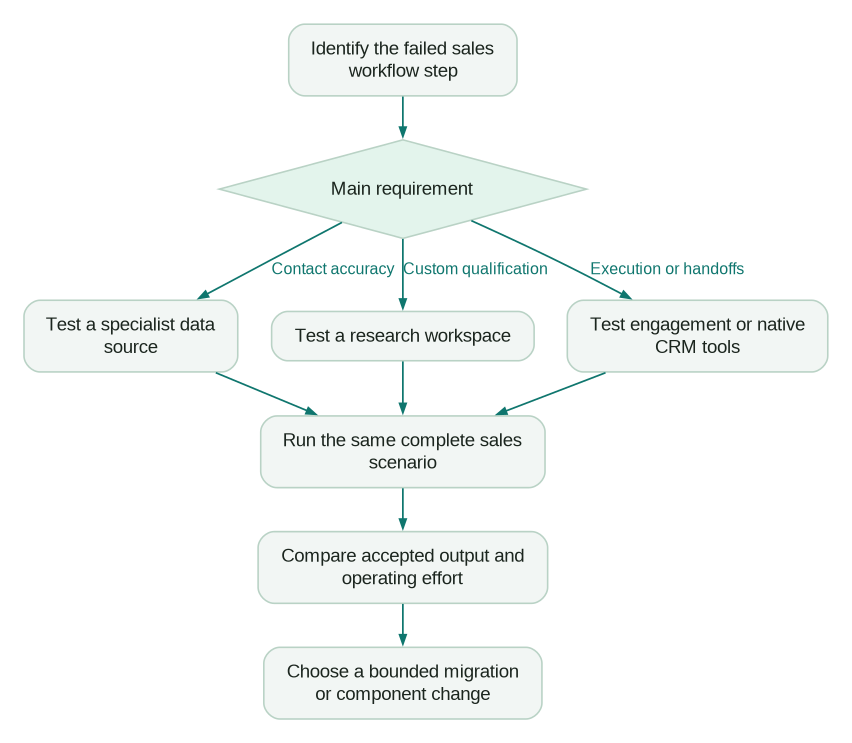
Read diagram as text
- Identify the failed sales step to Main requirement.
- Main requirement to Test a specialist data source: Contact accuracy.
- Main requirement to Test a research workspace: Custom qualification.
- Main requirement to Test engagement or native CRM tools: Execution or handoffs.
- Test a specialist data source to Run the same complete sales scenario.
- Test a research workspace to Run the same complete sales scenario.
- Test engagement or native CRM tools to Run the same complete sales scenario.
- Run the same complete sales scenario to Compare accepted output and operating effort.
- Compare accepted output and operating effort to Choose a bounded component change
What must survive the migration?
Preserve the rules and current conversations that make the sales process work. Email addresses alone cannot carry ownership, exclusions, reply state and follow-up commitments into a replacement.
Move one defined segment first. Set one authoritative writer for enrollment and each important CRM field. Keep the old subscription's renewal date and notice period in the plan, but tie cutover to an accepted workflow.
Checklist
- The replacement covers each required step or names the component that will.
- Existing customers, open opportunities and suppressed contacts retain their exclusions.
- Replies and scheduled follow-ups have an accountable destination owner.
- Source evidence and CRM record identities survive the export and import.
- Operator time, cash usage and accepted output are measured together.
- Rollback stops new enrollment while preserving ongoing conversations.
- A named owner confirms that the old system has no remaining required work before cancellation.
Choose the smallest change that resolves the demonstrated failure. Use the method for consolidating tools without losing a workflow before treating an old subscription as an available saving.
Want a second pair of eyes on your stack? Get the $99 martech audit. If the replacement workflow is already defined, request a detailed Apollo implementation scope covering the source data, enrollment rules and CRM acceptance tests.
Keep reading
Browse all GTM Engineering guides
 GTM Engineering
Apollo Pricing: Plans, Credits, Top-Ups and Team Costs
Compare Apollo plans from $49 per seat billed annually, credit costs, top-ups and realistic team budgets. See what happens when credits run out.
Jafrin Akter AloLast updated 14 min read
 GTM Engineering
Apollo Implementation Mistakes: Ownership, Sequences and CRM Sync
Fix Apollo identity, import, ownership and sequence problems. Learn why API deduplication can overwrite fields and how to test the full CRM handoff.
Jafrin Akter AloLast updated 12 min read
 GTM Engineering
Apollo vs Cognism for Prospecting, Phone Data and CRM Workflows
Compare Apollo and Cognism by phone-data coverage, credits, CRM handoff and complete workflow cost, with a usable-record budget and a controlled trial plan.
Jafrin Akter AloLast updated 12 min read
Apollo.io implementation
See the setup scope, acceptance checks and handover.
Questions people ask
What is the best Apollo alternative?
The best Apollo alternative is the one that fixes the part of Apollo that fails for your team. Choose Cognism when phone numbers and contact data are the gap, Clay for custom account research, Outreach for a structured sales-engagement process, Lemlist for outreach next to an existing CRM, and HubSpot when follow-up breaks between tools. Price the complete workflow, not one seat.
Can a shared services team buy the data while sales teams choose their own tools?
Yes, provided the contract and operating design support the intended users and destinations. Define who can reveal, export and retain records, then give each sales team the permitted subset with its source and refresh date. Centralize exclusion changes across those destinations. Ask the supplier to confirm the arrangement explicitly; one team's seat or export allowance may not authorize company-wide redistribution.
What should we do with enrichment credits left at the end of a contract?
Use them only for a current, justified workflow and check retention rights before the contract ends. Bulk enrichment solely to consume a balance creates data that may become stale before anyone acts on it. Compare the remaining credits with the accepted accounts already waiting for follow-up, and record whether the contract allows those exported records to remain in use afterward.
How can sales and operations resolve different preferences after a pilot?
Have both groups examine the same completed scenario and the same exceptions. Sales should show the actions that slowed a real task; operations should show the maintenance and repair work required behind it. Convert those observations into hours or failed acceptance cases where possible. Choose the arrangement that meets the agreed output within the team's available operating capacity.
What if our best customer segment is too small for a convincing comparison?
Use the pilot to verify identity, required fields and workflow behavior rather than claiming a statistically reliable sales uplift. Preserve every rejection reason and inspect unusual cases manually. If commercial outcomes remain uncertain, prefer a limited commitment that lets you collect more evidence. A small, relevant sample can establish feasibility even when it cannot estimate a stable conversion advantage.
Sources

Written by
Jafrin Akter AloData Engineer and Co-founder at Martechdevs and Growth and Analytics Partners
Jafrin writes practical guides to marketing technology, customer data, analytics and AI workflows. Martechdevs is a Growth and Analytics Partners company.