
Apollo vs Cognism for Prospecting, Phone Data and CRM Workflows
Pick Apollo.io if a small sales team wants prospect data and outreach in one operating workspace; pick Cognism if phone-led prospecting and a controlled data handoff justify a tailored contract. Apollo vs Cognism should be decided on your target accounts, usable contact coverage and total workflow cost. Database size alone cannot establish which provider finds the people your team needs.
On this page
Apollo and Cognism comparison
Compare the selected US offer in USD, including seats, credit allowances, billing term and the delivery route.
| Decision criterion | Apollo | Cognism | Budget or trial consequence |
|---|---|---|---|
| Starting commitment | Free; Basic $49/seat/month billed annually or $65 monthly | Tailored Standard or Pro quote, with 5 seats included | Obtain the paid order for the actual team |
| Main workflow | Data, sequencing and related sales execution | Prospecting data, mobile verification and CRM enrichment | Price any separate engagement system |
| Credit model | Shared team credits; verified email 1 credit, verified phone 8 credits | One credit per revealed contact; credits also support enrichment and export | Do not compare raw credit totals as equal units |
| Phone evaluation | Trial has a 20-number access cap | Pro includes on-demand mobile verification | Agree a representative sample and the available trial scope |
| CRM work | Integrations and plan-specific capabilities | CRM enrichment available separately or as an add-on | A connector logo does not define update behavior |
Commercial and evaluation details: Apollo plans, Apollo trial limits, Cognism pricing, Apollo integrations and Cognism integrations.
Apollo combines data with work a rep can perform after finding a person. Cognism is worth a closer look when the phone channel and the data supplied to an existing sales system carry much of the value. Both choices need a controlled evaluation of the actual market, especially when your targets span different countries, job levels and company sizes.
At Martechdevs, we begin a sales-data and outbound implementation with the target account definition and the destination CRM rules. That prevents a trial from rewarding the vendor that returns the largest pile of records. The useful output is a correct person at a relevant account, with the information your sales process can actually use.
Tool decision blocks
Apollo.io
- Best for: A founder-led or small sales team evaluating prospecting and outreach within one workflow.
- Pros: Apollo's plan structure includes email sequencing and core integrations on Basic, with broader capabilities on higher plans.
- Cons: All seats share one plan level, and different activities consume the team credit pool. A low seat price is incomplete without the required credit and integration scope.
- Free plan and startup offer: Free provides 75 credits per seat each month. The 14-day Basic or Professional trial allows access to 20 phone numbers; eligible startups can get 50% off Basic or Professional for one year, up to five seats.
- Choose it if: The team can run its target-list, outreach and CRM routine without adding unnecessary tools or manual transfers.
- Skip it if: The decisive phone or account segment fails the agreed coverage test, even after matching inputs and search settings are corrected.
The startup offer requires approval. Apollo lists fewer than 20 employees, no existing subscription, a valid company domain and an ecosystem-partner affiliation among its eligibility conditions. Model the ordinary renewal separately from the discount. The program should improve the economics of a suitable workflow, rather than rescue one that misses your target market.
Cognism
- Best for: A phone-led team that wants to evaluate verified mobile coverage and supply data to an existing CRM or engagement process.
- Pros: Cognism explains its phone-verification process, while Pro includes on-demand verification for priority contacts.
- Cons: A tailored package needs a full commercial review, including credit volume, seat use, export and enrichment requirements.
- Free plan and startup offer: The pricing page offers a sales demonstration and tailored quote, without a public permanent free allocation or universal startup discount. Agree the evaluation sample before the commercial review.
- Choose it if: The matched account test shows a valuable phone-data advantage and the team can turn that data into a maintained sales routine.
- Skip it if: The proposed package adds cost without improving usable coverage or reducing work in the existing stack.
Cognism describes phone verification as calling a number to confirm that the intended person answers. That is a useful process distinction, but it does not guarantee that a particular prospect will answer your rep's call. Test data identity and reachability separately from response to your offer. A correct number and a booked meeting are different outcomes.
Target-account coverage and evaluation design
Build the evaluation list before asking either vendor to demonstrate its strengths. Include the markets you sell into, the company sizes you can serve and the roles that participate in buying. Retain a known account identifier, such as a verified domain, so the same company is evaluated in each platform.
For person searches, specify the intended role and geography. A person at a multinational can work in a different country from the employer's headquarters. Mixing those two definitions can make a country coverage result meaningless. Keep the requested person location and company location as separate fields in the test.
Use a mix of known and unknown records. Known records help reveal mismatches, while unknown records show discovery value. Do not let either vendor replace difficult targets with more familiar companies. Record no-match results rather than dropping them from the denominator.
| Evaluation measure | Definition | Evidence to retain | Common mistake |
|---|---|---|---|
| Account match rate | Correct target companies returned ÷ target companies submitted | Source domain and matched company | Treating subsidiaries as interchangeable |
| Role coverage | Accounts with at least one relevant current contact ÷ target accounts | Title, employer and review outcome | Counting every returned employee |
| Usable email coverage | Accepted relevant contacts with usable email ÷ target contacts | Verification result and exclusions | Counting duplicate addresses twice |
| Usable phone coverage | Accepted relevant contacts with usable phone ÷ target contacts | Number type and identity review | Treating a switchboard as a direct mobile |
| CRM acceptance | Correctly written records ÷ approved records submitted | Destination IDs and rejected rows | Treating an export file as a completed handoff |
Set a practical acceptance threshold for each business segment. An aggregate result can hide a weak country or a seniority level that matters disproportionately to revenue. A small test is a screening exercise, so keep its conclusions limited to the sample and repeat it on a second representative set before a large commitment.
Phone verification and sales outcomes
A phone-led comparison should distinguish missing numbers, incorrect identities, valid numbers with no answer and actual conversations. Combining the last two categories can make reliable data look bad because the call timing or message was poor. Combining incorrect identities with no answer can make poor data look merely unresponsive.
Cognism publishes its verification approach on the Diamond Data page. Apollo's trial guidance limits phone access to 20 prospects and, on a dialer-enabled trial, 60 total call minutes with a ten-minute maximum per call. Those limits matter when planning the evaluation. A tiny phone sample cannot establish a broad market-wide winner.
Record how the sample was selected and keep the sales approach consistent. If one supplier is tested on familiar accounts with an experienced rep and the other on a new market with a new script, the result measures several changes at once. Where a clean comparison is impractical, label the conditions and avoid turning the observed difference into a platform-wide claim.
For a smaller contact-data shortlist, see Apollo vs Lusha. For a wider enterprise-data alternative, ZoomInfo vs Lusha emphasizes data delivery and recurring enrichment. These comparisons use different buying requirements rather than a universal ranking.
Best fit by sales model
| Company size or operating model | Best fit | Runner-up | Decision reason |
|---|---|---|---|
| Founder-led outbound with a small tool budget | Apollo | Cognism | Combining data and outreach can reduce handoffs |
| Phone-led team retaining an established engagement platform | Cognism Pro trial | Apollo Professional trial | Verified mobile coverage deserves a matched sample |
| Operations team mainly repairing existing CRM data | Cognism enrichment evaluation | Apollo | Price record maintenance separately from prospecting seats |
| Small team with mixed email and phone work | Apollo | Cognism | Test the combined workflow before adding another provider |
| Larger team entering an unfamiliar country | Matched regional trial | Either vendor by result | Accepted role and person-location coverage should decide |
These recommendations describe the first evaluation, rather than a claim that a provider wins every account in the category. Change the recommendation when the sample exposes a relevant gap. A tailored Cognism package can be justified by a valuable phone segment, while an Apollo setup can be the better operating choice even if another source supplies a subset of contacts.
Credit accounting and the complete quote
Cognism's current commercial model uses credits. Its pricing page states one credit for a contact reveal, no charge to view an already revealed contact, and renewed consumption when a contact changes jobs. CRM enrichment can be purchased separately or added to the prospecting package. Put those rules in the written order for your use case. Cognism credit terms.
Apollo pools credits across the team. Its pricing schedule lists one credit for a verified email and eight for a verified phone; other actions have separate charges. The credit usage guide lets administrators inspect consumption by features, team members and surfaces. Build the budget from the actions your process executes, including enrichment and any additional paid workflow activity.
Do not compare a Cognism contact reveal with an Apollo credit as though both buy the same thing. First define the output: a person with email, phone, approved company match and a successful CRM write. Then observe the credit consumption required to produce that output in each proposed package.
Ask for the subscription term, included seats, extra seats, credit renewal, unused-credit treatment and the relevant data rights. Apollo's pricing terms state that standard plans are for internal business use and that customer-facing products or resale require a separate agreement. An agency should establish its permitted use before building a client service around a data subscription.
Apollo seat and credit budget
Apollo Basic is $49 per seat per month billed annually, with 30,000 credits per seat per year granted upfront; monthly billing is $65 per seat with 2,500 monthly credits. Professional is $79 per seat per month billed annually or $99 per seat per month billed monthly, with 48,000 annual or 4,000 monthly credits respectively. These are US list amounts in USD. Apollo pricing.
For a hypothetical three-seat Basic team, annual billing is 3 × $49 × 12 = $1,764 upfront. Twelve monthly payments are 3 × $65 × 12 = $2,340, a $576 difference. The annual credit allocation is 90,000 upfront; the monthly arrangement provides 7,500 each month. The aggregate over twelve months can match while the availability and commitment differ. Add the required usage and other products before comparing this seat budget with a Cognism quote.
A hypothetical usable-record budget
Assume a hypothetical team spends $600 in a month on its selected data workflow and produces 400 approved records after matching, suppression and deduplication. A second hypothetical setup costs $900 and produces 750 approved records. These amounts are planning inputs, not Apollo or Cognism quotes, and the volumes are not measured vendor results.
| Hypothetical setup | Monthly workflow cost | Approved records | Cost per approved record |
|---|---|---|---|
| Setup A | $600 | 400 | $1.50 |
| Setup B | $900 | 750 | $1.20 |
| Setup B with only 500 approved records | $900 | 500 | $1.80 |
The calculation is monthly workflow cost divided by approved records. Setup B costs more in total but less per usable output in the first case. If its accepted output drops to 500, that advantage disappears. The metric is useful because it joins coverage and spend without assuming a sale or a meeting.
Keep the denominator unique and relevant. If 100 of the 750 records are duplicates of people already approved that month, the unique output is 650 and $900 ÷ 650 is about $1.38. That is still different from a cost per meeting, which would require its own observed outcome and attribution rules.
Use the software pricing tool to collect subscription, credit, dialer, engagement and integration costs. The Apollo pricing guide helps structure the Apollo order; the Cognism vs ZoomInfo guide is relevant when comparing larger tailored data arrangements.
CRM acceptance and repair loop
Both vendors list integrations with common CRM and sales tools. Confirm the exact direction of data movement, the objects supported and the credentials that control access. Apollo integration catalogue, Cognism integration catalogue. The trial should prove what happens to an existing contact as well as a new one.
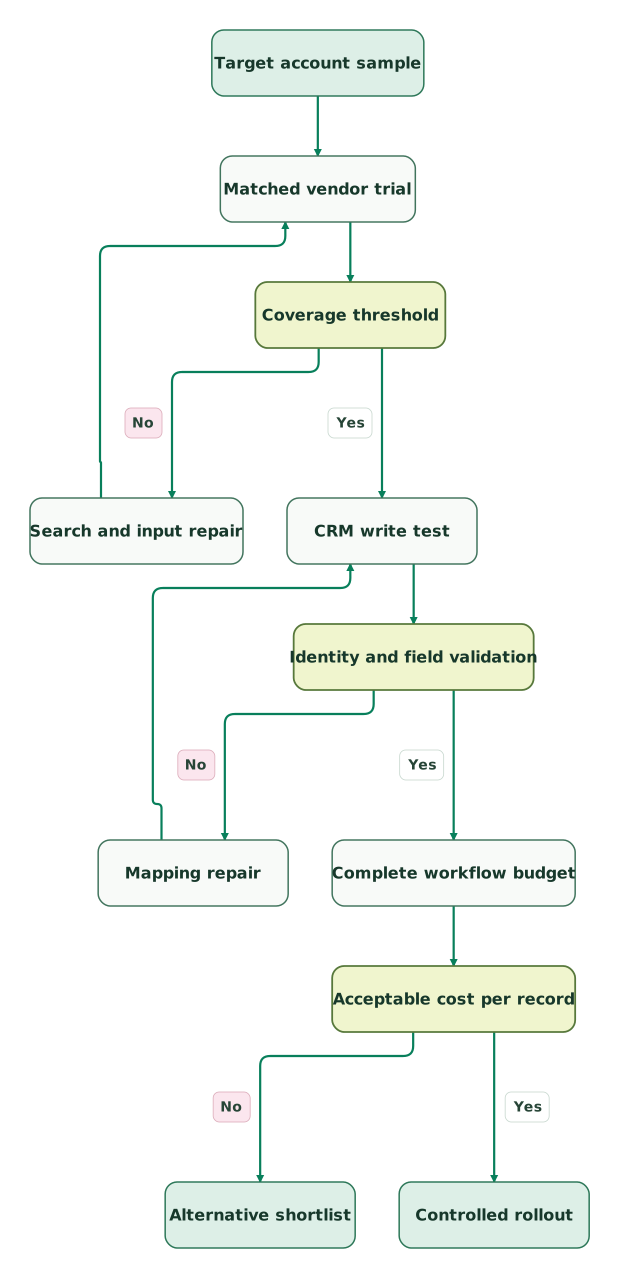
Read diagram as text
- Target account sample to Matched vendor trial.
- Matched vendor trial to Coverage threshold.
- Coverage threshold to Search and input repair: No.
- Search and input repair to Matched vendor trial.
- Coverage threshold to CRM write test: Yes.
- CRM write test to Identity and field validation.
- Identity and field validation to Mapping repair: No.
- Mapping repair to CRM write test.
- Identity and field validation to Complete workflow budget: Yes.
- Complete workflow budget to Acceptable cost per record.
- Acceptable cost per record to Controlled rollout: Yes.
- Acceptable cost per record to Alternative shortlist: No
Protect fields that sales or another system owns. A newly discovered job title may be useful, but an enrichment run should not silently replace the opportunity owner or a customer exclusion. Retain the source and update time for material data changes so a disputed result can be investigated.
Test a job change deliberately. Decide whether the old employment relationship remains as history, whether the current company changes and whether the person should leave an existing prospect sequence. Repeat the CRM acceptance test after any mapping repair, then inspect a small production cohort before increasing volume.
Apollo vs Cognism checklist
- Define target accounts, roles and person geography before vendor selection.
- Give both candidates the same representative sample and matching inputs.
- Separate no-match, wrong identity, no answer and conversation outcomes.
- Confirm trial phone limits and the scope of any sales-assisted evaluation.
- Record the full credit consumption needed for one approved CRM record.
- Price seats, enrichment, engagement tools and the ordinary renewal.
- Preserve suppression, field ownership and source information during updates.
- Test a duplicate, a current customer and a contact who changes jobs.
- Re-run affected validation after search or mapping repairs.
- Approve the small rollout from unique usable records and complete cost.
Use the CRM data hygiene audit skill to define matching and overwrite rules. The waterfall enrichment guide helps when neither provider covers every segment and a second supplier needs a controlled role.
Keep reading
Browse all GTM Engineering guides
 GTM Engineering
Apollo vs Lusha for Prospecting, Credits and CRM Enrichment
Compare Apollo and Lusha by usable contact coverage, paid workflow scope, credit charges, renewal rules and CRM updates, with a reproducible credit example.
Jafrin Akter AloLast updated 11 min read
 GTM Engineering
ZoomInfo vs Lusha for Sales Data, Enrichment and Team Costs
Choose between ZoomInfo and Lusha using account coverage, enrichment rules, trial scope and complete team costs, with a hypothetical usable-contact budget.
Jafrin Akter AloLast updated 11 min read
 GTM Engineering
Apollo vs ZoomInfo for Startups: Choose on Coverage and Cost
Compare Apollo and ZoomInfo using current pricing, usable contact coverage, CRM workflows and total cost. See when Clay or Lusha belongs on your shortlist.
Jafrin Akter AloLast updated 12 min read
GTM engineering & outbound
See the implementation scope, deliverables and acceptance checks.
Questions people ask
Can a twenty-number Apollo trial settle a Cognism phone-data comparison?
A twenty-number trial can expose obvious fit problems, but it cannot settle a broad phone-data comparison across several markets. Use it to check the workflow and matching quality, then agree a larger representative evaluation if the purchase depends on phone coverage. Keep sample size, role mix and location visible when presenting the result to the budget owner.
Does Cognism still need a credit budget for prospecting?
Yes, Cognism's current pricing describes credits for revealing contact records, with allocations attached to the subscription. Its rules distinguish already revealed contacts and later job changes. Ask for the included volume and relevant enrichment or export terms in the order, then estimate consumption from the approved records your team actually needs rather than from a total database size.
Can Apollo and Cognism feed the same CRM without duplicating records?
Apollo and Cognism can be evaluated against the same CRM, but duplicate prevention depends on the matching and write rules you configure. Define stable person and company identifiers, establish field ownership and test an existing contact before allowing bulk writes. Keep each provider's source information so conflicting values can be reviewed without losing the earlier accepted record.
Is a phone-verified record the same as a guaranteed conversation?
A phone-verified record is not a guaranteed conversation. Verification addresses whether a number belongs to the intended person; a conversation also depends on availability, timing and the sales approach. Measure those outcomes separately. A correct number with no answer should not be grouped with a wrong person when judging the underlying data supplier.
Can an Apollo startup discount be applied to every sales-data project?
An Apollo startup discount applies only to an approved eligible business and the stated plan and seat scope. The public program offers a one-year reduction with specific conditions, including team size and partner affiliation. Price the ordinary renewal and any excluded work separately, especially if the project also needs other data vendors, integration work or an engagement platform.
Sources

Written by
Jafrin Akter AloData Engineer and Co-founder at Martechdevs and Growth and Analytics Partners
Jafrin writes practical guides to marketing technology, customer data, analytics and AI workflows. Martechdevs is a Growth and Analytics Partners company.