
Airbyte Pricing 2026: Plans, Credits, Cost per Million Rows and the September Change
Airbyte Cloud starts at $20 a month on Standard, with five credits included and $5 for each extra credit. Plus packages run from $189 for 40 credits to $4,999 for 2,000. One credit covers about 167,000 API rows or 250 MB of database or file data. Core is free to self-host. Airbyte doubled Standard's price on 21 September 2026, from $10 a month and $2.50 a credit. Budget the first historical load, recovery, warehouse charges and the people who run the pipelines separately.
On this page
A customer relationship management (CRM) database with 50,000 contacts can generate far more than 50,000 extracted rows. Activity streams, repeated reads and historical reloads all change the work. Company headcount does not determine the invoice.
Before comparing subscriptions, name the output: a daily acquisition report, hourly product adoption analysis or an audience that needs to reach a lifecycle tool quickly. That decision determines which streams, historical depth and refresh frequency deserve a budget. Our warehouse and customer data implementation starts with those consumers and their requirements. For Airbyte itself, see our Airbyte implementation services.
Go to plans, the 2026 changes, cost per million rows or which package to choose.
Which Airbyte plan should you price?
Price Standard or Plus for volume-based managed ingestion, Pro for a capacity requirement, and Enterprise Flex when deployment boundaries determine the purchase. Core is the self-managed option. These are Airbyte data-replication plans.
Plan details are from Airbyte pricing, and Standard's extra-credit rate is in Airbyte's pricing release notes. Standard and Plus amounts are USD per month before tax; Pro and Enterprise Flex need contract quotes. Faster scheduling still depends on source limits and job duration. SSO means single sign-on; RBAC means role-based access control.
| Plan | Charging model | Fastest schedule | Main purchasing distinction |
|---|---|---|---|
| Core | No platform licence fee; infrastructure and operations extra | Depends on your deployment and source | Self-managed |
| Standard | USD 20, five credits; USD 5 extra | Hourly | Managed, low-volume starting point |
| Plus | Credit packages below | 15 minutes | SSO, field renaming, two workspaces |
| Pro | Custom Data Worker quote | Five minutes | RBAC, row filtering, hashing and encryption |
| Enterprise Flex | Custom capacity quote | Five minutes | In-boundary/hybrid deployment; managed control plane |
Standard's portal support has no response service-level agreement (SLA), with listed hours of 7am–7pm EST. Plus lists a 24-hour first-response SLA. A response target does not establish that a failed source will be repaired within that time.
Buy a higher plan for a specific constraint: freshness, access control, capacity or deployment. A shorter schedule cannot make a two-hour extraction finish in 15 minutes.
Is Airbyte free, and is there a startup discount?
Airbyte Core has no platform licence fee under its applicable licence; you operate the installation. Cloud's trial terms begin after the first successful sync and end after 14 days or 400 credits, whichever comes first.
The current plan page does not publish a general startup-credit allowance. Ask for written eligibility and terms before including a concession in the budget. A trial, a time-limited upgrade promotion and a startup programme are different offers. Separately, Airbyte's Y Combinator promotion offers USD 75,000 in Cloud credits to companies from a current or previous YC batch that raised under USD 5M, excluding existing customers. YC promotion
What changed in Airbyte pricing in 2026?
Airbyte changed Standard and Plus pricing in September, and its release history explains why older pages show different amounts. The official release notes distinguish the pricing changes from later corrections to trial and billing messages.
| Product date | Change | Budget consequence |
|---|---|---|
| 15 September 2026 | New Plus packages available; unused-credit rollover extended from two to three months | Compare all six package totals plus their own overage rates |
| 21 September 2026 | Standard changed from USD 10 with four credits to USD 20 with five; extra credits changed from USD 2.50 to USD 5 | Recalculate older Standard estimates |
| 1 October 2026 | Upgrade confirmation corrected to explain immediate Plus and unbilled Standard charges, with a restarted billing cycle | Do not assume a mid-period upgrade is prorated |
| 6 October 2026 | Signup and trial-banner text corrected from 30 days to 14 days | This is a messaging correction, not evidence that every trial changed that day |
Existing Standard customers already using SSO can keep it while retaining their plan; new Standard buyers do not receive it. An earlier upgrade promotion required eligible organizations to move to Plus by 21 October 2026. That was an upgrade deadline, not a universal expiry for awarded credits. Confirm any current offer and remaining balance separately from recurring prices.
Which Plus package is cheapest for your usage?
Choose the least expensive package plus overage for your expected credits, then check whether its features and unused balance fit the operating plan. Comparing only included credits misses cases where the smaller package with some overage is cheaper.
USD per monthly package, before tax and any credit balance or promotion. The package selector publishes package prices and included credits. The extra-credit rates come from the September pricing release notes; they are not displayed in the current selector. Effective included-credit prices are calculated from the package totals and rounded to cents.
| Included credits | Monthly package, USD | Extra credit, USD | Effective included credit, USD |
|---|---|---|---|
| 40 | 189 | 5.00 | 4.73 |
| 100 | 449 | 5.00 | 4.49 |
| 250 | 999 | 4.50 | 4.00 |
| 500 | 1,799 | 4.15 | 3.60 |
| 1,000 | 3,199 | 3.75 | 3.20 |
| 2,000 | 4,999 | 2.50 | 2.50 |
Airbyte's announcement approximates the 40-credit package at USD 4.75 per credit and the 100-credit package at USD 4.50. Dividing the actual package prices gives USD 4.725 and USD 4.49. Use the package invoice amount for calculations rather than multiplying the rounded descriptions.
If you use all included credits, the package prices imply the following average unit costs. These are calculated from the unrounded package price divided by its allowance, then multiplied by the credit conversion. They are not standalone pay-as-you-go prices; unused allowance raises your effective cost.
| Plus package | USD per million API rows at full allowance use | USD per observed GB at full allowance use |
|---|---|---|
| 40 credits | 28.35 | 18.90 |
| 100 credits | 26.94 | 17.96 |
| 250 credits | 23.98 | 15.98 |
| 500 credits | 21.59 | 14.39 |
| 1,000 credits | 19.19 | 12.80 |
| 2,000 credits | 15.00 | 10.00 |
The following break-even points are calculations using those prices, with no carried credit balance. Airbyte can meter fractional credits, so the exact crossing matters; the last column is a convenient whole-credit decision rule.
| Compare lower and next package | Equal-cost usage, credits | Next package cheaper from, whole credits |
|---|---|---|
| Standard → Plus 40 | 38.8 | 39 |
| Plus 40 → Plus 100 | 92 | 93 |
| Plus 100 → Plus 250 | 210 | 211 |
| Plus 250 → Plus 500 | 427.7778 | 428 |
| Plus 500 → Plus 1,000 | 837.3494 | 838 |
| Plus 1,000 → Plus 2,000 | 1,480 | 1,481 |
For example, the Plus 40 package reaches the Plus 100 price at 92 credits:
Plus 40 at 92 credits = USD 189 + (92 - 40) × USD 5
                     = USD 449
Plus 100 at 92 credits = USD 449
At 38 credits, Standard costs USD 185 against Plus 40 at USD 189. At 39 credits, Standard costs USD 190. Above that crossing, the smaller Standard allowance no longer wins this price-only comparison.
Unused Plus credits roll over for three months under the revised rollover policy. That can help with uneven usage, but only if the balance gets used before expiry. Confirm how credit vintages are consumed in your account before modelling a specific expiry order. Do not treat a large unused balance as a saving by itself.
How do rows and gigabytes become credits?
Airbyte Standard and Plus convert application programming interface (API) and custom-source rows separately from database and file volume. Airbyte's billing rules define the conversion below.
| Source type | Metered quantity | Credits |
|---|---|---|
| API or custom source | One million rows | 6 |
| Database or file source | One GB in Airbyte's observed protocol representation | 4 |
Full refreshes charge every synced row. Serialized database/file volume can exceed stored source size. A compressed backup, CRM contact count and final warehouse-table size therefore do not establish billed usage. On Standard, where an extra credit costs USD 5, that works out at about USD 30 per million API rows and USD 20 per GB of database or file data once the included credits are used.
One credit therefore represents about 166,667 API rows or 0.25 GB of observed database/file data. Five credits cover 1.25 GB by that formula, although the pricing card rounds the allowance to about 1 GB. A 40-credit package covers about 6.67 million API rows or 10 GB if used entirely for one source type.
Compare Fivetran's per-connection monthly active row (MAR) pricing against the same extraction workload. Its active-row unit and Airbyte's rows delivered are different meters.
For each stream, record its business output, sync mode, first-load volume, routine volume, required schedule, lookback window and recovery depth. This inventory reveals costs hidden by an account-level total.
Does the standalone cost estimator use the current prices?
Airbyte's standalone estimator still exists, but its published calculation uses USD 2.50 per credit without the current Standard base fee, allowance or Plus packages. Its source inputs distinguish database GB from API rows, and the conversion remains four credits per GB and six per million rows. Its dollar result therefore should not be used as a current Standard or Plus quote.
For example, 5 million API rows and 10 GB represent 70 credits. The estimator's formula gives USD 175. The current Standard calculation is USD 345, while Plus 40 with overage is USD 339. Use the current package comparison, then confirm the amount and credit balance shown in your account.
To build your estimate:
- Record a representative period after the initial historical load, including any monthly or seasonal peaks.
- Split API/custom rows from observed database/file GB.
- Convert each source to credits and project the actual operating calendar.
- Compare package plus overage totals, including any usable balance.
- Add the first load or recovery reread as its own scenario.
- Add destination and operating costs before approving the plan.
If a connector starts reporting a different billing unit, keep the old estimate and confirm the new source classification before comparing trends. Recalculate a normal cycle in the new unit rather than treating every credit movement as business growth.
What does an ordinary month versus launch month cost?
The historical load can change the cheapest package even when the ongoing workload is small. First compare two hypothetical recurring stacks. Both use USD list prices, exclude tax and carried credits, and assume the supplied volumes are the amounts Airbyte actually meters.
| Monthly workload | Credits | Standard bill | Plus 40 bill | Cheapest listed option |
|---|---|---|---|---|
| HubSpot, Stripe and Google Ads together extract 3 million API rows | 3 × 6 = 18 | 20 + 13 × 5 = 85 | 189 | Standard, USD 85 |
| 5 million API rows plus 10 GB from a product database | 5 × 6 + 10 × 4 = 70 | 20 + 65 × 5 = 345 | 189 + 30 × 5 = 339 | Plus 40, USD 339 |
The first stack is USD 1,020 across 12 identical months. At 70 credits, Plus 100 costs USD 449, so buying more included credits raises the bill by USD 110. Plus 40 and Plus 100 tie at 92 credits; Plus 100 becomes cheaper above that point.
A separate first load of 150 GB, measured in Airbyte's protocol representation, adds 150 × 4 = 600 credits. If all of those credits are additional Standard usage, the extra charge is 600 × USD 5 = USD 3,000. Adding that load to the 70-credit month produces 670 credits: Standard would cost USD 3,345, while Plus 500 would cost USD 1,799 + 170 × USD 4.15 = USD 2,504.50. Reprice the whole launch month; do not treat the USD 3,000 marginal amount as the cheapest available package bill.
Now keep the launch model separate from the continuing budget. Consider a fictional team combining a CRM API with a product database. These are planning inputs, not typical usage or a vendor quote.
An ordinary month processes three million API rows and two GB of database data as measured by Airbyte:
API credits = 3 million rows × 6 = 18
Database credits = 2 GB × 4 = 8
Total monthly credits = 26
With no existing balance, discount or trial credit:
Standard = USD 20 + max(26 - 5, 0) × USD 5
         = USD 125

Plus 40-credit package = USD 189
Standard costs less for this month. Choose Plus only if another requirement justifies the difference. If the CRM is the only source needed, also price native CRM export routes against the same freshness and history needs.
Now add a first historical load of eight million API rows and six GB in the same period. It adds 48 + 24 = 72 credits, bringing total usage to 98.
USD for this single hypothetical billing period, excluding tax, promotions and credit balances:
| Configuration | Calculation at 98 credits | Bill, USD |
|---|---|---|
| Standard | 20 + (98 − 5) × 5 | 485 |
| Plus 40 | 189 + (98 − 40) × 5 | 479 |
| Plus 100 | 449; usage within allowance | 449 |
Plus 100 wins this launch-month comparison by USD 36 against Standard and USD 30 against Plus 40. Review the recurring month separately before keeping the larger package. A plan change can reset a billing cycle, so this comparison does not assume you can switch midway through a period without a commercial consequence.
Why can the same source produce different bills?
Repeated extraction changes the cost even when the destination ends with the same records. Imagine a fictional API stream with 200,000 records. A daily full refresh over 30 days reads six million rows; a supported incremental configuration reading 20,000 changes daily processes 600,000 after its initial load.
Those recurring volumes consume 36 and 3.6 credits, a tenfold difference. Establish how updates and deletions are represented, whether the cursor advances correctly and whether the report needs historical versions before changing modes.
Airbyte's sync-mode documentation separates source reading from destination writing. Deduplicating the destination does not necessarily reduce source extraction.
At Martechdevs, we remove unused streams first, verify incremental correctness, reduce unnecessary history where supported, and align schedules with the decisions they serve. Package changes come after that work. The Airbyte implementation guide explains the matching correctness checks.
How do recovery and failed syncs affect the budget?
Budget a credible reread and its downstream work, and investigate metered usage even when the sync finishes unsuccessfully. Airbyte's billing policy bills additional credit usage regardless of sync status; a failed result is not an automatic free attempt.
Its refresh guidance explains that refreshed streams reimport available records. Retain/remove choices affect historical data, storage and compute. Removing history can lose records the source no longer holds.
Choose a concrete incident: a cursor mistake found after a week, a newly required historical field or an incomplete source extract. Estimate the repair needed for the affected output rather than resetting every connection.
Set an approval threshold in both money and consequence. A refresh touching finance reporting or customer activation should identify which consumers must wait and what proves the result is ready.
What sits outside the Airbyte invoice, including year two?
Warehouse usage, transformations and operating work continue after the connector bill. Airbyte's dbt Cloud integration requires paid dbt Cloud. Integrate.io's Airbyte cost analysis puts paid dbt Cloud at USD 100 per developer a month, which matches the Starter plan on dbt's pricing page. Transformation compute is charged by the destination separately.
Budget data movement, Snowflake warehouse costs or BigQuery usage, operating ownership and one-time implementation independently. A paid source API or export entitlement is another separate line: check its allowance and estimate requests from pagination, retries and the required schedule. For outbound operational updates, include reverse ETL tools that send warehouse data back out.
In another fictional planning model, monthly Airbyte costs USD 125, destination/transformation charges USD 180, and four operating hours are valued at USD 75 each. The total is USD 605. A USD 20 connector saving reduces that total by 3.3%; two fewer operating hours reduce it by 24.8%. Internal time becomes a cash saving only when spending actually falls.
For the annual comparison below, hold those recurring inputs constant, add the Standard launch premium of USD 360 once, and assume a hypothetical one-time implementation cost of USD 6,000. These are examples, not Martechdevs prices. Each year has 12 monthly billing periods; no grant, discount, rollover or growth is assumed.
| Budget component | Year one, USD | Year two, USD |
|---|---|---|
| Airbyte | 485 + 11 × 125 = 1,860 | 12 × 125 = 1,500 |
| Destination/transformation | 12 × 180 = 2,160 | 2,160 |
| Internal operating-time value | 12 × 4 × 75 = 3,600 | 3,600 |
| One-time implementation | 6,000 | 0 |
| Total resource budget | 13,620 | 7,260 |
Year two removes initial build and launch work, while recurring support and infrastructure remain. Re-estimate volume, pricing and operator time before renewal. Use a warehouse ROI model to judge whether the outputs justify that cost, keeping assumed revenue effects separate from demonstrated returns.
When should you evaluate capacity pricing or self-hosting?
Evaluate capacity when peak concurrency, governance or deployment requirements determine the plan. Supply a schedule, extraction durations, backfill needs and regional workloads when requesting a quote.
Airbyte's pricing page describes a Data Worker as typically supporting about three concurrent syncs. Its capacity-management documentation is more precise: consumption varies by source/resources, allocation is regional, and jobs queue when regional capacity is full unless applicable on-demand capacity is enabled. Approximate defaults are 0.5 workers per database sync, 0.25 for files/custom sources and 0.2 for APIs; the actual usage chart controls sizing.
For a hypothetical one-worker allocation, two default database syncs fill it. Three such syncs need 1.5 workers at once, while five default API syncs need one. Treat the “three syncs” description as an orientation, not a guaranteed concurrency entitlement. Include any on-demand capacity terms in the quote. The Data Worker guide describes on-demand runs at a premium rate and bills the whole run at that rate if it starts on on-demand capacity. Get the rate and an approval limit in writing; the guide does not publish a dollar tariff.
The plan comparison describes Pro as a flat annual quote and lists 24/5 support with a 12-hour critical first-response target and a Dedicated Solutions Architect for Pro and Enterprise Flex. Ask whether Enterprise Connectors, AWS PrivateLink and expanded enterprise support are included or separately priced. A response target is not a guaranteed resolution time.
Is self-hosting Airbyte Core cheaper?
Core removes the managed-platform subscription, while your team supplies infrastructure and operations. Airbyte's deployment guide describes Kubernetes deployment and ongoing upgrades. Budget backups, monitoring, connector changes and someone who can restore service when the primary owner is absent.
Airbyte's pricing page gives no infrastructure cost for Core. Integrate.io's Airbyte cost analysis estimates USD 500 to USD 3,000 or more a month for the compute, storage and networking behind a self-hosted deployment, before engineering time. Size your own infrastructure from the sources, volumes and schedules you run.
The platform repository's Elastic License 2.0 is royalty-free subject to its terms. It restricts offering the software to third parties as a hosted/managed service that exposes a substantial set of its features. Agencies and software vendors should review that scope before building a customer-facing service on Core. Airbyte's connector licence update also describes the move to ELv2 for connectors. Check each component's actual licence rather than assuming every connector is MIT-licensed.
Compare self-managed and managed proposals with the same source scope, recovery responsibilities and correctness requirements. Also compare Airbyte with Fivetran on the same workload before attributing every operating difference to the headline meter.
Which option fits a small team's workload?
Start with the workload's cheapest valid operating model, then pay for the specific constraint it cannot meet. Team size here supplies context; the row/volume assumptions determine cost.
| Hypothetical team and workload | Starting choice | Runner-up | Decision trigger |
|---|---|---|---|
| Ten people, 26 credits/month, hourly reporting | Standard at USD 125 | Plus 40 at USD 189 | A real 15-minute or SSO requirement |
| 25 people, 150 credits/month, faster audiences | Plus 100 at USD 699 | Plus 250 at USD 999 | Higher usage or usable carried credits change the comparison |
| 50 people, 500 credits/month, governed feeds | Plus 500 at USD 1,799 | Pro quote | RBAC, regional capacity or access requirements determine the tier |
| Existing platform team, supported sources, operational coverage | Evaluate Core total cost | Managed plan | Control and operator workload justify self-management |
The three monthly amounts are calculated before tax and carried balances. Pro remains quote-only; a 50-person team does not automatically need it.
How can you pay less for Airbyte?
Start by reducing unnecessary extraction, then select the cheapest plan that still meets the workload's requirements. Changing a package cannot fix a connector that rereads unnecessary history.
- Remove streams and fields no reporting or activation process uses. Keep an owner for every retained output.
- Verify incremental syncs where supported, including updates, deletions and cursor behavior. Do not trade a smaller invoice for incomplete data.
- Schedule work to meet the real freshness requirement. For capacity plans, stagger jobs and inspect each region's peak before buying more workers.
- Compare every Plus package with overage using unrounded prices. Include only carried credits that remain usable before expiry.
- Budget the first historical load and one recovery scenario separately. Check the immediate charge and new renewal date before a mid-period upgrade.
- Configure all three billing alerts: a sync above a dollar threshold, an invoice increase above a percentage, and an upcoming invoice above a dollar threshold. Give each alert an owner and an action.
The billing guide documents those alert types. Standard and Plus use card payment by default; ACH and custom discounts require a sales discussion. A cost alert is a notification, not a spending cap.
For eligible YC companies, confirm the startup offer before treating credits as available. Compare other managed options in Fivetran alternatives using the same sources, sync mode, history and operator responsibilities. Core needs the same comparison with engineer hours and recovery coverage included; there is no universal infrastructure bill that establishes self-hosting as cheaper.
What should the pilot prove before you commit?
The pilot should demonstrate correct recurring data at an understood cost, plus a recoverable failure path. A successful historical sync alone cannot establish that.
A useful Airbyte budget starts with a correct recurring sync. Fix mismatched data before pricing ordinary, launch and recovery usage, and choose a higher plan only when a measured feature, freshness or capacity requirement needs it.
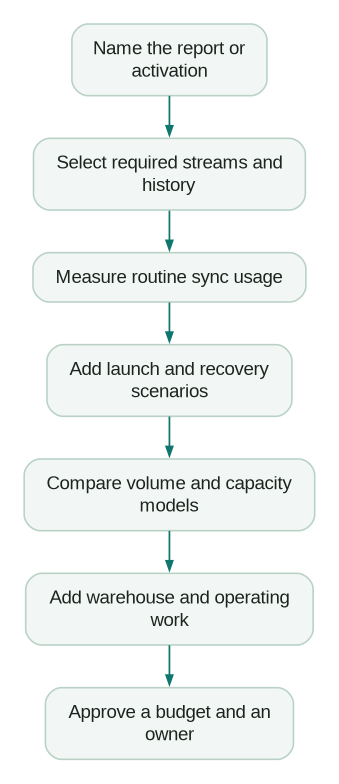
Read diagram as text
- Name the output streams and required history to Measure a representative recurring sync.
- Measure a representative recurring sync to Destination state reconciles to the source?.
- Destination state reconciles to the source? to Fix sync mode cursor or missing data: No.
- Fix sync mode cursor or missing data to Measure a representative recurring sync.
- Destination state reconciles to the source? to Price ordinary launch and recovery usage: Yes.
- Price ordinary launch and recovery usage to Plan meets freshness features and capacity?.
- Plan meets freshness features and capacity? to Compare another valid package or capacity quote: No.
- Compare another valid package or capacity quote to Price ordinary launch and recovery usage.
- Plan meets freshness features and capacity? to Add warehouse work alerts and recovery approval: Yes.
- Add warehouse work alerts and recovery approval to Budget and operating coverage confirmed?.
- Budget and operating coverage confirmed? to Add warehouse work alerts and recovery approval: No.
- Budget and operating coverage confirmed? to Approve the plan and named owners: Yes
Checklist
- Separate first-load usage from recurring usage for each material stream.
- Measure a representative cycle including updates, quiet periods and peaks.
- Reconcile destination totals and current state to the source.
- Price one recovery scenario and identify its approval owner.
- Verify the feature or usage requirement behind an upgrade.
- Include destination cost and named operating coverage.
- Set billing alerts and the response each should trigger.
Credit exhaustion does not pause syncs: additional usage is billed afterward. Passing USD 10,000 of credit usage during a billing period triggers an immediate saved-payment charge and invoice. Make cost alerts actionable before a large refresh starts.
Bring the ordinary, launch and recovery estimates to the $99 martech audit, or request a detailed Airbyte scope with the source inventory and acceptance requirements.
Keep reading
Browse all Data Warehouse guides
 Data Warehouse
Fivetran vs Airbyte: Compare the Workload, the Bill and the Maintenance
Compare Fivetran and Airbyte with current billing rules, worked costs, HubSpot connector checks and a practical pilot for small marketing data teams.
Jafrin Akter AloLast updated 11 min read
 Data Warehouse
Airbyte Implementation Mistakes: Syncs, Schemas and Recovery
Diagnose Airbyte duplicates, missing updates, partial backfills and unsafe Clear or Refresh recovery, with a SQL fixture and stream-level acceptance checks.
Jafrin Akter AloLast updated 12 min read
 Data Warehouse
5 Fivetran Alternatives: Choose by Source, Cost and Recovery
Compare 5 Fivetran alternatives and competitors: Airbyte from USD 20 a month, Stitch from USD 100, Hevo from USD 265, open-source dlt and Google Datastream.
Jafrin Akter AloLast updated 16 min read
Airbyte implementation
See the implementation scope, deliverables and acceptance checks.
Questions people ask
Is Airbyte free to use?
Airbyte Core has no platform licence fee for self-hosting under its applicable licence, but you pay for infrastructure and operations. Airbyte Cloud has a trial that starts after the first successful sync and ends after 14 days or 400 credits, whichever comes first. Continuing on Standard starts at USD 20 a month with five included credits.
How much does Airbyte cost per million rows?
On Airbyte Standard and Plus, a million rows from an API or custom source uses six credits; a GB from a database or file source uses four. Standard's USD 5 extra-credit rate means USD 30 per million API rows or USD 20 per GB after its allowance. Package credits and carried balances change the full invoice, so these are marginal rates.
Did Airbyte raise Standard prices in 2026?
Yes. Airbyte Standard changed on 21 September 2026 from USD 10 a month with four credits to USD 20 with five. Extra credits rose from USD 2.50 to USD 5. The base price and extra-credit rate doubled, but an individual invoice depends on usage and the larger allowance. New Plus packages use their own included credits and overage rates.
Is Airbyte open source or source-available?
Airbyte's platform uses Elastic License 2.0, which is source-available rather than open source under the OSI definition. Airbyte also moved connectors to ELv2, although component and historical licences can differ. You can run and modify it for internal pipelines under the licence terms. The restriction concerns hosted or managed services exposing a substantial set of Airbyte's features; check the actual component licence.
Will running out of credits stop my Airbyte syncs?
No. Airbyte Standard and Plus continue running scheduled and in-progress syncs after credits run out, then bill additional usage in arrears. A failed sync can still incur metered usage. Passing USD 10,000 in credit usage within a billing period triggers an automatic charge and invoice. Configure billing alerts and a refresh approval process before large loads; the allowance is not a hard spending cap.
Sources
- Airbyte, Pricing and plan selector.
- Airbyte, Cloud release notes.
- Airbyte, Manage billing and credits.
- Airbyte, Sync modes.
- Airbyte, Refreshing data.
- Airbyte, dbt Cloud integration.
- Airbyte, Deploying Airbyte.
- Airbyte, Platform licence.
- Airbyte, Manage and monitor Data Workers.
- Airbyte Y Combinator startup promotion.
- Airbyte, Standalone cost estimator.
- Airbyte, Why we moved to ELv2, including connector licensing.
- Integrate.io, Airbyte pricing: how much Airbyte really costs.
- dbt Labs, dbt pricing plans.

Written by
Jafrin Akter AloData Engineer and Co-founder at Martechdevs and Growth and Analytics Partners
Jafrin writes practical guides to marketing technology, customer data, analytics and AI workflows. Martechdevs is a Growth and Analytics Partners company.