
5 Fivetran Alternatives: Choose by Source, Cost and Recovery
A useful Fivetran alternative must reproduce the data your business uses, survive an interrupted sync and reduce a cost or constraint that matters. Airbyte, Hevo, Stitch, dlt and Google Datastream offer different replacement routes. Shortlist them by source behavior and operating ownership, then compare measured usage, historical coverage and recovery before moving production reports.
On this page
What should you establish before replacing Fivetran?
Establish the specific failure you need the replacement to solve: an unaffordable workload, missing data, inadequate freshness, deployment restrictions or excessive operating effort. A cheaper subscription cannot compensate for a connector that omits the fields used to calculate revenue.
Start with the report or operational decision that depends on the pipeline. Record its source objects, required fields, identifiers, acceptable delay and recovery deadline. Then trace those requirements to the existing connection and invoice. The Fivetran pricing guide helps separate usage, plan requirements and avoidable collection before evaluating a migration.
| Reason to change | Evidence to collect | What the replacement must prove |
|---|---|---|
| Cost exceeds the budget | Usage by connection, table and billing unit | Lower complete cost under the same workload |
| Required data is missing | Exact object, property, relationship or history gap | Those records arrive with usable keys and meaning |
| Data arrives too late | Source-change and report-ready timestamps | The full reporting path meets its deadline |
| Deployment is unsuitable | Approved region, network and credential requirements | The selected edition fits those requirements |
| Maintenance is excessive | Incidents, operator hours and repeated repairs | A sustainable owner and recovery process |
A pipeline that supplies daily finance reporting may need a different replacement from one supplying time-sensitive customer activation. Separate those workloads if their requirements differ. Avoid forcing every source into a single vendor for the convenience of having one invoice.
Martechdevs earns fees for implementation work. Our data warehouse and integration service can scope the source checks, migration and downstream model changes as one project. For a single tool, see Fivetran implementation or Airbyte implementation.
Which five Fivetran alternatives should you shortlist?
Shortlist managed platforms when the team wants operational support, a Python library when it can own the pipeline, and a specialized replication service when the source and destination fit. The following options address different reasons for switching; none earns a recommendation from its connector count alone.
Airbyte: deployment choice and custom extraction
- Best for: Teams that need to evaluate managed and self-managed ingestion or adapt an extraction to their own source.
- Pros: Airbyte offers managed Standard, Plus and capacity-based plans alongside self-managed Core. That gives an engineering team multiple operating models to evaluate.
- Cons: Self-management transfers infrastructure, upgrades and incident response to your team. Treat each connector's required objects and sync modes as a separate acceptance test.
- Free tier and trial: Core is free to self-host; managed plans offer a trial. Standard starts at USD 20 per month. Hosting and engineering remain costs on Core. Airbyte pricing
- Choose it if: A required source customization or deployment choice is valuable enough to justify the operating model you select.
- Skip it if: Your team expects the same support and maintenance arrangement across Core and managed editions.
Airbyte's repository uses Elastic License 2.0. Review the applicable terms when deciding how to deploy or offer the software; “free to self-host” does not mean unrestricted rights to resell a hosted service. Airbyte license For credit maths and plan break-even points, see Airbyte pricing.
For an Airbyte-only shortlist, use the deeper Fivetran versus Airbyte comparison. It covers connector depth, billing examples and maintenance without broadening the evaluation to unrelated platforms.
Hevo: a managed pipeline with an event allowance
- Best for: Teams seeking managed ingestion with a monthly event allowance that they can measure by pipeline.
- Pros: Hevo supplies managed pipelines, scheduling and tier-dependent support. Its usage reporting separates billable and historical events and offers an export for analysis. Hevo usage reporting
- Cons: An event allowance needs a workload forecast. Repeated updates and the selected plan's sync frequency can change the fit substantially.
- Free tier and trial: Hevo's free plan allows up to one million events per month from limited connectors, with hourly scheduling. A 14-day trial is available. Its pricing page lists Starter from USD 265 per month on annual billing; confirm the selected quota and contract. Hevo pricing
- Choose it if: The required source behavior passes and the event forecast fits a managed service budget.
- Skip it if: The required connector, frequency or security feature is outside the edition you priced.
Check the oldest required records before accepting a successful first sync. Hevo's initial historical load depends on what the source exposes; webhook-only sources do not supply that historical load. Its ingestion sequence also varies by source. Hevo historical and incremental synchronization Hevo does not bill historical loads, including restarts, which lowers the cost of the migration month. Hevo synchronization types
Stitch: a narrower managed ingestion requirement
- Best for: A small team with a straightforward, supported source set and one main analytics destination.
- Pros: Stitch publishes row allowances and package limits that can be mapped to a bounded reporting workload.
- Cons: Package limits and replicated-row usage matter. A source row copied again can consume usage again, even when the destination still contains one current record. Stitch row accounting
- Free tier and trial: Standard starts at USD 100 per month, with one destination, ten Standard sources and five users. Advanced and Premium cost USD 1,500 and USD 3,000 a month on annual billing. Stitch offers a 14-day trial; the entry paid package is not a free production plan. Stitch pricing
- Choose it if: Your actual integrations, destination and replication behavior fit that package without losing required data.
- Skip it if: Your forecast assumes repeated full-table extraction has the same usage as a one-time load.
“Simple” should describe the requirement you have verified. It should not mean ignoring update behavior, nested records or the restoration of a failed table.
dlt: a pipeline owned in Python
- Best for: An engineering team replacing a specific extraction with code it can maintain, review and operate.
- Pros: The dlt Python library handles extraction, normalization and loading, with schema handling and deployment wherever the required Python environment runs. Its repository uses Apache License 2.0. dlt overview, dlt license
- Cons: A library does not provide your organization's scheduling, access approval, alert ownership or source-change response. Those remain design and operating responsibilities.
- Free tier and startup offer: The library has no managed-platform subscription requirement. Infrastructure and engineering costs still apply; any separate hosted service needs its own commercial evaluation.
- Choose it if: A specific source requires custom logic and the team can own that logic beyond the initial build.
- Skip it if: The person building the extraction will be unavailable when its credentials expire or its API changes.
Choose the write behavior deliberately. dlt distinguishes append, replace and merge; an incremental cursor tracks progress, while merge keys or primary keys determine how incoming records update existing data. A current-state upsert does not automatically preserve every previous business state. dlt incremental loading
Google Datastream: a source-specific Google Cloud route
- Best for: A supported operational source feeding a Google Cloud reporting architecture, especially when database change capture is the central requirement.
- Pros: Datastream is serverless and supports replication into BigQuery, with Cloud Storage and other integration routes. Its supported sources include several database engines and selected applications; check the exact source and release status. Datastream overview
- Cons: A supported database route does not establish coverage for every marketing API in the existing Fivetran account. Price and validate those other sources separately.
- Free tier and startup offer: Datastream has source-dependent free allowances and usage billing. Do not assume a free allowance for one source applies to another. Add destination processing, storage and networking to the estimate. Datastream pricing
- Choose it if: The specific source, networking arrangement and destination pass the required change-capture and recovery tests.
- Skip it if: You need one replacement for a mixed marketing-source catalog without checking every route.
Which option fits your team and workload best?
Match the replacement to your team's operating capacity as well as its sources. These are illustrative scenarios, not claims that every company of a particular size has the same requirements.
| Team and workload | First candidate | Runner-up | Weaker fit and why |
|---|---|---|---|
| Ten-person business; supported daily reports; one destination | Stitch | Hevo | Self-managed Core if nobody can operate it |
| Thirty-person SaaS team; custom API extraction; a pipeline owner | Airbyte | dlt | A fixed connector that omits the required records |
| Mid-sized marketing team; managed ingestion and measured event budget | Hevo | Airbyte managed | dlt if the team cannot maintain source code |
| Google Cloud team; supported database feeding BigQuery | Datastream | Airbyte | A general platform chosen without comparing this specific route |
| Engineering team replacing one unusual API pipeline | dlt | Airbyte | A broader migration that creates unnecessary rebuild work |
The order changes when a mandatory requirement fails. A missing historical field can disqualify the cheapest candidate. An unowned recovery process can disqualify a technically flexible one. Keep the successful existing route where switching produces no useful improvement.
How do you compare MAR, rows, events and bytes fairly?
Compare each vendor's billable quantity for the same extraction, rather than treating a million units as equivalent across platforms. Preserve the source, selected objects, sync mode, frequency and destination when collecting the measurements.
For current-state replication, Fivetran generally counts a changed primary key once in the month within its billing scope. Its history mode and other usage rules need separate treatment. Airbyte Standard and Plus meter API/custom-source rows and database/file volume differently. Stitch counts replicated rows, including updated rows, copies and denested sub-rows. Fivetran MAR rules, Airbyte credit accounting, Stitch row accounting
Consider this hypothetical current-state source: 10,000 existing records, each changed and successfully extracted once a day for 20 days. There are no additional records, nested child tables, retries or resets. The initial load is excluded.
| Measurement | Calculation | Result | Meaning |
|---|---|---|---|
| Distinct changed keys | Unique keys changed during the month | 10,000 keys | Potential current-state MAR basis within one billing scope |
| Extracted update rows | 10,000 × 20 | 200,000 rows | Repeated movement matters to a row meter |
| Airbyte API usage | 0.2 million rows × 6 credits per million | 1.2 credits | Usage credits before plan allowance and dollar pricing |
| Database or file volume | Measure the serialized extraction | Not inferred from row count | Wide records can cost more than narrow records |
This example does not establish a cheaper vendor. It establishes which measurement to obtain. Airbyte's database and file meter observes data serialized in its protocol, which can differ from the stored source size. Hevo defines an event as a record inserted, updated or deleted in the destination; validate the billable classification in its usage export. Airbyte credit accounting, Hevo event definition
A practical forecast separates initial migration, ordinary operation and a recovery month. A trial's free history allowance can hide the cost of later resets. A full refresh can change both usage and source load. Ask for a quote against each measured scenario, including the exact plan, minimum commitment and overage policy.
What does the complete replacement cost include?
The complete replacement cost includes subscription or usage charges, infrastructure, operating time, implementation and the period when both pipelines run. Report first-year transition cost separately from steady-state cost so a short-lived migration expense does not disappear into a monthly estimate.
Use this hypothetical planning example in USD. The figures are assumptions for comparing operating models, not vendor quotations or Martechdevs project prices. The workload and rates stay constant for 24 months; taxes, financing and unexpected incidents are excluded.
| Cost item | Existing route | Managed candidate | Code-owned candidate |
|---|---|---|---|
| Platform and infrastructure per month | $600 | $300 | $80 |
| Operating time at $75 per hour | 2 hours = $150 | 4 hours = $300 | 10 hours = $750 |
| Steady-state total per month | $750 | $600 | $830 |
| One-time implementation | $0 | $2,000 | $4,000 |
| Two months of overlap at existing cost | $0 | $1,500 | $1,500 |
| First-year total | $9,000 | $10,700 | $15,460 |
| Second-year total | $9,000 | $7,200 | $9,960 |
The managed candidate saves $150 per steady-state month but incurs $3,500 in transition costs. Simple break-even is $3,500 ÷ $150, or about 23.3 months after the new route begins operating. Its two-year total is $17,900 against $18,000 for keeping the current route. A small change in workload or maintenance reverses that result.
The code-owned candidate has no cost break-even under these assumptions because its monthly total is higher. It may still be justified by a necessary capability; identify that capability explicitly instead of presenting it as a saving. Rebuild the forecast if a discount expires, headcount changes or the pilot reveals more operating work.
What must a replacement pipeline prove before cutover?
A replacement pipeline must prove field coverage, state changes, historical completeness, recovery and the downstream reporting result. A green sync status proves less than a reconciled report that survives a controlled failure.
Create a small acceptance dataset that reflects the real source. Include a new record, a changed record, a deletion or archive, a late correction, a missing optional field and an identifier that must remain a string. Use an isolated destination so the evaluation cannot overwrite the production reporting tables.
| Acceptance case | What to inspect | Pass condition |
|---|---|---|
| Initial history | Required earliest records and relationships | Approved coverage is present; gaps are explained |
| Update and late correction | Existing key, changed value and downstream total | Correct current value without duplicate business records |
| Delete or archive | Destination state and reporting exclusion | Agreed behavior matches the source operation |
| Schema change | New field and changed or invalid type | The change is handled or visibly held for review |
| Interrupted delivery | Saved progress, resumed records and backlog | Recovery meets the deadline without unexplained loss |
| Report continuity | Keys, totals, dates and classifications | Known reports reconcile to the agreed reference |
Run the cases through the real source connector and destination configuration. A hard delete may be observable through a database log but unavailable through a particular API extraction. Do not translate “incremental” into a promise to capture every deletion. Record the chosen source mode and its limits in the acceptance result.
Separate two meanings of history. A backfill loads records available now, including older records. A history table preserves changes across time. If the replacement only retrieves the current deal stage, it cannot reconstruct every previous stage merely because the initial load includes old deals. Preserve existing historical tables and their interpretation where the source cannot reproduce them.
After a controlled credential or connection interruption, check the records and the reporting deadline. Restarting the job is only one part of recovery. The data incident runbook helps assign containment, restoration and communication; the schema drift guide covers changes that a successful extraction can still pass downstream incorrectly.
The cutover decision below keeps coverage, recovery and commercial acceptance separate. A scope change returns to the required dataset before another test.
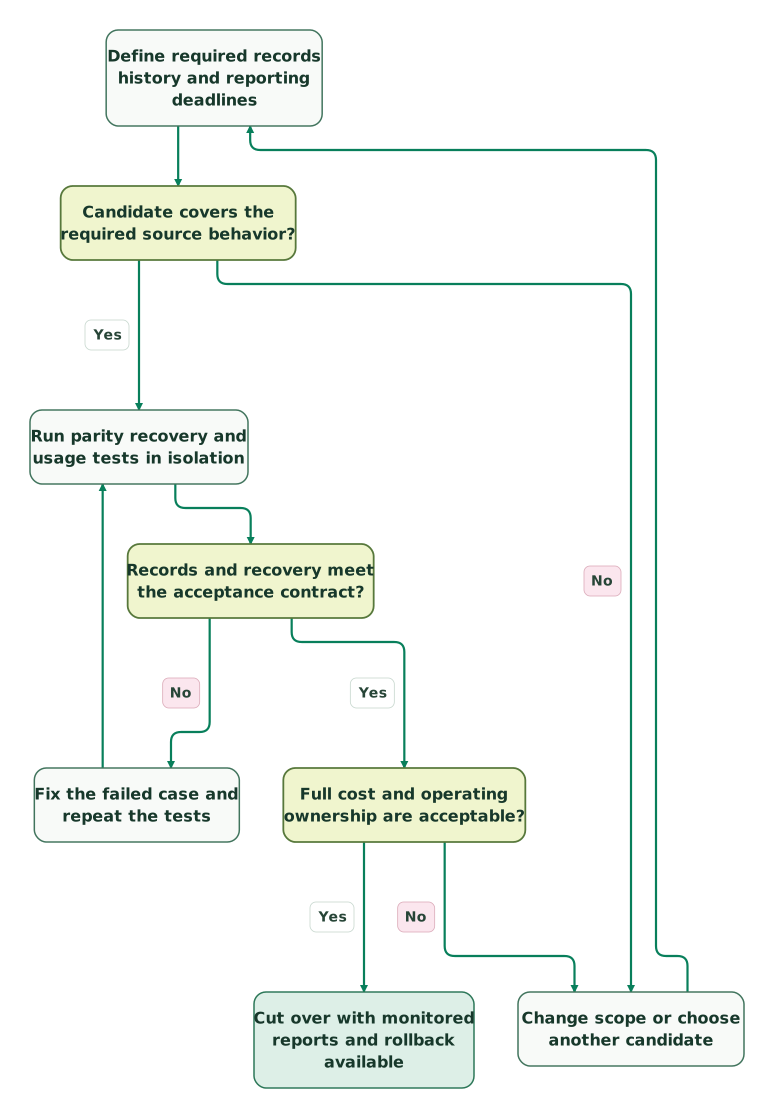
Read diagram as text
- Define required records history and reporting deadlines to Candidate covers the required source behavior?.
- Candidate covers the required source behavior? to Change scope or choose another candidate: No.
- Change scope or choose another candidate to Define required records history and reporting deadlines.
- Candidate covers the required source behavior? to Run parity recovery and usage tests in isolation: Yes.
- Run parity recovery and usage tests in isolation to Records and recovery meet the acceptance contract?.
- Records and recovery meet the acceptance contract? to Fix the failed case and repeat the tests: No.
- Fix the failed case and repeat the tests to Run parity recovery and usage tests in isolation.
- Records and recovery meet the acceptance contract? to Full cost and operating ownership are acceptable?: Yes.
- Full cost and operating ownership are acceptable? to Change scope or choose another candidate: No.
- Full cost and operating ownership are acceptable? to Cut over with monitored reports and rollback available: Yes
How do you switch without breaking the reports?
Switch the reporting dependency after parallel validation, while preserving a known recovery route and the historical data the new connector cannot recreate. Avoid sending two uncoordinated loaders into the same production tables.
- Inventory consumers of the current schema, including dbt models, BI reports and activation jobs. Record their owners.
- Load the candidate into separate raw tables. Map its identifiers, timestamps, deletion markers and nested structures into a stable reporting contract.
- Compare both routes for the same source window and business grain. Investigate missing and unexpected keys separately; equal row counts can hide substitutions.
- Run the recovery and late-change cases. Measure when the report becomes trustworthy again, not just when extraction resumes.
- Switch one bounded reporting consumer. Keep the previous tables and route available under an agreed rollback window and retention policy.
- Monitor the agreed records and metrics after cutover. Retire the redundant connection only after the owners accept continuity and any required historical archive is secured.
Use marketing data quality checks to validate the result and dbt tests for marketing data to protect its business rules. A new source schema can require model changes even when the new connector delivers every expected record.
Before approving the migration, confirm:
Checklist
- The reason for replacing Fivetran is supported by a measured problem.
- Required objects, fields, relationships and historical periods are written down.
- Updates, deletes, late corrections and schema changes have explicit acceptance cases.
- Usage is measured in the candidate's billing unit for ordinary and recovery workloads.
- First-year transition and second-year operating costs use stated assumptions.
- Credentials, monitoring and recovery have named owners.
- Parallel validation, downstream cutover and rollback have been rehearsed.
- Required history is preserved before the previous connection is retired.
If the uncertain part is the whole reporting chain, start with the $99 martech audit. For an agreed replacement route, request a detailed warehouse implementation scope covering ingestion, models, validation and operational handover.
Keep reading
Browse all Data Warehouse guides
 Data Warehouse
Fivetran Pricing: Plans, MAR Rates and How to Estimate Your Bill
Compare Fivetran MAR rates, plan limits and renewal terms, with worked connection, transformation and activation estimates and a practical cost review.
Jafrin Akter AloLast updated 18 min read
 Data Warehouse
Fivetran Implementation Mistakes: Syncs, History and Downstream Checks
Fix Fivetran mistakes with deletes, history mode, timestamps, re-syncs and schema changes. Includes a SQL fixture, incident record and acceptance checks.
Jafrin Akter AloLast updated 13 min read
 Data Warehouse
Fivetran vs Airbyte: Compare the Workload, the Bill and the Maintenance
Compare Fivetran and Airbyte with current billing rules, worked costs, HubSpot connector checks and a practical pilot for small marketing data teams.
Jafrin Akter AloLast updated 11 min read
Data warehouse & CDP
See the implementation scope, deliverables and acceptance checks.
Questions people ask
Can I replace just one expensive Fivetran connection?
Yes, you can evaluate a replacement for one connection while retaining Fivetran for other sources. Keep ownership, monitoring and downstream schemas explicit so the mixed setup does not create hidden coordination work. Compare the total cost of operating both routes, including duplicated platform minimums and support arrangements, before treating the connection-level saving as a company-wide saving.
Should I cancel Fivetran before starting the alternative's trial?
Keep the existing route available until the replacement has passed the agreed acceptance and recovery checks. Check renewal and notice terms early, but avoid creating a reporting gap to save a short overlap period. Preserve the current data and the means to restore the previous reporting path until the business owners accept the cutover and historical continuity.
Can a replacement preserve Fivetran's existing table names?
A replacement can expose compatible reporting views even when its raw table names and metadata differ. Map identifiers, types, timestamps and deletion behavior explicitly rather than renaming tables and assuming equivalence. Keep raw landing data separate from the stable reporting contract, then test the models and reports that consume it before changing their production dependency.
What if a source API cannot return records we already have?
Preserve the existing records in an approved historical dataset before retiring the old pipeline. Document their origin, coverage and relationship to newly extracted records, including the key and cutoff used to combine them. A new connector cannot recover information the source no longer exposes. If the missing period affects required reporting, the migration remains incomplete until its treatment is accepted.
What is the cheapest Fivetran alternative?
For most small teams it is self-hosted Airbyte or dlt, which have no licence fee but need engineering time to run. Among managed tools, Airbyte Cloud Standard starts at USD 20 a month, Stitch at USD 100 and Hevo Starter at USD 265 billed annually, and Hevo has a free tier for up to 1M events a month. Price your own sources and sync frequency before deciding.
Sources
- Fivetran usage and MAR rules
- Airbyte plans and pricing
- Airbyte billing and credits
- Airbyte Elastic License 2.0
- Hevo plans and pricing
- Hevo event usage reporting
- Hevo historical and incremental synchronization
- Stitch pricing and plan limits
- Stitch replicated-row accounting
- dlt Python library
- dlt Apache License 2.0
- dlt incremental loading and write behavior
- Google Datastream overview
- Google Datastream pricing

Written by
Jafrin Akter AloData Engineer and Co-founder at Martechdevs and Growth and Analytics Partners
Jafrin writes practical guides to marketing technology, customer data, analytics and AI workflows. Martechdevs is a Growth and Analytics Partners company.